
PSBC(601658)

Search documents
金融中报观|银行零售业务梯队格局背后,谁在领跑,谁在补课
Bei Jing Shang Bao· 2025-09-03 14:17
Core Insights - The competitive landscape of retail banking in A-shares is becoming clearer as the 2025 mid-year reports are disclosed, revealing a distinct tiered structure in retail AUM (Assets Under Management) [1][2] - The first tier consists of major state-owned banks and China Merchants Bank, all exceeding 16 trillion yuan in retail AUM, while the second tier includes joint-stock banks and some leading city commercial banks [1][2] - The retail business performance is mixed, with many banks facing pressure on retail revenue and net profit, highlighting a structural issue of profit growth without revenue increase [1][6] Tiered Structure of Retail AUM - The first tier banks, including Industrial and Commercial Bank of China (ICBC) and Agricultural Bank of China (ABC), lead with AUM exceeding 16 trillion yuan, with ICBC at over 24 trillion yuan and ABC at 23.68 trillion yuan [2][3] - China Construction Bank (CCB) and Postal Savings Bank of China also show strong performance, with CCB managing over 22 trillion yuan and Postal Savings Bank at 17.67 trillion yuan [2] - China Merchants Bank, known as the "king of retail," has a retail AUM of 16.03 trillion yuan, reflecting a 7.39% increase from the previous year [2] Second Tier Performance - The second tier banks have retail AUM ranging from 1 trillion to 6 trillion yuan, with notable growth from banks like Bank of Communications at 5.79 trillion yuan and Industrial Bank at 5.52 trillion yuan [3] - Joint-stock banks are active in this tier, with CITIC Bank and Shanghai Pudong Development Bank also showing significant growth in retail AUM [3] Third Tier Characteristics - The third tier banks have retail AUM mostly below 1 trillion yuan, with Nanjing Bank and Shanghai Rural Commercial Bank showing notable growth rates of 14.25% and 3.99% respectively [4] - Regional banks are leveraging local advantages to deepen market penetration, but face challenges in competing with larger banks [5] Retail Profitability Challenges - The retail banking sector is undergoing significant adjustments, with a shift in customer demand towards diversified financial solutions, which raises the bar for product innovation and service customization [6] - Leading banks like ICBC and China Merchants Bank are showing resilience, with ICBC's net profit rising by 46.05% despite a slight revenue decline [6][7] - However, some banks, including ABC and Ping An Bank, are experiencing declines in both revenue and net profit, indicating a challenging environment [7] Asset Quality Concerns - The retail banking sector is facing challenges in asset quality, particularly in personal loans, with rising non-performing loan (NPL) ratios reported by several banks [9][10] - For instance, China Merchants Bank's retail loan NPL ratio increased to 1.04%, while Chongqing Rural Commercial Bank's rose to 2.04% [9] - Some banks, like Ping An Bank and Industrial Bank, have managed to improve their asset quality through refined risk management practices [10] Strategic Recommendations - Analysts suggest that banks, especially smaller ones, should focus on enhancing their support for small and micro enterprises and optimizing financial resource allocation to uncover new growth points [8] - There is a call for banks to improve their digital capabilities and customer experience to better compete with larger institutions [8]




频繁举牌银行股中国平安学聪明了
Xin Lang Cai Jing· 2025-09-03 10:39
Core Viewpoint - Ping An Life has been actively increasing its stake in various bank stocks, particularly Agricultural Bank of China, indicating a strategic shift towards more stable investments after previous significant losses in other sectors [1][5]. Group 1: Investment Activities - Ping An Life has made multiple acquisitions of Agricultural Bank of China H-shares, reaching a 15% stake as of August 26, 2023, marking the third time this year it has increased its holdings in this bank [1]. - In addition to Agricultural Bank, Ping An Life has also targeted Postal Savings Bank and China Merchants Bank, with significant increases in their respective H-share holdings [2]. - The company has shown a pattern of increasing stakes in bank stocks, with a notable focus on state-owned banks that offer low volatility and high dividend yields [8]. Group 2: Historical Context and Lessons Learned - Ping An Life has faced substantial losses in past investments, notably in Fortis Group and China Fortune Land Development, leading to a more cautious investment strategy [4][5]. - The departure of the Chief Investment Officer, Deng Bin, has left the position vacant for over six months, indicating potential instability in investment strategy [3]. - The company’s past experiences have prompted a shift towards more secure investments, as evidenced by its recent focus on bank stocks [5]. Group 3: Financial Performance - As of the latest report, Ping An's total investment assets amount to 6.2 trillion, with a stock investment book value of 649.3 billion and net investment income of 92.8 billion [8].


2025年上半年业绩稳增!邮储银行:均衡下的韧性生长
市值风云· 2025-09-03 10:10
Core Viewpoint - The article emphasizes the resilience and long-term strategy of Postal Savings Bank in the face of industry challenges, highlighting its commitment to sustainable development and high-quality growth amidst a low interest rate environment [4][5][29]. Group 1: Financial Performance - In H1 2025, Postal Savings Bank reported revenue of 179.446 billion yuan, a year-on-year increase of 1.5%, and net profit of 49.415 billion yuan, up 1.08% [5]. - Compared to other major banks, Postal Savings Bank's revenue growth of 1.5% and net profit growth of 1.08% stands out, especially as many peers reported declines in net profit [6]. - The bank's average balance of interest-earning assets grew by 9.62% year-on-year, reaching 16.5 trillion yuan, with total assets increasing by 6.47% to 18.19 trillion yuan [10][12]. Group 2: Growth Drivers - The growth in profitability is attributed to two main drivers: the continuous expansion of interest-earning assets and rapid growth in non-interest income, alongside effective cost control [8]. - The bank's customer loans totaled 9.54 trillion yuan, a year-on-year increase of 6.99%, indicating a stable lending growth trajectory [12]. - Non-interest income saw significant growth, with total non-interest income increasing by nearly 20% year-on-year, contributing to the overall revenue [34]. Group 3: Retail Banking Strategy - Postal Savings Bank aims to become a leading large retail bank characterized by inclusivity, balance, stability, intelligence, and vitality [13][24]. - The bank's retail business remains robust, with personal loans issued reaching 4.86 trillion yuan, a growth of 1.86% year-on-year, surpassing the industry average [14]. - The bank's customer deposit total reached 16.11 trillion yuan, up 5.37% from the previous year, with personal deposits accounting for over 80% [20]. Group 4: Balanced Development Strategy - The bank is shifting from a retail-dominated model to a dual-driven approach of "retail + corporate" to enhance value creation [30]. - Corporate loans reached 4.19 trillion yuan, with a year-on-year growth of 14.83%, focusing on key sectors like advanced manufacturing and green finance [14][32]. - The bank's non-interest income from middle business segments has seen an annual growth rate of 11.3% over the past five years, significantly outperforming peers [34]. Group 5: Asset Quality and Capital Strength - As of June 2025, the non-performing loan ratio stood at 0.92%, indicating strong loan quality management, particularly in corporate lending where the ratio was 0.49% [37]. - The bank's capital adequacy ratio reached 14.57%, with a core tier 1 capital ratio of 10.52%, reflecting a solid capital base for future growth [42]. - The recent 130 billion yuan capital injection from the state enhances the bank's risk resilience and supports its long-term development strategy [40][43].


A股42家银行上半年利润1.1万亿
21世纪经济报道· 2025-09-03 09:58
Core Viewpoint - The banking sector in China has shown resilience and adaptability in a complex economic environment, with positive growth in revenue and net profit, while maintaining stable asset quality and improving operational efficiency [2][4][12]. Group 1: Revenue and Profit Growth - In the first half of 2025, the total revenue of 42 A-share listed banks reached 2.92 trillion yuan, a year-on-year increase of 1%, while net profit attributable to shareholders was 1.1 trillion yuan, up 0.8% [4][5]. - Among the major state-owned banks, the six largest contributed 1.81 trillion yuan in revenue and 682.52 billion yuan in net profit, accounting for over 60% of the overall market [4]. - Industrial and Commercial Bank of China (ICBC) led with a revenue of 409.08 billion yuan, marking a 1.8% increase, indicating a positive turnaround in growth [4][5]. Group 2: Asset Quality and Support for the Real Economy - As of June 2025, the total assets of the 42 listed banks reached 321.33 trillion yuan, a 6.35% increase from the end of the previous year [9]. - The total loans and advances issued by these banks amounted to 179.44 trillion yuan, reflecting an increase of approximately 13.4 trillion yuan, or 8.07% year-on-year [10]. - The non-performing loan (NPL) ratio stood at 1.15%, a slight decrease, with 25 banks showing a year-on-year decline in NPL ratios [12]. Group 3: Dividend Distribution - The number of banks implementing mid-year dividends increased to 18, with a total cash dividend of 204.66 billion yuan from the six major state-owned banks [14][15]. - ICBC proposed a dividend of 1.414 yuan per 10 shares, totaling approximately 50.40 billion yuan, leading the mid-year dividend distribution among listed banks [14]. - Other banks, such as China Bank and China Merchants Bank, also reported significant increases in their dividend payout ratios, reflecting strong performance and investor confidence [15].

A股42家银行上半年利润1.1万亿元 10家分红比例超30%
2 1 Shi Ji Jing Ji Bao Dao· 2025-09-03 08:45
Core Viewpoint - The A-share listed banks in China have shown positive growth in revenue and net profit for the first half of 2025, despite a complex economic environment, with a total revenue of 2.92 trillion yuan and a net profit of 1.1 trillion yuan, reflecting a year-on-year increase of 1% and 0.8% respectively [1][2]. Group 1: Financial Performance - The total revenue of 42 A-share listed banks reached 2.92 trillion yuan, with a year-on-year growth of 1%, while the net profit attributable to shareholders was 1.1 trillion yuan, up 0.8% [1][2]. - The six major state-owned banks contributed significantly, with a combined revenue of 1.81 trillion yuan and a net profit of 682.52 billion yuan, accounting for over 60% of the overall market [2]. - Industrial and Commercial Bank of China (ICBC) led with a revenue of 409.08 billion yuan, marking a 1.8% increase, indicating a positive turnaround in growth [2][3]. Group 2: Asset Quality and Loan Growth - The total assets of the 42 listed banks reached 321.33 trillion yuan, a 6.35% increase from the previous year, with the six major banks holding 214.02 trillion yuan [6]. - The total loans and advances issued by these banks amounted to 179.44 trillion yuan, reflecting an increase of approximately 8.07% [6][7]. - The non-performing loan (NPL) ratio stood at 1.15%, showing a slight decrease, with 25 banks reporting a year-on-year decline in NPL ratios [8]. Group 3: Revenue Structure and Diversification - Non-interest income for listed banks grew by 6.97%, with significant contributions from investment income, which increased by 23.46% [4][5]. - Banks are shifting towards a more diversified income structure, reducing reliance on traditional interest margins, with some banks reporting over 25% of their income from non-interest sources [4][5]. - China Bank reported a 26.43% increase in non-interest income, becoming a key driver of revenue growth [4]. Group 4: Dividend Distribution - The number of banks implementing mid-year dividends increased to 18, with a total cash dividend of 204.66 billion yuan from the six major state-owned banks [9][10]. - ICBC proposed a dividend of 1.414 yuan per 10 shares, leading the mid-year dividend total among listed banks [9]. - Several banks, including China Bank and China Merchants Bank, maintained a dividend payout ratio of over 30%, reflecting strong performance and investor confidence [10].


国有六大行上半年网点裁撤步伐显著放缓,农行、中行小幅增设
Cai Jing Wang· 2025-09-03 08:44
Core Insights - The number of physical bank branches among China's six major state-owned banks has stabilized, with a slight decrease of approximately 42 branches as of mid-2025 compared to the beginning of the year [1][5] - The focus of branch adjustments is shifting towards key urban areas such as the Beijing-Tianjin-Hebei region and county-level operations, indicating a strategic realignment in service delivery [1][6] Summary by Bank - **Industrial and Commercial Bank of China (ICBC)**: As of June 2025, ICBC has a total of 16,354 branches, with 15,941 located domestically and 413 internationally [2] - **Agricultural Bank of China (ABC)**: ABC reported 22,914 domestic branches and 17 overseas institutions as of June 2025 [2] - **Bank of China (BOC)**: BOC has a total of 11,516 branches, with 10,977 in mainland China and 539 in Hong Kong, Macau, Taiwan, and other regions [2] - **China Construction Bank (CCB)**: CCB has 14,727 branches, including 14,178 domestic branches [3] - **Bank of Communications (BoCom)**: BoCom operates over 2,800 domestic branches and 24 overseas branches [3] - **Postal Savings Bank of China (PSBC)**: PSBC has 39,188 branches and 71,435 ATMs as of mid-2025 [3] Overall Trends - The total number of branches across the six major banks is approximately 108,000, showing a decrease of about 42 branches in the first half of 2025 compared to the end of 2024 [5] - The pace of branch closures has significantly slowed, with projections indicating a reduction of around 300 branches by the end of 2024 [5] - The current phase of branch adjustments is characterized by a balance between closing redundant branches and opening new ones in high-demand areas [6]
国有大型银行板块9月3日跌1.08%,工商银行领跌,主力资金净流出1.32亿元
Zheng Xing Xing Ye Ri Bao· 2025-09-03 08:40
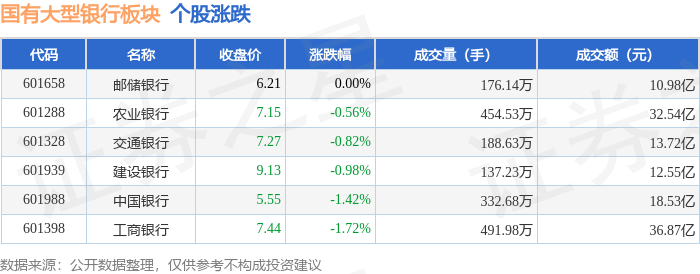
Market Performance - The state-owned large bank sector declined by 1.08% on September 3, with Industrial and Commercial Bank of China (ICBC) leading the drop [1] - The Shanghai Composite Index closed at 3813.56, down 1.16%, while the Shenzhen Component Index closed at 12472.0, down 0.65% [1] Individual Bank Performance - Postal Savings Bank of China (PSBC) remained unchanged at a closing price of 6.21, with a trading volume of 1.76 million shares [1] - Agricultural Bank of China (ABC) closed at 7.15, down 0.56%, with a trading volume of 4.55 million shares and a transaction value of 3.25 billion [1] - Bank of Communications (BoCom) closed at 7.27, down 0.82%, with a trading volume of 1.89 million shares [1] - China Construction Bank (CCB) closed at 9.13, down 0.98%, with a trading volume of 1.37 million shares [1] - Bank of China (BoC) closed at 5.55, down 1.42%, with a trading volume of 3.33 million shares [1] - ICBC closed at 7.44, down 1.72%, with a trading volume of 4.92 million shares [1] Fund Flow Analysis - The state-owned large bank sector experienced a net outflow of 132 million yuan from institutional investors, while retail investors saw a net inflow of 199 million yuan [1] - The detailed fund flow for individual banks shows that ABC had a net inflow of 279 million yuan from institutional investors, while PSBC had a net inflow of 70.84 million yuan [2] - ICBC experienced a significant net outflow of 390.7 million yuan from institutional investors, while retail investors contributed a net inflow of 32 million yuan [2]
速达快享!邮储银行遵义市分行联手政企破解农企融资难
Sou Hu Cai Jing· 2025-09-03 08:03
Group 1 - The collaboration between Zunyi Agricultural and Rural Bureau and Postal Savings Bank aims to empower the high-quality development of the agricultural processing industry and support rural revitalization [1][3] - Postal Savings Bank has provided a total loan of 16 million yuan to address the financing difficulties faced by local agricultural processing enterprises [1] - The bank has established a special service team to tailor financing solutions for enterprises based on their operational characteristics and actual needs, significantly reducing the average approval time for loans [3] Group 2 - The initiative includes in-depth cooperation between government and banking sectors, with the Agricultural and Rural Bureau conducting thorough research on the production and funding needs of local specialty industries such as tea, chili, and fruits [3] - A company representative expressed that the timely financial support from Postal Savings Bank was crucial for ensuring raw material reserves during the production peak season [3] - The bank plans to further enhance strategic collaboration with government departments and innovate financial products and service models to support the high-quality development of Zunyi's agricultural processing industry [3]

四大行上半年私人银行客户增长超8万户,工行将“科学家”纳入重点客群
Feng Huang Wang· 2025-09-03 06:30
Core Viewpoint - The growth rate of private banking clients among major state-owned banks has outpaced the market, with a total of 864,000 clients reported by four major banks in the first half of 2025, reflecting an increase of approximately 83,400 clients and a growth rate of 11% [1][4]. Group 1: Client Growth Data - Agricultural Bank of China reported 279,000 private banking clients with a managed asset scale of 3.5 trillion yuan as of June 2025 [3]. - Bank of China disclosed 216,900 private banking clients and a financial asset scale of 3.4 trillion yuan, with 205 private banking centers established domestically [3]. - China Construction Bank reported 265,500 private banking clients with financial assets amounting to 3.18 trillion yuan [3]. - Bank of Communications achieved a milestone with 102,600 private banking clients, marking the first time it surpassed the 100,000 client threshold, and managed assets of approximately 1.39 trillion yuan [4]. Group 2: Comparative Analysis - In 2024, the private banking client numbers for Agricultural Bank, China Construction Bank, and Bank of China were 256,000, 231,500, and 198,900 respectively, all exceeding the 100,000 mark, while Bank of Communications had 94,200 clients [6]. - The increase in private banking clients for the first half of 2025 was highest for China Construction Bank, with an addition of 34,000 clients, followed by Agricultural Bank with 23,000, Bank of China with 18,000, and Bank of Communications with 8,400 [6]. Group 3: Other Banks' Developments - Industrial and Commercial Bank of China did not disclose specific private banking client data in its latest report but emphasized its focus on serving entrepreneurs and scientists, indicating a strategic shift in client targeting [5]. - Postal Savings Bank of China reported a significant increase in its high-net-worth client base, with 41,400 clients having assets over 6 million yuan, reflecting a growth of 21.28% [7].
农、中、建、交四大行上半年私人银行客户增长超8万户,工行将“科学家”群体纳入重点客群
Xin Lang Cai Jing· 2025-09-03 06:11
Core Insights - The growth rate of private banking clients in major state-owned banks has outpaced the market, with a total of 864,000 clients reported by four major banks in the first half of 2025, reflecting an increase of approximately 83,400 clients or 11% since the beginning of the year [1][2] Group 1: Client Growth Data - Agricultural Bank of China reported 279,000 private banking clients with managed assets of 3.5 trillion yuan as of June 2025 [1] - Bank of China had 216,900 private banking clients and financial assets of 3.4 trillion yuan by the end of June 2025 [1] - China Construction Bank reported 265,500 private banking clients with financial assets of 3.18 trillion yuan [2] - Bank of Communications reached a milestone with 102,600 private banking clients, marking the first time it surpassed the 100,000 client threshold [2] Group 2: Comparative Analysis - In the first half of 2025, the increase in private banking clients for the four major banks was as follows: Agricultural Bank (+23,000), Bank of China (+18,000), China Construction Bank (+34,000), and Bank of Communications (+8,400) [5] - The total number of private banking clients for the four major banks reached 864,000, with all traditional "Big Five" banks surpassing the 100,000 client mark [2] Group 3: Industry Trends - Industrial and Commercial Bank of China did not disclose specific private banking client data in its report but emphasized its focus on serving entrepreneurs and scientists, indicating a strategic shift in targeting high-net-worth individuals [3] - Postal Savings Bank has been increasing its focus on private banking, reporting a significant growth in its high-net-worth client base, with 41,400 clients having assets over 6 million yuan, a 21.28% increase from the previous year [5]