
PSBC(601658)

Search documents
信用卡失速消费贷补位,上市银行零售信贷的“跷跷板”能稳吗
Nan Fang Du Shi Bao· 2025-09-03 04:01
Core Viewpoint - The retail credit market is experiencing a significant divergence between traditional credit card business contraction and the expansion of personal loans, driven by consumer demand and policy support [2][11]. Credit Card Business - The total number of credit cards and credit card loans has declined for 11 consecutive quarters, with a reduction of 12 million cards compared to the end of last year [2]. - Among 15 listed banks, 11 reported a decrease in credit card loan balances compared to the end of last year, highlighting a pronounced industry-wide contraction [3]. - The most significant decline in credit card loan balances was observed at Bank of China, with a drop of 13.89%, followed by Postal Savings Bank at 5.67% [4]. - Credit card transaction volumes have also decreased, leading to a decline in non-interest income, with some banks reporting drops exceeding 15% [2][6]. Personal Loans - In contrast to the credit card sector, personal loans, particularly consumer loans, have seen robust growth, with several banks reporting increases exceeding 10% [11]. - Among state-owned banks, personal loans and consumer loans have both shown positive growth, with Agricultural Bank leading at 5.60% [12]. - The consumer loan segment has become a key growth driver for banks, with many institutions launching tailored products to stimulate demand [2][11]. Asset Quality - The asset quality of retail credit is under pressure, with rising non-performing loan (NPL) ratios for personal loans and credit cards across many banks [16]. - State-owned banks generally exhibit higher NPL ratios, with notable increases in personal loan NPLs for several institutions [17]. - Credit card NPL ratios have also risen, particularly at Industrial and Commercial Bank of China, which reported a rate of 3.75% [18][20]. Market Dynamics - The decline in credit card usage reflects a broader shift in consumer spending patterns, with an increase in smaller, more frequent transactions [6][8]. - The overall market for credit cards is facing significant challenges, with many banks reporting double-digit declines in credit card income [9][10].






消费贷“国补”启动首日
Jing Ji Wang· 2025-09-03 01:20
Core Viewpoint - The implementation of the personal consumption loan interest subsidy policy aims to reduce borrowing costs for consumers, stimulate consumption, and support economic growth through a collaboration between fiscal and financial mechanisms [1][5]. Group 1: Policy Implementation - The personal consumption loan interest subsidy policy was officially implemented on September 1, with participation from six major state-owned banks, twelve national joint-stock commercial banks, and five larger consumer finance companies [1]. - Many banks have completed preparations to ensure consumers can benefit from the new subsidy policy promptly [1][2]. Group 2: Loan Details and Subsidy Structure - The subsidy covers two types of consumption scenarios: daily consumption loans under 50,000 yuan and key area consumption loans of 50,000 yuan or more, including categories like home appliances, education, and healthcare [2]. - The subsidy standard is set at an annual interest rate reduction of 1 percentage point, with a maximum subsidy of 1,000 yuan for loans under 50,000 yuan and 3,000 yuan for loans above that amount [2][3]. Group 3: Application Process - Consumers can apply for the subsidy through regular loan processes, with banks automatically deducting the subsidy from the interest owed once eligibility is confirmed [3]. - If consumers believe they qualify for the subsidy but do not see it reflected, they can appeal at bank branches with supporting documents [3][4]. Group 4: Compliance and Risk Management - The subsidy is only applicable to the portion of loans that are actually used for consumption, and any misuse of funds for investment or real estate will result in penalties [4][6]. - Banks are advised to implement strict risk controls and compliance measures to ensure that funds are used appropriately and to prevent fraudulent activities [6]. Group 5: Impact on Banking Sector - The subsidy policy is expected to positively impact banks' consumer credit business, encouraging them to enhance service quality and operational efficiency [5][7]. - Banks are focusing on simplifying the subsidy process and improving customer experience to better align with consumer needs and government policy objectives [7].


邮储银行:从客户需求出发实现对公业务增长
Jin Rong Shi Bao· 2025-09-03 01:03
Core Viewpoint - Postal Savings Bank of China (PSBC) has shown significant growth in corporate loans, indicating a strategic shift towards corporate finance that aligns with industry trends [1][2]. Group 1: Corporate Loan Growth - As of June 2025, PSBC's corporate loans increased by 541.098 billion yuan, a growth of 14.83%, with a year-on-year increase of 222.924 billion yuan [1]. - The proportion of corporate loans in the total credit volume rose from 62% at the end of 2021 to 67% in the first half of this year, with corporate credit accounting for 75% of new credit in June [1]. Group 2: Strategic Initiatives - PSBC has implemented a "1+N" operational and service system focused on customer-centricity, aiming to cultivate loyal and high-return corporate clients [2]. - The bank has seen a 62% increase in its main bank clients in the first half of the year, with these clients contributing 1.93 times the revenue and 1.33 times the risk-adjusted return on capital compared to general corporate clients [2]. Group 3: Operational Efficiency and Performance - PSBC has established an integrated service system that enhances operational efficiency by breaking down barriers between departments and optimizing traditional workflows [2]. - The total assets of corporate loans exceeded 4 trillion yuan, and the financing volume for corporate clients surpassed 6.4 trillion yuan, maintaining double-digit growth for three consecutive years [3]. - The new loan yield for PSBC's corporate loans is consistently about 30 basis points higher than the industry average, while the interest rate on liabilities is 20 basis points lower than peers, with a non-performing loan ratio of 0.49%, down 5 basis points from the end of last year [3].
万联晨会-20250903
Wanlian Securities· 2025-09-03 00:52
Market Overview - The A-share market experienced a collective decline on Tuesday, with the Shanghai Composite Index closing down 0.45% at 3,858.13 points, the Shenzhen Component down 2.14%, and the ChiNext Index down 2.85% [2][6] - The total trading volume in the A-share market was approximately 2.87 trillion RMB, with over 3,900 stocks declining [2][6] - In the Shenwan industry sector, banking and public utilities led the gains, while the telecommunications sector saw the largest declines [2][6] - The Hang Seng Index closed down 0.47%, and the Hang Seng Technology Index fell 1.22% [2][6] - U.S. stock indices also closed lower, with the Dow Jones down 0.55%, S&P 500 down 0.69%, and Nasdaq down 0.82% [2][6] Important News - The Ministry of Finance and the State Taxation Administration issued a notice regarding the tax policies for transferring state-owned equity and cash income to supplement the social security fund. Key points include exemptions from VAT on interest income and financial product transfer income, and certain tax exemptions for the transfer of state-owned equity [3][7] Industry Insights Pharmaceutical Retail Industry - In the first half of 2025, the pharmaceutical retail industry faced overall performance pressure due to declining consumer purchasing power, intensified competition, stricter management of personal medical accounts, and the impact of drug procurement policies [8] - The industry showed signs of clearing and cost reduction, leading to improved development quality [8] - The overall revenue of the retail pharmacy sector grew by 0.10% year-on-year, while net profit attributable to shareholders increased by 0.88%, indicating a slowdown in growth [9] Blood Products Industry - The blood products sector experienced revenue and profit pressure in the first half of 2025, primarily due to declining product prices, with overall revenue down 0.76% and net profit down 17.96% year-on-year [12][13] - Despite the challenges, the blood products industry remains stable due to consistent demand driven by population aging and improved medical standards [13] - The industry is expected to maintain steady growth in the second half of the year, supported by price stabilization and new product launches [13] Postal Savings Bank - Postal Savings Bank reported a recovery in performance in the first half of 2025, with operating income, pre-provision profit, and net profit attributable to shareholders increasing by 1.5%, 14.9%, and 0.8% respectively [14] - The bank's loan growth remained high at 10.5% year-on-year, and total assets grew by 10.8% [14][15] - The bank's net interest income decreased by 2.7% year-on-year, but non-interest income saw significant growth, particularly from investment banking and wealth management services [14]
消费贷“国补”落地!五大行已上线“贴息专区” 中行嵌入现有业务流程
Xin Lang Cai Jing· 2025-09-03 00:31
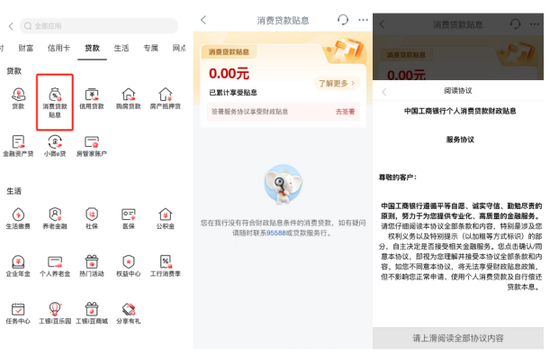
Core Viewpoint - The implementation plan for personal consumption loan interest subsidies has been officially launched, allowing residents to benefit from interest subsidies on personal consumption loans issued by various banks from September 1, 2025, to August 31, 2026, provided the loans are used for consumption and can be verified by the lending institutions [1]. Group 1: Policy Details - The interest subsidy policy applies to personal consumption loans (excluding credit card business) issued by six major state-owned banks, twelve national joint-stock banks, and five other lending institutions [1]. - The subsidy will be directly deducted from the loan interest charged to borrowers, calculated based on the specified subsidy ratio and upper limit [16]. Group 2: Bank Implementation - Major state-owned banks, including Industrial and Commercial Bank of China, Agricultural Bank of China, China Construction Bank, Bank of Communications, and Postal Savings Bank, have launched "subsidy zones" on their mobile banking apps [1][2]. - China Bank has integrated the subsidy agreement signing process into its existing loan application workflow, enhancing customer experience [13]. - Other joint-stock banks, such as Ping An Bank and CITIC Bank, have also introduced specific features for applying for the interest subsidy through their mobile banking platforms [15]. Group 3: User Experience - Borrowers can access the subsidy features through various pathways in their respective banking apps, such as "loan" sections or dedicated subsidy areas [3][6][10][12]. - The signing of the subsidy service agreement does not guarantee eligibility for the subsidy; eligibility will be determined based on the borrower's loan consumption records [8]. Group 4: Compliance and Warnings - Banks have emphasized that the subsidy policy does not cover credit card (including installment) business [16]. - Borrowers must follow the prescribed procedures to apply for the subsidy, and failure to sign the necessary agreements will be considered a waiver of the subsidy [16]. - Banks have warned against fraudulent activities related to obtaining subsidy funds and will take strict actions against any violations [17].



天风证券晨会集萃-20250903
Tianfeng Securities· 2025-09-02 23:42
Group 1 - The report highlights that the performance of various sectors such as electronics, home appliances, non-bank financials, machinery, non-ferrous metals, computers, food and beverage, defense, telecommunications, media, and agriculture is improving [3][25]. - From the perspective of earnings surprises, industries with the highest upward revisions in net profit forecasts from June 30, 2025, to August 30, 2025, include steel, non-ferrous metals, beauty care, non-bank financials, and banks [3][27]. - The report identifies a phenomenon of profit discontinuity, where the lowest price on the first trading day after earnings announcements is higher than the highest price on the previous trading day, particularly in sectors like food and beverage, beauty care, non-bank financials, banks, and transportation [3][27]. Group 2 - In August, major equity indices in the A-share market continued to rise, with the ChiNext index increasing by 24.13% [4][31]. - The central bank's net fund injection in August was 446.6 billion yuan, indicating a slight tightening of liquidity towards the end of the month [4][31]. - The report notes a rebound in non-ferrous metals, while oil prices have slightly declined, and pork prices remain low [4][31]. Group 3 - The global semiconductor industry is experiencing structural prosperity driven by rapid growth in AI computing demand, accelerated terminal intelligence, recovery in automotive electronics, and deepening domestic substitution [11][25]. - In Q2 2025, the semiconductor sector reported revenues of 133.66 billion yuan and a net profit of 10.63 billion yuan, indicating a clear trend of profit recovery [11][25]. - The report suggests focusing on sectors such as storage, power, foundry, ASIC, and SoC for their earnings elasticity, as well as equipment materials and domestic substitution in computing chips [11][25]. Group 4 - The U.S. fixed income market is the largest globally, with a market size of 58.2 trillion USD in 2024, accounting for 40.10% of the global total [9][38]. - As of Q1 2025, the U.S. fixed income market's outstanding amount reached 47.44 trillion USD, with U.S. Treasury bonds making up over 60% of this figure [9][38]. - The report indicates that the issuance volume in the U.S. fixed income market for the first half of 2025 was 5.70 trillion USD, reflecting a 14.21% increase compared to the same period in 2024 [9][38]. Group 5 - The report emphasizes the importance of AI applications across various sectors, including gaming, healthcare, marketing, education, finance, and office productivity, highlighting the ongoing integration of AI technologies [6][34]. - The AI sector is expected to see significant growth driven by government policies promoting the integration of AI into key industries [6][34]. - The satellite internet industry is also noted for its rapid development, with low-orbit satellites driving innovation across the supply chain [6][34].



国有六大行合计日赚超37亿元
Sou Hu Cai Jing· 2025-09-02 20:20
Core Viewpoint - The six major state-owned banks in China reported strong performance in the first half of 2025, with increased credit issuance, rising operating income, and improved asset quality, as indicated by a collective decrease in non-performing loan ratios [1][4]. Group 1: Financial Performance - The six major banks achieved a total operating income exceeding 1.8 trillion yuan and a net profit attributable to shareholders of 682.5 billion yuan in the first half of 2025, averaging over 3.7 billion yuan in net profit per day [2]. - Industrial and Commercial Bank of China (ICBC) led with an operating income of 427.1 billion yuan, followed by China Construction Bank (CCB) and Agricultural Bank of China (ABC) with 394.3 billion yuan and 369.9 billion yuan, respectively [2]. - In terms of net profit, ICBC reported 168.1 billion yuan, CCB followed with 162.1 billion yuan, while ABC, Bank of China (BOC), Postal Savings Bank of China (PSBC), and Bank of Communications (BoCom) reported net profits of 139.5 billion yuan, 117.6 billion yuan, 49.2 billion yuan, and 46.0 billion yuan, respectively [2]. Group 2: Asset Quality - The asset quality of the six banks remained stable, with a collective decrease in non-performing loan ratios and a high provision coverage ratio, indicating strong risk mitigation capabilities [4]. - PSBC reported the lowest non-performing loan ratio at 0.92% among the six banks [4]. Group 3: Asset Scale - All six banks experienced steady growth in total assets, with ICBC's total assets surpassing 52 trillion yuan, reaching 52.32 trillion yuan, maintaining its leading position in the industry [3]. Group 4: Net Interest Margin - The banks faced pressure on net interest margins due to factors such as the reduction in loan market quotation rates (LPR) and changes in deposit structures, leading to a general contraction in interest income [5]. - Management from various banks indicated efforts to stabilize interest income through adapting to interest rate changes and diversifying non-interest income sources, with expectations for marginal stabilization in net interest margins in the second half of the year [5][6].
上市银行竞逐移动端 加速迭代提升服务质效
Zheng Quan Ri Bao Zhi Sheng· 2025-09-02 16:39
Core Insights - Mobile banking has evolved from a simple financial tool to a comprehensive service platform, emphasizing banks' overall service capabilities [1][3] - The competition for customer acquisition on mobile platforms is intensifying, with major state-owned banks leading in personal mobile banking user numbers [1][2] Group 1: Personal Mobile Banking Performance - As of June 2023, Industrial and Commercial Bank of China (ICBC) leads with 600 million personal mobile banking users, followed by Agricultural Bank of China (ABC) with 586 million, and China Construction Bank (CCB) with 432 million [1] - Postal Savings Bank of China (PSBC) has 386 million personal mobile banking customers, while Bank of China (BOC) has over 302 million signed customers [1] - Among joint-stock banks, Ping An Bank's mobile app has 17.8 million registered users, a 2% increase from the end of 2022 [1] Group 2: Corporate Mobile Banking Development - Corporate mobile banking is focusing on enhancing payment, cross-border finance, and foreign exchange services, with ICBC reporting 17.87 million corporate mobile banking clients and 7.59 million monthly active users [2] - Agricultural Bank of China's corporate mobile banking registered clients increased by 960,000 to 9.7 million [2] - BOC is promoting a multi-version service system for corporate mobile banking, enhancing features for cross-border finance [2] Group 3: Digital Transformation and Ecosystem Development - The trend in mobile banking development is characterized by "dual-core driving and ecological integration," with personal banking focusing on user scale and experience, while corporate banking emphasizes specialized services [3] - Banks are deepening AI applications and exploring various mobile banking scenarios to enhance online service quality [4] - The adaptation to the HarmonyOS system is becoming standard, with banks like PSBC and CCB launching features that improve user experience and operational efficiency [4][5] Group 4: User Experience and Future Directions - Banks are encouraged to build sustainable user experience management systems and enhance customer experience through AI-driven solutions [6] - The focus is on creating personalized financial solutions and improving service delivery through advanced technology [6]
明年发行?“数字日元”浮出水面
Bei Jing Shang Bao· 2025-09-02 15:39
Core Viewpoint - Japan is transitioning towards a cashless society, with the introduction of a digital yen by Japan Post Bank aimed at facilitating digital financial transactions and leveraging blockchain technology [1][3]. Group 1: Digital Yen Introduction - Japan Post Bank plans to launch a digital yen (DCJPY) by the end of the fiscal year 2026, allowing its 120 million account holders to easily conduct digital financial transactions [1][3]. - The digital yen will be fully backed 1:1 by legal yen and will enable instant transactions for tokenized securities without any exchange fees [3]. - The initiative aims to attract younger consumers by reducing transaction settlement times from days to instant [3][7]. Group 2: Regulatory and Security Considerations - The Financial Services Agency of Japan is set to approve its first yen-denominated stablecoin, issued by fintech company JPYC, in the fall [4]. - Concerns regarding the balance between necessary regulation and privacy protection in the context of digital currencies have been raised [4][6]. - The Bank of Japan is considering how to provide central bank funds while improving private sector payment systems and ensuring a secure digital payment infrastructure [4][6]. Group 3: Historical Context and Challenges - Japan has been cautious about retail digital currencies, with experiments dating back to 2016 and a focus on legal implications since 2018 [5][6]. - Concerns include the reliance on cash among the elderly, the impact of natural disasters on digital currency usage, and potential financial instability during crises [6][7]. - The central bank's issuance of digital currency could disrupt traditional banking functions and lead to financial disintermediation [6]. Group 4: Shift Towards Cashless Society - The cashless payment ratio in Japan has increased from 13.2% in 2010 to 42.8% in 2024, indicating a significant shift in consumer behavior [7]. - The emergence of digital currencies is expected to further accelerate the transition to a cashless society, with policymakers viewing this shift as crucial for enhancing productivity and integrating Japan into the global market [7][8]. - The Bank of Japan emphasizes that digital currencies will not replace physical cash but will serve as a complementary option [8].

逆势崛起,18万亿零售大行竟成“黑马”?
Zheng Quan Shi Bao· 2025-09-02 13:54
Core Insights - Postal Savings Bank of China (PSBC) has shown remarkable growth in corporate banking, with a 14.83% increase in corporate loans and over 41.62% growth in corporate intermediary income in the first half of 2025, outperforming other major state-owned banks [1][3] - The bank's non-performing loan ratio for corporate loans stands at 0.49%, significantly lower than the industry average of 0.91% [1][5] - PSBC's total assets exceeded 18 trillion yuan, indicating a robust expansion strategy aimed at becoming a leading large retail bank [1][3] Corporate Banking Performance - As of June 2025, PSBC's corporate loans increased by 541.1 billion yuan, reaching a total of 4.19 trillion yuan, ranking sixth among domestic commercial banks [3][4] - The bank's corporate deposits grew by 229.6 billion yuan, with a 13.86% increase, totaling 1.89 trillion yuan [3][4] - Compared to other major banks, PSBC's corporate loan growth exceeded the average growth of 8.32% by 6.51 percentage points [3][4] Growth Metrics - PSBC's corporate customer financing total (FPA) reached 6.43 trillion yuan, reflecting a 15.72% increase from the beginning of the year, with a 65% growth over three years [4][5] - The bank's corporate loan and deposit net increases, as well as corporate intermediary income, have all more than doubled over the past three years [4][5] Strategic Focus - The bank's corporate banking strategy emphasizes a balanced business structure, with corporate finance being a key driver for achieving this balance [1][12] - PSBC's management has identified four strategic keywords for its corporate banking approach: integration, high efficiency, differentiation, and finance+ [8][9][10] Market Positioning - PSBC has strategically focused on underserved markets, targeting sectors such as technology finance and green finance, with significant loan balances in these areas [5][10] - The bank's corporate loan yield remains approximately 30 basis points higher than comparable peers, while its cost of liabilities is about 20 basis points lower [5][6] Future Growth Potential - The bank acknowledges a 20 percentage point gap in corporate income contribution compared to peers, indicating substantial growth potential [13] - PSBC is actively pursuing the establishment of a financial asset investment company (AIC) to enhance its comprehensive service capabilities in corporate finance [14] Digital Transformation - The bank is leveraging AI and big data to enhance its corporate banking operations, achieving a 261% year-on-year increase in approved amounts through advanced credit assessment technologies [14] - The implementation of a smart investment banking ecosystem has significantly reduced transaction times, showcasing the bank's commitment to digital innovation [14]