
PSBC(601658)

Search documents
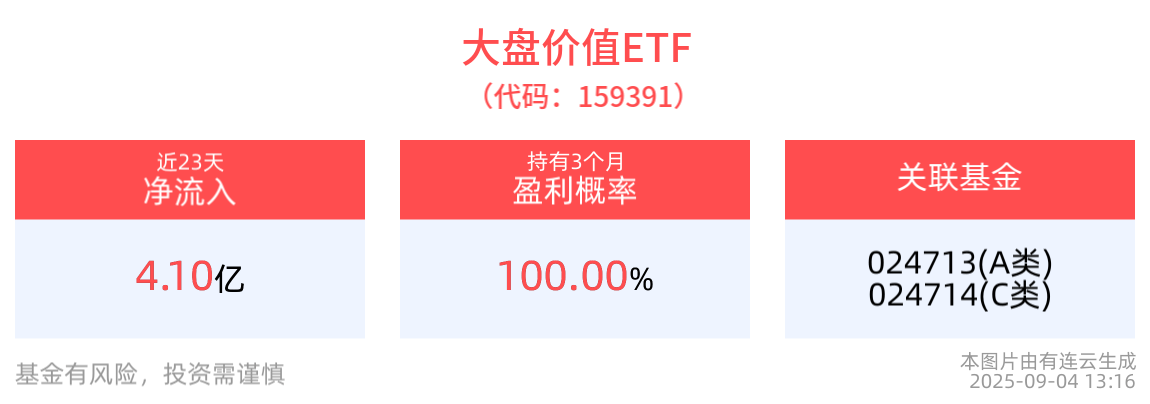
缩量5000亿,牛市已经结束了?大盘价值ETF(159391)近23个交易日净流入4.10亿元,红利低波100ETF(159307)最新份额创新高
Sou Hu Cai Jing· 2025-09-04 06:34
Market Performance - The National Securities Large Cap Value Index decreased by 0.70% as of September 4, 2025, with mixed performance among constituent stocks [2] - The Hang Seng High Dividend Yield Index fell by 1.08%, showing a similar trend of mixed stock performance [7] - The CSI Dividend Low Volatility 100 Index declined by 0.21%, reflecting a downward trend in the market [5] ETF Performance - The Large Cap Value ETF (159391) dropped by 0.45%, with a recent price of 1.1 yuan, but has seen a 4.25% increase over the past three months [2] - The Dividend Low Volatility 100 ETF (159307) decreased by 0.37%, currently priced at 1.08 yuan, with a 3.92% increase over the last three months [5] - The Hong Kong Dividend ETF (513690) fell by 0.84%, priced at 1.07 yuan, but has increased by 1.23% over the past month [7] Trading Volume and Liquidity - The Large Cap Value ETF had a turnover of 0.06% with a transaction volume of 290,100 yuan, averaging 4.4 million yuan daily over the past year [2] - The Dividend Low Volatility 100 ETF recorded a turnover of 1.27% with a transaction volume of 16.02 million yuan, averaging 22.9 million yuan daily over the past week [5] - The Hong Kong Dividend ETF had a turnover of 2.1% with a transaction volume of 102 million yuan, averaging 218 million yuan daily over the past month [7] Market Sentiment and Analysis - The recent market decline is attributed to investors' profit-taking ahead of the "93 Military Parade," reflecting a consensus expectation of market performance [8] - The core logic driving the market's previous rise is not solely linked to the parade, suggesting that the current adjustment is a healthy trading behavior [8] - Future focus should be on low-valued sectors with potential for rebound, particularly those with policy support or improving fundamentals [8] Sector Insights - The Large Cap Value ETF tracks the National Securities Large Cap Value Index, which includes major financial sector stocks with high dividend yields [9] - The Dividend Low Volatility 100 ETF focuses on companies with high dividend yields and low volatility, with the banking sector being the largest contributor [9] - The Hong Kong Dividend ETF tracks high dividend stocks available through the Hong Kong Stock Connect, with real estate and banking being significant sectors [11]




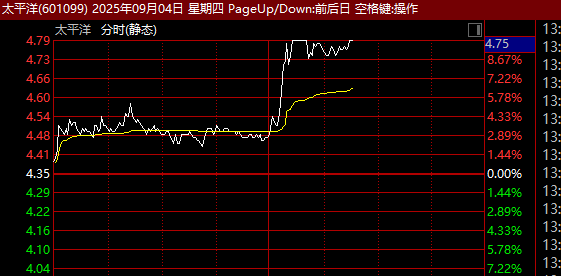
601099,直拉涨停!金融股,集体异动!
Zheng Quan Shi Bao Wang· 2025-09-04 06:21
Group 1 - Pacific Securities (601099) experienced a significant surge, hitting the daily limit up, with other securities firms like Huayin Securities (002945), Guosheng Jinkong (002670), and Xinda Securities (601059) also rising [1] - Huatai Securities' research report indicated that since the beginning of the year, the equity market has been on an upward trend, but the brokerage index has not recovered as much as the broader market, with large brokerages still valued at historically low levels [3] - The report highlighted that the current yield on equity assets is steadily increasing, with stock trading volumes and margin financing continuing to break through, indicating a strong recovery phase for brokerage operations [3] Group 2 - In addition to the securities sector, bank stocks also showed strength, with Agricultural Bank rising over 2% and Postal Savings Bank (601658) increasing by over 1% [4] - The pet economy concept stocks surged in the afternoon, with Yiyi Co. (001206) hitting the daily limit up, and other companies like Jieya Co. (301108) and Tianyuan Pet (301335) rising over 10% [4] - Renewable energy sectors such as photovoltaic and energy storage continued to perform well, with Shangneng Electric (300827) reaching a 20% limit up, and companies like JinkoSolar (002459) also hitting the daily limit [4]




银行研究框架及25H1业绩综述:营收及利润增速双双转正
GOLDEN SUN SECURITIES· 2025-09-04 06:14
Investment Rating - The report indicates a positive outlook for the banking industry, with overall revenue and net profit growth rates turning positive in the first half of 2025, at 1.0% and 0.8% respectively, showing improvements from the previous quarter [4]. Core Insights - The banking sector's net interest margin for the first half of 2025 is reported at 1.42%, a decrease of 10 basis points compared to the previous year, but the decline is narrowing due to improved cost management on the liability side [5]. - Non-interest income, particularly from fees and commissions, has increased by 3.1% year-on-year, driven by a recovery in wealth management and a more active market environment [5]. - The asset quality remains stable, with a non-performing loan ratio of 1.23% and a provision coverage ratio of 239%, indicating a solid credit environment [5]. Summary by Sections Financial Performance Overview - The overall revenue and net profit growth for listed banks in the first half of 2025 were 1.0% and 0.8%, respectively, with both metrics showing improvement from the first quarter [4][22]. - The total assets of listed banks reached 321.3 trillion yuan, growing by 6.35% year-to-date, with loans and advances totaling 179.4 trillion yuan, accounting for 55.84% of total assets [21][24]. Income Sources - Net interest income decreased by 1.3% year-on-year, but the decline rate has slowed, reflecting better management of funding costs [5]. - Fee and commission income grew by 3.1% year-on-year, benefiting from a recovering market and the gradual impact of regulatory changes [5]. - Other non-interest income saw a significant increase of 10.7%, primarily due to favorable market conditions in the bond market [5]. Asset Quality and Management - The non-performing loan ratio remained stable at 1.23%, with a provision coverage ratio of 239%, indicating a robust asset quality [5]. - The credit cost for the first half of 2025 was 0.81%, a decrease of 5 basis points year-on-year, suggesting manageable credit risks [5]. Loan Growth and Composition - Loan growth was primarily driven by corporate lending, with significant contributions from infrastructure and manufacturing sectors [20]. - Personal loan growth was weaker, with a year-on-year increase of only 3.6%, reflecting a cautious approach to consumer lending amid rising risks [20]. Investment and Market Conditions - The investment asset proportion decreased to 34% as banks adjusted their strategies in response to market volatility [20]. - The overall yield on bonds fluctuated significantly, prompting banks to engage in tactical trading to enhance returns [20].




辽沈银行董事长任职资格获核准
Sou Hu Cai Jing· 2025-09-04 05:52
Group 1: Beijing Bank - Beijing Bank reported a revenue of 36.218 billion yuan for the first half of 2025, representing a year-on-year growth of 1.02% [2] - The net profit for the same period was 15.053 billion yuan, with a year-on-year increase of 1.12% [2] - As of June 30, 2025, the non-performing loan ratio was 1.30%, a decrease of 0.01 percentage points from the beginning of the year, and the provision coverage ratio stood at 195.74% [2] Group 2: Liaoning Financial Supervision - The qualification of Yang Fade as the chairman of Liao Shen Bank has been approved by the Liaoning Financial Supervision Bureau [3] Group 3: Jining Bank - Jining Bank has received approval to increase its registered capital by approximately 796 million yuan, changing from about 3.295 billion yuan to approximately 4.091 billion yuan [3] Group 4: Postal Savings Bank - Postal Savings Bank disclosed the performance of its subsidiary, China Postal Consumer Finance, which achieved a revenue of 3.972 billion yuan and a net profit of 633 million yuan in the first half of 2025 [4] - As of June 30, 2025, China Postal Consumer Finance had total assets of 72.351 billion yuan and net assets of 7.346 billion yuan [4] Group 5: Tenpay Microloan - Tenpay Microloan reported a revenue of 662 million yuan for the first half of 2025, reflecting a year-on-year growth of 30.2% [5] - The net profit for the same period was 68 million yuan, showing a year-on-year decline of 56.38%, indicating a situation of "increased revenue but decreased profit" [5] - As of June 30, 2025, Tenpay Microloan had total assets of 15.355 billion yuan, a decrease of 5.52% from the beginning of the year [5]


中期分红队伍持续壮大
Jin Rong Shi Bao· 2025-09-04 03:03
Core Viewpoint - The recent announcements of interim dividend plans by A-share listed banks highlight a trend towards increased shareholder returns, with a total proposed dividend amount exceeding 200 billion yuan from major state-owned banks and several joint-stock banks [1][4]. Group 1: State-Owned Banks - Six major state-owned banks have announced their interim dividend plans for 2025, with a total proposed dividend amount exceeding 200 billion yuan [1]. - Industrial and Commercial Bank of China leads with a proposed dividend of 1.414 yuan per 10 shares, totaling 503.96 billion yuan [1]. - Other state-owned banks, including Agricultural Bank of China, Bank of China, China Construction Bank, Bank of Communications, and Postal Savings Bank, have proposed dividends of 418.23 billion yuan, 352.50 billion yuan, 486.05 billion yuan, 138.11 billion yuan, and 147.72 billion yuan respectively [1]. Group 2: Joint-Stock Banks - Several joint-stock banks, including China Merchants Bank, CITIC Bank, Minsheng Bank, Ping An Bank, and Huaxia Bank, have confirmed their interim dividend plans for 2025 [1][2]. - China Merchants Bank announced its first interim profit distribution plan since its listing, with a cash dividend amounting to 35% of its net profit attributable to ordinary shareholders for the first half of 2025 [1][2]. - CITIC Bank plans to increase its interim dividend payout ratio to 30.7%, enhancing investor return expectations [2]. Group 3: New Participants in Interim Dividends - New entrants to the interim dividend group include Ningbo Bank, Changsha Bank, Su Nong Bank, and Jiangyin Bank, indicating a growing trend among listed banks to adopt interim dividends [2][4]. - Su Nong Bank announced its first interim dividend plan, proposing a cash dividend of 0.9 yuan per 10 shares, totaling 1.82 billion yuan [2][3]. Group 4: Overall Market Trends - A total of 23 A-share listed banks implemented interim dividends in 2024, distributing over 250 billion yuan, with the number of banks participating expected to increase in 2025 [4]. - The push for interim dividends is seen as a response to regulatory guidance aimed at enhancing shareholder returns and stabilizing market expectations [5].

商业银行“降成本”举措显效
Jin Rong Shi Bao· 2025-09-04 03:03
Core Insights - Major commercial banks in China have shown solid performance in managing costs and optimizing asset-liability structures, contributing to stable growth in operating results [1][4] - In the first half of 2025, 42 A-share listed banks achieved operating income exceeding 2.9 trillion yuan, a year-on-year increase of over 1%, and a net profit of 1.1 trillion yuan, up 0.8% year-on-year [1] - Several banks, including Industrial and Commercial Bank of China (ICBC), Agricultural Bank of China (ABC), China Construction Bank (CCB), and Postal Savings Bank of China (PSBC), reported net profits exceeding 100 billion yuan [1] Cost Management - Construction Bank reported a cost-to-income ratio of 23.72%, a decrease of 0.43 percentage points year-on-year, highlighting effective cost management [1] - PSBC achieved a significant reduction in its cost-to-income ratio by 5.15 percentage points through various cost control measures [1] - Bank of China reported a cost-to-income ratio of 25.11%, emphasizing its focus on reducing costs and improving efficiency [2] Asset-Liability Management - Agricultural Bank of China has focused on controlling key expenses and reducing flexible costs to save on expenditures [3] - Several banks, including ICBC and CCB, have successfully lowered their deposit interest rates, with ICBC's rate decreasing by 26 basis points and CCB's by 32 basis points [4] - Postal Savings Bank's self-operated deposit interest rate fell by 20 basis points to around 1.1%, indicating a trend of decreasing funding costs [4] Revenue Generation - Shanghai Pudong Development Bank reported a cost reduction of over 140 million yuan through effective management of rental costs and the disposal of idle properties [3] - China Everbright Bank has focused on optimizing its funding costs and increasing high-quality deposits, leading to stable profit growth [5][6] - Zhejiang Merchants Bank saw its deposit interest rate decrease by 31 basis points to 1.88%, while its total deposits grew by 7.47% year-on-year [4]
邮储银行(601658):盈利增速回正 息差边际企稳
Xin Lang Cai Jing· 2025-09-04 02:47
Core Viewpoint - Postal Savings Bank of China reported a slight increase in revenue and net profit for the first half of 2025, indicating a recovery in financial performance after previous declines [1][2]. Financial Performance - The bank achieved an operating income of 179.4 billion yuan, up 1.5% year-on-year, and a net profit attributable to shareholders of 49.2 billion yuan, up 0.8% year-on-year [1]. - The annualized weighted average ROE was 10.91% [1]. - Total assets reached 18.2 trillion yuan, a 10.8% increase year-on-year, with total loans and deposits growing by 10.1% and 8.4% respectively [1]. Revenue and Income Breakdown - Net interest income decreased by 2.7% year-on-year, but the decline was less severe than in the first quarter of 2025 [2]. - Non-interest income saw a significant increase of 19.1% year-on-year, with contributions from both middle-income and other non-interest revenues [2]. - Fee income rose by 11.6% year-on-year, driven by strong performance in investment banking and wealth management, which grew by 48.2% and 47.9% respectively [2]. Margin and Asset Quality - The net interest margin stabilized at 1.70%, with a narrowing decline compared to previous quarters [3]. - Loan rates decreased, with the average loan rate at 3.30%, down 48 basis points from the end of 2024 [3]. - The non-performing loan (NPL) ratio slightly increased to 0.92%, primarily due to fluctuations in personal loan quality, while corporate loan quality improved [4]. Risk Management and Outlook - The bank's provisioning coverage ratio remains high at 260%, indicating stable risk absorption capacity despite a slight decline [4]. - The bank's focus on retail banking and its unique "self-operated + agency" model continue to provide a competitive advantage, particularly in rural and central-western regions [5]. - Earnings per share (EPS) forecasts for 2025-2027 are projected at 0.74, 0.77, and 0.80 yuan, with corresponding growth rates of 2.6%, 3.6%, and 4.3% [5].
A股上市银行成绩单亮眼
2 1 Shi Ji Jing Ji Bao Dao· 2025-09-03 22:06
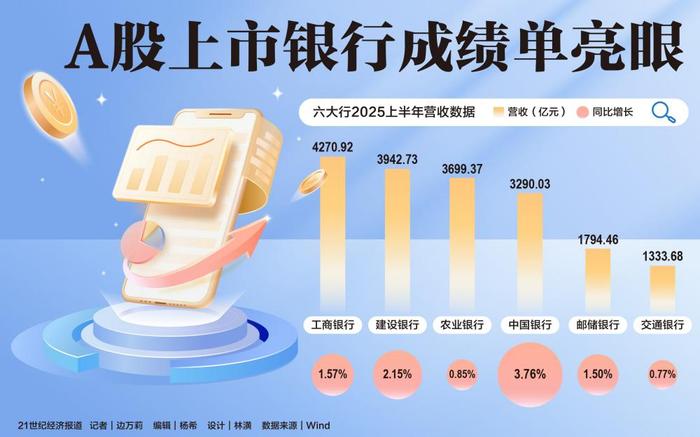
Core Insights - The banking sector in A-shares has shown resilience with a total revenue of 2.92 trillion yuan and a net profit of 1.1 trillion yuan for the first half of 2025, reflecting a year-on-year growth of 1% and 0.8% respectively [1][3] - The non-performing loan (NPL) ratio stands at 1.15%, indicating a slight improvement from the previous quarter [1][10] - The number of banks distributing mid-year dividends has increased to 18, with over half of them maintaining a dividend payout ratio of 30% or more [1][11] Revenue and Profit Growth - A-shares listed banks achieved a total revenue of 2.92 trillion yuan, marking a 1% increase year-on-year, while net profit reached 1.1 trillion yuan, up 0.8% [3][4] - Among the major banks, Industrial and Commercial Bank of China (ICBC) led with a revenue of 4270.92 billion yuan, showing a growth of 1.57% [3] - 30 out of 42 listed banks reported positive revenue growth, with 12 banks showing a reduced decline in revenue growth rates [3][4] Asset Quality and Loan Growth - The total assets of A-shares listed banks reached 321.33 trillion yuan, a 6.35% increase from the previous year [8] - Loans and advances amounted to 179.44 trillion yuan, reflecting an increase of approximately 13.4 trillion yuan or 8.07% [8][9] - The NPL ratio decreased by 1 basis point, with 25 banks showing a year-on-year decline in NPL ratios [10] Diversification of Income Sources - Non-interest income grew by 6.97% year-on-year, with significant contributions from investment income, which increased by 23.46% [6][7] - Banks are shifting towards a more diversified income structure, reducing reliance on traditional interest margins [6][7] - For instance, the non-interest income of China Bank surged by 26.43%, becoming a key driver of revenue growth [6] Dividend Distribution - The total cash dividends from the six major state-owned banks reached 2046.57 billion yuan, with ICBC leading at approximately 503.96 billion yuan [11][12] - Several banks, including China Merchants Bank and Jiangyin Bank, implemented mid-year dividends for the first time [11][12] - The dividend payout ratios for banks such as Shanghai Bank and CITIC Bank have also seen increases, reflecting strong performance [11][12]
A股近六成上市银行上半年中间业务收入同比增长
Zheng Quan Ri Bao Zhi Sheng· 2025-09-03 16:40
Core Viewpoint - The intermediary business income of A-share listed banks in China has shown improvement in the first half of 2025, becoming a crucial area for banks to transform and develop amid narrowing net interest margins [1][4]. Group 1: Overall Performance - In the first half of 2025, the total net income from fees and commissions of 42 listed banks reached 409.53 billion yuan, an increase of 3.06% compared to the same period last year [1]. - Out of the 42 listed banks, 25 reported positive growth in net income from fees and commissions, with three banks experiencing growth rates exceeding 100% and nine banks exceeding 10% [2]. Group 2: Performance by Bank Type - Among the six major state-owned banks, Bank of China and China Construction Bank both saw their fee and commission income grow by over 4%, while Agricultural Bank of China and Postal Savings Bank of China reported growth exceeding 10% [2]. - In the joint-stock banks category, four out of nine banks reported positive growth in net income from fees and commissions, with CITIC Bank achieving 16.91 billion yuan (up 3.38%), Industrial Bank at 13.08 billion yuan (up 2.59%), Huaxia Bank at 3.10 billion yuan (up 2.55%), and Minsheng Bank at 9.69 billion yuan (up 0.41%) [2]. Group 3: Notable Performers - Some city commercial banks and rural commercial banks exhibited significant growth in their fee and commission income, with Changshu Bank reporting a remarkable increase of 637.77% to 142 million yuan, followed by Ruifeng Bank with a 274.07% increase to 54 million yuan, and Zhangjiagang Bank with a 140% increase to 61 million yuan [3]. Group 4: Future Outlook - Analysts predict that the growth trend in intermediary business income is likely to continue in the second half of 2025, driven by supportive macroeconomic policies and increasing demand for high-yield products among residents [4]. - The focus for banks will be on expanding non-interest income, particularly in wealth management and other light-capital businesses, to optimize their income structure [4][6].


信用卡业务“跑马圈地”退潮后,转型创新路在何方?
Bei Jing Shang Bao· 2025-09-03 15:01
Core Insights - The credit card business in China's banking sector is undergoing a significant adjustment, shifting from an era of aggressive expansion to a focus on optimizing existing customer bases and asset quality [1][2][3] Group 1: Credit Card Business Performance - In the first half of 2025, 11 out of 15 listed banks reported a decline in credit card loan balances, with China Bank showing the most significant reduction of 13.89% to 510.97 billion yuan [2] - The total credit card loan balance for the 15 banks showed a mixed trend, with only four banks, including Industrial and Agricultural Banks, experiencing growth [2] - Credit card transaction volumes also declined, with a notable drop of 8.54% for China Merchants Bank, despite leading the sector with a transaction amount of 2.02 trillion yuan [3] Group 2: Bad Debt and Risk Management - The total bad credit card loans across 11 banks reached 162.69 billion yuan, an increase of 5.88 billion yuan from the beginning of the year, with notable increases in bad loans for banks like China Communications Bank and Industrial Bank [4] - Only three banks managed to improve their bad loan ratios, while eight banks, including China Merchants Bank and Industrial Bank, saw increases in their bad loan ratios [4] - The overall credit card market is experiencing a contraction, with the total number of credit cards decreasing to 715 million by Q2 2025, down from 727 million in Q4 2024 [5] Group 3: Strategic Adjustments and Future Directions - Banks are actively working to optimize asset quality and manage bad debts, with nearly a thousand bad loan transfer announcements made in 2025 [6] - The focus is shifting towards product innovation and differentiated competition, emphasizing quality over quantity in credit card offerings [6][7] - Strategies include targeting high-end customers and meeting basic customer needs, with an emphasis on enhancing customer experience and integrating credit cards with other retail banking services [7]




