CHINA TELECOM(601728)

Search documents
中国电信与阿里巴巴签署协议 将在云和AI基础设施等领域展开合作
Huan Qiu Wang· 2025-08-31 08:53
Group 1 - The core agreement involves collaboration in cloud and AI infrastructure, new service industry e-commerce, and social value innovation [3] - The focus will be on key industries to jointly create integrated digital and AI application solutions [3] - The partnership aims to leverage global service capabilities to assist Chinese companies in their overseas expansion [3]



中国电信与阿里巴巴签署战略合作协议:在云和 AI 基础设施等领域展开深入合作
Xin Lang Ke Ji· 2025-08-31 07:39
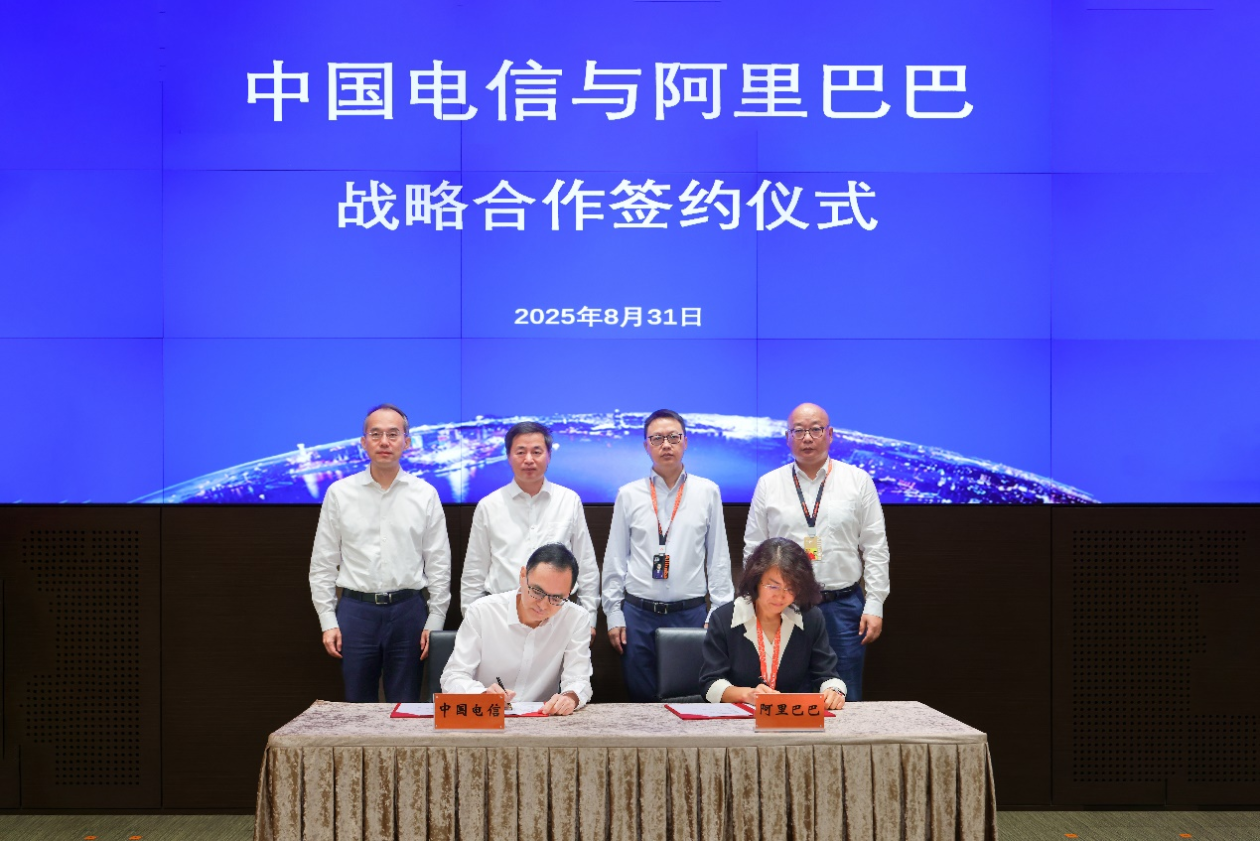
Group 1 - China Telecom and Alibaba held a strategic cooperation signing ceremony in Hangzhou on August 31 [1] - The agreement focuses on collaboration in cloud and AI infrastructure, new service industry e-commerce, and social value innovation [1] - Both companies will target key industries to jointly create integrated digital and AI application solutions, leveraging global service capabilities to support Chinese enterprises going abroad [1]

中国电信与阿里巴巴签署战略合作协议
Xin Lang Cai Jing· 2025-08-31 07:00
Core Insights - China Telecom and Alibaba signed a strategic cooperation agreement on August 31, focusing on collaboration in cloud and AI infrastructure, e-commerce services, and social value innovation [1] - The partnership aims to develop integrated digital and AI application solutions targeting key industries, leveraging global service capabilities to assist Chinese enterprises in going global [1]
中国电信与阿里巴巴签署战略合作协议:在云和AI基础设施等领域展开深入合作
Xin Lang Cai Jing· 2025-08-31 06:48
Core Viewpoint - China Telecom and Alibaba have signed a strategic cooperation agreement to collaborate in cloud and AI infrastructure, new service industry e-commerce, and social value innovation [1] Group 1: Strategic Collaboration - The signing ceremony took place in Hangzhou, attended by key executives from both companies [1] - The agreement focuses on deep cooperation in various fields, including cloud and AI infrastructure [1] - Both companies aim to create integrated digital and AI application solutions targeting key industries [1] Group 2: Global Service Capability - The partnership will leverage global service capabilities to jointly support Chinese enterprises in their overseas expansion [1]
加速入市,险资二季度A股布局揭晓
Huan Qiu Wang· 2025-08-31 01:56
Group 1 - Insurance capital has been actively investing in A-share companies, with 368 companies appearing in the top ten circulating shareholders list by the end of Q2 [1][3] - China Life Insurance increased its holdings in CITIC Bank and China Telecom by 259 million shares and 205 million shares respectively, and also added over 150 million shares in China State Construction [1][3] - The insurance sector's investment strategy focuses on long-term value, emphasizing factors such as long-term competitiveness, sustainable profitability, and shareholder return capabilities [3][4] Group 2 - The total stock balance of life and property insurance companies reached 3.07 trillion yuan by the end of Q2, with a net increase of 640.6 billion yuan in the first half of the year [4] - The net increase in Q2 alone was 251.3 billion yuan, marking a record high with an 8.8% increase [4] - The acceleration of insurance capital entering the market is driven by favorable policies and the internal demand for long-term investments amid low interest rates and an "asset shortage" environment [4]





报0.51元的没中标,报4.95元的却中标了!一次省级“采购”,释放重要信号
Xin Lang Cai Jing· 2025-08-30 16:36
Core Viewpoint - The first provincial-level "cloud film" bulk procurement in China is reshaping the value perception of medical procurement, focusing on quality rather than just price reduction [1][3]. Group 1: Procurement Model Innovation - The cloud film procurement project in Guizhou marks a shift from "lowest price wins" to a new evaluation system where price accounts for only 10 points, technology for 30 points, and business for 60 points [3][4]. - The highest bid was 4.98 yuan per person, while the lowest was 0.51 yuan, with the final winning bid set at 4.95 yuan per person [1][5]. - The project aims to reduce redundant examinations by 20% to 30%, addressing the issues of high medical costs and accessibility for patients [1][12]. Group 2: Project Details and Requirements - The procurement covers all public medical institutions in Guizhou capable of providing radiological services, with a total demand of 21.56 million instances in the first year [11]. - The winning bidder must meet stringent requirements for technology, quality, and safety, including a system availability of at least 99.99% and response times within specified limits [3][9]. - The two-year procurement cycle is designed to ensure that companies do not incur losses and can recover their costs effectively [9][10]. Group 3: Economic Impact and Cost Savings - The procurement price of 4.95 yuan per person is significantly lower than the traditional film costs, which range from 12 to 18 yuan per person [12][20]. - Hospitals utilizing cloud film services can save substantial amounts on procurement costs, with estimates of savings reaching up to 1.5 million yuan annually for larger institutions [12]. - The cost of data storage is expected to decrease further, enhancing the economic viability of cloud film solutions [12][20]. Group 4: Future Prospects and Industry Trends - The initiative is part of a broader plan to establish a national medical insurance imaging cloud data network by the end of 2027, facilitating data sharing across institutions [1][18]. - The transition from traditional film to cloud film is seen as inevitable, with the market for physical film expected to decline as cloud solutions become more prevalent [20]. - The cloud film model represents a shift in revenue generation from one-time sales to ongoing service fees, indicating a transformation in the business landscape for medical imaging [20].


险资二季度加仓超270股
财联社· 2025-08-30 04:16
Core Viewpoint - Insurance funds have significantly increased their holdings in A-shares, focusing on long-term investments and high-dividend stocks to enhance portfolio returns and support the real economy [1][5][7]. Group 1: Investment Trends - As of the end of Q2, insurance funds appeared in the top ten shareholders of over 1,000 A-share companies, with a total holding of 926.7 billion shares valued at 1.57 trillion yuan [2][3]. - More than 270 stocks were increased in holdings by insurance funds during Q2, with notable increases in companies like CITIC Bank and China Telecom [2][4]. - Insurance companies are actively entering new positions, with 288 new entries in the top ten shareholders list of various A-share companies [2]. Group 2: Sector Focus - The sectors where insurance funds are increasing their investments include hardware equipment, electrical equipment, software services, pharmaceutical biology, and banking [3][6]. - High-dividend stocks are particularly favored due to their stable returns, especially in a declining interest rate environment [5][6]. Group 3: Strategic Insights - Insurance companies emphasize a strategy of long-term, stable, and value-oriented investments, dynamically adjusting their holdings based on risk and return profiles [5][7]. - The total investment in stocks by insurance funds reached 3.07 trillion yuan by the end of Q2, reflecting a net purchase of approximately 640 billion yuan in the first half of the year [5][6]. - Companies like China Life and PICC have significantly increased their equity investment allocations, with China Life's stock allocation rising from 12.18% to 13.60% [6][7].


中国电信取得一种数据库表处理方法相关专利
Jin Rong Jie· 2025-08-30 01:46
Group 1 - The core point of the article is that China Telecom has obtained a patent for a database table processing method, device, equipment, and medium, with the patent announcement number CN 115757419 B and an application date of November 2022 [1] - China Telecom, established in 2002 and located in Beijing, primarily engages in telecommunications, broadcasting, television, and satellite transmission services [1] - The registered capital of China Telecom is approximately 91.5 billion RMB [1] Group 2 - According to data from Tianyancha, China Telecom has invested in 88 companies and participated in 5,000 bidding projects [1] - The company holds 53 trademark registrations and has 5,000 patent records, along with 72 administrative licenses [1]
卫星通信行业ESG相关报告披露率为46%,太空环境治理议题待完善
Mei Ri Jing Ji Xin Wen· 2025-08-29 13:10
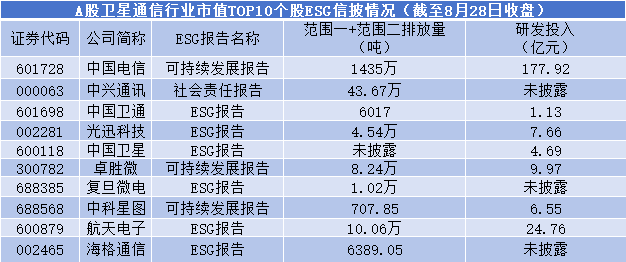
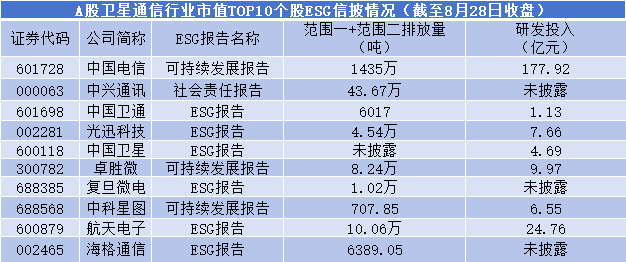
Core Viewpoint - The satellite communication industry is experiencing significant policy support from the Ministry of Industry and Information Technology, which has issued guidelines to optimize business access and promote industry development through 19 measures across six areas [1]. Industry Overview - The satellite communication sector consists of 50 listed companies, with 23 companies disclosing ESG-related reports for 2024, resulting in a disclosure rate of 46%, slightly below the overall industry rate of 46.81% as of August 29 [1][2]. - The top ten companies by market capitalization have all disclosed ESG reports, with nine of them providing carbon emission data [2]. ESG Disclosure Insights - The carbon emissions reported by companies vary significantly, with China Telecom reporting the highest emissions at 14.35 million tons of CO2, while China Science and Technology Corporation reported the lowest at 707.85 tons [2][4]. - The differences in carbon emission disclosures are attributed to selective reporting and methodological discrepancies, as companies may choose different accounting boundaries for their emissions [3][4]. R&D and Product Quality - Innovation, product quality, and supply chain management are prioritized as significant issues within the satellite communication industry, with seven of the top ten companies disclosing R&D investment amounts [5][7]. - Companies like China Satellite and China Telecom have implemented measures to enhance product quality and customer service, including establishing quality control systems and monitoring customer complaints [7][9]. Unique Industry Challenges - The satellite communication industry faces unique challenges regarding ESG disclosures, such as the need to address space environment protection, satellite decommissioning plans, and debris management [9][10]. - Experts suggest that the industry should emphasize its distinct characteristics in ESG reports, including the environmental impact of launch activities and the sustainable use of critical raw materials [9][10].



ESG信披观察 | 卫星通信行业ESG相关报告披露率为46%,太空环境治理议题待完善
Mei Ri Jing Ji Xin Wen· 2025-08-29 13:04
Core Insights - The satellite communication industry is experiencing significant policy support with the Ministry of Industry and Information Technology issuing guidelines to optimize business access and promote industry development through 19 measures across six areas [1] ESG Disclosure - The "satellite communication" sector consists of 50 listed companies, with 23 companies disclosing ESG-related reports for 2024, resulting in a disclosure rate of 46%, slightly below the overall industry rate of 46.81% as of August 29 [1][2] - Among the top ten companies by market capitalization, all have disclosed ESG reports, with nine companies providing carbon emission data, indicating a growing awareness of ESG principles in the emerging industry [2][6] - The carbon emissions reported by the top companies vary significantly, with China Telecom reporting the highest at 1,435,000 tons of CO2, while Zhongke Xingtou reported the lowest at 707.85 tons [2][4] Challenges in ESG Reporting - The current voluntary nature of carbon emission disclosure leads to inconsistencies in reporting, as companies may choose different accounting boundaries, affecting comparability [3][5] - The lack of unified standards and high-quality data in the industry complicates accurate measurement of carbon emissions throughout the satellite manufacturing and launch lifecycle [3][12] R&D and Product Quality - Innovation, product quality, and supply chain management are prioritized in the ESG reports of the satellite communication industry, with seven of the top ten companies disclosing R&D investment amounts [6][9] - Specific measures for quality control have been implemented by various companies, such as establishing customer service systems and quality inspection frameworks [9][12] Unique Industry Considerations - The satellite communication sector has unique ESG considerations, including the environmental impact of satellite launches and space debris management, which should be highlighted in ESG disclosures [12][13] - The industry is encouraged to address the sustainability of raw material procurement and the social value of satellite applications in areas like emergency rescue and education [12][13]