
CHINA TELECOM(601728)

Search documents
748万元!中国电信伊春分公司七号院合同能源管理技术服务项目公开招标
Xin Lang Cai Jing· 2025-11-28 04:41
Core Viewpoint - The China Telecom Group has announced a tender for an energy management service project in Yichun City, Heilongjiang Province, with an estimated procurement amount of 7.48 million yuan and a service duration of 10 years [1]. Project Overview and Tender Content - The project involves providing an integrated thermal energy solution for the No. 7 Courtyard in Yichun City, which includes the construction and operation of a centralized heating system to ensure stable and efficient thermal energy supply [1]. - The estimated procurement amount is 7.48 million yuan (excluding tax), covering all necessary costs for construction, operation, and maintenance [1]. - The contract will be signed as a single contract [2]. - The service period will commence from the date of contract signing and will last for 10 years [2]. - The construction period requires the provision of heating services within 5 days after the contract is signed [2]. - The service location is specified as the No. 7 Courtyard in Yichun City [3]. Tender Requirements - The project does not divide into bid packages and sets a maximum bid limit, with the maximum bid limit for heating supply construction set at 2.7 million yuan and an annual operation and maintenance fee of 478,000 yuan [4]. - Bidders must be independent legal entities or registered organizations in China, with good bank credit [5]. - Joint bids are not accepted, but agents can bid if they meet specific requirements, including having authorization from the manufacturer [5]. - Bidders must not have any disqualifying conditions, such as being suspended from bidding or having a history of fraud or significant quality issues in the past three to five years [7]. Qualification Review and Document Acquisition - The qualification review will be conducted after the bid submission, and any bids that do not pass the review will be rejected [10]. - The tender documents can be obtained from November 27, 2025, to December 2, 2025, without any associated fees [10]. - The deadline for bid submission is set for December 19, 2025, at 09:00 [11]. Contact Information - The tender is managed by China Telecom Group Co., Ltd. Yichun Branch, with the bidding agency being Dingxin Project Management Consulting Co., Ltd. [14].



中国电信:2025年AI智能体安全治理白皮书
Sou Hu Cai Jing· 2025-11-27 08:27
Core Insights - The article discusses the transition of AI agents from "conversational intelligence" to "decision-making intelligence," highlighting their capabilities as "digital collaborative partners" with environmental awareness, autonomous planning, and task execution. However, this advancement brings unprecedented security challenges [1][2]. Summary by Sections AI Agent Security Risks - The white paper identifies unique systemic risks associated with AI agents, such as attackers using hidden commands to induce the agent to download malware or employing long messages to trigger privacy breaches. These cases indicate that traditional boundary defenses are ineffective [1]. - Risks span four layers: - **Perception Layer**: Vulnerable to multi-modal input deception and protocol abuse. - **Decision Layer**: Prone to errors due to hallucinations and semantic ambiguities leading to cascading mistakes. - **Memory Layer**: Risks include persistent poisoning and cross-session privilege escalation. - **Execution Layer**: Potential for privilege loss to turn into an attack vector [1][2]. AI Agent Security Governance - To address these challenges, the white paper proposes a dynamic defense system covering the entire lifecycle of AI agents, emphasizing three governance goals: "safe, controllable, and trustworthy." It outlines layered technical countermeasures such as sandbox isolation for tool invocation, dual verification for decisions, encryption and access control for memory content, and real-time blocking of execution behaviors [2]. - The report includes practical case studies from the Starry Sky AI platform, MCP protocol security scanning tools, and automated evaluation of edge AI agents, demonstrating the feasibility and effectiveness of the governance solutions [2]. Call to Action - The white paper serves not only as a technical guide but also as an action plan for building a trustworthy AI ecosystem. It calls for collaboration among government, industry, and enterprises to enhance top-level design, strengthen technical capabilities, and implement differentiated protection strategies for AI agents based on their autonomy levels, ensuring that technological development remains on a secure path [2].

独家:中国电信前8月云收入贡献最大的10家省公司曝光北方占2家
Xin Lang Cai Jing· 2025-11-27 07:40
其次,这10家省公司多为集团大省公司,发展基础好。这样的省公司拥有高速宽带网络、数据中心等完善的基础设施,能够保障云服务的高效运行。比如粤港澳大湾区、长三角地区等地,数据中 据运营商财经网副总经理康锐表示,中国电信天翼云近年来发展态势良好,已成为国内云服务市场的头部企业,尤其在政务云、专属云等领域占据领先地位,而这一成绩的背后这10家省公司的贡 据了解,对于中国电信云业务收入贡献最大的10家省公司是他们。 运营商财经网 吴碧慧/文 这一名单中,南方省公司占比更多,为8家,北方省公司只有2家,即河北电信和北京电信。 根据营收规模分别是广东电信、上海电信、江苏电信、浙江电信、四川电信、安徽电信、湖南电信、河北电信、北京电信和福建电信。 据知情人士独家透露,在今年前8月中,中国电信天翼云收入已达700多亿元,同比实现正增长,但却鲜少有人知晓中国电信旗下省公司天翼云收入情况如何?对于集团云业务收入的贡献又如何 首先,这10家省公司大多是经济较为发达的地区,比如产业结构以高新技术、金融、互联网等为主,企业数字化转型需求旺盛,为云业务发展提供了广阔的市场空间。 ...
通信行业2026年上半年投资策略:算力、5G-A建设持续推进,关注硬件端发展机遇
Dongguan Securities· 2025-11-26 07:12
Group 1 - The communication sector shows steady growth with a year-on-year increase in profit margins, with total revenue reaching 20,663.80 billion yuan in the first three quarters of 2025, a 4.23% increase, and net profit of 1,990.01 billion yuan, up 8.78% year-on-year [5][19] - The performance of major cloud service providers (CSPs) continues to improve, with capital expenditures from North America's top four cloud companies reaching approximately 112.47 billion USD in Q3 2025, marking an 18.38% quarter-on-quarter increase, the highest level since 2019 [26][27] - The ongoing rollout of 5G-A networks is expected to create new growth opportunities for various hardware sectors, as 5G-A offers superior performance compared to existing 5G networks, driving new business models and market spaces [5][6] Group 2 - The investment outlook for the communication industry remains positive, with a recommendation to overweight the sector, as the overall operation of the communication industry is stable, and the construction of network infrastructure continues to advance [5][6] - The capital expenditure guidance for computing power is optimistic, with significant investments from major operators in cloud and digitalization, indicating a shift towards increased spending in these areas [29][30] - The demand for optical modules is expected to remain strong, driven by increased capital expenditures and the acceleration of AI applications, with projected growth rates of 93% in the Ethernet optical module market in 2024 [51][52]

谷歌挑战英伟达算力霸权,AI军备竞赛推动通信板块新机遇,通信ETF(159695)有望持续受益
Xin Lang Cai Jing· 2025-11-26 03:44
Core Viewpoint - The communication sector is experiencing significant growth driven by advancements in artificial intelligence (AI) and increased capital expenditure from domestic and international cloud service providers [1]. Group 1: Market Performance - As of November 26, 2025, the Guozheng Communication Index surged by 5.63%, with notable increases in constituent stocks such as Zhongji Xuchuang (up 13.91%), Xinwei Communication (up 10.38%), and Xinyi Sheng (up 10.10%) [1]. - The top ten weighted stocks in the Guozheng Communication Index account for 66.96% of the index, including Zhongji Xuchuang, Xinwei Communication, and ZTE Corporation [1]. Group 2: Industry Trends - Google is leveraging its breakthroughs in AI models to challenge Nvidia, while Meta is negotiating with Google for the use of TPU chips worth billions in its data centers by 2027 [1]. - The ongoing AI arms race is expected to drive demand for computing power, with the communication sector positioned as a key player in this growth [1]. - The "14th Five-Year Plan" emphasizes the acceleration of a new technological revolution and industrial transformation, highlighting the importance of AI applications [1]. Group 3: Investment Opportunities - The Communication ETF (159695) closely tracks the Guozheng Communication Index, providing an easy way to invest in the optical communication industry [2]. - Investors can also consider the Communication ETF linked fund (019072) to capitalize on investment opportunities arising from the AI transformation in the optical communication sector [3].



通信服务板块11月25日涨0.26%,超讯通信领涨,主力资金净流出4.77亿元





Zheng Xing Xing Ye Ri Bao· 2025-11-25 09:10
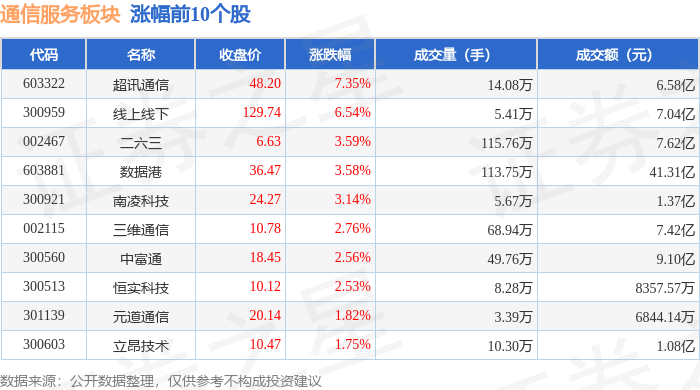
Core Insights - The communication services sector experienced a slight increase of 0.26% on November 25, with Chaoxun Communication leading the gains [1] - The Shanghai Composite Index closed at 3870.02, up 0.87%, while the Shenzhen Component Index closed at 12777.31, up 1.53% [1] Stock Performance - Chaoxun Communication (603322) closed at 48.20, with a rise of 7.35% and a trading volume of 140,800 shares, amounting to a transaction value of 658 million [1] - Online and Offline (300959) saw a closing price of 129.74, increasing by 6.54% with a trading volume of 54,100 shares, totaling 704 million [1] - Other notable performers included: - Erli San (002467) at 6.63, up 3.59% [1] - Dataport (603881) at 36.47, up 3.58% [1] - Nanling Technology (300921) at 24.27, up 3.14% [1] Fund Flow Analysis - The communication services sector saw a net outflow of 477 million from institutional investors, while retail investors contributed a net inflow of 454 million [2] - Notable stock fund flows included: - China Mobile (600941) with a net outflow of 46.68 million from institutional investors [3] - Erli San (002467) with a net inflow of 38.94 million from institutional investors [3] - Online and Offline (300959) with a net inflow of 31.11 million from institutional investors [3]
通信行业资金流入榜:永鼎股份等13股净流入资金超亿元
Zheng Quan Shi Bao Wang· 2025-11-25 09:05
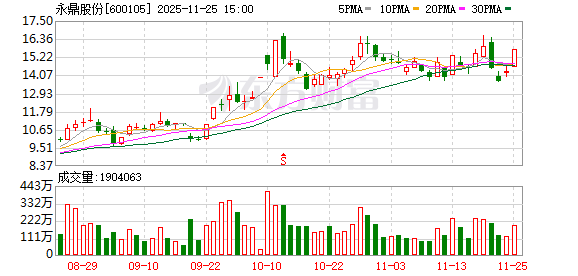
Core Points - The Shanghai Composite Index rose by 0.87% on November 25, with 29 out of 31 sectors experiencing gains, led by the communication and media sectors, which increased by 3.54% and 2.85% respectively [2] - The net inflow of capital in the two markets was 13.215 billion yuan, with 19 sectors seeing net inflows, particularly the electronics sector, which had a net inflow of 5 billion yuan and a rise of 2.14% [2] - The defense and military industry and transportation sectors were the only ones to decline, with decreases of 0.32% and 0.11% respectively [2] Industry Summary - The communication sector saw a significant increase of 3.54%, with a total net capital inflow of 4.881 billion yuan. Out of 124 stocks in this sector, 113 rose, and 8 hit the daily limit [3] - The top three stocks in terms of net capital inflow within the communication sector were Yongding Co. with 935 million yuan, followed by Zhongji Xuchuang and Xinyi Sheng with 687 million yuan and 651 million yuan respectively [3] - The communication sector also had 5 stocks with net outflows exceeding 50 million yuan, led by Shida Group, Data Port, and Hengxin Oriental, which saw outflows of 289 million yuan, 237 million yuan, and 6.38 million yuan respectively [5] Capital Flow Summary - The top inflow stocks in the communication sector included Yongding Co. (10.01% increase), Zhongji Xuchuang (5.00% increase), and Xinyi Sheng (4.00% increase) [4] - The top outflow stocks included Shida Group (10.04% decrease), Data Port (3.58% decrease), and Hengxin Oriental (-0.67% decrease) [5]

卫星物联网业务商用试验启动 填补通信空白,拓展低空经济应用场景
Ke Ji Ri Bao· 2025-11-25 05:46
Core Insights - The Ministry of Industry and Information Technology has officially launched a two-year commercial trial for satellite IoT services, aiming to enrich the satellite communication market, stimulate market vitality, enhance service capabilities, and establish a safety regulatory system [1] Group 1: Understanding Satellite IoT - Satellite IoT utilizes satellite communication technology to provide data collection and transmission services for a vast array of IoT devices across ground, ocean, and air [2] - It offers wide-area IoT connectivity for various terminals, including data collection terminals, wearable devices, handheld terminals, and transportation vehicles like cars, ships, and aircraft [2] - Satellite IoT addresses communication gaps in remote areas, sky, and ocean where traditional terrestrial networks cannot reach, providing global coverage [2] Group 2: Role in Emerging Industries - Satellite IoT can achieve global real-time tracking and data transmission for low-altitude aircraft, addressing communication shortcomings in the low-altitude economy [3] - In sectors like drone logistics, satellite IoT mitigates issues of signal interruption due to insufficient ground station coverage, enhancing flight safety and efficiency [3] - The technology is expected to attract more capital and resources into the low-altitude sector, promoting collaborative development across the drone manufacturing, airspace management, and data service industries, creating a virtuous cycle of "technology-scenario-industry" [3] Group 3: Future Development of "Internet of Everything" - China's satellite communication sector has accelerated, with recent policy initiatives aimed at optimizing business access and promoting industry development [4] - Major telecom companies, including China Telecom, China Mobile, and China Unicom, have obtained operational qualifications for satellite mobile communication, enabling services like direct satellite connections for emergency communications and remote area connectivity [4] - China Telecom has launched a trial for its "Tiantong + Beidou" domestic satellite-based high-precision positioning service, targeting areas with weak or no network coverage, enhancing support for scenarios like drone inspections and low-altitude navigation [4]


中原证券通信行业2026年度策略:智启新质 算力互联破浪前行
智通财经网· 2025-11-25 02:52
Core Viewpoint - The report from Zhongyuan Securities indicates that a series of AI industry catalytic events will occur in 2026, strengthening the leading position of top optical module manufacturers due to their technological, customer, and scale advantages. The current valuation of the communication industry index is below the ten-year average, and the industry maintains a "stronger than the market" investment rating based on performance growth expectations and valuation levels [1][2]. Summary by Sections Review of 2025 - In early 2025, the DeepSeek large model boosted market sentiment, and the three major operators completed the deployment of DeepSeek computing power private networks, enhancing their cloud service capabilities. Domestic cloud manufacturers provided positive capital expenditure guidance, leading to an increase in industry valuations. However, from February to April, the industry index experienced significant fluctuations due to concerns over U.S. tariff policies and future demand for optical modules. By mid-April, the easing of tariff policies and validation of AI computing power demand led to a gradual recovery in the industry index and valuations. In late July, North American cloud manufacturers raised their capital expenditure guidance, further catalyzing the industry. Since September, leading manufacturers faced short-term performance fatigue due to product iterations and customer structure adjustments, raising concerns about unclear downstream business models [2]. Outlook for 2026 - A series of AI industry catalytic events are expected, including the mass production of NVIDIA's next-generation Rubin GPU, the release of Google's new large model Gemini, and clear capital expenditure guidance from cloud manufacturers. AI smartphones equipped with large models are anticipated to become personalized smart assistants, potentially driving the next wave of smartphone upgrades. The development of key 6G technologies by telecom operators is expected to accelerate revenue growth from AI computing power. The report is optimistic about the high industry prosperity and strong growth potential of optical modules, optical devices, optical chips, and the increasing penetration of AI smartphones, as well as the stable operations of quality dividend assets in telecom operators [3][4]. Capital Expenditure Outlook for Leading Cloud Manufacturers - The demand for 800G is increasing, and the industry is transitioning from 800G to 1.6T technology. Leading optical module manufacturers are expected to further highlight their advantages due to technological leadership, stable customer relationships, and scalable delivery capabilities. The development of AI is driving the construction of large data centers, benefiting optical device manufacturers. The long R&D and expansion cycles for optical chips create high barriers in technology, talent, customer validation, and capital, leading to a persistent supply-demand gap for certain optical chips. The increasing demand for domestic controllable solutions is expected to translate into performance for domestic computing power. Recommended companies to watch include: NewEase, Huagong Technology, Guangxun Technology, Yuanjie Technology, Shijia Photon, and Taicheng Light [4]. AI Smartphones and Market Trends - Generative AI smartphones are set to provide users with new interactive experiences, multimodal content generation capabilities, personalized services, and innovative application ecosystems. The continuous improvement of edge AI computing power and large model capabilities is expected to further increase the market penetration of AI smartphones. Innovations and upgrades in AI smartphones are likely to lead to higher average selling prices and improved profit margins. The growth in edge AI shipments will drive sustained growth in core product lines of consumer electronics components [5]. Telecom Operators' Performance - The three major telecom operators are considered quality dividend assets with high dividend yield potential, offering cash dividends twice a year. The quality of traditional business revenue is improving, and a decrease in capital expenditure is expected to lower future depreciation and amortization costs, maintaining stable operations. Additionally, telecom operators are likely to leverage their advantages in data centers, big data, and network infrastructure to reconstruct business models with the help of AI. Investment recommendations include focusing on the optical module, optical device, and optical chip sectors, as well as AI smartphone and telecom operator sectors [6].


中国电信展示智能制造领域创新成果(附图片)
Xin Lang Cai Jing· 2025-11-25 00:08
Core Insights - The 2025 China 5G+ Industrial Internet Conference opened in Wuhan, focusing on "Everything Connected, Intelligent Navigation" [2] - China Telecom showcased its innovative achievements in industrial digital transformation and smart manufacturing [2] Group 1: Technological Innovations - China Telecom presented its "Six Networks" industrial application achievements, which include mobile, broadband, IoT, satellite, visual, and computing networks, supporting diverse digital needs [2] - The company introduced advanced solutions such as industrial AI algorithm libraries and low-altitude economic platforms, highlighting its strong technical foundation in the 5G+ industrial internet sector [2] Group 2: AI and Data Capabilities - China Telecom developed a comprehensive large model technology system, the Starry Sky MaaS platform, which integrates services across the entire chain of computing, models, data, tools, and applications, catering to over 100 industry scenarios [2] - The Starry Sky Trusted Data Space aggregates an average of 1.6PB of multi-source data daily, providing high-quality data support for model training [2] Group 3: Industrial Internet Platforms - The "Yizhi Enterprise Procurement and Control Integration Platform" is designed to meet enterprise digital transformation needs, supporting over 300 industrial protocols and enabling flexible device access [3] - The "Yigong Cloud Industrial Internet Platform" targets small and medium-sized enterprises, offering low-cost, modular, and easily deployable digital solutions across 18 key industries [3] Group 4: Practical Applications - China Telecom showcased over 20 5G integrated application solutions in sectors such as energy, chemicals, automotive, and manufacturing, demonstrating its role in driving the intelligent upgrade of traditional industries [3] - Interactive experience zones featured robots and smart devices operating in simulated industrial environments, including a humanoid robot for automotive quality inspection using 5G deterministic networks [4] Group 5: Future Collaboration - China Telecom aims to continue its open cooperation philosophy, partnering with various stakeholders to advance the construction of a digital China and create a promising future for smart industries [4] - The conference included forums on satellite internet innovation, AI empowerment in industrial ecosystems, and collaboration across government, industry, academia, and research sectors [4]
