CEB BANK(601818)

Search documents
发卡不行了,信用卡改“拼”分期了
经济观察报· 2025-08-19 10:31
Core Viewpoint - The credit card industry is undergoing significant adjustments, with many banks reducing credit card benefits and closing branches, indicating a shift towards a more streamlined and competitive landscape [1][5][12]. Group 1: Industry Adjustments - Many banks are experiencing a decline in credit card issuance, with over 40 credit card branches approved for closure this year [5][12]. - The credit card sector is facing intense competition in the credit consumption market, leading to a transformation at a critical juncture [6][7]. - The trend of banks focusing on installment payment options is increasing, as they seek to enhance customer retention and profitability [3][10]. Group 2: Market Trends - The total number of credit cards in circulation has decreased, with a drop of approximately 4 million cards year-on-year, marking a 5.14% decline [14]. - Major banks like ICBC and CCB have reported a reduction in their credit card issuance, with ICBC's issuance down by 1.96% and CCB's by 300,000 cards [14]. - Credit card consumption amounts are also declining, with significant drops reported by various banks, including a 16.57% decrease in total consumption for Ping An Bank [14][16]. Group 3: Strategic Shifts - The industry is transitioning from a focus on acquiring new customers to optimizing existing customer relationships, emphasizing quality over quantity [15][17]. - Banks are increasingly targeting high-net-worth clients and integrating various financial services to enhance customer retention and profitability [17]. - The emphasis on product innovation and risk management is crucial for sustainable development in the credit card sector [15][17].








中国光大银行8月29日召开董事会会议审议并批准中期业绩
Ge Long Hui· 2025-08-19 09:55
格隆汇8月19日丨中国光大银行(06818.HK)公布,公司将于2025年8月29日(星期五)召开董事会会议,藉 以审议并(如认为适当)批准包括公司截至2025年6月30日止六个月的中期业绩及其他事宜。 ...

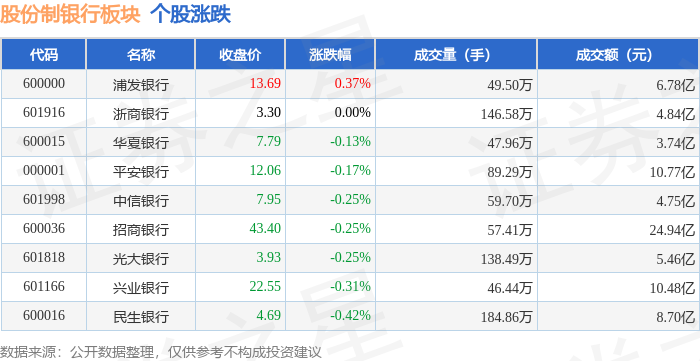
股份制银行板块8月19日跌0.16%,民生银行领跌,主力资金净流入3.27亿元
Zheng Xing Xing Ye Ri Bao· 2025-08-19 08:33
从资金流向上来看,当日股份制银行板块主力资金净流入3.27亿元,游资资金净流出8754.9万元,散户资 金净流出2.39亿元。股份制银行板块个股资金流向见下表: | 代码 | 名称 | 主力净流入(元) | 主力净占比 游资净流入 (元) | | 游资净占比 散户净流入 (元) | | 散户净占比 | | --- | --- | --- | --- | --- | --- | --- | --- | | 600000 浦发银行 | | 1.06亿 ﮯ | 15.65% | -3959.94万 | -5.84% | -6648.73万 | -9.81% | | 600036 招商银行 | | 9793.37万 | 3.93% | -4550.66万 | -1.82% | -5242.71万 | -2.10% | | 601166 兴业银行 | | 9596.85万 | 9.16% | -2153.61万 | -2.06% | -7443.23万 | -7.10% | | 601998 中信银行 | | 5510.35万 | 11.60% | -1388.74万 | -2.92% | -4121.61万 | -8 ...


中国光大银行(06818) - 关於召开董事会会议的通知
2025-08-19 08:33
香港交易及結算所有限公司及香港聯合交易所有限公司對本公告的內容概不負責,對其 準確性或完整性亦不發表任何聲明,並明確表示,概不對因本公告全部或任何部份內容 而產生或因倚賴該等內容而引致之任何損失承擔任何責任。 China Everbright Bank Company Limited 關於召開董事會會議的通知 中國光大銀行股份有限公司(「本公司」)謹此公佈,本公司將於2025年8月29日(星期五)召 開董事會會議,藉以審議並(如認為適當)批准包括本公司截至2025年6月30日止六個月的 中期業績及其他事宜。 中國光大銀行股份有限公司 董事會 中國‧北京 2025年8月19日 於本公告日期,本公司執行董事為郝成先生、齊曄女士及楊兵兵先生;非執行董事為吳 利軍先生、崔勇先生、曲亮先生、朱文輝先生、姚威先生、張銘文先生及李巍先生;以 及獨立非執行董事為邵瑞慶先生、洪永淼先生、李引泉先生、劉世平先生、黃志凌先生 及黃振中先生。 6818 ...
中证香港上市可交易内地银行指数报1186.55点,前十大权重包含重庆农村商业银行等
Jin Rong Jie· 2025-08-18 14:50
Group 1 - The core viewpoint of the article highlights the performance of the China Securities Index for Hong Kong-listed tradable mainland banks, which opened high and reported a value of 1186.55 points. The index has seen a decline of 6.53% over the past month, an increase of 4.35% over the past three months, and a year-to-date increase of 16.78% [1][2][3] - The index includes three thematic indices: HKT Hong Kong Real Estate, HKT Mainland Consumption, and HKT Mainland Banks, reflecting the overall performance of related securities in the Hong Kong stock market, characterized by high liquidity and ease of short selling [1][2] - The top ten holdings of the index are: China Construction Bank (31.22%), Industrial and Commercial Bank of China (23.92%), Bank of China (17.21%), China Merchants Bank (10.45%), Agricultural Bank of China (7.74%), CITIC Bank (3.55%), Postal Savings Bank of China (2.57%), Minsheng Bank (1.43%), Chongqing Rural Commercial Bank (0.73%), and China Everbright Bank (0.65%) [1][2] Group 2 - The index's sample consists entirely of financial sector companies, with a 100% representation [2] - The index samples are adjusted biannually, with adjustments occurring on the next trading day after the second Friday of June and December each year. Weight factors are generally fixed until the next scheduled adjustment, with special circumstances allowing for temporary adjustments [2]

股债冰火两重天,银行热推含权产品近1个月年化收益率超6%
2 1 Shi Ji Jing Ji Bao Dao· 2025-08-18 11:03
Core Viewpoint - The recent performance of the stock market has been strong, surpassing 3700 points, while the bond market has shown increased volatility, indicating a clear stock-bond seesaw effect. Investors are shifting their focus towards the stock market, benefiting certain "fixed income + equity" products, which have shown impressive returns due to the stock market's rise [2][7]. Group 1: Product Performance - The "Yangguang Jin Zengli Le Xiang Ri Kai 1 Hao" product has recently achieved an annualized return of 6.39% over the past month, benefiting from the stock market's upward trend [7]. - The product's equity investment ratio was reported at 4.65% as of June 30, indicating a low exposure to equities, which helps in controlling risk [7][25]. - In the first half of the year, this product outperformed many of its peers, with an average net value growth rate of 1.43%, translating to an annualized return of 2.86% [9][23]. Group 2: Risk and Return Metrics - The product received a score of 73 for performance and 90 for risk control, ranking 29th out of 968 similar products, indicating strong risk management and performance metrics [9][11]. - The product's maximum drawdown since inception was only 0.25%, showcasing its risk control capabilities [17]. - The product's Sharpe ratio stands at 6.40, reflecting a favorable risk-return profile [17]. Group 3: Investment Strategy - The product primarily invests in fixed income assets (80%-100%), with a maximum equity investment of 20%, and a focus on low-volatility preferred stocks and dividend strategies [13][25]. - The use of derivatives, such as government bond futures, is employed for risk hedging, indicating a proactive approach to managing market risks [21][22]. - The product is designed for investors with a moderate risk tolerance seeking slightly higher returns, with a minimum holding period of 30 days [25].

发卡不行了,信用卡改“拼”分期了
3 6 Ke· 2025-08-18 07:14
Core Insights - The credit card industry is undergoing significant changes, with banks shifting focus from acquiring new customers to competing for existing ones, leading to a rise in installment payment options and a reduction in credit card branches [1][2][4][6]. Group 1: Market Trends - Many banks are actively promoting installment payment options, with some offering discounted rates around 4% annualized [1][5]. - Over 40 banks have closed credit card branches this year, indicating a trend towards consolidation and efficiency in the credit card sector [1][5]. - The total number of credit cards issued in China has decreased, with a drop of approximately 4 million cards year-on-year, marking a 5.14% decline [6]. Group 2: Financial Performance - Credit card delinquency rates have increased for several banks, with Minsheng Bank reporting a delinquency rate of 3.28%, up 30 basis points from the previous year [3]. - Credit card consumption amounts have also declined, with major banks like China Construction Bank and Industrial and Commercial Bank of China reporting decreases in transaction volumes [8]. Group 3: Strategic Shifts - Banks are focusing on high-value customers and enhancing product offerings to improve customer retention and profitability [7][9]. - The industry is moving towards integrating various financial services, such as savings, investments, and loans, to provide a more comprehensive service to high-end clients [9].
中国光大银行落地全国首单支持养老产业债务融资工具
Xin Hua Wang· 2025-08-18 07:02
Core Insights - China Everbright Bank has successfully issued the first debt financing tool in the country to support the elderly care industry, with a scale of 300 million yuan and a coupon rate of 1.75% [1] Group 1: Financial Instrument Details - The bond issued by Hubei Cultural Tourism Group Co., Ltd. is the first of its kind in the nation aimed at supporting the elderly care sector [1] - The funds raised will be used for various elderly care projects, including residential elderly care, community elderly care, health management, and age-friendly renovations, with at least 50% allocated to these initiatives [1] Group 2: Strategic Importance - This issuance aligns with national policies aimed at establishing a comprehensive elderly care service system, reflecting the bank's commitment to serving national strategies and financial missions [1] - The initiative demonstrates a significant innovation and deep layout in elderly finance as part of the bank's broader financial strategy [1] Group 3: Future Plans - China Everbright Bank plans to continue its role as a "financial national team," focusing on effective service to the real economy and contributing to high-quality economic development [2]
中国光大银行落地全国首单支持养老产业债务融资工具,做深做实金融“五篇大文章”
Jiang Nan Shi Bao· 2025-08-18 02:46
Core Viewpoint - The issuance of the first targeted debt financing tool supporting the elderly care industry in China marks a significant innovation in financing channels for high-quality development in this sector [1] Group 1: Debt Financing Tool - China Everbright Bank's Wuhan branch underwrote the issuance of Hubei Cultural Tourism Group Co., Ltd.'s first phase of targeted debt financing tools for 2025, with a total issuance scale of 300 million yuan and a coupon rate of 1.75% [1] - This bond is the first of its kind in the country to support the elderly care industry, providing a low-cost and efficient financing channel [1] Group 2: Use of Proceeds - At least 50% of the raised funds will be allocated to the issuer's elderly care projects, which include various product categories such as residential elderly care, community elderly care, health management, and age-friendly renovations [1] - The projects align with the "Institutional Elderly Care Services" classification in the "Elderly Care Industry Statistical Classification (2020)" and comply with national policies on establishing an elderly care service system [1] Group 3: Strategic Importance - The issuance of this targeted debt financing tool reflects China Everbright Bank's commitment to serving national strategies and fulfilling its financial mission, showcasing deep engagement and innovative breakthroughs in elderly finance [1] - The bank aims to continue its role as a "financial national team," leveraging its unique advantages to support the real economy and contribute to high-quality economic development [2]
银行股震荡反弹 江阴银行涨超7%
Mei Ri Jing Ji Xin Wen· 2025-08-18 02:03
每经AI快讯,8月18日,银行股早盘展开反弹,江阴银行涨超7%,苏农银行、张家港行涨超5%,无锡 银行、青农商行、紫金银行、西安银行、光大银行等跟涨。 (文章来源:每日经济新闻) ...