
CEB BANK(601818)

Search documents
收盘丨沪指缩量微涨0.18%,养殖业板块强势爆发
Di Yi Cai Jing· 2025-11-19 07:17
Market Overview - The total trading volume in the Shanghai and Shenzhen markets reached 1.73 trillion yuan, a decrease of 200.2 billion yuan compared to the previous trading day [1][4] - The three major A-share indices showed mixed performance, with the Shanghai Composite Index rising by 0.18%, the Shenzhen Component Index remaining flat, and the ChiNext Index increasing by 0.25% [1] Sector Performance - The gold sector showed strong performance, while the aquaculture sector surged in the afternoon, with military equipment, insurance, silicon energy, and beauty care sectors also performing actively [2] - Conversely, the Hainan Free Trade Zone sector adjusted, and the gas, cultural media, diversified finance, real estate, and pharmaceutical sectors experienced notable declines [2] Individual Stock Highlights - Notable gainers in the aquaculture sector included Guolian Aquatic, Zhangzidao, and Dahu Co., with significant price increases of 20.09%, 10.10%, and 10.08% respectively [3] - The banking sector also performed well, with China Bank rising over 3% to reach a historical high, alongside significant gains from Everbright Bank, Ping An Bank, and Jiangsu Bank [4] Capital Flow - Main capital inflows were observed in the communication, banking, and precious metals sectors, while there were net outflows from the computer, media, and pharmaceutical sectors [6] - Specific stocks with net inflows included Xinyi Sheng, Haili Heavy Industry, and Ningde Times, attracting 978 million yuan, 679 million yuan, and 612 million yuan respectively [7] - Conversely, stocks such as Huasheng Tiancheng, Liou Co., and SMIC faced net outflows of 1.044 billion yuan, 993 million yuan, and 830 million yuan respectively [8] Analyst Insights - Shenwan Hongyuan predicts a potential comprehensive market rally in the second half of 2026, marking the beginning of "Bull Market 2.0" [9] - Zhongyuan Securities suggests that the current A-share market is in a phase of consolidation around the 4000-point mark, with a likelihood of continued market style rebalancing [9] - CITIC Securities notes that the Shanghai Composite Index is fluctuating around 4000 points, with total market turnover decreasing to approximately 2 trillion yuan, indicating a focus on thematic investments and growth sectors [9]






A股权重股行情明显 银行板块走强
Qi Huo Ri Bao Wang· 2025-11-19 05:37
Group 1 - The A-share market showed mixed performance with the Shanghai Composite Index down 0.04% and the Shenzhen Component Index down 0.32%, while the ChiNext Index rose by 0.12% as of the morning close on November 19 [1] - The market saw a significant trading volume exceeding 1.11 trillion yuan, indicating active trading [1] - The insurance sector experienced a notable increase, with China Life Insurance rising over 3%, and the banking sector also strengthened, highlighted by China Bank's 2.77% increase, reaching a historical high [1] Group 2 - Longjiang Securities noted that since the fourth quarter, bank stocks have regained upward momentum, with state-owned bank indices reaching new highs, reflecting ongoing accumulation by institutional investors [1] - The report emphasized that the market's short-term style factors and trading funds have not altered the systemic revaluation direction of bank stocks, suggesting that each adjustment provides an opportunity for accumulation [1] - Longjiang Securities also indicated that large state-owned banks are being strategically allocated with a focus on bond-like thinking and replacing non-standard assets, showing a more lenient tolerance for short-term dividend yields and performance growth compared to market expectations [2]



超4500只个股下跌
第一财经· 2025-11-19 03:53
Core Viewpoint - The article provides an overview of the A-share market performance, highlighting the fluctuations in major indices and sector performances, with a focus on the banking sector and specific stocks that have shown significant movements [3][5][9]. Market Performance - As of midday, the Shanghai Composite Index decreased by 0.04%, the Shenzhen Component Index fell by 0.32%, while the ChiNext Index rose by 0.12% [3]. - The total trading volume in the Shanghai and Shenzhen markets reached 1.11 trillion yuan, a decrease of 176.7 billion yuan compared to the previous trading day, with over 4,500 stocks declining [4]. Sector Highlights - The top-performing sectors included the shipbuilding sector, lithium extraction from salt lakes, precious metals, beauty care, and oil and gas [3]. - The banking sector showed strength, with China Bank's stock price reaching a new high, increasing by over 2% [5][6]. Notable Stocks - China Bank's stock rose by 2.60% to 5.93 yuan, while other banks like Everbright Bank and Traffic Bank also saw gains of 1.98% and 1.75%, respectively [6]. - Several high-position stocks continued to decline, with some experiencing limit-down situations [6]. Additional Market Indicators - The shipping index for European routes dropped over 2%, currently at 1649 points [5]. - Lithium carbonate futures saw an increase of over 4% during the day [7]. International Market Context - The Hong Kong market opened with the Hang Seng Index up by 0.09%, and notable gains were seen in companies like Baidu and XPeng Motors [10]. Economic Indicators - The People's Bank of China conducted a 31.05 billion yuan reverse repurchase operation with a rate of 1.40%, while the previous day's reverse repos amounted to 19.55 billion yuan [11]. - The central parity rate of the RMB against the USD was reported at 7.0872, depreciating by 16 basis points from the previous day [12].




光大银行电子渠道相关系统将在11月20日进行升级维护
Jin Tou Wang· 2025-11-19 03:32
Core Points - China Everbright Bank announced a system upgrade maintenance for various digital banking services to enhance service quality [1] - The maintenance will take place on November 20, 2025, from 20:00 to 24:00, during which certain services may be affected [1] - Customers are advised to make necessary arrangements in advance due to potential service disruptions [1] Company Summary - The upgrade will impact personal mobile banking, personal online banking, corporate online banking, and other related services [1] - The bank expresses gratitude for customer support and encourages inquiries through their 24-hour customer service hotline [1]
区域银行频获增持,银行ETF天弘(515290)规模近62亿元,机构:银行营收端增速有望持续改善
2 1 Shi Ji Jing Ji Bao Dao· 2025-11-19 03:31
Group 1 - The A-share market showed a positive trend on November 19, with the banking index rising by 0.93% [1] - The Tianhong Bank ETF (515290) recorded a trading volume exceeding 35 million yuan, indicating strong investor interest [1] - Major banks such as Bank of China, Everbright Bank, and Postal Savings Bank saw their stock prices increase by over 2% [1] Group 2 - As of November 18, the Tianhong Bank ETF had a total scale of nearly 6.2 billion yuan, covering 42 listed banks across various categories [2] - There has been significant insider buying in regional banks this year, with several banks announcing plans for share buybacks in November [2] - Securities firms noted that the profit growth rate for listed banks improved in Q3, driven by reduced provisioning, stabilized net interest margins, and improved wealth management income [2]



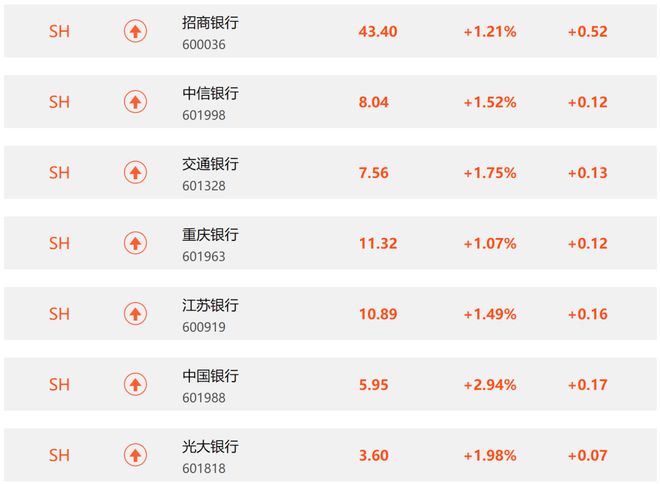
中国银行股价创新高
Di Yi Cai Jing Zi Xun· 2025-11-19 02:53
Core Points - Bank stocks experienced a volatile rise on November 19, with notable gains among several banks [1] - China Bank's stock price reached a new high, increasing by over 2% [1] Group 1: Stock Performance - China Bank's stock rose by 2.94%, reaching a price of 5.95 [2] - Everbright Bank's stock increased by 1.98%, with a price of 3.60 [2] - Jiangsu Bank's stock saw a rise of 1.49%, priced at 10.89 [2] - Traffic Bank's stock rose by 1.75%, reaching 7.56 [2] - Chongqing Bank's stock increased by 1.07%, priced at 11.32 [2] - CITIC Bank's stock rose by 1.52%, with a price of 8.04 [2] - China Merchants Bank's stock increased by 1.21%, priced at 43.40 [2]
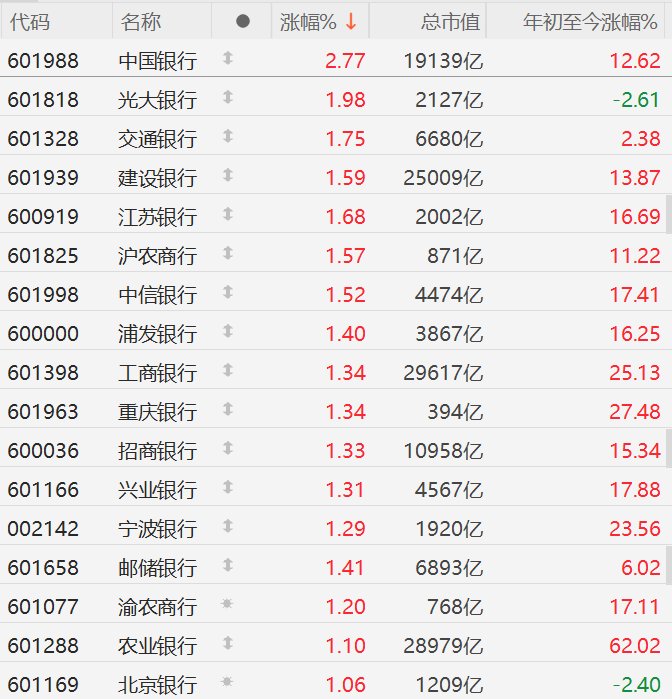
又有银行股创新高!中国银行涨近3%创历史新高
Ge Long Hui A P P· 2025-11-19 02:34
Core Insights - The A-share market saw a collective rise in bank stocks, with notable increases in China Bank, which rose nearly 3%, and other banks like Everbright Bank, Bank of Communications, and Agricultural Bank of China also showing gains of over 1% [1] Summary by Category Stock Performance - China Bank increased by 2.77%, reaching a total market capitalization of 191.39 billion, with a year-to-date increase of 12.62% [2] - Everbright Bank rose by 1.98%, with a market cap of 21.27 billion and a year-to-date decline of 2.61% [2] - Bank of Communications saw a 1.75% increase, with a market cap of 66.80 billion and a year-to-date increase of 2.38% [2] - Agricultural Bank of China increased by 1.10%, with a market cap of 289.79 billion and a year-to-date increase of 62.02% [2] - Other banks such as Construction Bank, Jiangsu Bank, and Industrial and Commercial Bank of China also reported gains, with year-to-date increases ranging from 15.34% to 25.13% [2] Historical Performance - China Bank reached a new historical high, following similar achievements by Agricultural Bank and Industrial and Commercial Bank [1]

银行股震荡走高,中国银行涨近2%
Mei Ri Jing Ji Xin Wen· 2025-11-19 02:34
Core Viewpoint - Bank stocks experienced fluctuations but ultimately rose, with notable gains in several major Chinese banks on November 19 [1]. Group 1: Stock Performance - China Bank saw an increase of nearly 2% [1]. - Other banks that performed well include Everbright Bank, Jiangsu Bank, Transportation Bank, Chongqing Bank, Citic Bank, and China Merchants Bank, which had significant gains [1].
光大银行涨2.27%,成交额7.17亿元,主力资金净流入9633.19万元
Xin Lang Zheng Quan· 2025-11-19 02:33
Core Viewpoint - Everbright Bank's stock price has shown fluctuations, with a recent increase of 2.27% and a total market capitalization of 213.29 billion yuan, despite a year-to-date decline of 1.93% [1] Group 1: Stock Performance - As of November 19, Everbright Bank's stock price reached 3.61 yuan per share, with a trading volume of 717 million yuan and a turnover rate of 0.43% [1] - The stock has experienced a 3.14% increase over the last five trading days and a 3.14% increase over the last twenty days, while it has declined by 8.14% over the last sixty days [1] Group 2: Financial Performance - For the period from January to September 2025, Everbright Bank reported a net profit of 37.018 billion yuan, representing a year-on-year decrease of 3.63% [2] - The bank's cumulative cash distribution since its A-share listing amounts to 125.709 billion yuan, with 32.615 billion yuan distributed over the last three years [3] Group 3: Shareholder Information - As of September 30, 2025, the number of shareholders of Everbright Bank increased to 180,200, a rise of 28.23%, while the average number of circulating shares per person decreased by 22.12% to 258,627 shares [2] - The top ten circulating shareholders include Hong Kong Central Clearing Limited, holding 1.084 billion shares (a decrease of 256 million shares), and China Securities Finance Corporation, holding 989 million shares (unchanged) [3]
焕新登场,光大银行正式推出手机银行13.0版
Jin Rong Jie· 2025-11-18 07:39
Core Viewpoint - The banking industry is accelerating its transformation towards online, mobile, digital, and intelligent services, with China Everbright Bank launching its mobile banking version 13.0 to enhance customer experience through technology innovation [1] Group 1: Mobile Banking Features - The new mobile banking version features five upgraded homepages: "Home," "Borrow Money," "Wealth," "Activities," and "My Account," designed for aesthetics, usability, and uniqueness [2] - The "Home" page includes new sections for wealth selection, rural revitalization, and convenient living, with frequently used functions fixed at the top for easy access [2] - The "Borrow Money" page offers a dual-tab format for loans and credit cards, providing comprehensive funding solutions for customers [2] Group 2: Wealth Management Enhancements - The mobile banking 13.0 version strengthens wealth management functions, focusing on the "Sunshine Wealth" brand to meet diverse customer needs [3] - New features include a "Life's Four Funds" section for managing liquid assets, stable investments, advanced investments, and insurance [3] - The investment channel introduces a "Regular Investment" section with three types of investment strategies: target investment, popular investment, and stable investment [3] Group 3: Loan Services - The new "Borrow Money" section addresses fragmented traditional financial services by providing tailored funding solutions based on real-life scenarios [4] - The "Loan" page includes four areas: "I Want to Operate," "I Want to Buy a House," "I Want to Consume," and "I Have Credit Enhancement," forming a product matrix for various customer needs [4] - The "Credit Card" page offers comprehensive services, including account checking, repayment, credit limit adjustments, and rewards redemption [4] Group 4: Pension Financial Services - The mobile banking version enhances pension financial services with dual sections for pension finance and personal pensions, offering comprehensive services [5] - The "Enjoy Service" section integrates resources from various subsidiaries to provide specialized services combining finance and healthcare [5] - The "Simplified Version" is designed for elderly customers, featuring key information and functions prominently on the homepage for easier access [5] Group 5: Lifestyle Services - The "Activities" page offers a variety of benefits in food, beverages, travel, entertainment, and shopping, enhancing the lifestyle service ecosystem [6] - The platform provides affordable and quality agricultural products through "Everbright Purchase Excitement" [6] - New cross-border financial services are introduced for outbound customers and foreign nationals, including online asset proof applications available 24/7 [6]