CEB BANK(601818)

Search documents
银行ETF基金、银行ETF、银行AH优选ETF上涨,Q3险资加力布局银行板块
Ge Long Hui A P P· 2025-11-20 04:08
Core Viewpoint - The A-share market has seen a significant rise in bank stocks, with notable increases in major banks such as China Bank and Construction Bank, indicating a positive sentiment towards the banking sector [1][4]. Group 1: Stock Performance - China Bank rose over 5%, Construction Bank over 4%, and Postal Savings Bank over 3%, with several other banks also showing gains of over 2% [1]. - Bank ETFs, including various Southern and E-Fund ETFs, have also experienced upward movement, reflecting the overall positive trend in the banking sector [3]. Group 2: ETF Insights - Bank ETFs track the China Securities Bank Index, with nearly 30% of their holdings in major state-owned banks like Industrial and Agricultural Bank, while about 70% focuses on high-growth banks [3]. - The Bank AH Preferred ETF tracks the Bank AH Index, utilizing a monthly security category conversion strategy based on AH prices [4]. Group 3: Institutional Investment Trends - As of Q3 2025, insurance capital has increased its holdings in the banking sector, with a holding ratio of 27.95% and a market value accounting for 3.99% of circulating A-shares [5]. - Insurance capital has increased its positions in 23 banks, with 10 banks seeing increased holdings, indicating a growing interest in the banking sector [6]. Group 4: Market Dynamics - The A-share market is experiencing a style shift, influenced by factors such as the approaching end-of-year assessments for institutions and the central bank's implementation of a moderately loose monetary policy [4]. - The decline in the proportion of bank holdings among public funds suggests a potential opportunity for reallocation towards undervalued financial stocks [4]. Group 5: Future Outlook - The insurance sector is expected to continue increasing its investment in banks, driven by stable dividends and low valuations, with a focus on high ROE small and medium-sized banks [6]. - The ongoing improvement in net profits for banks and the potential for valuation reconstruction through increased capital inflows are seen as positive indicators for the banking sector's future [6].







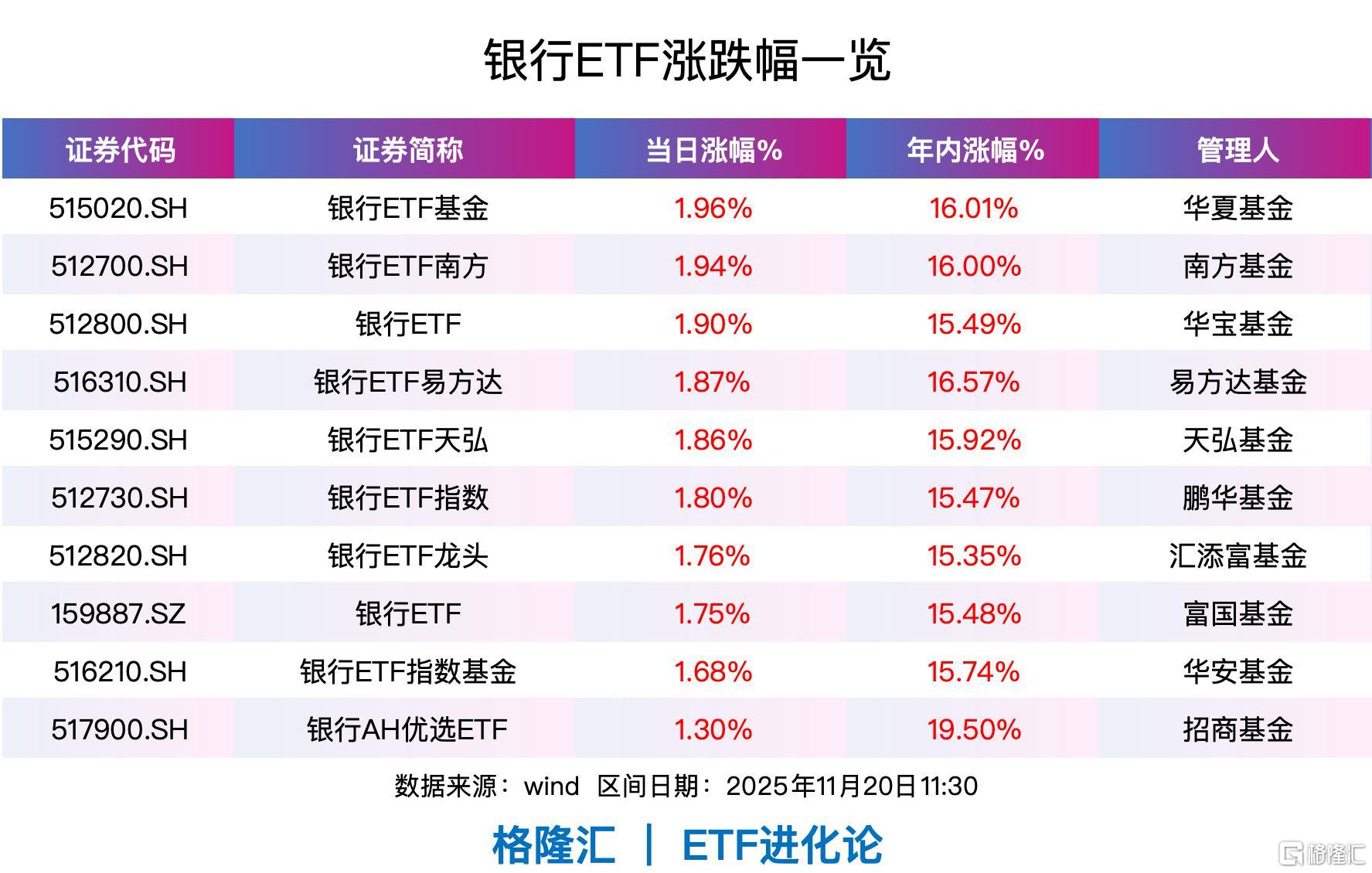
银行ETF指数(512730)涨超1.6%,银行估值仍处于历史偏低水平
Xin Lang Cai Jing· 2025-11-20 03:43
Group 1 - The core viewpoint indicates a strong performance in the banking sector, with the China Securities Bank Index rising by 1.73% and individual stocks like Bank of China and Construction Bank showing significant gains [1] - The banking sector is experiencing a defensive style resurgence, with the total market capitalization of A-shares surpassing 2.25 trillion [1] - Current credit growth is slowing down, and social financing growth is also retreating from high levels, although policies are in place to support demand recovery [1] Group 2 - The banking sector's retail risk has increased but remains manageable, supported by substantial provisioning and stable dividend policies [1] - The advantages of banks in areas such as gold markets, wealth management, and investment banking contribute to differentiated valuations within the sector [1] - The valuation of banks is still at historically low levels, and there is potential for medium to long-term capital allocation, making increased investment in the banking sector a favorable choice [1] Group 3 - The Bank ETF Index closely tracks the China Securities Bank Index and serves as an analytical tool for investors [2] - As of October 31, 2025, the top ten weighted stocks in the China Securities Bank Index account for 64.87% of the index, highlighting the concentration of investment in major banks [2]



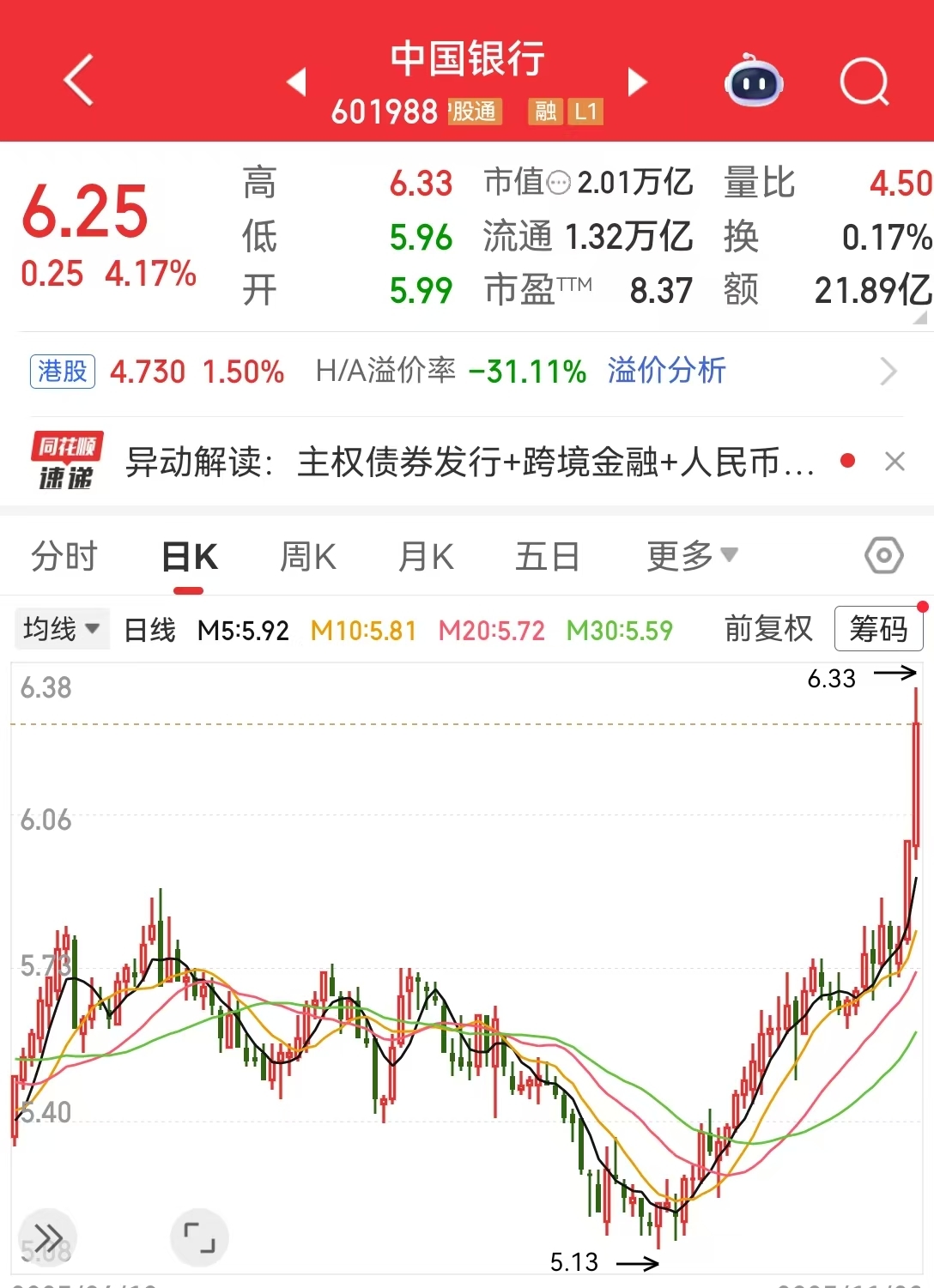
银行板块再度走强,中国银行续创新高,建设银行等拉升
Zheng Quan Shi Bao Wang· 2025-11-20 03:36
Core Viewpoint - The recent rally in the banking sector is primarily driven by a shift in market investment style, with mid-term dividends acting as a catalyst, and the trend is expected to continue until the end of December [1] Group 1: Market Performance - As of the latest report, major banks such as Bank of China saw a nearly 5% increase, while China Construction Bank and Postal Savings Bank rose nearly 4%, and other banks like Everbright Bank and Minsheng Bank increased by over 2% [1] - The banking sector is experiencing a strong upward trend, indicating positive investor sentiment and market dynamics [1] Group 2: Investment Opportunities - According to Guosen Securities, there are likely to be good investment opportunities in the banking sector before the main theme of spring volatility becomes clear, suggesting that investors should overlook short-term fluctuations [1] - The demand for insurance capital allocation is significant due to the low interest rate environment, making stable bank stocks attractive to insurance funds [1] - The banking sector is expected to be an important allocation direction as the basic bottom-line expectations have become clear, which can help reduce asset yield volatility [1] Group 3: Recommendations - The institution recommends focusing on high-dividend, fundamentally stable stocks in the short term, while also considering quality stocks for potential upside [1] - It is suggested to pay attention to major banks like Industrial and Commercial Bank of China and China Merchants Bank as they represent stable investment opportunities [1]

中国银行涨超4%续创历史新高,A股市值超2万亿元!农业银行年内涨幅超60%!上市银行超2600亿“红包雨”来袭
Mei Ri Jing Ji Xin Wen· 2025-11-20 03:11
每经编辑|杜宇 11月20日电,A股早盘银行板块延续强势,中国银行(SH601988)涨超4%,续创历史新高,总市值超2万亿元。 邮储银行、光大银行、建设银行、中信银行等涨幅靠前。 | 建设银行 v | | | | | | --- | --- | --- | --- | --- | | 601939 LT 沪股通 | | | | | | 9.84 市值-2.57万亿 量比 4.91 501 9.81 | | | | | | 保 9.45 流通 941.14亿 换 | | 0.92% | | | | 0.29 3.05% 开 9.48 市盈™ 7.59 额 | | 8.52 Z | | | | 港股 8.250 1.48% H/A溢价率 -23.45% 溢价分析 | | | | | | 分时 | | | | | | 均价:9.68 最新:9.81 0.29 +3.05% | | | | | | --------- +3.36% 大单 9.89 *749 9.84 --- | | | | | | 季5 | 9.85 5989 | | | | | 卖4 | | 9.84 3823 | | | | 卖3 | | 9. ...

争夺年轻用户流量红利,银行扎堆入驻小红书
Guan Cha Zhe Wang· 2025-11-20 02:40
具体来看,招商银行在小红书上已经收获了51.3万粉丝,中信银行信用卡账号紧随其后,有12.6万粉 丝,而光大银行则稳稳坐拥9.4万粉丝的小圈子。可以说,银行们在小红书的"粉丝赛跑"已经悄然开 始,各家都在努力抢占年轻用户的关注度。 凭借在用户消费决策链中的关键入口地位、以及天然具备的"强搜索"属性,小红书正成为各大商业银行 竞相"挖金"的新阵地。 除招商银行、江苏银行等较早布局的机构外,近期浙商银行、大华银行等多家银行也陆续开设官方账 号,让银行在小红书上的身影越来越多。 小红书 小红书 据《证券日报》此前报道,自今年以来,银行、券商、基金、保险等金融机构已成规模地入驻小红书。 截止至今年5月份,各类金融机构已开设超过200个官方账号,其中银行总行、业务条线与各地分支机构 创建的官方账号数量也已超过60个。不同类型金融机构不断"进场",小红书正日益成为它们争抢流量入 口的缩影。 平台流量庞大,潜在客群可观、活跃度高,这也解释了银行为何积极入驻。另据小红书财经与蚂蚁财富 联合推出的《2024年轻人十大理财趋势盘点》显示,2024年,小红书上"存钱"相关的笔记阅读量达到83 亿,2000多万"00后"通过余额宝定 ...



贯彻落实党的二十届四中全会精神 积极贡献“高质效”银行力量
Jin Rong Shi Bao· 2025-11-20 02:03
Core Viewpoint - The article outlines the strategic framework for China's economic and social development over the next five years, emphasizing the importance of high-quality development and efficient allocation of resources through financial services [1][4]. Group 1: Efficient Resource Allocation - Efficient allocation of resources relies on optimizing the combination of new and traditional factors, enhancing overall productivity, and requires both policy guidance and market participation [2]. - Financial systems play a crucial role in directing capital to specific sectors, alleviating resource misallocation, and supporting the integration of technology and industry [2][3]. Group 2: Financial Empowerment of Industry - The "Five Key Financial Articles" initiative aims to support industrial transformation and the development of new productive forces, with a strong focus on technology finance [4]. - Financial institutions are encouraged to provide targeted support to key sectors, such as integrated circuits and artificial intelligence, through differentiated credit policies and innovative financial products [4][5]. Group 3: Green Finance and Inclusive Finance - The banking sector is innovating green finance products to support low-carbon transitions and the development of green industries, with a focus on creating a multi-level green finance service system [6]. - Inclusive finance initiatives are being developed to meet the diverse financial needs of small technology enterprises and support elderly care services [6]. Group 4: Integration of Finance and Real Economy - Deep integration of finance with various economic scenarios is essential for building a unified national market, enhancing resource allocation efficiency, and promoting consumption [7][8]. - The establishment of a convenient payment system and customized financial solutions for industries is being prioritized to facilitate the flow of information, logistics, and capital [8]. Group 5: Commitment to High-Quality Development - The company is committed to implementing the directives from the 20th Central Committee, focusing on high-quality development, efficient resource allocation, and supporting the construction of a unified national market [9].
中国银行A股股价创新高;现货黄金站上4100美元/盎司 | 金融早参
Mei Ri Jing Ji Xin Wen· 2025-11-19 23:24
Group 1: Central Bank Operations - The central bank conducted a 310.5 billion yuan 7-day reverse repurchase operation, with a bid amount and winning amount of 310.5 billion yuan, maintaining an operation rate of 1.40% [1] Group 2: Banking Sector Performance - A-shares in the banking sector experienced fluctuations but generally rose, with China Bank's stock price increasing over 2% to reach a new high, alongside significant gains from other banks such as Everbright Bank and CITIC Bank [2] - The rise in bank stock prices reflects positive market expectations for future growth in the financial industry, likely driven by economic recovery expectations and policy support [2] Group 3: Insurance Sector Performance - The insurance sector in A-shares continued to rise, with China Life and China Property & Casualty Insurance both increasing over 3%, along with other major insurers [3] - The notable growth in the insurance sector indicates investor optimism, potentially influenced by market perceptions of economic stability and increased risk management awareness among individuals [3] Group 4: Gold Market Trends - Spot gold prices reached 4,100 USD per ounce, reflecting a 0.85% increase during the day [4] - The rise in gold prices indicates a sustained preference for safe-haven assets, driven by increasing geopolitical risks and inflation pressures, showcasing gold's appeal as a traditional safe-haven investment [4]


AI重塑银行数字竞争力,机制与人才变革正在进行时
2 1 Shi Ji Jing Ji Bao Dao· 2025-11-19 09:26
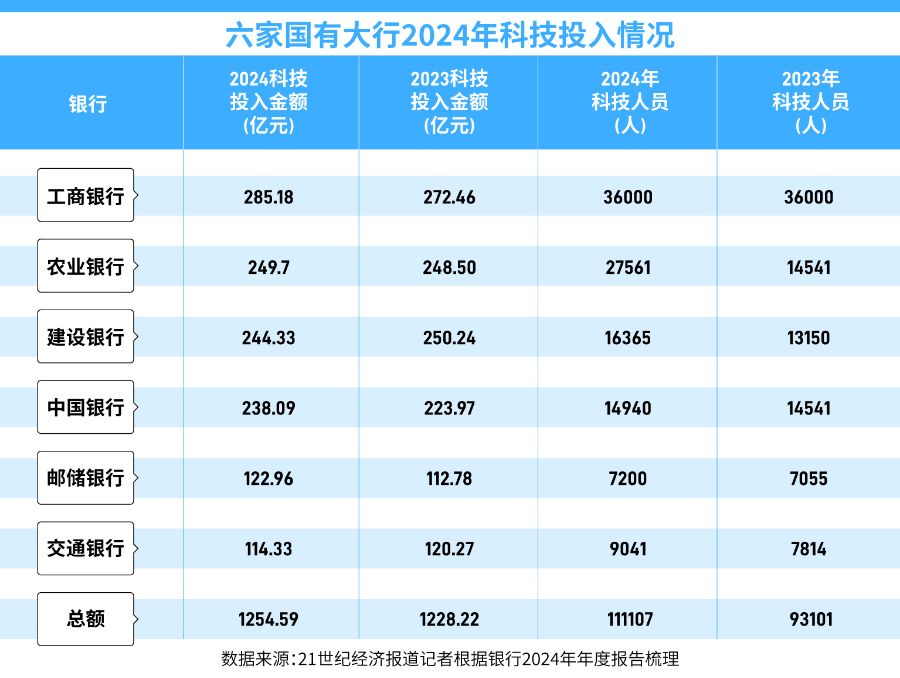
Core Insights - The banking industry is entering a new phase of digital finance development driven by AI applications, enhancing the integration of technology and business operations [2] - There is a significant increase in technology investment among major banks, with a focus on optimizing governance structures and resource management [3][4] - AI is reshaping competitive dynamics in the banking sector, enabling smaller banks to leverage technology for innovation and growth [2] Technology Investment and Governance - In 2024, the total technology investment by six major state-owned banks exceeded 120 billion yuan, marking a 2.15% year-on-year increase, with a total of over 111,000 technology personnel, up 19.34% from the previous year [3][4] - The technology investment of these six banks accounts for over 50% of the total technology spending in the banking industry, which exceeds 200 billion yuan [4] - Some banks, such as China Construction Bank and Ping An Bank, have reported a decrease in technology investment, indicating a shift towards optimizing technology resource management [5][6] AI Application and Innovation - AI applications are accelerating the integration of business and technology, with various banks launching innovative projects across different scenarios [2][6] - Smaller banks like Qingdao Bank and Hunan Bank have demonstrated significant innovation capabilities through AI, winning multiple awards in recent fintech competitions [2] Talent Development and Resource Allocation - The proportion of technology personnel in major banks has increased, reflecting a growing emphasis on talent as a core resource for digital finance development [9][10] - Banks are adopting dual pathways for cultivating composite talents, focusing on both external recruitment and internal mechanisms to enhance the integration of technology and business [11][12] - The shift towards "business-technology co-creation" is emphasized, with banks encouraging deeper involvement of business units in technology development processes [13]
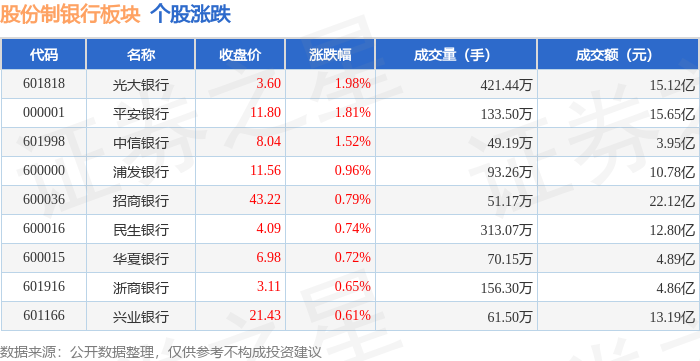
股份制银行板块11月19日涨1.02%,光大银行领涨,主力资金净流入5.77亿元
Zheng Xing Xing Ye Ri Bao· 2025-11-19 08:52
Core Insights - The banking sector saw a rise of 1.02% on November 19, with Everbright Bank leading the gains [1] - The Shanghai Composite Index closed at 3946.74, up 0.18%, while the Shenzhen Component Index closed at 13080.09, unchanged [1] Banking Sector Performance - Everbright Bank's stock price increased by 1.98% to 3.60, with a trading volume of 4.21 million shares and a transaction value of 15.12 million [1] - Ping An Bank rose by 1.81% to 11.80, with a trading volume of 1.34 million shares and a transaction value of 1.56 billion [1] - CITIC Bank's stock price increased by 1.52% to 8.04, with a trading volume of 491,900 shares and a transaction value of 39.5 million [1] - Other banks like Shanghai Pudong Development Bank, China Merchants Bank, and Minsheng Bank also showed positive performance, with varying increases in stock prices and trading volumes [1] Capital Flow Analysis - The banking sector experienced a net inflow of 577 million from main funds, while retail funds saw a net outflow of 174 million [1] - Major banks like China Merchants Bank and Ping An Bank had significant net inflows from main funds, while they faced outflows from retail and speculative funds [2] - Everbright Bank had a net inflow of 24.92 million from main funds but saw a net outflow of 98.58 million from retail investors [2]
超4100只个股下跌
第一财经· 2025-11-19 07:37
Market Overview - The A-share market experienced a fluctuating trend, with the Shanghai Composite Index rising by 0.18% to close at 3946.74, while the Shenzhen Component Index remained flat and the ChiNext Index increased by 0.25% to 3076.85 [3][4]. Sector Performance - The gold sector showed strength, and the aquaculture sector surged in the afternoon, with stocks like Guolian Aquatic and Zangzi Island hitting the daily limit [4][5]. - The banking sector also performed well, with China Bank rising over 3% to reach a historical high, alongside significant gains in other banks like Everbright Bank and Ping An Bank [6]. Trading Volume and Market Sentiment - The total trading volume in the Shanghai and Shenzhen markets was 1.73 trillion, a decrease of 200.2 billion from the previous trading day, with over 4100 stocks declining [7]. - Main funds saw a net inflow into sectors such as telecommunications, banking, and precious metals, while there was a net outflow from computer, media, and pharmaceutical sectors [9]. Institutional Insights - Shenwan Hongyuan predicts a comprehensive market rally may start in the second half of 2026, marking the beginning of "Bull Market 2.0" [10]. - Zhongyuan Securities notes that the current A-share market is in a phase of consolidation around the 4000-point mark, with a likely continuation of style rebalancing between cyclical and technology sectors [11]. - CITIC Securities observes that the Shanghai Composite Index is fluctuating around 4000 points, with total market turnover decreasing to around 2 trillion, indicating active investment in thematic and growth sectors [12].