
COSCO SHIP HOLD(601919)

Search documents
中远海控(01919.HK)12月19日耗资5366.89万港元回购396.55万股
Ge Long Hui· 2025-12-19 09:47
中远海控(01919.HK)12月19日耗资5366.89万港元回购396.55万股 中远海控(01919.HK)12月18日耗资 8055.74万港元回购590万股 相关事件 格隆汇12月19日丨中远海控(01919.HK)发布公告,2025年12月19日耗资5366.89万港元回购396.55万股, 回购价格每股13.47-13.73港元。 ...
中远海控(01919) - 翌日披露报表
2025-12-19 09:33
FF305 公司名稱: 中遠海運控股股份有限公司 呈交日期: 2025年12月19日 如上市發行人的已發行股份或庫存股份出現變動而須根據《香港聯合交易所有限公司(「香港聯交所」)證券上市規則》(「《主板上市規則》」)第13.25A條 / 《香港聯合交易所有限公司GEM證券 上市規則》(「《GEM上市規則》」)第17.27A條作出披露,必須填妥第一章節 。 翌日披露報表 (股份發行人 ── 已發行股份或庫存股份變動、股份購回及/或在場内出售庫存股份) | 第一章節 | | | | | | | | | --- | --- | --- | --- | --- | --- | --- | --- | | 1. 股份分類 | 普通股 | 股份類別 | H | | 於香港聯交所上市 | 是 | | | 證券代號 (如上市) | 01919 | 說明 | | | | | | | A. 已發行股份或庫存股份變動 | | | 已發行股份(不包括庫存股份)變動 | | 庫存股份變動 | | | | | 事件 | | 佔有關事件前的現有已發 | | | 每股發行/出售價 (註4) | 已發行股份總數 | | | | 已發行股份(不 ...
高盛:对明年航运及油轮业持乐观态度 对集装箱船运较谨慎
Zhi Tong Cai Jing· 2025-12-19 08:29
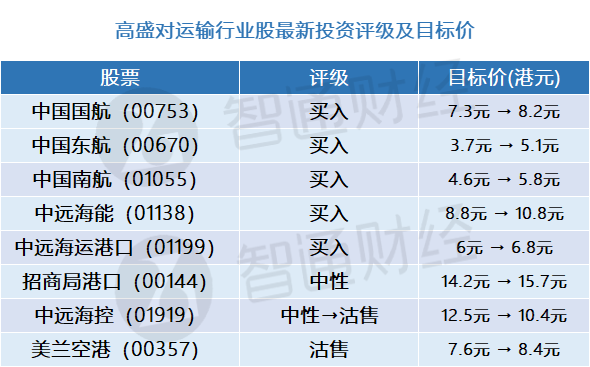
Group 1: Airline Industry - Goldman Sachs forecasts that international demand will rise while supply constraints persist, leading to an expected return on equity (ROE) of 22% for airlines by 2027, surpassing the industry cycle average [1] - Despite risks associated with Japan in the first half of the year, the outlook for airline stocks remains positive, with further upward potential for ticket prices [1] - Preferred stocks include China National Aviation Holding (601111) H-shares (00753) and China Eastern Airlines (600115) A-shares (600115.SH) [1] Group 2: Container Shipping - The firm adopts a more cautious stance on container shipping due to supply recovery, which is expected to compress industry profit margins [1] - New ship orders this year have exceeded expectations, resulting in an order-to-existing capacity ratio of 33% [1] - Potential reopening of the Red Sea may pose additional downside risks, potentially releasing about 10% of effective capacity, which could lead to China COSCO Shipping Holdings (601919) (01919, 601919.SH) entering a cash consumption state [1] Group 3: Oil Tankers - The outlook for oil tankers remains optimistic, with expectations of rising spot freight rates during the sustained upward cycle in 2026 [1] - The oil reserve process in China may take up to a year, longer than the market's three-month expectation, while effective capacity is predicted to grow by only 1% [1] - China COSCO Shipping Energy Transportation (600026) (01138, 600026.SH) is expected to benefit due to its significant exposure to oil tankers and the Chinese import market [1] Group 4: Stock Ratings and Target Prices - China National Aviation (00753): Buy, target price raised from 7.3 to 8.2 HKD [2] - China Eastern Airlines (00670): Buy, target price raised from 3.7 to 5.1 HKD [2] - China Southern Airlines (01055): Buy, target price raised from 4.6 to 5.8 HKD [2] - China COSCO Shipping Energy (01138): Buy, target price raised from 8.8 to 10.8 HKD [2] - China COSCO Shipping Ports (01199): Buy, target price raised from 6 to 6.8 HKD [2] - China Merchants Port (00144): Neutral, target price raised from 14.2 to 15.7 HKD [2] - China COSCO Shipping Holdings (01919): Neutral to Sell, target price lowered from 12.5 to 10.4 HKD [2] - Meilan Airport (00357): Sell, target price raised from 7.6 to 8.4 HKD [2]

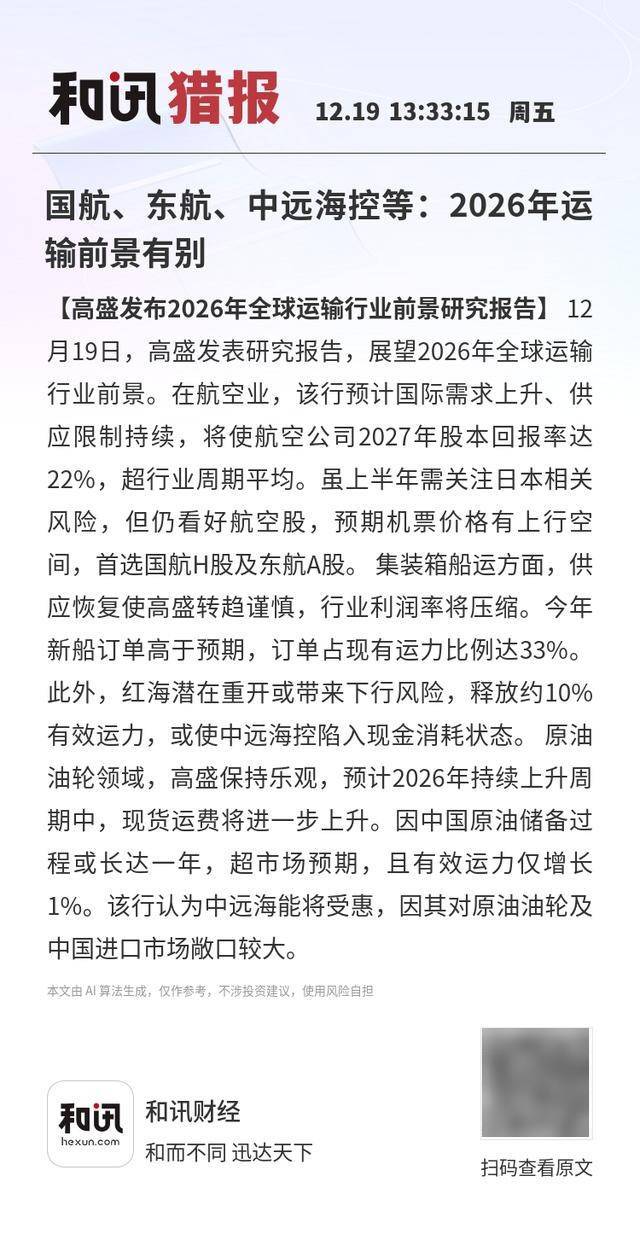
国航、东航、中远海控等:2026年运输前景有别
Sou Hu Cai Jing· 2025-12-19 06:04
Group 1 - The core viewpoint of the report is that Goldman Sachs projects a positive outlook for the global transportation industry by 2026, particularly in the aviation and oil tanker sectors, while expressing caution in the container shipping segment [1] Group 2 - In the aviation sector, Goldman Sachs expects international demand to rise and supply constraints to persist, leading to an estimated return on equity of 22% for airlines by 2027, which exceeds the industry cycle average [1] - The report highlights a preference for specific airline stocks, namely Air China H-shares and China Eastern Airlines A-shares, due to anticipated upward pressure on ticket prices [1] Group 3 - In the container shipping sector, Goldman Sachs has adopted a cautious stance due to a recovery in supply, which is expected to compress industry profit margins [1] - The report notes that new ship orders have exceeded expectations, with orders representing 33% of existing capacity, and potential reopening of the Red Sea could pose downward risks by releasing about 10% of effective capacity [1] Group 4 - In the oil tanker segment, Goldman Sachs maintains an optimistic outlook, forecasting a continued upward cycle in spot freight rates through 2026 [1] - The report indicates that China's oil reserve process may take up to a year, exceeding market expectations, while effective capacity is projected to grow by only 1%, benefiting companies like China Merchants Energy due to their exposure to the oil tanker and Chinese import markets [1]
中方终于松口,同意长和出售港口,美国愿与中方平分股份,中方:要当只当大股东!
Sou Hu Cai Jing· 2025-12-19 03:01
在这个看似简单的商业交易背后,隐藏的是深刻的经济、政治以及战略层面的考量。美国之所以对这笔交易高度警惕,实际上源于对中国日益增强的全球影 响力的担忧。美国担心,如果中方获得巴拿马港口的控制权,那么将对其在全球航运及贸易中的霸主地位形成直接威胁。 在近期的国际经济舞台上,巴拿马港口交易风波愈演愈烈。李嘉诚旗下的长江和记集团本试图将其控制的巴拿马港口出售给贝莱德集团与地中海航运公司联 合组成的财团。此举不仅关乎企业利益,更是一场国家间力量博弈的缩影。随着中美关系的持续紧张和全球供应链的不确定性,这一事件更是成为了各国关 注的焦点。 综上所述,巴拿马港口交易的突然"逆转",不仅关乎一个港口的命运,也关乎中美之间、以及更广泛的国际社会格局的变迁。随着未来谈判的推进,我们有 理由期待更多的变数与结果浮出水面。 至于巴拿马,虽然目前仍在美方的压力下,但并非毫无转机。中方若能在谈判中找到突破口,甚至有可能引导巴方转变立场。毕竟,巴拿马同样需要中国的 投资与合作,这种互惠共赢的机会值得珍惜。从更深层次来看,巴拿马港口的争夺战不仅是一次简单的商业竞争,它反映出的是在全球经济形势严峻的当 下,各国如何重新审视自身的战略利益与合作 ...

中远海控(01919.HK)连续35日回购,累计斥资13.84亿港元
Zheng Quan Shi Bao Wang· 2025-12-18 13:50
证券时报·数据宝统计,中远海控在港交所公告显示,12月18日以每股13.520港元至13.760港元的价格回 购590.00万股,回购金额达8055.74万港元。该股当日收盘价13.690港元,上涨0.96%,全天成交额2.26 亿港元。 自10月31日以来公司已连续35日进行回购,合计回购1.01亿股,累计回购金额13.84亿港元。 其间该股 累计上涨2.32%。 | 日期 | 回购股数(万股) | 回购最高价(港元) | 回购最低价(港元) | 回购金额(万港元) | | --- | --- | --- | --- | --- | | 2025.12.18 | 590.00 | 13.760 | 13.520 | 8055.74 | | 2025.12.17 | 285.75 | 13.590 | 13.350 | 3861.30 | | 2025.12.16 | 300.00 | 13.650 | 13.340 | 4031.69 | | 2025.12.15 | 295.00 | 13.730 | 13.450 | 4001.61 | | 2025.12.12 | 446.10 | 13.820 | ...
供需面进一步宽松,运费中枢下移
Guo Tai Jun An Qi Huo· 2025-12-18 13:13
1. Report Industry Investment Rating No relevant industry investment rating information provided in the report. 2. Core Viewpoints of the Report - In 2026, it is highly likely that the price center of the Container Shipping Index (Europe Line) futures will decline, and the volatility will continue to converge. The supply - side growth will gradually absorb the "bonus" of the detour caused by the Red Sea crisis, and the global maritime trade growth rate on the demand side may slow down [2][101]. - In 2026, the supply and demand of the Europe Line will both increase, but it is highly probable that the supply - demand situation will become looser. The annual freight rate center of the Europe Line is expected to fluctuate between 1300 - 2500 US dollars/FEU, corresponding to an SCFIS index of approximately 850 - 1800 points [2][101]. 3. Summary According to the Table of Contents 3.1 Overview - **Review of Spot and Futures Price Trends**: The Container Shipping Index (Europe Line) as a service - type futures has a relatively weak anchoring between spot and forward prices. The futures price generally follows the spot seasonal pattern, with a steeper upward slope than the downward slope in each V - shaped price movement, and the price center of the V - shaped movement continues to decline. Each contract has its own trading logic, with some similarities, such as the 2602 contract being similar to the 2508 contract [6]. - **Futures Price Structure Trends**: In the two - year listing period of EC, arbitrage trading mainly relied on seasonality. However, in 2025, due to increased macro and geopolitical uncertainties, the traditional trading logic of peak and off - peak seasons may fail. In the context of the Red Sea resumption risk in 2026, the safety margin of long spreads may be easier to capture than short spreads [29]. 3.2 Supply: Static Capacity Tends to be Saturated, and There is a Risk of Red Sea Route Resumption in the Distant Future - **Capacity Development**: In 2026, the global static capacity growth rate will be 4.6%. The Europe Line is expected to receive 8 - 14 new ships, mainly for upgrading ship types and filling small gaps. The difficulty of blank sailings will increase in 2026. In terms of dynamic capacity, the actual weekly average capacity of the China - Northwest Europe route in 2025 increased by 11.4% compared to 2024. In terms of market share, the capacity of Cosco Group and Hapag - Lloyd on the Northwest Europe route has increased [34][36][37]. - **Supply Chain Event Review**: - **Port Congestion**: The average in - port capacity of major ports related to Northwest Europe increased in 2025. Port congestion can cause passive blank sailings, affect the index settlement price, and lead to the loss of customer resources of some shipping companies [47][48]. - **Impact of the US Line on the European Supply Side**: After the implementation of the equal - tariff policy on April 2, 2025, 15 US - bound ships were transferred to the European Line from April to May, increasing the supply pressure. After the relaxation of tariffs on May 12, the US Line "rushed to export", and some ships were transferred from the European Line [54]. - **Impact of the 301 Investigation on the European Line Market**: The US 301 investigation on China's maritime, logistics, and shipbuilding industries and China's counter - measures did not cause significant disruptions to the European Line container shipping market [57][58][59]. 3.3 Demand: There is No Strong Inventory - Replenishment Drive in the US in the First Half of the Year, and European Import Demand May be Resilient - **US Perspective**: In the first half of 2026, if there are no major changes in the Sino - US tariff policy, the US may maintain rigid inventory replenishment. There is no strong upward drive on the demand side, so importers do not have a strong motivation for large - scale inventory replenishment [70]. - **European Perspective**: In 2025, from January to October, Asia's exports of containers to Europe continued to grow rapidly. In 2026, European import demand may be resilient, but attention should be paid to the marginal change in the growth rate [83]. 3.4 Major Geopolitical Events and Their Impact Paths - **Middle East**: The Red Sea and potential Hormuz Strait security risks persist. Shipping companies are preparing for the resumption of the Red Sea route in 2026, but the risk has not completely disappeared, and there is no unified schedule for the west - bound resumption of the European Line. If the Red Sea route resumes, there will be an issue of over - capacity [90][91][92]. - **Russia - Ukraine Conflict**: In 2025, the situation on the battlefield tilted in favor of Russia, and there was a "28 - point cease - fire framework" proposed but not accepted. In 2026, the conflict may end with Ukraine "forced to accept a cease - fire" or "resisting firmly with Europe". The easing of the conflict may boost the import demand of the Europe - Mediterranean route and have a positive impact on the European Line [94][95]. - **Taiwan Strait**: Japan's provocations may lead to an escalation of the situation in the Taiwan Strait. In case of conflict, the shipping routes in the East China Sea, South China Sea, and the Malacca Strait may be affected, leading to an increase in shipping prices [97][98]. 3.5 Strategy Recommendations - **2602 Contract**: The trading logic is similar to that of the 2508 contract, focusing on freight rate height, inflection point time, and subsequent decline rate. The current most profitable spread - filling market has ended, and it is expected to be mainly volatile and follow the delivery logic [3][102]. - **2604 and 2610 Contracts**: Market speculative funds may try to trade on the off - peak season attributes. The 2604 contract has already priced in most of the off - peak season expectations, and it is recommended to short with a fluctuating rhythm, with a fundamental resistance level of 1150 - 1250 points. The 2610 contract is suitable for trading the long - term weakening of the fundamentals and the negative impact of the Red Sea route resumption [3][102]. - **2606 and 2608 Contracts**: Due to the uncertainty of the Red Sea route resumption rhythm, there is a certain risk in unilateral long positions. In the initial stage, it is advisable to enter the market through 6 - 10 and 8 - 10 long spreads [3][103].
中远海控(601919) - 中远海控H股公告:翌日披露报表
2025-12-18 10:15
FF305 翌日披露報表 (股份發行人 ── 已發行股份或庫存股份變動、股份購回及/或在場内出售庫存股份) 表格類別: 股票 狀態: 新提交 公司名稱: 中遠海運控股股份有限公司 呈交日期: 2025年12月18日 | 1). | 購回股份(擬註銷但截至期終結存日期尚未註銷) | 3,000,000 | 0.1042 % | HKD | 13.57 | | --- | --- | --- | --- | --- | --- | | | 變動日期 2025年10月31日 | | | | | | 2). | 購回股份(擬註銷但截至期終結存日期尚未註銷) | 1,500,000 | 0.0521 % | HKD | 13.81 | | | 變動日期 2025年11月3日 | | | | | | 3). | 購回股份(擬註銷但截至期終結存日期尚未註銷) | 4,500,000 | 0.1563 % | HKD | 13.71 | | | 變動日期 2025年11月4日 | | | | | | 4). | 購回股份(擬註銷但截至期終結存日期尚未註銷) | 1,250,000 | 0.0434 % | HKD | 13. ...
中远海控12月18日斥资8055.74万港元回购590万股
Zhi Tong Cai Jing· 2025-12-18 09:52
中远海控(601919)(01919)发布公告,该公司于2025年12月18日斥资8055.74万港元回购590万股股份, 每股回购价格为13.52-13.76港元。 ...
中远海控(01919.HK)12月18日耗资8055.74万港元回购590万股
Ge Long Hui· 2025-12-18 09:48
格隆汇12月18日丨中远海控(01919.HK)发布公告,2025年12月18日耗资8055.74万港元回购590万股,回 购价格每股13.52-13.76港元。 ...