CNNP(601985)
Search documents
公用事业行业跟踪周报:2025年5月全社会用电同比+4.4%-20250623
Soochow Securities· 2025-06-23 05:02
Investment Rating - The report maintains an "Overweight" rating for the utility sector [1]. Core Insights - In May 2025, the total electricity consumption increased by 4.4% year-on-year, with a total of 809.6 billion kWh consumed [4][6]. - The electricity price in May 2025 saw a year-on-year decrease of 3% but a slight month-on-month increase of 0.4% [40]. - The report highlights significant growth in various sectors, with the first industry showing an 8.4% increase, the second industry at 2.1%, and the third industry at 9.4% [4][13]. Summary by Sections 1. Market Review - The SW utility index decreased by 1.13% during the week of June 16-20, 2025, with notable declines in nuclear, water, and thermal power sectors [9][12]. 2. Electricity Sector Tracking 2.1. Electricity Consumption - Total electricity consumption from January to April 2025 reached 3.16 trillion kWh, reflecting a year-on-year increase of 3.1% [13]. - The growth rates for different sectors were: first industry +10.0%, second industry +2.3%, third industry +6.0%, and urban-rural residential consumption +2.5% [13][14]. 2.2. Power Generation - Cumulative power generation from January to April 2025 was 2.98 trillion kWh, with a slight year-on-year increase of 0.1% [22]. - The breakdown of generation by source showed thermal power down by 4.1%, water power up by 2.2%, nuclear power up by 12.7%, wind power up by 10.9%, and solar power up by 19.5% [22]. 2.3. Electricity Prices - The average grid purchase price in May 2025 was 394 RMB/MWh, down 3% year-on-year [40]. 2.4. Thermal Power - As of June 20, 2025, the price of thermal coal was 609 RMB/ton, a decrease of 29.84% year-on-year [45]. - The cumulative installed capacity of thermal power reached 1.46 billion kW, with a year-on-year increase of 4.1% [47]. 2.5. Hydropower - The water level at the Three Gorges Reservoir was 149.15 meters, consistent with previous years, and inflow and outflow rates increased by 19.72% and 63.96% respectively [53]. 2.6. Nuclear Power - In 2024, 11 new nuclear units were approved, indicating a positive growth trajectory for the sector [22]. 2.7. Renewable Energy - Wind and solar power saw significant increases in installed capacity, with wind power up by 18.5% and solar power up by 74.6% [22]. 3. Investment Recommendations - The report suggests focusing on investment opportunities in hydropower and thermal power during the peak summer season, recommending specific companies such as China Yangtze Power and Huaneng International [4].
汇丰:核能与铀_中国在核电领域的立场
汇丰· 2025-06-23 02:09
Investment Rating - The report maintains a "Hold" rating for CGN Power and Dongfang Electric, with target prices adjusted to HKD2.90 (from HKD2.70) and HKD12.30 respectively. Hyundai E&C is rated as "Buy" with a target price of KRW93,000 [4][10][51]. Core Insights - China's nuclear power capacity is projected to reach 66GW by 2025 and 110GW by 2030, accounting for 7% of the power supply mix by 2030, up from 5% in 2024. This growth is supported by the approval of at least 10 new reactors annually since 2022 [2][9][13]. - The development of small modular reactors (SMRs) is highlighted as a key area for expansion, with several projects nearing commercial operation. However, the high levelized cost of energy (LCOE) for SMRs compared to large-scale reactors and renewables presents challenges for domestic deployment [3][28][30]. - The report emphasizes the importance of equipment and turnkey solution providers in capturing growth in the nuclear sector, as they are better positioned than utilities, which face longer return profiles and tariff variations [4][9]. Summary by Sections China's Nuclear Power Development - China's nuclear capacity is on track to nearly double by 2030, with significant investments in new technologies including SMRs and fusion [9][12]. - The government aims for 70GW of nuclear power by 2025, with expectations to surpass 110GW by 2030 as approvals accelerate [13][30]. Small Modular Reactors (SMRs) - China is advancing in SMR technology, with projects like Shidao Bay 1 and Changjiang Linglong-1 nearing commercial operation. However, the current capex for SMRs is significantly higher than for large-scale reactors [3][28]. - The ACP100 reactor, designed for multiple applications, is set for grid connection by 2026, showcasing China's capability in SMR development [22][28]. Investment Opportunities - Key players in the nuclear supply chain include CGN Power, Dongfang Electric, and Hyundai E&C, with the latter benefiting from global nuclear expansion [4][10]. - The report identifies potential for SMR technology exports, particularly to developing markets with limited grid capacity [32]. Fusion Power - Fusion power is still in early stages, with significant challenges in achieving sustainable reactions. However, China is investing in fusion research with a target to build an industrial prototype by 2035 [33][38]. - Opportunities in the supply chain for fusion-related equipment are anticipated, driven by ongoing experimental projects [42]. Uranium Market - China's reliance on uranium imports remains high, with current prices elevated due to geopolitical tensions. The demand for uranium is expected to double by 2040, driven by the expansion of nuclear capacity [45][49].
环保公用事业行业周报(2025、06、22):火电发电量由降转增,第二产业用电量增速环比下滑-20250622
CMS· 2025-06-22 13:34
Investment Rating - The report maintains a "Recommendation" rating for the industry [2] Core Viewpoints - The environmental and public utility sectors experienced declines, with the environmental index down 2.51% and the public utility index down 1.13%. The power sector specifically saw a 1.31% drop, while the gas sector increased by 0.69% [6][31] - As of June 20, 2025, the price of Qinhuangdao 5500 kcal thermal coal has dropped to 620 CNY/ton, marking a relative low since 2022. The performance of thermal power companies varies significantly based on their geographic location and demand for electricity [6][10] - The report highlights a shift in electricity generation, with thermal power generation increasing to 4614.6 billion kWh in May, a year-on-year increase of 1.2%, while hydropower generation decreased by 14.3% [10][21] Summary by Sections Key Event Interpretations - In May, total electricity generation reached 7377.6 billion kWh, a year-on-year increase of 0.5%, with thermal power generation showing a recovery [10][21] - The overall electricity consumption in May was 8096 billion kWh, up 4.4% year-on-year, with a notable decline in the growth rate of electricity consumption in the secondary industry [21] Market Performance Review - The environmental sector has seen a cumulative increase of 3.34% since the beginning of 2025, outperforming the Shanghai and Shenzhen 300 indices [6][31] - The report details the performance of various sub-sectors, with thermal power down 1.31% and nuclear power showing a slight increase of 0.15% [31][37] Key Data Tracking - The report tracks coal prices, noting that the price of Qinhuangdao 5500 kcal thermal coal remains low, with significant declines from previous highs [46] - It also monitors water reservoir levels, with the Three Gorges Reservoir showing a water level of 149.13 meters as of June 20, 2025, a year-on-year increase of 0.3% [48] Industry Key Events - The report discusses recent government initiatives aimed at promoting renewable energy and improving energy efficiency, including financial support for renewable energy projects [78]
电力及公用事业行业周报(25WK24):5月用电量同比增长4.4%,湖南机制量价公布-20250622
Minsheng Securities· 2025-06-22 03:54
Investment Rating - The report maintains a recommendation for companies such as Funiu Co., Ltd. and Shenneng Co., Ltd. while cautiously recommending China General Nuclear Power and Anhui Energy [4][21]. Core Viewpoints - In May, the total electricity consumption reached 809.6 billion kWh, showing a year-on-year growth of 4.4%. The first industry saw an increase of 8.4%, the second industry 2.1%, the third industry 9.4%, and urban and rural residents' consumption 9.6% [2][22]. - The report highlights that coal prices are expected to remain low, benefiting thermal power generation, which is anticipated to improve performance in Q2. Companies are actively investing in wind power and cogeneration assets for long-term growth potential [4][19]. Summary by Sections Weekly Market Review - The electricity sector underperformed the broader market, with the public utility sector closing at 2355.40 points, down 1.13%, and the electricity sub-sector at 3131.64 points, down 1.31% [1][8]. - Among the electricity sub-sectors, photovoltaic generation fell by 1.57%, wind power by 1.28%, while thermal services rose by 2.08% [1][13]. Industry Data Tracking - The average price of thermal coal in the Bohai Rim region was 663.00 RMB/ton, with no change week-on-week [48]. - The report notes that the electricity market is experiencing a decline in coal and gas prices, with the average transaction price for coal in Guangdong dropping by 28.43% [69]. Investment Recommendations - The report recommends focusing on companies with stable performance and growth potential, particularly in thermal power and hydropower sectors, such as Changjiang Electric Power and Sichuan Investment Energy [4][20]. - It also suggests monitoring companies involved in asset restructuring and mergers, as these are expected to gain traction this year [20].
金十图示:2025年06月20日(周五)富时中国A50指数成分股今日收盘行情一览:银行、保险板块午后延续涨势,消费电子全天走势分化
news flash· 2025-06-20 07:05
Market Overview - The FTSE China A50 Index components showed a mixed performance with the banking and insurance sectors continuing to rise in the afternoon, while the consumer electronics sector experienced divergent trends [1][7]. Banking and Insurance Sector - Major banks and insurance companies such as China Pacific Insurance, Ping An Insurance, and China Life Insurance reported market capitalizations of 376.78 billion, 340.36 billion, and 996.83 billion respectively, with trading volumes of 7.95 million, 46.06 million, and 6.95 million [3]. - The insurance sector saw positive changes with Ping An Insurance increasing by 1.54 (+2.89%) and China Life Insurance by 0.14 (+1.67%) [3]. Consumer Electronics Sector - The consumer electronics sector displayed mixed results, with companies like Industrial Fulian and Luxshare Precision reporting market capitalizations of 408.89 billion and 240.74 billion respectively, and trading volumes of 39.50 million and 10.37 million [4]. - Industrial Fulian's stock decreased by 0.22 (-1.06%), while Luxshare Precision increased by 0.18 (+0.35%) [4]. Alcohol Industry - The alcohol sector, represented by Kweichow Moutai and Wuliangye, showed strong market capitalizations of 1,794.68 billion and 223.79 billion respectively, with trading volumes of 49.91 million and 21.95 million [3]. - Kweichow Moutai's stock increased by 2.66 (+0.19%), while Wuliangye rose by 6.84 (+3.87%) [3]. Semiconductor Sector - The semiconductor industry, including companies like North Huachuang and Cambrian, reported market capitalizations of 227.97 billion and 310.30 billion respectively, with trading volumes of 14.35 million and 21.38 million [3]. - North Huachuang's stock increased by 3.21 (+0.76%), while Cambrian's stock decreased by 8.11 (-1.39%) [3]. Automotive Sector - The automotive sector, featuring Great Wall Motors and BYD, had market capitalizations of 179.31 billion and 1,869.56 billion respectively, with trading volumes of 25.08 million and 3.83 million [3]. - Great Wall Motors' stock decreased by 0.25 (-0.07%), while BYD's stock decreased by 0.16 (-0.76%) [3]. Energy Sector - The energy sector, including China Petroleum and China Shenhua, reported market capitalizations of 1,676.47 billion and 1,095.42 billion respectively, with trading volumes of 12.62 million and 8.75 million [3]. - China Petroleum's stock increased by 0.21 (+1.30%), while China Shenhua's stock decreased by 1.84 (-0.76%) [3].
金十图示:2025年06月20日(周五)富时中国A50指数成分股午盘收盘行情一览:银行、保险、酿酒全面反弹,电力板块继续回调
news flash· 2025-06-20 03:34
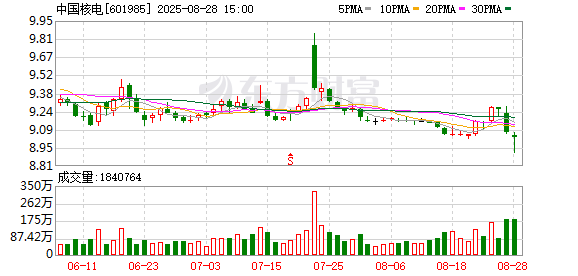
Group 1: Market Overview - The FTSE China A50 Index components showed a rebound in banking, insurance, and liquor sectors, while the power sector continued to adjust [1][4][5] - Major insurance companies like China Pacific Insurance, China Life Insurance, and Ping An Insurance reported market capitalizations of 378.55 billion, 342.10 billion, and 994.83 billion respectively, with trading volumes of 4.88 million, 24.23 million, and 3.99 million [4] - The liquor industry, led by Kweichow Moutai, Wuliangye, and Shanxi Fenjiu, had market capitalizations of 1807.87 billion, 225.39 billion, and 463.74 billion respectively, with trading volumes of 27.96 million, 15.85 million, and 20.97 million [4] Group 2: Sector Performance - The semiconductor sector, including companies like Northern Huachuang and Cambrian, had market capitalizations of 226.75 billion and 240.86 billion respectively, with trading volumes of 7.87 million and 14.31 million [4] - In the automotive sector, Great Wall Motors and BYD reported market capitalizations of 281.32 billion and 1874.12 billion respectively, with trading volumes of 13.90 million and 1.60 million [4] - The power sector, represented by companies like Yangtze Power and China Nuclear Power, had market capitalizations of 746.53 billion and 329.67 billion respectively, with trading volumes of 9.73 million and 16.36 million [5] Group 3: Notable Companies - China Shenhua Energy and Shaanxi Coal and Chemical Industry had market capitalizations of 193.12 billion and 1095.10 billion respectively, with trading volumes of 4.57 million and 18.81 million [4] - In the food and beverage sector, companies like Citic Securities and Haitai Flavor reported market capitalizations of 385.04 billion and 325.62 billion respectively, with trading volumes of 5.48 million and 3.31 million [5] - The electronics sector, including companies like Industrial Fulian and Luxshare Precision, had market capitalizations of 342.13 billion and 409.89 billion respectively, with trading volumes of 5.39 million and 23.98 million [5]
中证新能源指数下跌1.29%,前十大权重包含通威股份等
Jin Rong Jie· 2025-06-19 10:11
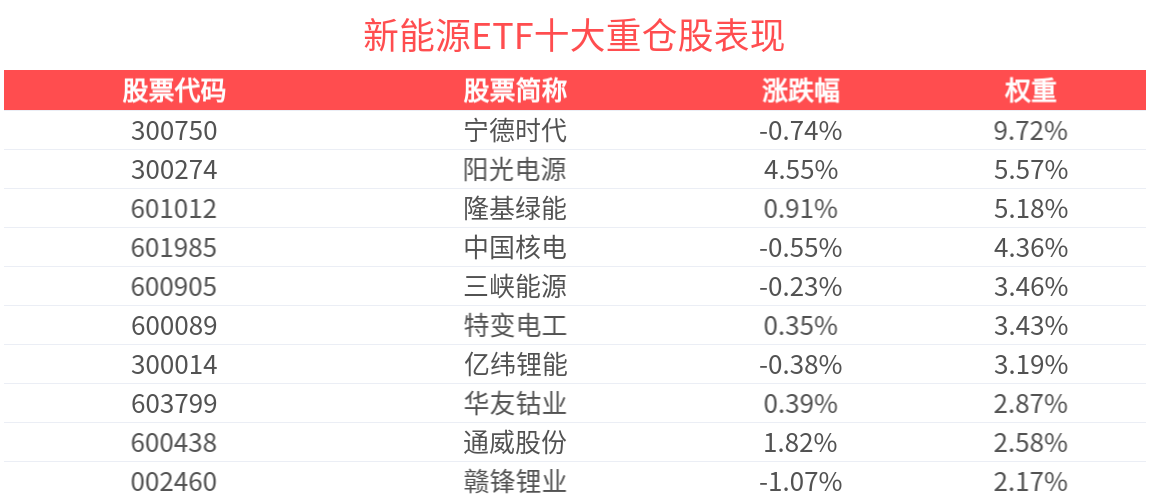
Core Viewpoint - The China Securities New Energy Index has experienced a decline in recent months, reflecting the overall performance of listed companies in the renewable energy sector [2]. Group 1: Index Performance - The China Securities New Energy Index fell by 1.29% to 1768.83 points, with a trading volume of 36.878 billion yuan [1]. - Over the past month, the index has decreased by 1.69%, by 10.68% over the last three months, and by 9.32% year-to-date [2]. Group 2: Index Composition - The index includes companies involved in renewable energy production, application, storage, and related equipment, with a base date of December 31, 2011, set at 1000.0 points [2]. - The top ten weighted companies in the index are: CATL (9.99%), Sungrow Power (5.53%), LONGi Green Energy (5.26%), China Nuclear Power (4.73%), Three Gorges Energy (3.69%), TBEA (3.52%), EVE Energy (3.15%), Huayou Cobalt (2.96%), Tongwei Co. (2.45%), and Ganfeng Lithium (2.13%) [2]. Group 3: Market and Sector Breakdown - The index's holdings are primarily listed on the Shenzhen Stock Exchange (58.70%), followed by the Shanghai Stock Exchange (40.87%) and the Beijing Stock Exchange (0.43%) [2]. - In terms of industry composition, the index is comprised of 73.71% in industrials, 14.26% in utilities, and 12.02% in materials [2]. Group 4: Index Adjustment Mechanism - The index samples are adjusted biannually, with adjustments occurring on the next trading day after the second Friday of June and December [3]. - Weight factors are generally fixed until the next scheduled adjustment, with special circumstances allowing for temporary adjustments [3].
美企对中国稀土宣战,一年逆袭?中哈连签10份协议,拿下关键订单
Sou Hu Cai Jing· 2025-06-19 08:21
Group 1: Rare Earth Industry - The U.S. is attempting to challenge China's dominance in the rare earth market, claiming it can break China's monopoly within a year, despite China's control over 70% of global rare earth mining and 85% of refining capacity [1] - U.S. companies lack the mature separation and purification technology that China has developed over 30 years, making the claim of a quick turnaround unrealistic [1] - The U.S. Department of Energy's funding for 15 rare earth projects has not resulted in any commercial production, highlighting the challenges faced by U.S. firms in achieving independence from Chinese technology [1] Group 2: Pharmaceutical Industry - Over 60% of daily-use medications and raw materials in the U.S. come from China, with 80% of basic drug raw materials like amoxicillin relying on Chinese supply [3] - The potential consequences of aggressive manufacturing repatriation policies could lead to a situation where U.S. pharmaceutical companies abandon the domestic market, resulting in a "no medicine available" scenario [3] Group 3: Nuclear Energy Sector - China has secured a significant nuclear power project in Kazakhstan, with the China National Nuclear Corporation becoming a strategic partner for Kazakhstan's nuclear energy development, valued at over $10 billion [3][5] - The comprehensive "full industry chain solution" provided by China, including financing and waste management, addresses Kazakhstan's needs more effectively than competitors [5] - The strategic partnership with Kazakhstan not only ensures uranium supply for China's new energy sector but also opens international markets for Chinese nuclear technology [5] Group 4: Broader Strategic Implications - The competition between the U.S. and China extends beyond trade deficits to a clash of development models, with China promoting a narrative of building a community with a shared future [7] - While the U.S. focuses on tariffs and political maneuvers, China is leveraging technology and capital to secure high-end manufacturing contracts and redefine globalization [5][7]
金十图示:2025年06月19日(周四)富时中国A50指数成分股今日收盘行情一览:石油板块午后翻红,银行股全天走势分化
news flash· 2025-06-19 07:07
Summary of Key Points Core Viewpoint - The FTSE China A50 Index component stocks showed mixed performance, with the oil sector rebounding in the afternoon while bank stocks exhibited divergent trends throughout the day [1]. Industry Summaries Insurance - China Pacific Insurance had a market capitalization of 370.597 billion, with a trading volume of 940 million, closing down by 1.75% [3]. - China Life Insurance had a market capitalization of 335.461 billion, with a trading volume of 2.144 billion, closing down by 1.13% [3]. - Ping An Insurance had a market capitalization of 968.784 billion, with a trading volume of 470 million, closing down by 1.18% [3]. Alcohol Industry - Kweichow Moutai had a market capitalization of 1,791.338 billion, with a trading volume of 3.490 billion, closing up by 0.07% [3]. - Shanxi Fenjiu had a market capitalization of 215.446 billion, with a trading volume of 1.927 billion, closing down by 0.48% [3]. - Wuliangye Yibin had a market capitalization of 455.235 billion, with a trading volume of 1.057 billion, closing down by 0.89% [3]. Semiconductor - Northern Huachuang had a market capitalization of 226.255 billion, with a trading volume of 2.520 billion, closing up by 1.82% [3]. - Cambricon Technologies had a market capitalization of 242.993 billion, with a trading volume of 1.975 billion, closing down by 0.31% [3]. - Hygon Information Technology had a market capitalization of 311.810 billion, with a trading volume of 1.436 billion, closing down by 0.39% [3]. Automotive - BYD had a market capitalization of 279.855 billion, with a trading volume of 3.438 billion, closing down by 0.71% [3]. - Great Wall Motors had a market capitalization of 1,870.934 billion, with a trading volume of 321 million, closing unchanged [3]. - Shanghai-Kunming High-Speed Railway had a market capitalization of 180.679 billion, with a trading volume of 444 million, closing down by 1.86% [3]. Oil and Gas - Sinopec had a market capitalization of 708.072 billion, with a trading volume of 1.217 billion, closing up by 1.39% [3]. - COSCO Shipping had a market capitalization of 1,692.944 billion, with a trading volume of 1.228 billion, closing up by 0.76% [3]. - China National Offshore Oil Corporation had a market capitalization of 249.695 billion, with a trading volume of 2.102 billion, closing down by 1.35% [3]. Coal Industry - Shaanxi Coal and Chemical Industry had a market capitalization of 191.767 billion, with a trading volume of 3.605 billion, closing up by 0.43% [3]. - China Shenhua Energy had a market capitalization of 782.621 billion, with a trading volume of 1.140 billion, closing down by 1.00% [3]. - Contemporary Amperex Technology Co., Limited (CATL) had a market capitalization of 1,103.809 billion, with a trading volume of 6.560 billion, closing down by 1.41% [3]. Food and Beverage - China National Nuclear Power had a market capitalization of 195.396 billion, with a trading volume of 1.717 billion, closing up by 0.03% [4]. - Yangtze Power had a market capitalization of 330.779 billion, with a trading volume of 8.370 billion, closing down by 0.94% [4]. - Dongfang Fortune had a market capitalization of 751.664 billion, with a trading volume of 55.410 billion, closing down by 2.65% [4]. Consumer Electronics - Heng Rui Medicine had a market capitalization of 413.263 billion, with a trading volume of 1.701 billion, closing down by 1.65% [4]. - Luxshare Precision had a market capitalization of 340.610 billion, with a trading volume of 3.497 billion, closing down by 0.67% [4]. - Industrial Fulian had a market capitalization of 237.184 billion, with a trading volume of 1.931 billion, closing down by 0.44% [4].
250万吨石油说不要就不要,中核集团却主动出击,这背后有何深意
Sou Hu Cai Jing· 2025-06-18 16:00
Group 1 - The core point of the article revolves around China's rejection of Russia's proposal to increase oil supply through Kazakhstan, which surprised many in the energy sector given the historically smooth energy cooperation between China and Russia [1][3][5] - The rejection is attributed to increased transportation costs of 15-20% and significant pipeline construction expenses due to the longer route from Russia to China via Kazakhstan [7][8] - China prioritizes energy security and prefers direct pipelines from the China-Russia border for better control and efficiency, reflecting a strategic approach to energy diplomacy [10][30] Group 2 - Following the rejection of the oil proposal, China Nuclear Group announced plans to build Kazakhstan's second nuclear power plant, leveraging Kazakhstan's vast uranium reserves [12][14] - Kazakhstan's energy landscape is shifting, as the country has relied heavily on coal for electricity, which is expected to face a significant power shortage by 2025 [14][16] - The nuclear project represents a more valuable opportunity for Kazakhstan compared to transit fees from oil, highlighting China's comprehensive capabilities in nuclear energy [33][34] Group 3 - The diplomatic engagement between China and Kazakhstan is characterized by high-level receptions and a desire for cooperation, contrasting with Mongolia's missed opportunities due to indecision [21][23] - Kazakhstan's strategy of balancing relations with both Russia and China demonstrates a pragmatic approach to foreign policy, as seen in its decision to allow both countries to participate in nuclear projects [26][28] - China's energy diplomacy is evolving towards a more nuanced and pragmatic approach, focusing on specific project economics, safety, and controllability rather than binary choices [30][34]