
BANK OF CHINA(601988)

Search documents
中国银行股份有限公司2025年第四次临时股东会决议公告
Zhong Guo Zheng Quan Bao - Zhong Zheng Wang· 2025-11-28 00:28
Meeting Overview - The shareholders' meeting of Bank of China was held on November 27, 2025, at the bank's headquarters in Beijing [1] - The meeting was chaired by Chairman Ge Haijiao, utilizing a combination of on-site and online voting methods [1] Attendance - Out of 15 current directors, 13 attended the meeting, while two independent non-executive directors were absent due to other important commitments [2] - Senior management personnel also attended the meeting [3] Proposal Review - The proposal for the Bank of China's 2025 interim profit distribution plan was approved [3] - The ordinary resolution was passed with more than half of the voting rights held by attending shareholders [3] - The bank will distribute a cash dividend of RMB 0.1094 per ordinary share (pre-tax) to A-share and H-share shareholders registered by the close of business on December 10, 2025, with the A-share payment date expected on December 11, 2025, and the H-share payment date on January 23, 2026 [3] Legal Verification - The meeting was witnessed by Beijing Jindu Law Firm, confirming that all procedures complied with legal and regulatory requirements [4] - The qualifications of attendees and the validity of the meeting's resolutions were affirmed by the legal representatives [4]
多家银行下架中长期存款产品
Zheng Quan Ri Bao· 2025-11-27 15:49
Core Viewpoint - Major state-owned banks and some joint-stock banks in China have recently suspended the sale of 5-year large-denomination time deposits, with current offerings primarily focused on 1-month to 3-year products [1] Group 1: Bank Actions - Six major state-owned banks, including ICBC, ABC, BOC, CCB, BOCOM, and PSBC, along with several joint-stock banks, have withdrawn long-term deposit products [1] - Many small and medium-sized banks have also announced the suspension of 3-year and 5-year fixed deposit products while simultaneously lowering interest rates across various deposit terms [1] - The remaining large-denomination time deposits are mostly concentrated in 1-month, 3-month, and 3-year terms, with 3-year products becoming the primary long-term offering [1] Group 2: Interest Rate Trends - The interest rates for 3-year large-denomination time deposits generally range from 1.5% to 1.75%, with reports of "tight quotas" and "sold out" situations being common [1] - The average net interest margin for commercial banks has dropped to a historical low of 1.42% in Q3, reflecting the pressure on bank profitability [2] Group 3: Strategic Adjustments - The adjustments in long-term deposit products are a response to the narrowing net interest margin, aimed at alleviating profitability pressures [2][3] - The shift indicates a transition from a focus on scale expansion to a more refined approach that emphasizes the quality of liabilities [3] Group 4: Future Outlook - There is potential for further reductions in deposit rates as banks continue to adjust high-cost deposit products [4] - Investors are advised to monitor market dynamics closely, including LPR adjustments and regulatory changes, while diversifying their asset allocation based on risk preferences [4]





工行、农行、中行、建行、交行、邮储,集体停售!
Mei Ri Jing Ji Xin Wen· 2025-11-27 13:40
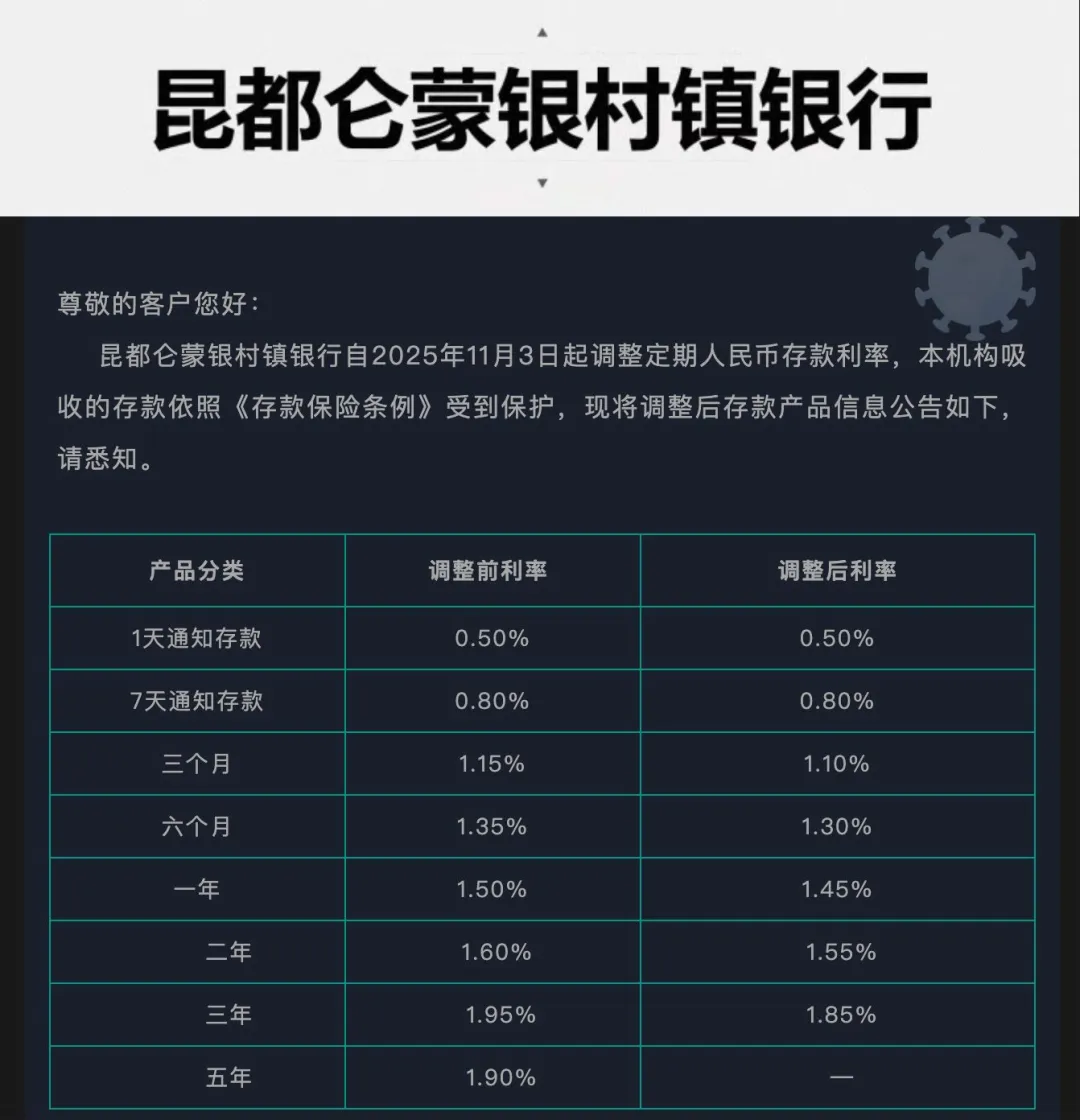
Core Viewpoint - The major state-owned banks in China have collectively removed five-year large-denomination time deposits, indicating a trend of declining long-term deposit products in the banking industry [1][2][4] Group 1: Changes in Deposit Products - The six major state-owned banks have eliminated five-year large-denomination time deposits, with only three-year products remaining, which have seen interest rates drop to between 1.5% and 1.75% [1] - The first bank to announce the cancellation of five-year time deposits was Tongyu County Mengyin Village Bank, which will stop offering this product starting November 5, 2025 [1] - Other banks, including at least seven private banks, have also begun to remove five-year time deposits, reflecting a broader trend in the industry [3][4] Group 2: Interest Rate Adjustments - The interest rates for various deposit products have been adjusted downwards, with one-year and two-year rates reduced by 5 basis points to 1.45% and 1.55%, respectively, and the three-year rate decreased by 10 basis points to 1.85% [3] - The adjustments are a response to the pressure on net interest margins faced by banks, as the yield on assets (like loan rates) is declining while the cost of liabilities (like deposit rates) remains rigid [2][4] Group 3: Industry Context and Implications - The banking industry is experiencing a "two-sided squeeze" where declining loan rates and high competition for deposits are pressuring net interest margins, leading to the reduction of long-term high-interest deposit products [4] - A survey indicated that 62.3% of urban depositors prefer to save more, a slight decrease from the previous quarter, suggesting a shift in savings behavior due to lower interest rates [4] - Analysts predict that while long-term deposits will not completely disappear, they will exhibit differentiated supply characteristics, with state-owned banks likely retaining five-year deposits as service tools but at potentially lower rates [5]

两家国有大行2025年中期利润分配方案获股东会通过
Bei Jing Shang Bao· 2025-11-27 13:15
Group 1 - China Construction Bank announced the resolution of its second extraordinary general meeting for 2025, approving the mid-year profit distribution plan [1] - The bank reported a net profit attributable to shareholders of RMB 162.076 billion for the first half of 2025, with a cash dividend of RMB 48.605 billion to be distributed to ordinary shareholders [1] - The dividend payout ratio is set at 30.0%, with a cash dividend of RMB 1.858 per share (including tax) [1] Group 2 - Bank of China held its fourth extraordinary general meeting for 2025, approving the mid-year profit distribution plan [2] - The bank will distribute a cash dividend of RMB 0.1094 per share (pre-tax) to A-share and H-share shareholders registered by December 10, 2025 [2] - The expected payment dates for the dividends are December 11, 2025, for A-shares and January 23, 2026, for H-shares [2]
广东中行“文化产业金融服务包”?全方位护航文化企业行稳致远
2 1 Shi Ji Jing Ji Bao Dao· 2025-11-27 12:37
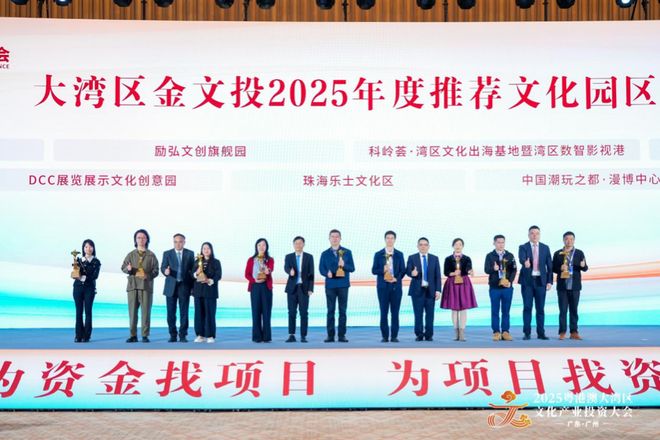
Core Viewpoint - The 2025 Guangdong-Hong Kong-Macao Greater Bay Area Cultural Industry Investment Conference aims to promote high-quality development in the cultural industry, creating a one-stop service platform for funding and project matching, attracting over 330 cultural enterprises and more than 200 investors [1][2]. Group 1: Cultural Industry Development - The cultural industry in China is currently in a golden period of high-quality development, becoming a new driving force for economic growth [1]. - The "14th Five-Year Plan" emphasizes the need to stimulate cultural innovation and development, indicating greater opportunities for the cultural industry during this period [1]. Group 2: Financial Solutions by Guangdong Bank - Guangdong Bank has tailored financial solutions for cultural enterprises, including products like "Innovation Points Loan" and "Technology Tongbao," which cater to different stages and types of cultural businesses [2]. - The "Innovation Points Loan" utilizes a three-dimensional model to achieve precise credit matching, while "Technology Tongbao" offers credit loans up to 30 million yuan for companies with patents or technological qualifications [2]. Group 3: International Expansion and Cooperation - Guangdong Bank has introduced "Foreign Trade Loans" to support cultural enterprises in international markets, providing credit based on previous year's import and export volumes [3]. - A strategic cooperation agreement will be signed between the Guangdong Provincial Publicity Department and Guangdong Bank to support high-quality development in the cultural industry, focusing on digital integration and international cultural dissemination [3]. Group 4: Future Outlook - The integration of technology and the cultural industry is expected to contribute significantly to cultural prosperity, economic growth, and enhancing international influence [3]. - Guangdong Bank aims to provide more precise and efficient financial services to support the digital transformation and sustainable development of cultural enterprises [3].
广东中行“文化产业金融服务包” 全方位护航文化企业行稳致远
2 1 Shi Ji Jing Ji Bao Dao· 2025-11-27 12:28
Core Viewpoint - The 2025 Guangdong-Hong Kong-Macao Greater Bay Area Cultural Industry Investment Conference aims to create a one-stop service platform for cultural project financing, attracting over 330 cultural enterprises and more than 200 investors [1][3] Group 1: Cultural Industry Development - The cultural industry in China is currently in a golden period of high-quality development, becoming a new driving force for economic growth [3][4] - The "14th Five-Year Plan" emphasizes the need to stimulate cultural innovation and promote the development of socialist culture [3] Group 2: Financial Solutions by Guangdong Bank - Guangdong Bank provides comprehensive financial services tailored for cultural enterprises, integrating investment, loans, and services [3][5] - Specific financial products include "Innovation Points Loan" for precise credit matching, "Technology Tongbao" for credit loans based on patents, and AIC equity investment services to support sustainable development [5][6] Group 3: International Expansion and Cooperation - Guangdong Bank has introduced "Foreign Trade Loans" to assist cultural enterprises in international markets, providing credit based on previous export volumes [6] - A strategic cooperation agreement will be signed between the Guangdong Provincial Publicity Department and Guangdong Bank to support high-quality cultural industry development and digital integration [6] Group 4: Future Outlook - The integration of technology and culture is expected to contribute significantly to cultural prosperity, economic growth, and enhancing international influence [6] - Guangdong Bank will focus on providing precise and efficient financial services to support the digital transformation of the cultural industry [6]
超2600亿“红包”落地!13家银行中期分红,六大行贡献七成
Xin Jing Bao· 2025-11-27 12:05
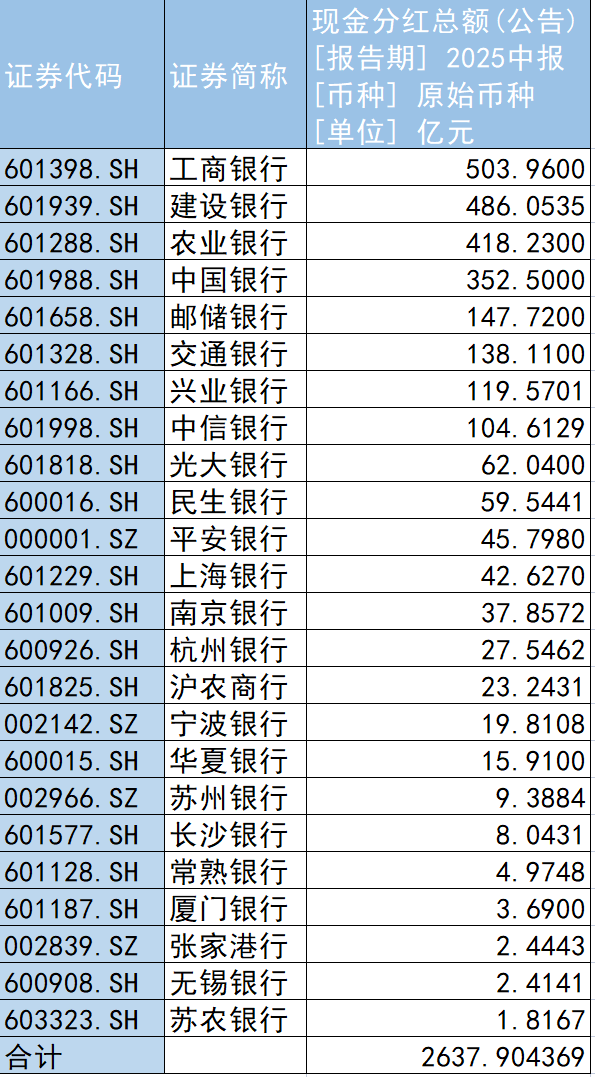
Core Viewpoint - The mid-term dividends of listed banks have exceeded 260 billion yuan, reflecting a trend towards enhancing shareholder returns and stabilizing market confidence [1][2][5]. Group 1: Dividend Distribution - As of November 26, 2025, 42 A-share listed banks have distributed a total of 263.79 billion yuan in mid-term dividends, with 13 banks having completed their distributions [1][2]. - The six major state-owned banks contributed over 70% of the total mid-term dividends, amounting to 204.66 billion yuan, with Industrial and Commercial Bank of China leading at 50.40 billion yuan [2][3]. - Several banks, including Shanghai Bank and Nanjing Bank, have also participated in mid-term dividends, with total distributions from city commercial banks reaching 3.10 billion yuan [2][4]. Group 2: Market Impact and Investor Confidence - The implementation of mid-term dividends is seen as a signal of stable operations, enhancing market confidence and attracting long-term capital [1][5][9]. - First-time dividend issuers have experienced positive short-term stock performance, indicating that dividends can boost shareholder confidence and improve capital efficiency [5][9]. - The trend of mid-term dividends is aligned with regulatory encouragement for banks to optimize dividend policies and improve shareholder returns [1][6]. Group 3: Future Outlook and Strategic Considerations - The decision to implement mid-term dividends reflects banks' strong financial performance and stable profit models, which provide a solid foundation for such distributions [6][9]. - Analysts suggest that banks should balance short-term dividend payouts with long-term growth strategies, ensuring that capital is adequately retained for future development [9]. - The ongoing trend of mid-term dividends is viewed as a sign of the maturation of China's capital markets and a shift towards greater emphasis on investor returns [9].

中国银行(601988) - 中国银行股份有限公司2025年第四次临时股东会决议公告
2025-11-27 11:45
1 证券代码:601988 证券简称:中国银行 公告编号:临 2025-084 中国银行股份有限公司 2025年第四次临时股东会决议公告 中国银行股份有限公司(简称"中国银行"或"本行")董事会及全体董事 保证本公告内容不存在任何虚假记载、误导性陈述或者重大遗漏,并对其内容的 真实性、准确性和完整性承担法律责任。 重要内容提示: 本次会议是否有否决议案:无 一、 会议召开和出席情况 | 1.出席会议的股东和代理人人数(包括现场出席及通过 网络投票出席) | 3,825 | | --- | --- | | 其中:A 股股东人数 | 3,824 | | H 股股东人数 | 1 | | 2.出席会议的股东所持有表决权的股份总数(股) | 267,894,756,055 | | 其中:A 股股东持有股份总数 | 225,356,959,864 | | H 股股东持有股份总数 | 42,537,796,191 | | 3.出席会议的股东所持有表决权股份数占本行有表决权 股份总数的比例(%) | 83.142283 | | 其中:A 股股东持股占股份总数的比例(%) | 69.940496 | | H 股股东持股占股份总 ...
中国银行(03988) - 建议派发截至2025年6月30日止六个月之中期股息(更新)
2025-11-27 11:42
EF002 免責聲明 | 香港交易及結算所有限公司及香港聯合交易所有限公司對本公告的內容概不負責,對其準確性或完整性亦不發表任何聲明,並明確表示,概不對因 | 公告全部或任何部份內容而產生或因倚賴該等內容而引致的任何損失承擔任何責任。 | | --- | --- | | | 股票發行人現金股息(可選擇貨幣)公告 | | 發行人名稱 | 中國銀行股份有限公司 | | 股份代號 | 03988 | | 多櫃檯股份代號及貨幣 | 不適用 | | 相關股份代號及名稱 | 不適用 | | 公告標題 | 建議派發截至2025年6月30日止六个月之中期股息(更新) | | 公告日期 | 2025年11月27日 | | 公告狀態 | 更新公告 | | 更新/撤回理由 | 更新中期利润分配方案细节 | | 股息信息 | | | 股息類型 | 中期(半年期) | | 股息性質 | 普通股息 | | 財政年末 | 2025年12月31日 | | 宣派股息的報告期末 | 2025年6月30日 | | 宣派股息 | 每 10 股 1.094 RMB | | 股東批准日期 | 2025年11月27日 | | 香港過戶登記處相關信息 | ...
中国银行(601988) - 北京市金杜律师事务所关于中国银行股份有限公司2025年第四次临时股东会之法律意见书
2025-11-27 11:30
t com # s fi NG&WCOD 北京市朝阳区东三环中路1号 环球金融中心办公楼东楼18层 邮编:100020 18th Floor, East Tower, World Financial Center 1 Dongsanhuan Zhonglu Chaoyang District Beiing, 100020 P.R. China T +86 10 5878 5588 -86 10 5878 5566 www.kwm.com 北京市金杜律师事务所 关于中国银行股份有限公司 2025年第四次临时股东会 ou | Haikou | Hangzhou | Hong Kong SAR | Jinan | Naniino | Qingdao | Shanghai | Shanghai | in-Gang | Shenzher Asia Pacific I Europe I Middle East I South America I Africa 1. 公司 2024年年度股东大会审议通过的《公司章程》; 2. 公司于 2025年8月29日披露于上海证券交易所网站的《中国银行股份 有限公司董事会决议公告》; ...