BANK OF CHINA(601988)

Search documents
工行、农行、中行、建行、交行、民生银行、多家外资银行紧急行动!
Jin Rong Shi Bao· 2025-11-28 11:21
Core Viewpoint - Multiple financial institutions in Hong Kong have mobilized to support disaster relief and recovery efforts following a fire incident at the Hong Fu Court in Tai Po, demonstrating a strong commitment to corporate social responsibility and community support [1] Group 1: Actions by Major Banks - Industrial and Commercial Bank of China (ICBC) has organized a volunteer team and provided emergency financial services, including loan extensions and fee waivers for affected customers [2] - Agricultural Bank of China plans to donate HKD 10 million and is coordinating with local organizations for targeted donations and support for insurance claims [3] - Bank of China is donating HKD 20 million and has set up a dedicated donation account, while also offering expedited banking services for affected clients [4] - China Construction Bank is donating HKD 10 million and has established a green channel for cross-border donations, along with various financial support measures for affected customers [5] - Bank of Communications has set up emergency service stations and extended branch hours to assist affected clients [6][7] - Minsheng Bank has donated HKD 5 million to the relief fund and expressed condolences to the victims [8] Group 2: Contributions from Foreign Banks - HSBC and Hang Seng Bank have jointly donated HKD 30 million to support the affected residents and families [8] - Standard Chartered Bank is contributing HKD 10 million and is providing flexible loan repayment options for affected customers [9] - HSBC's chairman emphasized the importance of collaborating with community partners to address urgent needs [9]




银行行业资金流出榜:中国银行、邮储银行等净流出资金居前
Zheng Quan Shi Bao Wang· 2025-11-28 10:08
Market Overview - The Shanghai Composite Index rose by 0.34% on November 28, with 29 out of the 31 sectors experiencing gains, led by the steel and agriculture sectors, both up by 1.59% [1] - The banking sector was the biggest loser, declining by 0.83%, followed by coal, which fell by 0.14% [1] Capital Flow - The net inflow of capital in the two markets was 10.84 billion yuan, with 19 sectors seeing net inflows [1] - The electronics sector had the highest net inflow, amounting to 3.423 billion yuan, with a daily increase of 1.30% [1] - The non-ferrous metals sector also performed well, with a daily increase of 1.44% and a net inflow of 3.051 billion yuan [1] Banking Sector Analysis - The banking sector saw a net outflow of 1.287 billion yuan, with 42 stocks in the sector, of which only 4 rose while 36 fell [2] - Among the banks, China Merchants Bank had the highest net inflow of 206 million yuan, followed by Jiangyin Bank and Hangzhou Bank with net inflows of 20.155 million yuan and 15.338 million yuan, respectively [2] - Major banks with significant net outflows included Bank of China (net outflow of 264 million yuan), Postal Savings Bank (222 million yuan), and Agricultural Bank (160 million yuan) [2] Individual Bank Performance - The following banks experienced notable declines in stock price and net capital outflow: - Bank of China: -1.62% with a net outflow of 263.56 million yuan [3] - Postal Savings Bank: -1.90% with a net outflow of 222.33 million yuan [3] - Agricultural Bank: -0.74% with a net outflow of 160.14 million yuan [3] - Other banks with significant declines included China Construction Bank (-0.51%), Bank of Communications (-1.56%), and Industrial and Commercial Bank (-0.61%) [3]


国有大型银行板块11月28日跌0.96%,邮储银行领跌,主力资金净流出8.49亿元
Zheng Xing Xing Ye Ri Bao· 2025-11-28 09:05
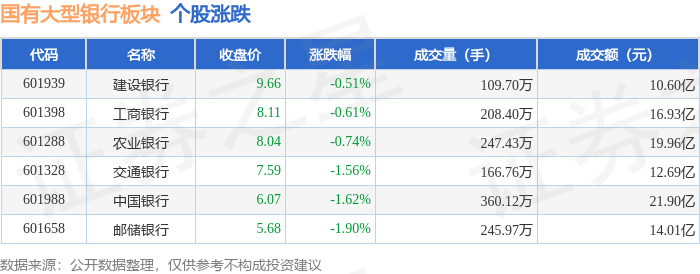
Core Insights - The state-owned large bank sector experienced a decline of 0.96% on November 28, with Postal Savings Bank leading the drop [1] - The Shanghai Composite Index closed at 3888.6, up 0.34%, while the Shenzhen Component Index closed at 12984.08, up 0.85% [1] Bank Performance Summary - Construction Bank: Closed at 9.66, down 0.51%, with a trading volume of 1.097 million shares [1] - Industrial and Commercial Bank: Closed at 8.11, down 0.61%, with a trading volume of 2.084 million shares [1] - Agricultural Bank: Closed at 8.04, down 0.74%, with a trading volume of 2.474 million shares [1] - Transportation Bank: Closed at 7.59, down 1.56%, with a trading volume of 1.668 million shares [1] - Bank of China: Closed at 6.07, down 1.62%, with a trading volume of 3.601 million shares [1] - Postal Savings Bank: Closed at 5.68, down 1.90%, with a trading volume of 2.460 million shares [1] Capital Flow Analysis - The state-owned large bank sector saw a net outflow of 849 million yuan from institutional investors, while retail investors contributed a net inflow of 153 million yuan [1] - The detailed capital flow for individual banks shows significant net outflows for major banks, with the Industrial and Commercial Bank experiencing a net outflow of 69.01 million yuan from institutional investors [2] - Postal Savings Bank had a net outflow of 165 million yuan from institutional investors, while retail investors contributed a net inflow of 41.32 million yuan [2]



2025年全球系统重要性银行公布 我国5家银行入选
Zhong Guo Jing Ying Bao· 2025-11-28 09:00
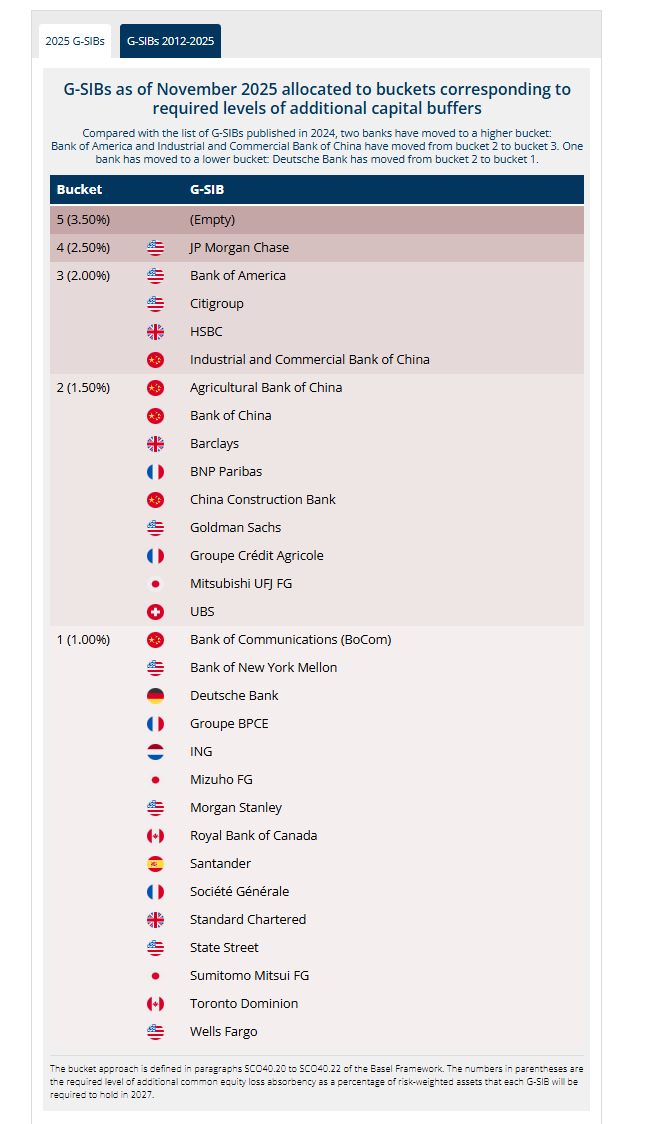
Core Points - The Financial Stability Board (FSB) released the latest list of Global Systemically Important Banks (G-SIBs) for 2025, which includes 29 banks, consistent with the 2024 list, but with adjustments in classification groups [1] - China has five banks listed as G-SIBs: Industrial and Commercial Bank of China, Agricultural Bank of China, Bank of China, China Construction Bank, and Bank of Communications [1] - The classification groups for these banks are as follows: Bank of Communications is in Group 1 (additional capital requirement of 1%), Agricultural Bank of China, Bank of China, and China Construction Bank are in Group 2 (additional capital requirement of 1.5%), and Industrial and Commercial Bank of China is in Group 3 (additional capital requirement of 2.0%) [1]
理财自律监管组织+1,中国银行保险资产管理业协会来了!
2 1 Shi Ji Jing Ji Bao Dao· 2025-11-28 08:12
两个字的变化,如何搅动规模32万亿人民币的大市场?近日,中国保险资产管理业协会正式更名为"中 国银行保险资产管理业协会",新增"银行"二字,意味着哪些变化?来看本期飞钱说。 (文章来源:21世纪经济报道) ...
A股超4100股上涨,福建股多股涨停,锂矿股反弹
2 1 Shi Ji Jing Ji Bao Dao· 2025-11-28 07:49
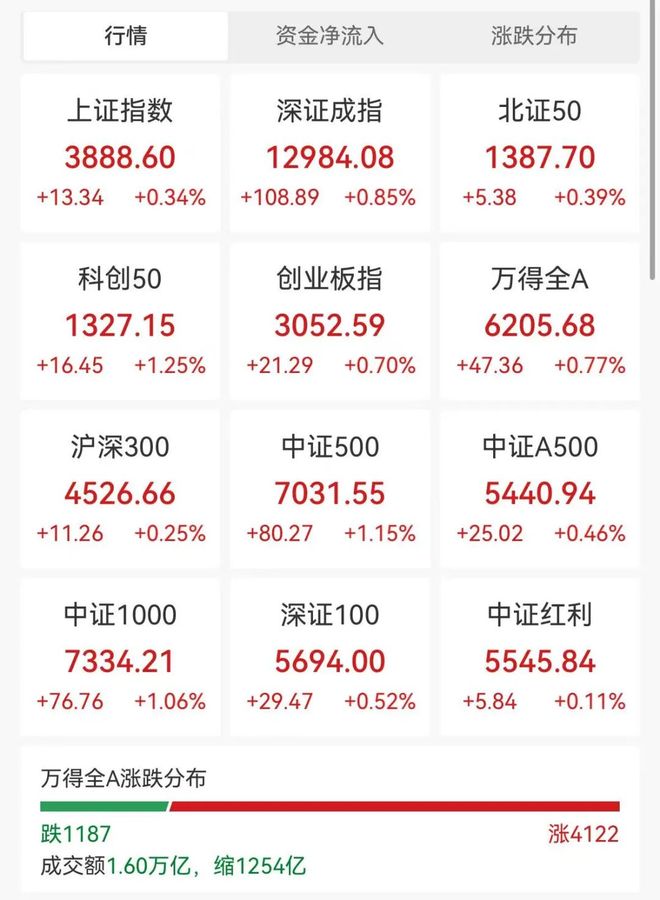
Market Overview - The A-share market ended November with a cumulative decline of 1.67%, marking the end of a six-month upward trend after reaching a ten-year high mid-month [1] - On November 28, all major A-share indices closed in the green, with the Shanghai Composite Index at 3888.60, up by 13.34 points or 0.34% [2] Sector Performance - The Fujian sector showed significant activity, with stocks like Haixia Innovation rising over 16%, and several others such as Pingtan Development and Fujian Cement hitting the daily limit [3] - The lithium mining stocks experienced a rebound, with Dazhong Mining hitting the limit, and Shengxin Lithium Energy and Yahua Group rising over 7% and 6% respectively [5] - The commercial aerospace concept stocks saw volatility, with Aerospace Hanyu recording a 20% limit up, and other related stocks also performing well [5] Banking Sector - The banking sector faced collective adjustments, with Postal Savings Bank down nearly 2%, and major banks like Bank of China and China CITIC Bank declining over 1% [8] - Despite the downturn, several listed banks have seen major shareholders or senior management implement or plan share buybacks, particularly among resilient city commercial banks and rural commercial banks [8] Pharmaceutical Sector - The pharmaceutical sector experienced a pullback, with stocks like Guangji Pharmaceutical and Zhongsheng Pharmaceutical hitting the daily limit down, and Yue Wannianqing dropping over 10% [9] AI Sector - The AI application sector showed weakness, with companies like Yaowang Technology and Yidian Tianxia declining over 4% [9] - According to Guojin Securities, the rapid growth in global AI computing power demand is driving significant investments in high-efficiency and high-reliability power equipment, indicating ongoing industry vitality [9]


A股超4100股上涨,福建股多股涨停,锂矿股反弹
21世纪经济报道· 2025-11-28 07:41
Market Overview - The A-share market ended November with a cumulative decline of 1.67%, marking the end of a six-month upward trend after reaching a ten-year high mid-month [1] - On November 28, all major A-share indices closed in the green, with the Shanghai Composite Index at 3888.60, up 0.34% [2] Sector Performance - The Fujian sector showed significant activity, with stocks like Haixia Innovation rising over 16% and several others hitting the daily limit [3] - The Hainan sector also rebounded, with Hainan Ruize achieving three consecutive daily limits and Shennong Agriculture and Hainan Rubber both rising over 8% [5] - Lithium mining stocks experienced a strong rebound, with major players like Dazhong Mining and Shengxin Lithium Energy seeing gains of over 7% and 6%, respectively [6][7] Stock Specifics - The Two Straits Integration Index increased by 5.41%, with notable performers including Haixia Innovation (16.05), Pingtan Development (10.73), and Fujian Cement (7.49) [4] - In the lithium sector, Dazhong Mining (31.47), Shengxin Lithium Energy (35.26), and Yahua Group (22.59) were highlighted for their performance [7] Declines and Adjustments - Banking stocks collectively adjusted, with Postal Savings Bank down nearly 2% and others like Bank of China and CITIC Bank falling over 1% [9] - The pharmaceutical sector faced a pullback, with stocks like Guangji Pharmaceutical and Zhongsheng Pharmaceutical hitting the daily limit down, and Yue Wannianqing dropping over 10% [9] - AI application stocks also struggled, with companies like Yaowang Technology and Yidian Tianxia declining over 4% [9]



当还不起房贷的人变多,银行如何“甩包袱”?
Jing Ji Guan Cha Wang· 2025-11-28 06:49
Core Viewpoint - The issuance of non-performing asset-backed securities (ABS) is becoming a normalized practice among banks, serving as a crucial tool for managing non-performing assets and mitigating systemic risks in the current economic environment [3][4][5]. Group 1: Non-Performing Asset Management - Non-performing asset securitization is increasingly recognized as an important institutional tool for commercial banks to revitalize existing assets and prevent systemic risks [3][4]. - Several banks, including Bohai Bank, China Construction Bank, and China Merchants Bank, have recently issued ABS backed by non-performing personal housing loans, indicating a trend towards structured financial products [3][4][5]. - The structure of these ABS typically includes a priority/subordinate tier, fixed interest rates, and relies on the realization of collateral to support cash flows, despite the underlying assets being classified as "non-performing" [3][5][6]. Group 2: Asset Quality and Recovery - The weighted average overdue period for the underlying assets in the recent Bohai Bank ABS issuance is 15.95 months, with a loss loan ratio of 56.60%, indicating a higher risk exposure compared to similar projects from other banks [6][10]. - The expected recovery rate for the underlying assets is 40.26%, with a total market value of collateral estimated at 1.184 billion yuan, but the realizable value is projected to be only 459 million yuan due to various factors [5][10]. - The current economic backdrop, including high household leverage and a slow increase in mortgage delinquency rates, is pressuring banks to actively manage their non-performing assets [4][10]. Group 3: Systemic Risk and Future Outlook - The current issuance of non-performing housing loan ABS is accompanied by common risks, including potential higher-than-expected issuance rates and limitations in due diligence that may leave some asset flaws unidentified [11][12]. - While securitization helps banks offload risks, it does not eliminate them, as risks may transfer to non-bank investors who may lack the expertise to manage these assets effectively [11][12]. - Historical data suggests that existing provisions could release at least 800 billion yuan in net profit for listed banks over the next few years, supporting the stability of overall net profits despite potential challenges [2][12].

从“金融地标”到“文化坐标” 中国银行(天津)博物馆的文化叙事
Jin Rong Shi Bao· 2025-11-28 04:33
Core Viewpoint - The establishment of the Bank of China (Tianjin) Museum serves as a significant cultural initiative to preserve and promote the history of modern Chinese finance, reflecting the evolution of financial services in support of national development and cultural heritage [2][14]. Group 1: Historical Context and Significance - The Bank of China (Tianjin) is the oldest financial institution in Tianjin, witnessing the rise of the Chinese nation from hardship to rejuvenation, thus embodying a unique red gene and financial culture [2][3]. - The museum's construction is a conscious effort to recover financial heritage from historical fragments, with a focus on the archives of the Bank of China Tianjin branch, which includes 437 boxes of valuable documents [2][3]. Group 2: Museum Features and Exhibits - The museum features over 630 exhibits, with more than half being physical artifacts, showcasing the transformation of dormant financial memories into tangible cultural assets [3][4]. - The narrative structure of the museum is centered around the theme "Financial Services for the Great Rejuvenation of the Chinese Nation," highlighting the continuous role of finance in national development across different historical periods [4][5]. Group 3: Thematic Exhibition Areas - The museum consists of seven thematic exhibition areas, each detailing different aspects of the Bank of China's contributions, from its foundational role in the early 20th century to its support for national economic recovery and development [5][6]. - Each exhibition area, such as "Centennial Style" and "Centennial Witness," illustrates the bank's historical significance in supporting industrial growth and national resistance against foreign aggression [5][9]. Group 4: Cultural and Educational Outreach - Since its opening, the museum has welcomed over 170,000 visitors and hosted more than 1,000 events, emphasizing its role as a dynamic platform for cultural dissemination [12]. - The museum integrates financial culture into various educational activities, collaborating with universities and utilizing multimedia formats to enhance public engagement with financial history [12][13]. Group 5: Cross-Disciplinary Collaboration - The museum positions itself as a "financial culture salon," actively engaging with government, regulatory bodies, and local enterprises to host diverse cultural events, thereby fostering community connections [13][14]. - The development of cultural products, such as souvenirs inspired by the museum's themes, aims to achieve both cultural and social value, reinforcing the museum's commitment to community welfare [13][14].
全球系统重要性银行名单(G-SIBS)发布
Shang Hai Zheng Quan Bao· 2025-11-28 03:26
Core Points - The Financial Stability Board (FSB) released the 2025 Global Systemically Important Banks (G-SIBs) list, with the Industrial and Commercial Bank of China (ICBC) moving from bucket 2 to bucket 3, becoming the first Chinese bank in this category [1][3] - The total number of G-SIBs remains at 29, unchanged from the 2024 list, but there have been adjustments in the bucket allocations of some banks [3] - The adjustments in bank classifications are primarily influenced by changes in their business activities, with the "complexity" metric having the most significant impact on scoring changes [3] Bucket Allocations - Bucket 5 (3.50%): Empty - Bucket 4 (2.50%): JP Morgan Chase - Bucket 3 (2.00%): Bank of America, Industrial and Commercial Bank of China, Citigroup, HSBC [2] - Bucket 2 (1.50%): Agricultural Bank of China, Bank of China, China Construction Bank, among others [2] - Bucket 1 (1.0096%): Bank of Communications, Deutsche Bank, and others [2] Future Implications - Higher capital buffer requirements for banks that move up in classification will take effect starting January 1, 2027 [3] - Fitch Ratings had predicted the rise of ICBC to bucket 3, while other Chinese banks are expected to remain on the G-SIBs list [3]