CICC(601995)

Search documents
中金公司(601995) - 中金公司H股公告(股份发行人的证券变动月报表)
2026-01-05 09:15
股份發行人及根據《上市規則》第十九B章上市的香港預託證券發行人的證券變動月報表 截至月份: 2025年12月31日 狀態: 新提交 本月底法定/註冊股本總額: RMB 4,827,256,868 備註: 致:香港交易及結算所有限公司 公司名稱: 中國國際金融股份有限公司 呈交日期: 2026年1月5日 I. 法定/註冊股本變動 | 1. 股份分類 | 普通股 | 股份類別 | H | | 於香港聯交所上市 (註1) | | 是 | | | --- | --- | --- | --- | --- | --- | --- | --- | --- | | 證券代號 (如上市) | 03908 | 說明 | | | | | | | | | | 法定/註冊股份數目 | | | 面值 | | 法定/註冊股本 | | | 上月底結存 | | | 1,903,714,428 | RMB | | 1 RMB | | 1,903,714,428 | | 增加 / 減少 (-) | | | | | | RMB | | | | 本月底結存 | | | 1,903,714,428 | RMB | | 1 RMB | | 1,903,7 ...
中金公司(03908) - 截至二零二五年十二月三十一日股份发行人的证券变动月报表
2026-01-05 08:30
股份發行人及根據《上市規則》第十九B章上市的香港預託證券發行人的證券變動月報表 截至月份: 2025年12月31日 狀態: 新提交 致:香港交易及結算所有限公司 I. 法定/註冊股本變動 | 1. 股份分類 | 普通股 | 股份類別 | H | | 於香港聯交所上市 (註1) | | 是 | | | --- | --- | --- | --- | --- | --- | --- | --- | --- | | 證券代號 (如上市) | 03908 | 說明 | | | | | | | | | | 法定/註冊股份數目 | | | 面值 | | 法定/註冊股本 | | | 上月底結存 | | | 1,903,714,428 | RMB | | 1 RMB | | 1,903,714,428 | | 增加 / 減少 (-) | | | | | | RMB | | | | 本月底結存 | | | 1,903,714,428 | RMB | | 1 RMB | | 1,903,714,428 | | 2. 股份分類 | 普通股 | 股份類別 | A | | 於香港聯交所上市 (註1) | | 否 | | | --- | ...
【中金2026展望:泡沫加速!美国“财政主导”利好中美股市和金银铜】中金公司预计,2026年特朗普政府将转向财政货币双宽松,美联储常态化扩表释放流动性,缓解美国经济三大症结(信心扰动、小企业扩张迟滞、地产疲弱)。宽松环境利好科技、工业、资源板块,并推动美元趋势性贬值。弱美元周期下,人民币有...
Sou Hu Cai Jing· 2026-01-05 08:10
Core Viewpoint - CICC predicts that by 2026, the Trump administration will shift towards a dual approach of fiscal and monetary easing, which will benefit both US and Chinese stock markets as well as gold, silver, and copper [1] Group 1: Economic Environment - The Federal Reserve is expected to normalize its balance sheet expansion, releasing liquidity to alleviate three major issues in the US economy: confidence disturbances, stagnation in small business expansion, and weakness in the real estate sector [1] - A loose monetary environment is favorable for the technology, industrial, and resource sectors, while also promoting a trend of dollar depreciation [1] Group 2: Currency and Market Impact - During a weak dollar cycle, there is potential for the renminbi to appreciate, leading to a global rebalancing of funds that will boost A-shares and Hong Kong stocks [1] - New economy sectors are expected to continue leading the market, while the consumer demand sector is likely to experience a rebound [1] Group 3: Inflation-Linked Assets - Assets such as gold, silver, and copper are anticipated to benefit from inflationary trends [1]
REITs月度观察(20251201-202501231):二级市场价格延续下跌态势,新增多只产品申报及受理-20260105
EBSCN· 2026-01-05 07:25
1. Report Industry Investment Rating No relevant content provided. 2. Core Viewpoints of the Report - The secondary - market prices of publicly - offered REITs in China continued the downward trend in December 2025. The performance of REITs was weaker compared to other mainstream asset classes. The primary market had new product applications and acceptances, and the policy environment was optimized with the expansion of the REITs issuance scope and the introduction of relevant development promotion policies [1][2][40] 3. Summary by Directory 3.1 Primary Market 3.1.1 Listed Projects - As of December 31, 2025, there were 78 publicly - offered REITs in China, with a total issuance scale of 201.749 billion yuan (excluding expansion). The traffic infrastructure category had the largest issuance scale at 68.771 billion yuan, followed by the park infrastructure category at 32.933 billion yuan. In December 2025, one new REIT, Huaxia Anbo Warehouse REIT, was listed, with an issuance scale of 2.448 billion yuan and an asset type of warehousing and logistics [11]. 3.1.2 Pending - Listing Projects - As of December 31, 2025, there were 19 REITs pending listing, including 16 initial - offering REITs and 3 REITs pending expansion. During the month, the project status of several REITs was updated, such as "accepted", "feedback received", "declared", and "approved" [14]. 3.2 Secondary - Market Performance 3.2.1 Price Trends - **At the level of major asset classes**: In December 2025, the secondary - market prices of publicly - offered REITs continued the downward trend. The returns of China's publicly - offered REITs were - 2.51%, ranking behind A - shares, convertible bonds, gold, pure bonds, and US stocks, and ahead of crude oil [16]. - **At the underlying asset level**: Both equity - type and franchise - type REITs' prices declined, with franchise - type REITs having a larger decline. Among different underlying asset types, new infrastructure - type REITs had the largest increase, and new infrastructure and affordable housing - type REITs had better returns at 1.24% and 0.05% respectively [20][22]. - **At the single - REIT level**: In December 2025, 23 REITs rose and 55 fell. The top three in terms of increase were Huatai Nanjing Jianye REIT, CICC Chongqing Liangjiang REIT, and Huaxia Fund China Resources Youchao REIT [24]. 3.2.2 Trading Volume and Turnover Rate - **At the underlying asset level**: In December 2025, the trading volume of publicly - offered REITs decreased compared to the previous month. The water conservancy facilities - type REITs had the highest average daily turnover rate. The top three in terms of trading volume were traffic infrastructure, consumer infrastructure, and park infrastructure categories. The top three in terms of average daily turnover rate were water conservancy facilities, municipal facilities, and new infrastructure categories [26]. - **At the single - REIT level**: The trading volume and turnover rate of single REITs continued to show differentiation. The top three in terms of trading volume were CICC Puluosi REIT, Huaxia China Communications Construction REIT, and Huaxia Fund China Resources Youchao REIT. The top three in terms of trading amount were Huaxia China Resources Commercial REIT, Huaxia China Communications Construction REIT, and Zheshang HuHangYong REIT. The top three in terms of turnover rate were Huaxia Anbo Warehouse REIT, CITIC Construction Shenyang International Software Park REIT, and ICBC Inner Mongolia Energy Clean Energy REIT [27]. 3.2.3 Main - Force Net Inflow and Block Trading - **Main - force net inflow situation**: In December 2025, the total main - force net inflow was 119.71 million yuan, indicating an increase in market trading enthusiasm compared to the previous month. The top three underlying asset types in terms of main - force net inflow were traffic infrastructure, consumer infrastructure, and warehousing and logistics. The top three single REITs in terms of main - force net inflow were Huaxia China Resources Commercial REIT, Huaxia Anbo Warehouse REIT, and China Merchants Expressway REIT [30]. - **Block trading situation**: In December 2025, the total block - trading amount was 1.29 billion yuan, a decrease compared to the previous month. There were block trades on 19 trading days. December 29 had the highest single - day block - trading amount. The top three single REITs in terms of block - trading amount were Huaxia Shouchuang Outlet Mall REIT, China Merchants Expressway REIT, and Southern Runze Technology Data Center REIT [35]. 3.3 Related Policies - On December 1, the National Development and Reform Commission issued the "List of Industry Scope for Infrastructure Real Estate Investment Trust Fund (REITs) Projects (2025 Edition)", expanding the issuance scope of infrastructure REITs to 15 industries, mainly adding commercial office facilities and urban renewal facilities. On December 31, the China Securities Regulatory Commission issued the "Notice on Promoting the High - Quality Development of the Real Estate Investment Trust Fund (REITs) Market" and the "Announcement on Launching the Pilot Program of Commercial Real Estate Investment Trust Funds". The Shanghai and Shenzhen Stock Exchanges also revised and issued the business rules for publicly - offered REITs [40].
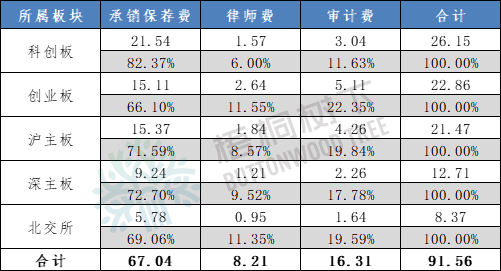
2025年A股IPO中介机构收费排行榜
Sou Hu Cai Jing· 2026-01-05 06:36
Core Insights - In 2025, a total of 116 companies were listed on the A-share market, representing a 16% increase from 100 companies in the same period last year [1] - The net fundraising amount for these 116 newly listed companies reached 122.025 billion yuan, a significant increase of 104.25% compared to 59.743 billion yuan in the previous year [1] - The total fees charged by IPO intermediaries for these companies amounted to 9.156 billion yuan, with underwriting and sponsorship fees accounting for 6.704 billion yuan, legal fees for 0.821 billion yuan, and audit fees for 1.631 billion yuan [1] Segment Analysis Underwriting and Sponsorship Fees - The total underwriting and sponsorship fees ranked by board are as follows: Sci-Tech Innovation Board (21.54 billion yuan), Shanghai Main Board (15.37 billion yuan), Growth Enterprise Market (15.11 billion yuan), Shenzhen Main Board (9.24 billion yuan), and Beijing Stock Exchange (5.78 billion yuan) [2][3] - The average underwriting fee is highest for the Sci-Tech Innovation Board at 11.337 million yuan, while the lowest is for the Beijing Stock Exchange at 2.222 million yuan [4] Legal Fees - The total legal fees ranked by firms are led by Shanghai Jintiancheng (1.14 billion yuan), followed by Beijing Zhonglun (1.05 billion yuan), and Zhejiang Tiance (0.57 billion yuan) [7][8] - The average legal fee is highest for the Sci-Tech Innovation Board at 832.01 thousand yuan, and lowest for the Beijing Stock Exchange at 364.62 thousand yuan [4] Audit Fees - The top three audit firms by total fees are Rongcheng (4.17 billion yuan), Tianjian (2.86 billion yuan), and Lixin (2.19 billion yuan) [10][11] - The average audit fee is highest for the Shanghai Main Board at 1.8518 million yuan, and lowest for the Beijing Stock Exchange at 632.39 thousand yuan [4]




中金公司12月31日获融资买入1.23亿元,融资余额30.35亿元
Xin Lang Cai Jing· 2026-01-05 06:29
Group 1: Company Overview - China International Capital Corporation (CICC) is headquartered in Beijing and was established on July 31, 1995, with its listing date on November 2, 2020 [2] - The company operates through six main divisions: Investment Banking, Equity Sales and Trading, Fixed Income, Wealth Management, Investment Management, and Other Services [2] - The revenue composition of CICC includes Wealth Management (32.58%), Equity Business (25.78%), Fixed Income (13.38%), Investment Banking (11.26%), Other (8.87%), Asset Management (4.21%), and Private Equity (3.91%) [2] Group 2: Financial Performance - As of September 30, 2025, CICC reported a total revenue of 20.76 billion yuan, representing a year-on-year growth of 54.36% [3] - The net profit attributable to shareholders for the same period was 6.57 billion yuan, showing a significant increase of 129.75% year-on-year [3] - CICC has distributed a total of 5.36 billion yuan in dividends since its A-share listing, with 3.04 billion yuan distributed over the past three years [3] Group 3: Shareholder and Market Activity - As of September 30, 2025, CICC had 118,900 shareholders, a decrease of 4.10% from the previous period, while the average circulating shares per person increased by 4.28% to 24,662 shares [3] - On December 31, CICC's stock price decreased by 0.54%, with a trading volume of 825 million yuan [1] - The financing buy-in amount on December 31 was 123 million yuan, while the financing repayment was 168 million yuan, resulting in a net financing buy of -45.08 million yuan [1]
2025年A股IPO中介机构收费排行榜
梧桐树下V· 2026-01-05 03:33
Core Insights - In 2025, a total of 116 companies were listed on the A-share market, representing a 16% increase from 100 companies in the same period last year [1] - The net fundraising amount for these 116 newly listed companies reached 1220.25 billion yuan, a significant increase of 104.25% compared to 597.43 billion yuan in the previous year [1] - The total fees charged by IPO intermediaries for these companies amounted to 91.56 billion yuan, with underwriting and sponsorship fees accounting for 67.04 billion yuan, legal fees for 8.21 billion yuan, and audit fees for 16.31 billion yuan [1] Segment Analysis Underwriting and Sponsorship Fees - The total underwriting and sponsorship fees by segment are ranked as follows: Sci-Tech Innovation Board, Shanghai Main Board, ChiNext, Shenzhen Main Board, and Beijing Stock Exchange [2] - The average underwriting fee is highest in the Sci-Tech Innovation Board at 11,337.61 thousand yuan, while the lowest is in the Beijing Stock Exchange at 2,222.30 thousand yuan [5][6] - The total underwriting fees are led by CITIC Securities with 12.44 billion yuan from 15 deals, followed by Guotai Junan and CITIC Jinshi with 9.96 billion yuan and 8.82 billion yuan, respectively [8][10] Legal Fees - The top three law firms by total fees are Shanghai Jintiancheng, Beijing Zhonglun, and Zhejiang Tiance, with total fees of 1.14 billion yuan, 1.05 billion yuan, and 0.57 billion yuan, respectively [11] - The average legal fee is highest in the Sci-Tech Innovation Board at 832.01 thousand yuan, while the lowest is in the Beijing Stock Exchange at 364.62 thousand yuan [5] Audit Fees - The leading audit firms by total fees are Rongcheng, Tianjian, and Lixin, with total fees of 4.17 billion yuan, 2.86 billion yuan, and 2.19 billion yuan, respectively [12][14] - The average audit fee is highest in the Shanghai Main Board at 1,851.80 thousand yuan, while the lowest is in the Beijing Stock Exchange at 632.39 thousand yuan [6] Overall Fee Structure - The total fees for intermediaries in the IPO process are distributed as follows: underwriting fees (67.04 billion yuan), legal fees (8.21 billion yuan), and audit fees (16.31 billion yuan) [1][4] - The average fees across segments indicate that the Sci-Tech Innovation Board commands the highest fees overall, while the Beijing Stock Exchange has the lowest average fees [5][6]


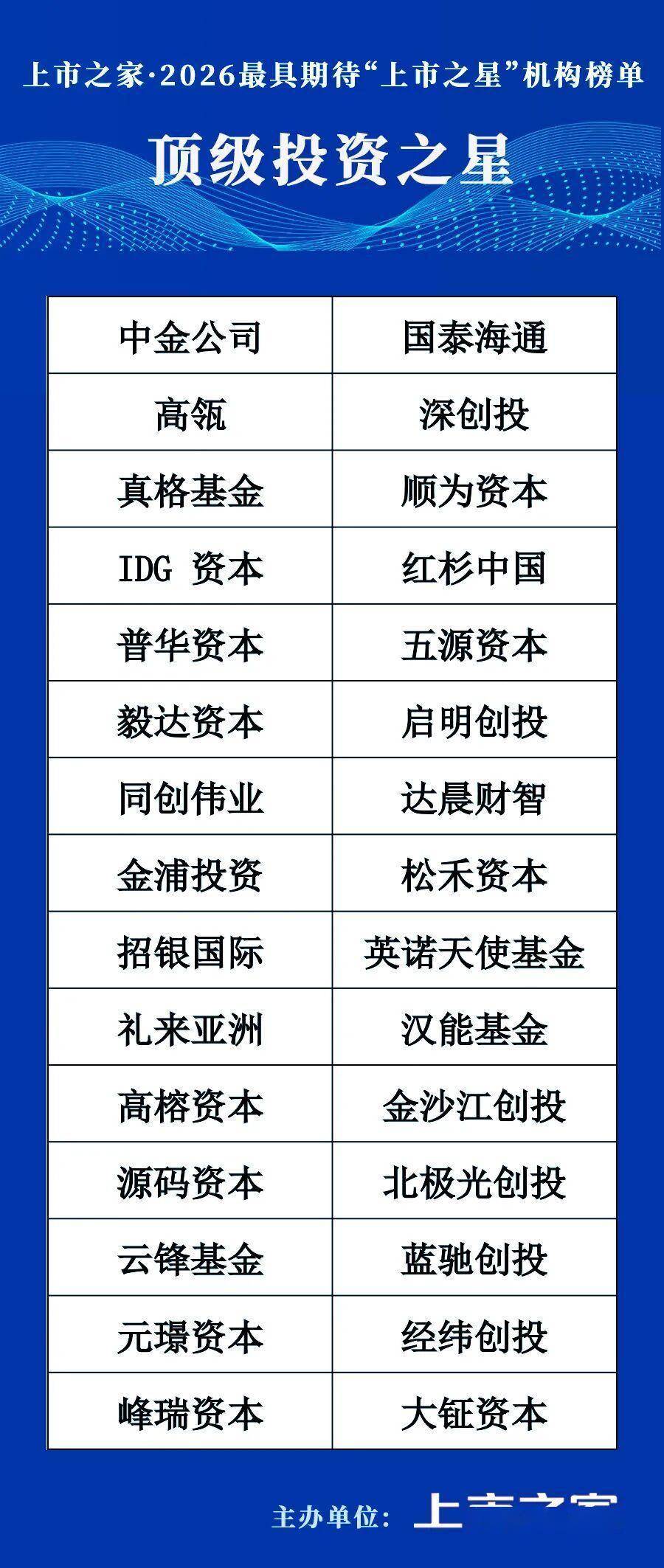
中金公司、高瓴、深创投等企业斩获上市之家2026最具期待“顶级投资之星”
Sou Hu Cai Jing· 2026-01-05 02:37
Core Insights - The "2026 Most Anticipated IPO Stars" list was announced on January 4, highlighting top investment firms in the industry [1] Group 1: Award Winners - A total of 30 investment firms received the "Top Investment Star" award, including notable names such as CICC, Guotai Junan, Hillhouse Capital, and Sequoia China [1][2] - Other recognized firms include IDG Capital, ZhenFund, and Shunwei Capital, showcasing a diverse range of investment strategies and focuses [1][3]
成都星拓微电子科技股份有限公司启动上市辅导
Jing Ji Guan Cha Wang· 2026-01-05 01:40
Group 1 - Chengdu Xingtou Microelectronics Technology Co., Ltd. has filed for guidance record registration with the Sichuan Securities Regulatory Bureau on January 5, 2026 [1] - The guiding institution for this registration is China International Capital Corporation [1]
中金公司李求索:2026年国际秩序重构与中国产业创新两大因素共振将支持A股表现
Zheng Quan Shi Bao Wang· 2026-01-05 01:37
Group 1 - The core viewpoint is that the restructuring of the international order and China's industrial innovation will resonate in 2026, supporting the performance of A-shares [1] - The market is expected to show a pattern of rising initially and then stabilizing, with increased volatility and valuation uplift in the context of active capital [1] - Three main lines of focus are suggested: 1) Growth sectors such as AI, which is expected to enter the application realization phase, with opportunities in computing power, optical modules, and cloud computing infrastructure, leaning towards domestic directions; application areas include robotics, consumer electronics, intelligent driving, and software applications [1] 2) External demand breakout, focusing on sectors like home appliances, construction machinery, commercial buses, power grid equipment, gaming, and globally priced resources like non-ferrous metals, in line with the trend of going abroad and exposure to the US [1] 3) Cyclical reversal, with attention to sectors nearing improvement inflection points or supported by policies, such as chemicals, aquaculture, and new energy [1] Group 2 - There is an expectation for capital market policies to further promote a "long-term" and "steady" market [2] - The restructuring of the international monetary system and global capital reallocation could further drive the opening of capital markets, such as expanding the range of foreign investment and encouraging the internationalization of Chinese securities firms [2] - The focus is on supporting financing for innovative enterprises and enhancing market inclusivity while optimizing mechanisms for medium- and long-term capital entry, thereby increasing market stability and resilience [2]