CNCB(601998)

Search documents
股份制银行板块8月14日涨0.08%,招商银行领涨,主力资金净流出1.73亿元
Zheng Xing Xing Ye Ri Bao· 2025-08-14 08:33
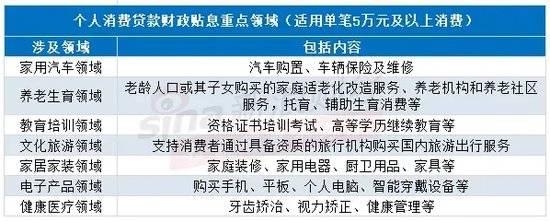
证券之星消息,8月14日股份制银行板块较上一交易日上涨0.08%,招商银行领涨。当日上证指数报收于3666.44,下跌0.46%。深证成指报收于 11451.43,下跌0.87%。股份制银行板块个股涨跌见下表: | 代码 | 名称 | 收盘价 | 涨跌幅 | 成交量(手) | 成交额(元) | | --- | --- | --- | --- | --- | --- | | 600036 | 指商银行 | 43.78 | 0.55% | 67.64万 | 29.60亿 | | 600000 | 浦发银行 | 13.87 | 0.29% | 71.28万 | 9.91亿 | | 661698 | 中信银行 | 8.27 | 0.24% | 41.42万 | 3.45 Z | | 601818 | 光大银行 | 4.04 | 0.00% | 136.19万 | 5.53亿 | | 600015 | 华夏银行 | 7.96 | -0.25% | 32.14万 | 2.58亿 | | 601166 | 兴 银行 | 22.73 | -0.31% | 62.94万 | 14.34亿 | | 000001 | 平安银行 | ...





重大利好,如何享受?看完这篇,立刻学会
天天基金网· 2025-08-14 05:09
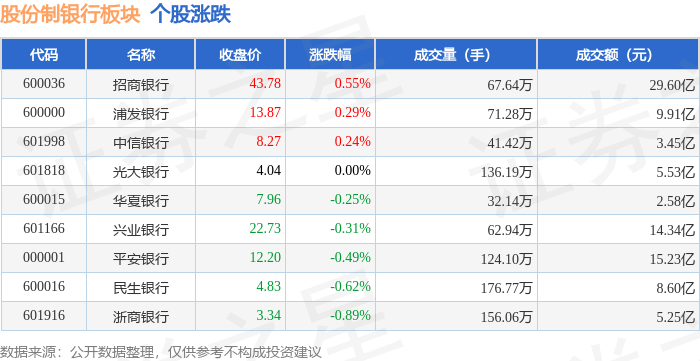
Core Viewpoint - The article discusses the implementation plan for the personal consumption loan interest subsidy policy aimed at supporting resident consumption from September 1, 2025, to August 31, 2026, detailing eligibility, subsidy rules, and application processes [1]. Summary by Sections Support Scope - The policy applies to personal consumption loans issued by recognized financial institutions, excluding credit card transactions, where the loan is used for actual consumption. Eligible consumption includes both small daily expenses and larger purchases such as vehicles, home renovations, and electronics. Each individual can receive a maximum subsidy of 500 yuan per transaction, with multiple transactions eligible for cumulative benefits [2]. Subsidy Rules - For transactions under 50,000 yuan, the subsidy is calculated based on the actual amount, with a maximum of 1,000 yuan for multiple transactions at the same institution. For transactions over 50,000 yuan, the subsidy is capped at 3,000 yuan, calculated based on a maximum of 50,000 yuan per transaction. The policy may be extended or expanded based on its effectiveness [3]. Loan Processing Institutions - The policy is limited to 23 recognized financial institutions, including 18 banks and 5 other personal consumption loan providers. The policy supports reasonable borrowing needs and actual consumption behaviors, excluding any non-consumption or fraudulent activities [4]. Subsidy Standards - The average interest rate for personal consumption loans is around 3%. The subsidy rate is set at 1 percentage point, which is approximately one-third of the current commercial bank loan rates, with the central and provincial governments covering 90% and 10% of the subsidy, respectively [5]. Cumulative Subsidy Limits - Each borrower can receive a total subsidy of up to 3,000 yuan from one institution, corresponding to a cumulative consumption amount of 300,000 yuan. For loans under 50,000 yuan, the maximum cumulative subsidy is 1,000 yuan, linked to a consumption amount of 100,000 yuan [6]. Key Areas for Subsidy - The subsidy focuses on several key areas, including household vehicles, home renovations, electronic products, health care, and education training, among others [7][11]. Application Process - Borrowers must authorize the loan processing institution to access transaction information when applying for a personal consumption loan. Existing loans can also be adjusted through supplementary agreements. The institution will calculate the subsidy based on actual consumption and apply it directly to the interest payments, simplifying the process for borrowers [8][9]. Administrative Efficiency - To reduce the burden on borrowers and enhance policy effectiveness, the calculation and application of subsidy funds are primarily managed by the loan processing institutions and local government departments, minimizing additional steps for borrowers [9].





中信银行将依法合规、积极有序推动个人消费贷款财政贴息工作
Jin Tou Wang· 2025-08-14 03:42
Core Viewpoint - China CITIC Bank (601998) announced its initiative to promote personal consumption loan interest subsidies to stimulate domestic demand and enhance consumer spending potential in line with government policies [1] Group 1: Policy Implementation - The bank will implement the personal consumption loan interest subsidy program as per the "Implementation Plan for Personal Consumption Loan Financial Subsidy Policy" (Cai Jin [2025] No. 80) [1] - CITIC Bank will develop specific implementation details and operational guidelines to ensure efficient and convenient access to the subsidy for eligible customers [1] Group 2: Customer Communication - Customers are encouraged to follow CITIC Bank's official online channels and branch announcements for updates regarding the subsidy program [1] - The bank emphasizes that it will not charge any fees for processing personal consumption loan interest subsidies [1] Group 3: Security Measures - To protect customers from potential fraud, the bank advises against trusting communications from individuals outside its official channels regarding the subsidy program [1] - Customers are encouraged to contact CITIC Bank's 24-hour service hotline for any inquiries [1]
中信银行绿色金融 “信”守低碳每一度
Xin Jing Bao· 2025-08-14 03:40
Core Viewpoint - CITIC Bank is committed to promoting green finance and sustainable development, aligning with the philosophy that "lucid waters and lush mountains are invaluable assets" [4][10]. Group 1: Green Finance Initiatives - CITIC Bank has established a comprehensive governance structure for sustainable development, including a green finance development plan for 2024-2026 [4]. - The bank's green credit balance has exceeded 600 billion yuan, actively supporting industries and projects that align with green development trends [5]. - Innovations in green financial products include the issuance of the first overseas green bond and the launch of the first domestic biodiversity-themed bond index [5][6]. Group 2: Regional Contributions - Various branches of CITIC Bank are implementing green finance initiatives, such as: - Beijing branch supporting carbon reduction projects [6]. - Tianjin branch providing 110 million yuan in loans for a major seawater desalination project [6]. - Shanghai branch introducing CCER pledge loans for green low-carbon transitions [6][7]. Group 3: Climate Risk Management - CITIC Bank has developed a robust climate risk management system and is a supporter of TCFD and a member of the "Climate Investment and Financing Alliance" [10]. - The bank has established a management mechanism for climate risk identification, assessment, and response, integrating climate risk into its overall risk management framework [12][13]. Group 4: Low-Carbon Operations - The bank has incorporated low-carbon principles into its operational management, implementing guidelines to manage environmental footprints across various dimensions [14]. - Initiatives include promoting paperless operations and energy-saving renovations, with the Huzhou Deqing branch achieving LEED Gold certification for green building [15].

跟踪指数年内涨超20%,港股通央企红利ETF天弘(159281)即将结募,机构:港股红利资产股息溢价长期更高
2 1 Shi Ji Jing Ji Bao Dao· 2025-08-14 02:47
Core Viewpoint - The Hong Kong stock market is experiencing active performance in dividend-related concepts, with the Hong Kong Stock Connect Central Enterprise Dividend Index showing a year-to-date increase of 20.17% as of August 13 [1][2]. Group 1: Index and ETF Performance - The Hong Kong Stock Connect Central Enterprise Dividend Index (931233) has risen by 0.66% as of the latest report, with significant contributors including New China Life Insurance and China Overseas Grand Oceans Group [1]. - The Hong Kong Stock Connect Central Enterprise Dividend ETF Tianhong (159281) is currently being issued, with a management fee of 0.5% and a custody fee of 0.1% [1][2]. Group 2: Investment Value of the Index - The index reflects stable dividend levels and high dividend yields from centrally controlled enterprises, making it a favorable investment option within the Hong Kong Stock Connect framework [2]. - The investment value of the index is supported by four main factors: 1. High dividend assets are more attractive in a weak recovery market due to stable cash flows [2]. 2. Central enterprises are increasingly focusing on market performance and dividend expectations as part of their value management [2]. 3. The Hong Kong market has a higher emphasis on dividends compared to the A-share market, with significant differences in dividend ratios and yields [3]. 4. The long-term effectiveness of dividend investment strategies in the Chinese market is supported by historical data showing a 10% annualized return over the past decade [3]. Group 3: Market Comparisons - The Hang Seng Index's dividend yield is currently higher than that of the Shanghai Composite Index, with the Hang Seng High Dividend Yield Index at 6% compared to the 4.6% of the A-share market [3]. - The long-term dividend yield premium of Hong Kong dividend assets over long-term government bonds has remained positive since 2019, indicating a stronger performance compared to A-shares [3].

7月金融数据点评:社融增速继续回升,关注近期政策对信贷的提振效果
Orient Securities· 2025-08-14 00:42
Investment Rating - The report maintains a "Positive" outlook for the banking industry [6] Core Viewpoints - The growth rate of social financing continues to rebound, with government bonds playing a core driving role [9][10] - The recent policy measures are expected to have a positive impact on credit demand, particularly for household loans [13][14] - Non-bank deposits have significantly increased, indicating improved M1 growth driven by the conversion of household deposits to corporate deposits [18] Summary by Sections Social Financing Growth - In July 2025, social financing grew by 9.0% year-on-year, with a monthly increment of 1.16 trillion yuan, which was below market expectations by 250 billion yuan [9][10] - The increase in government bonds contributed 555.9 billion yuan to social financing, continuing its core role in driving growth [10] - Corporate direct financing increased by 102.9 billion yuan, with bond financing up by 75.5 billion yuan, benefiting from a recovery in the A-share market [10] Loan Growth - Total RMB loans grew by 6.9% year-on-year in July 2025, with a net decrease of 50 billion yuan for the month [13] - Household loans saw a year-on-year decrease of 2.793 billion yuan, while corporate loans decreased by 3.9 billion yuan [13][14] - The report expresses optimism regarding the effectiveness of recent policy measures to support loan growth, particularly for household loans [13] Non-Bank Deposits - M1 grew by 5.6% year-on-year in July, with M2 growing by 8.8%, indicating a narrowing gap between M2 and M1 growth rates [18] - The increase in non-bank deposits by 1.39 trillion yuan aligns with the observed trends in household and corporate deposit conversions [18] - The report notes that the increase in corporate deposits by 320.9 billion yuan is primarily due to significant fiscal spending [18] Investment Recommendations - The report suggests focusing on two investment themes: high-dividend stocks due to the reduction in insurance preset rates and fundamentally strong mid-sized banks [24][25] - Recommended banks for high-dividend strategies include China Construction Bank, Industrial and Commercial Bank of China, China Merchants Bank, and Agricultural Bank of China [25] - For mid-sized banks, the report recommends focusing on Industrial Bank, CITIC Bank, Nanjing Bank, Jiangsu Bank, and Hangzhou Bank [25]

银行理财产品移行提速 资管新规进入过渡期
Bei Jing Shang Bao· 2025-08-13 23:12
Core Viewpoint - The migration of bank wealth management products to wealth management subsidiaries is accelerating as the transition period for asset management regulations approaches its end, with several banks announcing plans to transfer their products [1][4]. Group 1: Migration of Wealth Management Products - China Merchants Bank and CITIC Bank have announced plans to transfer several previously issued wealth management products to their respective wealth management subsidiaries [2][3]. - The migration includes specific products such as "CITIC Wealth Management Growth Strong Bond Daily Open Net Value RMB Wealth Management Product" and others, with a scheduled pause in subscription and redemption transactions [2][3]. - This marks the eighth transfer of wealth management products by China Merchants Bank this year, totaling 59 products transferred to its wealth management subsidiary [4]. Group 2: Reasons for Acceleration - Analysts suggest that the increasing maturity of wealth management subsidiaries in terms of product issuance, sales, operational management, and investment research capabilities necessitates the accelerated migration of wealth management products from parent banks [1][4]. Group 3: Challenges in Migration - The migration process may face challenges such as system compatibility issues, customer acceptance of product name changes, and the management of existing assets, particularly those with flaws or risks [5]. - Wealth management subsidiaries are advised to maintain strict financial separation from parent banks and enhance their product offerings through improved risk control and investment research capabilities [6].
多家银行迅速响应两项贷款贴息政策
Zheng Quan Ri Bao· 2025-08-13 16:43
Core Viewpoint - The implementation of the personal consumption loan interest subsidy policy and the service industry loan interest subsidy policy is expected to optimize and expand service consumption supply, creating new growth points for service consumption [1][2][3] Group 1: Policy Implementation - The personal consumption loan interest subsidy policy will be effective from September 1, 2025, to August 31, 2026, allowing eligible personal consumption loans to enjoy interest subsidies [2] - Major banks, including Industrial and Commercial Bank of China, Agricultural Bank of China, and others, have announced their commitment to implement the personal consumption loan interest subsidy policy in accordance with market-oriented and legal principles [2][3] - The service industry loan interest subsidy policy will support eight categories of service sectors, including catering, health, and tourism, from March 16, 2025, to December 31, 2025 [3] Group 2: Impact on Banking Sector - The interest subsidy policies are expected to positively impact credit, particularly operational loans, and enhance the market share of state-owned and joint-stock banks [4] - The policies are anticipated to drive structural growth in consumer finance and inclusive finance, with an increase in the proportion of retail and inclusive loans [4] - The policies will create new growth opportunities for banks in three dimensions: structural expansion of consumer credit, solidifying the client base for corporate clients, and synergizing retail and corporate business [4] Group 3: Challenges and Risk Management - The implementation of the subsidy policies presents challenges for banks, necessitating enhanced risk management throughout the loan process, particularly regarding the use of loans [5] - Banks are advised to strengthen system support, optimize business processes, and enhance risk prevention measures to ensure asset quality remains stable [5][6] - The need for digital risk management and improved comprehensive financial service capabilities is emphasized for achieving high-quality development [6]

9月起,这些个人消费贷款可享受财政贴息!操作指南来了→
Sou Hu Cai Jing· 2025-08-13 13:12
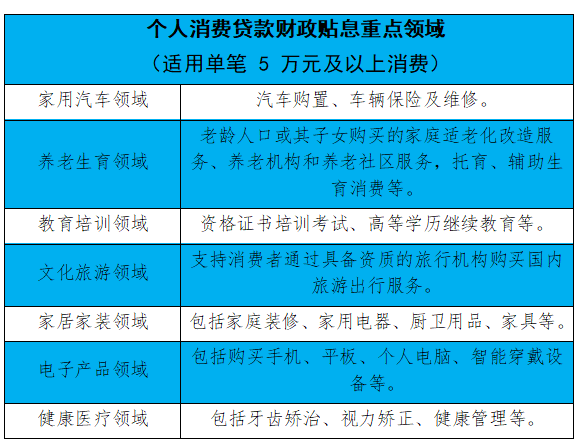
Core Viewpoint - The Ministry of Finance, the People's Bank of China, and the Financial Regulatory Administration have issued a policy implementation plan for personal consumption loan interest subsidies, aimed at stimulating consumer spending in key sectors. Summary by Relevant Sections Support Scope - The subsidy policy applies to personal consumption loans under two categories: loans below 50,000 yuan and loans of 50,000 yuan or more in key areas such as home appliances, automotive, healthcare, and education [2]. Loan Issuing Institutions - The policy includes six major state-owned commercial banks and twelve nationwide joint-stock commercial banks, along with five other personal consumption loan issuing institutions [4]. Subsidy Standards - The annual subsidy rate is set at 1% of the actual loan principal used for consumption, capped at 50% of the loan contract interest rate. The central and provincial finances will cover 90% and 10% of the subsidy funds, respectively [6][7]. Key Areas for Subsidy - The key areas eligible for subsidies for loans of 50,000 yuan or more include: - Automotive: vehicle purchase, insurance, and maintenance [9] - Elderly care and childbirth: services for elderly home modifications and childcare [9] - Education and training: qualification training and continuing education [10] - Cultural tourism: domestic travel services through qualified agencies [11] - Home improvement: renovation and household appliances [12] - Electronics: purchase of mobile phones, tablets, and computers [13] - Healthcare: dental correction and health management [14] Implementation Process - For existing loans, lending institutions can obtain borrower authorization through supplementary agreements to calculate the subsidy amount based on actual consumption. Borrowers will be informed of the subsidy details via SMS or mobile apps [17]. Example of Subsidy Impact - A consumer using a personal consumption loan of 200,000 yuan for home renovation at a 3% interest rate would save up to 2,000 yuan in interest payments due to the 1% subsidy, effectively reducing their interest burden by one-third [17].
个人消费贷贴息下月来了!国有大行、股份行“入围”,最高补多少?
Sou Hu Cai Jing· 2025-08-13 11:57
Core Viewpoint - The Ministry of Finance, the Central Bank, and the Banking Regulatory Commission have released a personal consumption loan interest subsidy policy aimed at stimulating consumer spending from September 1, 2025, to August 31, 2026, with a maximum subsidy of 3,000 yuan per borrower [1][4]. Summary by Relevant Sections Policy Details - The subsidy applies to personal consumption loans used for various categories, including household vehicles, elderly care, education, cultural tourism, home decoration, electronics, and healthcare [2][3]. - The annual subsidy rate is set at 1%, with a maximum of 50% of the loan contract interest rate, funded by central and provincial finances [3][4]. Eligible Institutions - A total of 23 lending institutions have been selected, including 6 state-owned banks and 12 joint-stock banks, while local banks such as city commercial banks and rural commercial banks are notably absent [5][7]. Borrower Guidelines - Borrowers must authorize lending institutions to access transaction information to qualify for the subsidy, which will not affect their ability to apply for loans or repay them [6][9]. Market Impact - The policy is expected to increase market concentration towards larger banks, with analysts predicting a potential recovery in credit demand, particularly for operational loans [9][10]. - The subsidy is anticipated to significantly boost consumer demand, with estimates suggesting that every 100 billion yuan in fiscal spending could leverage 1 trillion yuan in consumption [10][11].