
WuXi AppTec(603259)

Search documents
CRO概念下跌1.78%,16股主力资金净流出超千万元
Zheng Quan Shi Bao Wang· 2025-12-02 09:06
Group 1: Market Performance - The CRO concept index declined by 1.78%, ranking among the top declines in the concept sector, with notable declines from companies such as Aopumai, Yinos, and Medisi [1] - Among the CRO concept stocks, six companies experienced price increases, with Haipruy, Hehua Co., and Dongfang Ocean rising by 0.75%, 0.52%, and 0.39% respectively [1] Group 2: Capital Flow - The CRO concept sector saw a net outflow of 907 million yuan, with 53 stocks experiencing net outflows, and 16 stocks seeing outflows exceeding 10 million yuan [3] - WuXi AppTec had the highest net outflow of 447 million yuan, followed by Tigermed, Kanglong Chemical, and Medisi with net outflows of 69.78 million yuan, 47.47 million yuan, and 38.39 million yuan respectively [3] - The stocks with the highest net inflows included Dian Diagnostics, Hanyu Pharmaceutical, and Dongfang Ocean, with net inflows of 19.93 million yuan, 17.26 million yuan, and 13.49 million yuan respectively [3][5]


医疗服务板块12月2日跌2.05%,益诺思领跌,主力资金净流出9.53亿元
Zheng Xing Xing Ye Ri Bao· 2025-12-02 09:03
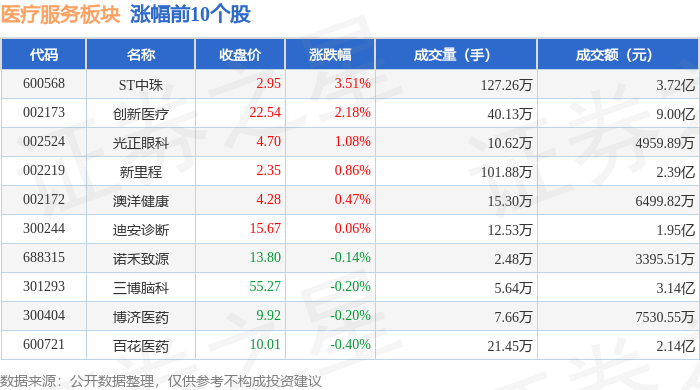
Core Viewpoint - The medical services sector experienced a decline of 2.05% on December 2, with Yinosh leading the drop. The Shanghai Composite Index closed at 3897.71, down 0.42%, while the Shenzhen Component Index closed at 13056.7, down 0.68% [1]. Group 1: Market Performance - The medical services sector saw significant individual stock movements, with ST Zhongzhu closing at 2.95, up 3.51%, and Yinosh closing at 41.58, down 7.27% [1][2]. - The total net outflow of main funds in the medical services sector was 9.53 billion yuan, while retail investors saw a net inflow of 6.87 billion yuan [2][3]. Group 2: Individual Stock Analysis - ST Zhongzhu had a trading volume of 1.27 million hands and a transaction amount of 372 million yuan, while Yinosh had a trading volume of 19,500 hands and a transaction amount of 82.48 million yuan [1][2]. - The stock performance varied, with some stocks like Innovation Medical and Dean Diagnostics showing slight declines, while others like ST Zhongzhu showed gains [1][2]. Group 3: Fund Flow Analysis - Main funds showed a net inflow in stocks like Innovation Medical (63.01 million yuan) and Dean Diagnostics (20.61 million yuan), while there were net outflows in several other stocks [3]. - Retail investors contributed to the net inflow in stocks like Innovation Medical and Dean Diagnostics, despite overall sector outflows [3].




药明康德(603259) - H股公告
2025-12-02 09:00
股份發行人及根據《上市規則》第十九B章上市的香港預託證券發行人的證券變動月報表 截至月份: 2025年11月30日 狀態: 新提交 致:香港交易及結算所有限公司 公司名稱: 無錫藥明康德新藥開發股份有限公司 呈交日期: 2025年12月2日 備註: 第 1 頁 共 11 頁 v 1.1.1 I. 法定/註冊股本變動 | 1. 股份分類 | 普通股 | 股份類別 | H | | | 於香港聯交所上市 (註1) | | 是 | | | --- | --- | --- | --- | --- | --- | --- | --- | --- | --- | | 證券代號 (如上市) | 02359 | 說明 | | | | | | | | | | | 法定/註冊股份數目 | | | 面值 | | | 法定/註冊股本 | | | 上月底結存 | | | 510,476,909 | RMB | | 1 | RMB | | 510,476,909 | | 增加 / 減少 (-) | | | 0 | | | | RMB | | 0 | | 本月底結存 | | | 510,476,909 | RMB | | 1 | RMB | ...
药明康德(02359) - 截至二零二五年十一月三十日止月份之股份发行人的证券变动月报表
2025-12-02 08:30
股份發行人及根據《上市規則》第十九B章上市的香港預託證券發行人的證券變動月報表 截至月份: 2025年11月30日 狀態: 新提交 致:香港交易及結算所有限公司 公司名稱: 無錫藥明康德新藥開發股份有限公司 呈交日期: 2025年12月2日 I. 法定/註冊股本變動 | 1. 股份分類 | 普通股 | 股份類別 | H | | | 於香港聯交所上市 (註1) | | 是 | | | --- | --- | --- | --- | --- | --- | --- | --- | --- | --- | | 證券代號 (如上市) | 02359 | 說明 | | | | | | | | | | | 法定/註冊股份數目 | | | 面值 | | | 法定/註冊股本 | | | 上月底結存 | | | 510,476,909 | RMB | | 1 | RMB | | 510,476,909 | | 增加 / 減少 (-) | | | 0 | | | | RMB | | 0 | | 本月底結存 | | | 510,476,909 | RMB | | 1 | RMB | | 510,476,909 | | 2. 股份分 ...
6家AH股“倒挂”背后:流通股比例小,外资更爱行业龙头
第一财经· 2025-12-02 06:29
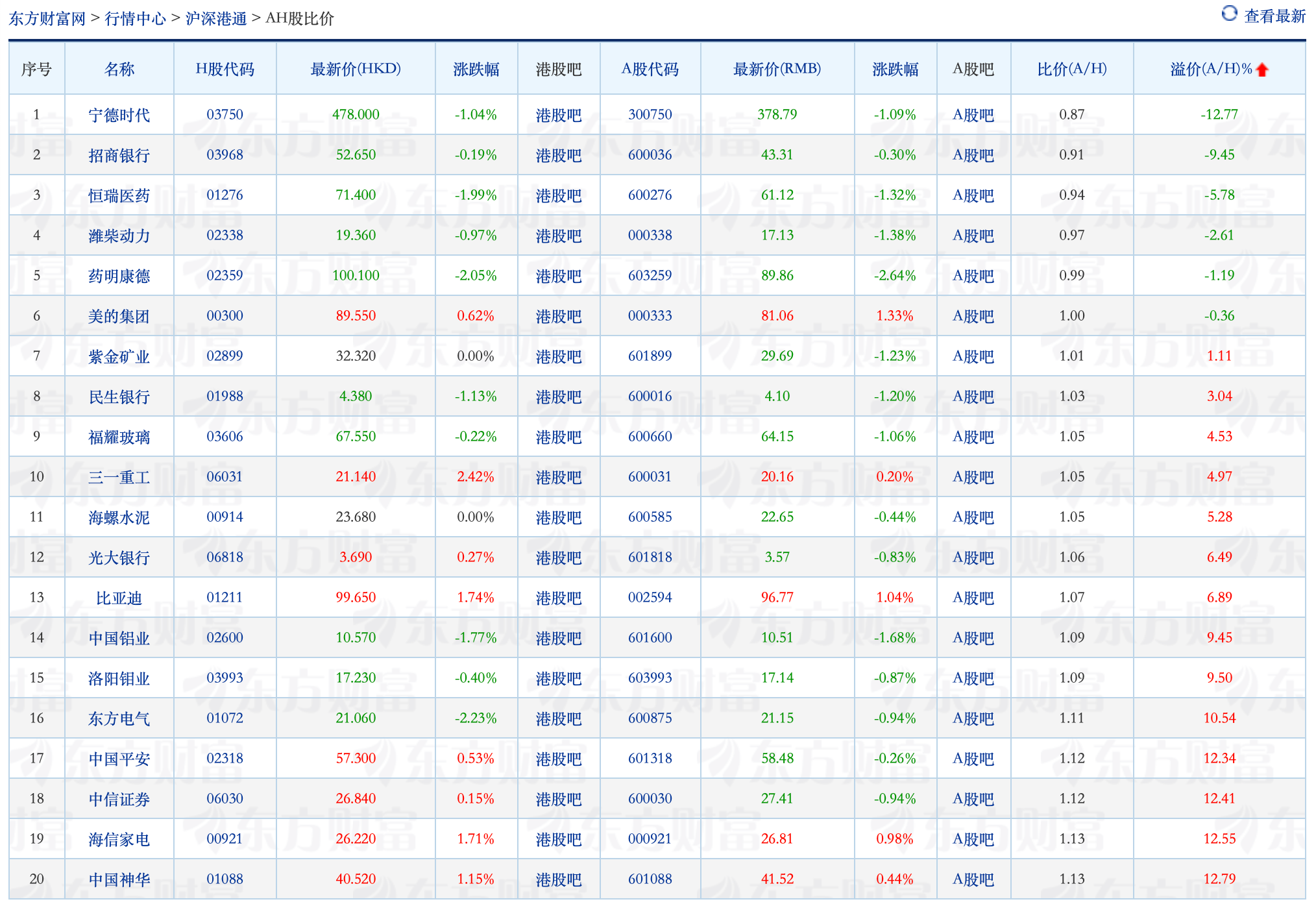
Core Viewpoint - A-shares have lower trading costs and better market liquidity compared to H-shares, with a current premium of about 20% for A-shares as indicated by the Hang Seng AH Premium Index (HSAHP) being above 120. However, certain companies like CATL have shown a reverse phenomenon where H-shares are priced higher than A-shares [2][4]. Group 1: Market Dynamics - The phenomenon of H-shares trading at a premium over A-shares is attributed to the smaller market capitalization of H-shares compared to A-shares, leading to relative scarcity in liquidity [5]. - Among the six companies exhibiting this "inversion," three are newly listed, resulting in lower liquidity for H-shares, which can lead to inflated prices due to concentrated holdings by large institutions [5][6]. - As institutional investors gradually exit their positions, the liquidity of H-shares is expected to increase, potentially narrowing the premium of H-shares over A-shares [5]. Group 2: Characteristics of A-H Share Companies - Companies with inverted pricing typically share common traits: they are large enterprises with stable operating histories and solid financials, often in traditional industries like finance and energy [6]. - The valuation of these companies tends to be higher in the A-share market, reflecting differing expectations from overseas investors regarding future growth potential [6][8]. Group 3: Foreign Investment Preferences - Foreign investors prefer industry leaders that have a competitive edge in the market, which are often scarce in the international market [8]. - These leading companies usually possess strong brand recognition, stable profitability, and good governance structures, aligning with foreign investors' long-term investment criteria [8][9]. - The preference for H-shares over A-shares is also influenced by the perceived monopolistic characteristics of certain companies, which can lead to higher valuations in the H-share market [9].



6家AH股“倒挂”背后:流通股比例小,外资更爱行业龙头
Di Yi Cai Jing· 2025-12-02 06:25
Core Viewpoint - The phenomenon of "AH share premium inversion" is observed in six companies, where H-shares are priced higher than A-shares, attributed to low liquidity and foreign investors' preference for industry leaders [1][2]. Group 1: Market Dynamics - The Heng Seng AH Share Premium Index (HSAHP) remains above 120, indicating a 20% premium of A-shares over H-shares [1]. - The six companies experiencing this inversion include CATL, China Merchants Bank, Hengrui Medicine, Weichai Power, WuXi AppTec, and Midea Group [2]. - The market sees a preference for newly listed stocks in the H-share market, which have lower liquidity, leading to higher valuations [2]. Group 2: Liquidity and New Listings - The "inversion" stocks are characterized by a high proportion of newly listed shares, with three of the six companies listed for less than a year [2]. - The market capitalization of H-shares is often significantly smaller than that of A-shares, contributing to the liquidity scarcity and price inversion [2]. - As institutional investors gradually exit their IPO allocations, the liquidity in the H-share market is expected to increase, potentially narrowing the premium [2]. Group 3: Foreign Investment Preferences - Foreign investors show a strong preference for industry leaders that have established market positions and stable financials [3][4]. - These companies typically operate in traditional sectors such as finance, energy, and infrastructure, which have predictable profit models [3]. - The preference for H-shares is also driven by the perception of higher growth potential and better governance structures in these companies [4]. Group 4: Examples of Inversion - BYD and China Merchants Bank are highlighted as typical examples of companies where H-shares occasionally exhibit a premium over A-shares [5]. - The presence of monopolistic characteristics in H-shares can attract foreign investment, as these companies are often seen as irreplaceable in the global market [5].

短期波动的背后,药明康德的长期价值根基稳固
Zhong Jin Zai Xian· 2025-12-02 05:06
Core Viewpoint - WuXi AppTec remains a focus in the capital market despite recent shareholder reductions and asset optimization initiatives, indicating that the company's long-term value foundation is solid and investor confidence in its future development remains intact [1] Group 1: Shareholder Actions and Market Response - On October 29, WuXi AppTec announced that 17 shareholders plan to reduce their holdings by no more than 2% of the total A-share capital due to personal funding needs, which is a manageable proportion [1] - By November 26, the company disclosed that from November 20 to 25, shareholders collectively reduced their holdings by 11.8279 million shares, accounting for 0.3963% of the total capital, while the stock price increased by 1.19% during this period, closing at 94.31 yuan on November 25 [1] - The company’s reduction plan complies with regulatory requirements, ensuring a transparent and orderly process, and includes a six-month lock-up period for buyers in block trades to mitigate rapid sell-off risks [1] Group 2: Financial Performance and Shareholder Returns - Since its dual listing in 2018, WuXi AppTec has demonstrated exceptional growth, with a cumulative return of 12.3 times for investors holding shares since the IPO until September 2025 [2] - The company has implemented a shareholder return plan of approximately 7 billion yuan in 2025, representing 72% of the net profit for 2024, with total shareholder returns exceeding 20 billion yuan over the past seven years, accounting for over 40% of net profits during the same period [2] - As cash flow improves, the company is expected to enhance shareholder returns further, providing solid value support for long-term investors [2] Group 3: Strategic Focus and Market Expansion - WuXi AppTec is actively optimizing its asset structure by selling its clinical business to focus on its core high-growth CRDMO business, which is expected to enhance operational efficiency and overall competitiveness [2] - The company is strategically positioning itself in the Saudi market, which is experiencing significant growth in healthcare and life sciences, leveraging its integrated CRDMO platform for future growth opportunities [3] - The company is accelerating its global layout for the CRDMO core business, with significant capacity expansions in China, the U.S., Switzerland, and Singapore, achieving a total volume of over 100,000L for peptide solid-phase synthesis reactors ahead of schedule [3] Group 4: Long-term Outlook and Industry Position - WuXi AppTec demonstrates strong adaptability and sustained profitability in a complex macro environment, with steady revenue growth and an expanding global service network [4] - The long-term development prospects for WuXi AppTec are solid, supported by the continuous growth in global drug research and development demand, and the enduring positive outlook for the CXO industry [4] - The company's unique integrated CRDMO model, diverse customer base, and proactive positioning in emerging technologies and therapies provide a robust foundation for long-term growth [4]
6家AH股“倒挂”背后:流通股比例小 外资更爱行业龙头|市场观察
Di Yi Cai Jing· 2025-12-02 05:01
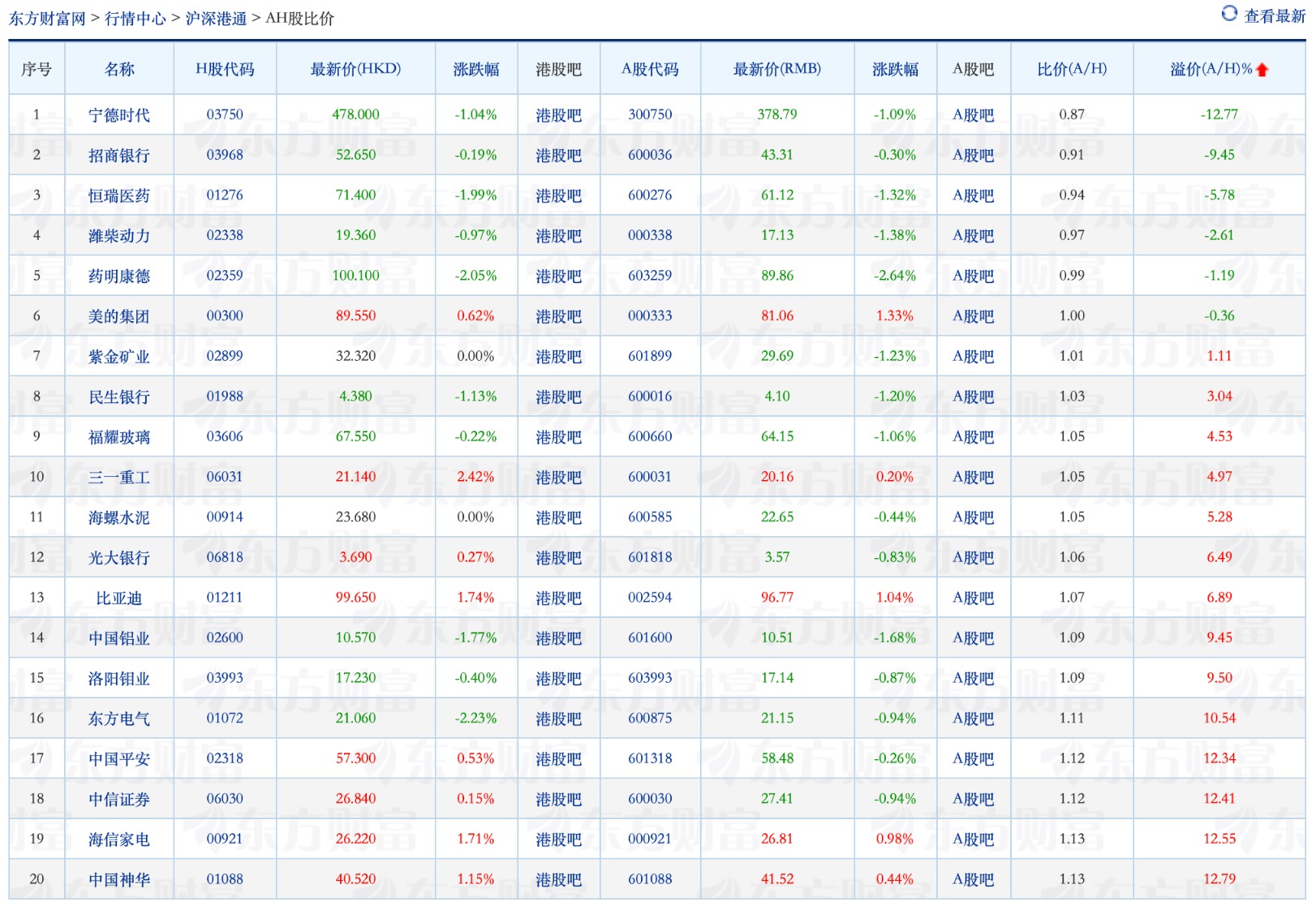
Core Insights - A-shares have lower trading costs and better market liquidity compared to H-shares, with a current premium of approximately 20% for A-shares as indicated by the Hang Seng AH Premium Index (HSAHP) being above 120 [1][2] - A peculiar situation has arisen where H-shares of certain companies, such as CATL, are trading at higher prices than their A-shares, attributed to factors like limited liquidity and the preference of overseas investors for industry leaders [1][2][3] Group 1: Market Dynamics - The six companies experiencing H-share price premiums over A-shares include CATL, China Merchants Bank, Hengrui Medicine, Weichai Power, WuXi AppTec, and Midea Group [2] - The phenomenon of H-share price premiums is linked to the smaller market capitalization of H-shares compared to A-shares, leading to relative scarcity in liquidity [2][3] - Newly listed companies in the H-share market tend to have lower trading volumes, which can lead to inflated prices due to concentrated holdings by large institutions [2][3] Group 2: Investor Preferences - Foreign investors show a preference for industry leaders that have established market positions and stable financials, often leading to higher valuations in the H-share market [4][5] - Companies with strong brand recognition and stable profitability are more likely to attract foreign investment, as these factors align with the long-term investment strategies of international investors [4][5] - The preference for H-shares over A-shares is also influenced by the perceived growth potential and governance standards of the companies involved [4][5] Group 3: Specific Company Examples - CATL's H-shares were observed to have a premium of over 30% shortly after listing, which has since narrowed to approximately 13% as liquidity increased [2] - Other examples of companies with close pricing between H-shares and A-shares include BYD and China Merchants Bank, reflecting positive market sentiment regarding their growth prospects and governance [5]
6家AH股“倒挂”背后:流通股比例小,外资更爱行业龙头|市场观察
Di Yi Cai Jing· 2025-12-02 04:52
Core Insights - A-shares have lower trading costs and better market liquidity compared to H-shares, with an overall premium of 20% for A-shares as indicated by the Hang Seng AH Premium Index (HSAHP) remaining above 120 [1][2] - A peculiar situation has arisen where H-shares of certain companies, such as CATL, are trading at higher prices than their A-shares, attributed to factors like limited liquidity and the preference of overseas investors for industry leaders [1][2][3] Group 1: Market Dynamics - The six companies experiencing H-share price premiums over A-shares include CATL, China Merchants Bank, Hengrui Medicine, Weichai Power, WuXi AppTec, and Midea Group, with others like Zijin Mining and BYD showing closer price alignment [2][3] - The phenomenon of "inverted pricing" is largely due to the smaller market capitalization of H-shares compared to A-shares, leading to relative scarcity in liquidity which drives up prices [2][3] Group 2: Investor Preferences - Foreign investors show a strong preference for industry leaders that are scarce in the international market, often leading to higher valuations for these companies in H-shares [4][5] - Companies with stable financials and established operational histories, particularly in traditional sectors like finance and energy, tend to attract more foreign investment, reflecting differing growth expectations between domestic and international investors [3][4] Group 3: Future Outlook - As large institutional investors gradually exit their positions, the liquidity of H-shares is expected to increase, potentially narrowing the premium of H-shares over A-shares [2][4] - The case of CATL illustrates this trend, where its H-share premium over A-shares decreased from over 30% to approximately 13% following the unlocking of shares held by certain investors [2][4]
CRDMO飞轮效应,带动药明康德长期增长确定性
Cai Fu Zai Xian· 2025-12-02 04:50
Core Viewpoint - The investment philosophy of Duan Yongping emphasizes understanding the intrinsic value of a company beyond market fluctuations, as illustrated by the recent share reduction news from WuXi AppTec [1] Group 1: Shareholder Actions - On October 29, WuXi AppTec announced a plan for its actual controller to reduce shares by up to 2% of the total share capital through centralized bidding and/or block trading [1] - The market reacted strongly to the news, despite the reduction being relatively small and regulated, indicating a growing desensitization among investors regarding the negative perception of share reductions [1] Group 2: Company Performance - Since October 30, WuXi AppTec's stock has outperformed the market, even increasing by 1.19% during the share reduction period from November 20 to 25 [2] - WuXi AppTec has established a unique business model since its founding in 2000, focusing on assisting pharmaceutical companies in lowering development barriers and accelerating new drug launches [2] Group 3: Financial Metrics - Investors who held WuXi AppTec shares since its IPO have seen a return of 12.3 times by September this year, supported by a solid business model [3] - As of the first half of this year, WuXi AppTec's ongoing business orders have achieved a compound growth rate of 38% since 2018, nearing 60 billion [3] - By the third quarter of 2025, WuXi AppTec's revenue is projected to exceed 32.857 billion, with a year-on-year growth of 18.61% and an increase in net profit margin from 26.5% to 32.1% [3] Group 4: Shareholder Returns - WuXi AppTec's expected earnings per share in 2025 will be seven times that of its IPO, with a total of 20 billion allocated for cash dividends and share buybacks over the past seven years [4] - The company has implemented a nearly 7 billion shareholder return plan for 2025, which represents 72% of the net profit for 2024 [4] - For the first three quarters of 2025, WuXi AppTec's net profit attributable to shareholders reached 12.076 billion, reflecting an 84.84% year-on-year increase [4] Group 5: Long-term Belief - Achieving a 12-fold return over seven years requires a strong belief in the long-term value of the company and the power of belief itself [5]