Shanghai Smith Adhesive New Material (603683)

Search documents
化学制品板块8月14日跌1.49%,硅烷科技领跌,主力资金净流出31.74亿元
Zheng Xing Xing Ye Ri Bao· 2025-08-14 08:33
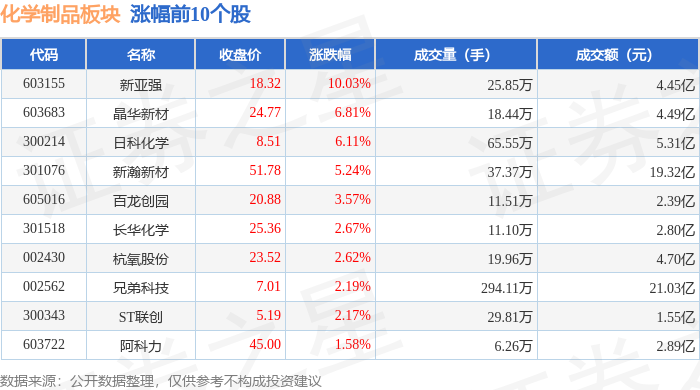
Market Overview - The chemical products sector experienced a decline of 1.49% on August 14, with silane technology leading the drop [1] - The Shanghai Composite Index closed at 3666.44, down 0.46%, while the Shenzhen Component Index closed at 11451.43, down 0.87% [1] Stock Performance - Notable gainers in the chemical products sector included: - Xinyeqiang (603155) with a closing price of 18.32, up 10.03% and a trading volume of 258,500 shares, totaling 445 million yuan [1] - Jinghua New Materials (603683) closed at 24.77, up 6.81% with a trading volume of 184,400 shares [1] - Rike Chemical (300214) closed at 8.51, up 6.11% with a trading volume of 655,500 shares [1] - Other significant gainers included Xinchao New Materials (301076) and Bailong Chuangyuan (605016) with increases of 5.24% and 3.57% respectively [1] Fund Flow Analysis - The chemical products sector saw a net outflow of 3.174 billion yuan from institutional investors, while retail investors contributed a net inflow of 2.748 billion yuan [2] - The sector's overall fund flow indicates a mixed sentiment, with institutional investors withdrawing capital while retail investors showed interest [2] Individual Stock Fund Flow - Xinyeqiang (603155) had a net outflow of 50.11 million yuan from institutional investors, while retail investors contributed a net inflow of 38.76 million yuan [3] - Jinghua New Materials (603683) experienced a net inflow of 34.91 million yuan from institutional investors, but a net outflow of 41.08 million yuan from retail investors [3] - Other stocks like ST Lianchuang (300343) and Ruanhe Materials (300727) also showed varied fund flows, indicating differing investor sentiments across the sector [3]


东北证券:触觉传感器技术演化市场扩容 推荐关注晶华新材
智通财经网· 2025-08-13 06:55
Core Insights - The humanoid robot industry is accelerating, leading to technological upgrades and market expansion for tactile sensors, which are key components [2] - By 2030, the market for electronic skin in humanoid robots is expected to reach 15.5 billion, with the dexterous hand electronic skin market accounting for approximately 5 billion [2][6] Tactile Sensor Types - Tactile sensors are categorized into layered tactile sensors and magnetoelectric/visual tactile sensors. Layered tactile sensors include piezoresistive, piezoelectric, and capacitive sensors, composed of sensitive layers, electrode layers, base layers, packaging layers, and adhesive layers [2] - The sensitive layer is crucial for force-sensitive response and is made from materials like PDMS or carbon nanotubes, while the base layer provides mechanical support [2] Technology Evolution - Piezoresistive and piezoelectric sensors are cost-effective and mature, suitable for non-precision scenarios in humanoid robots, while magnetoelectric and visual tactile sensors are designed for high-precision applications [3] - Magnetoelectric sensors can measure three-dimensional forces and moments but are complex and costly, while visual tactile sensors can detect additional physical information but require high computational power [3] Competitive Barriers - Key competitive barriers in the industry include materials, algorithms, semiconductor-level manufacturing processes, and customer channels [4] Material and Algorithm Insights - The active layer material is critical for the sensitivity of tactile sensors, with mainstream processes involving the incorporation of conductive materials like carbon nanotubes into elastomers like PDMS [5] - Common signal processing algorithms used in tactile sensors include dimensionality reduction, time-frequency analysis, and classification algorithms [5] Market Projections - The market for electronic skin in humanoid robots is projected to reach 15.5 billion by 2030, with the dexterous hand electronic skin market expected to reach 5 billion [6] - As costs decrease, the application range of electronic skin is anticipated to expand beyond current limitations, enhancing market potential [6]

东北证券:预计2030年人形机器人电子皮肤市场空间将达155亿元
Ge Long Hui A P P· 2025-08-13 04:18
Group 1 - The humanoid robot industry is accelerating in commercialization, leading to technological upgrades and market expansion for tactile sensors as core components [1] - As technology matures and costs decrease, it is expected that dexterous electronic skin touchpoints will expand from five fingertips to full coverage of the palm and finger pads [1] - The market for humanoid robot electronic skin is projected to reach 15.5 billion by 2030, with the dexterous electronic skin market accounting for approximately 5 billion [1] - Companies with leading material processes, such as Jinghua New Materials, are recommended for attention [1]

东北证券:触觉传感器技术演化市场扩容 推荐关注晶华新材(603683.SH)
智通财经网· 2025-08-13 03:55
Core Insights - The humanoid robot industry is accelerating, leading to technological upgrades and market expansion for tactile sensors, which are core components [1] - By 2030, the market for humanoid robot electronic skin is expected to reach 15.5 billion, with the dexterous hand electronic skin market projected at around 5 billion [1][4] Group 1: Tactile Sensor Types - Tactile sensors are categorized into layered tactile sensors and magnetoelectric/visual tactile sensors [1] - Layered tactile sensors include piezoresistive, piezoelectric, and capacitive sensors, composed of sensitive layers, electrode layers, substrate layers, packaging layers, and adhesive layers [1] - The sensitive layer is made of materials that respond to force, while the substrate layer provides mechanical support and recovery capability [1] Group 2: Technology Evolution - Piezoresistive/piezoelectric sensors are cost-effective and mature, suitable for non-precision scenarios, while magnetoelectric and visual tactile sensors are designed for high-precision applications [2] - Magnetoelectric sensors can directly measure three-dimensional forces and moments but are complex and costly to produce [2] - Visual tactile sensors can perceive additional physical information like texture and temperature but require high computational power [2] Group 3: Competitive Barriers - Key components for tactile sensors include materials, algorithms, semiconductor-level fabrication processes, and customer channels [3] - The active layer material is crucial for sensor sensitivity, with common materials being carbon nanotubes and graphene combined with elastomers like PDMS [3] - Signal processing algorithms used in tactile sensors include dimensionality reduction, time-frequency analysis, and classification algorithms [3] Group 4: Market Potential - The market for humanoid robot electronic skin is projected to reach 15.5 billion by 2030, with the dexterous hand electronic skin market expected to be 5 billion [4] - As technology matures and costs decrease, the application range of electronic skin is anticipated to expand beyond fingertips to full hand coverage [4] - Currently, other body parts like arms, legs, and feet are not covered, but cost reductions may enhance the application scope [4]
既要“安全垫”也要“成长源” 公募苦练定增掘金术
Zhong Guo Zheng Quan Bao· 2025-08-12 21:40
Group 1 - The core viewpoint of the article highlights the increasing interest and participation of public funds in A-share companies' private placement projects, with significant floating profits reported [1][2][4] - As of August 11, 2023, 24 public institutions participated in 48 private placement projects, with a total allocation amounting to 14.383 billion yuan and a floating profit exceeding 5 billion yuan, representing a floating profit ratio of 34.86% [2][4] - Notably, 47 out of the 48 companies involved in these private placements achieved floating profits, with some projects like Leshan Electric Power showing a floating profit ratio as high as 181.84% [2][3] Group 2 - The sectors with high floating profit ratios from private placements include electricity, machinery, public utilities, electronics, and defense [3] - Nord Fund and Caitong Fund are the most active public institutions in private placements this year, with floating profits of 1.872 billion yuan and 1.709 billion yuan, respectively [4] - The investment strategy emphasizes the importance of individual stock growth returns and the need for a balanced portfolio across industries and companies [6][7] Group 3 - The article discusses the emergence of new investment strategies such as inquiry transfer, which has shown significant growth in both quantity and value, surpassing the total issuance of competitive private placements [7][8] - Inquiry transfer is currently applicable only to the Sci-Tech Innovation Board and the Growth Enterprise Market, indicating a trend towards more innovative investment opportunities [7] - The article suggests that while private placement investments can be effective, they require thorough research on the underlying companies and their industry dynamics [8]




公募苦练定增掘金术
Zhong Guo Zheng Quan Bao· 2025-08-12 21:06
Group 1 - The core viewpoint of the articles highlights the increasing interest and participation of public funds in A-share companies' private placement projects, with significant floating profits reported [1][2][3] - As of August 11, 2023, 24 public institutions participated in 48 A-share companies' private placements, with a total allocation amount of 14.383 billion yuan and a floating profit exceeding 5 billion yuan, representing a floating profit ratio of 34.86% [1][2] - Notably, 47 out of the 48 companies involved in these private placements achieved floating profits, with some companies like Leshan Electric Power and Jinghua New Materials showing floating profit ratios of 181.84% and 158.04% respectively [2][3] Group 2 - The data indicates that the highest floating profit ratios were observed in sectors such as electricity, machinery, public utilities, electronics, and defense, with significant allocations in companies like Haohua Technology and Chip Origin [2][3] - Nord Fund and Caitong Fund emerged as the most active public institutions in participating in private placements, with floating profits of 1.872 billion yuan and 1.709 billion yuan respectively [2][3] - Investment strategies have shifted towards focusing on individual stock growth returns, with an emphasis on the importance of fundamental research and reasonable pricing strategies for private placements [3][4] Group 3 - The articles also discuss the rising trend of inquiry transfer as a new investment direction, which has shown significant growth in both transfer quantity and amount, surpassing the total of competitive private placements [4][5] - The inquiry transfer mechanism, similar to private placements, is expected to provide new investment opportunities, particularly in the Sci-Tech Innovation Board and the Growth Enterprise Market [4][5] - Overall, the current market environment presents favorable investment opportunities in private placements, with a focus on selecting quality stocks to enhance returns [3][4]
电子皮肤百亿市场,算法+工艺+渠道构造壁垒
NORTHEAST SECURITIES· 2025-08-12 13:41
Investment Rating - The report rates the industry as "Outperforming the Market" [4] Core Insights - The electronic skin market is projected to reach 15.5 billion yuan by 2030, driven by advancements in technology and cost reductions [4][37] - The core barriers to entry in the tactile sensor market include materials, algorithms, semiconductor-level manufacturing processes, and customer channels [3][4] - The report highlights the competitive landscape as relatively fragmented, with various manufacturers specializing in different types of tactile sensors [3][4] Summary by Sections Tactile Sensor Technology - Tactile sensors are categorized into layered tactile sensors and other types, with layered sensors including resistive, piezoelectric, and capacitive sensors [15][16] - The key performance indicators for tactile sensors include sensitivity, detection range, linearity, and response time [15][24] Market Potential - The humanoid robot market is expected to see significant growth, with projected sales reaching 1.24 million units by 2025 and 1 million units by 2030, leading to a market size of 155 billion yuan [37][38] - The report estimates that the market for dexterous hand electronic skin will grow from 0.15 million yuan in 2025 to 5 billion yuan by 2030 [37][38] Competitive Landscape - The report identifies several key players in the tactile sensor market, including companies specializing in resistive, capacitive, and magnetic sensors [3][4][42] - The core materials used in electronic skin include PDMS and other flexible substrates, which are crucial for the performance of tactile sensors [45][49] Application Areas - Tactile sensors are increasingly being integrated into various sectors, including automotive, industrial automation, healthcare, and consumer electronics, reflecting a growing demand for intelligent and digital solutions [40][41]
晶华新材2025年中报简析:增收不增利,公司应收账款体量较大
Zheng Quan Zhi Xing· 2025-08-11 23:00
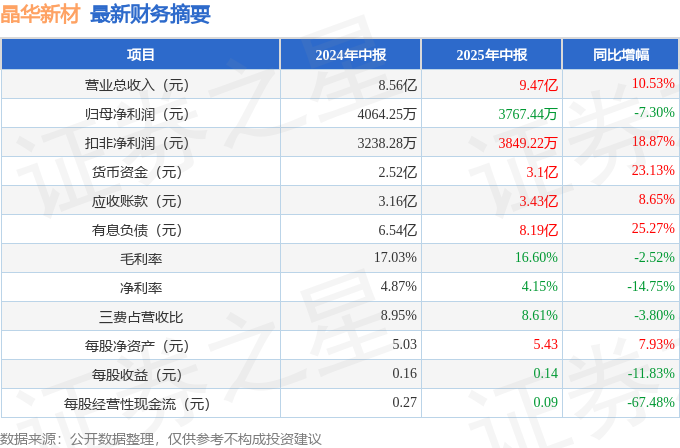
Core Viewpoint - Jinghua New Materials (603683) reported a mixed performance in its 2025 mid-year financial results, with revenue growth but a decline in net profit, indicating potential challenges in profitability despite increased sales [1] Financial Performance Summary - Total revenue for the first half of 2025 reached 947 million yuan, a year-on-year increase of 10.53% [1] - Net profit attributable to shareholders was 37.67 million yuan, down 7.3% year-on-year [1] - In Q2 2025, total revenue was 509 million yuan, up 8.75% year-on-year, while net profit was 18.88 million yuan, a slight decline of 0.94% [1] - The gross margin decreased to 16.6%, down 2.52% year-on-year, and the net margin fell to 4.15%, down 14.75% year-on-year [1] - Total operating expenses (selling, administrative, and financial expenses) amounted to 81.52 million yuan, accounting for 8.61% of revenue, a decrease of 3.8% year-on-year [1] Key Financial Metrics - Earnings per share (EPS) decreased to 0.14 yuan, down 11.83% year-on-year [1] - Operating cash flow per share dropped significantly to 0.09 yuan, a decrease of 67.48% year-on-year [1] - The company's receivables were notably high, with accounts receivable accounting for 512.21% of net profit [1] Changes in Financial Items - Cash and cash equivalents increased by 89.6% due to shareholder investments [2] - Trade receivables rose by 8.65% to 343 million yuan [1][2] - Long-term receivables increased by 35.03% due to higher financing lease deposits [2] - Fixed assets grew by 72.95% as a result of construction projects being completed [2] Operational Insights - The increase in revenue was primarily driven by growth in electronic-grade adhesive materials [3] - Sales expenses surged by 62.19% due to higher personnel costs and share-based payment amortization [3] - Research and development expenses rose by 21.24%, reflecting increased investment in R&D [4] Investment Considerations - The company's return on invested capital (ROIC) was reported at 4.39%, indicating weak capital returns [5] - The debt-to-asset ratio for interest-bearing liabilities reached 26.56%, suggesting potential concerns regarding debt levels [5] - Analysts project a net profit of 82 million yuan for 2025, with an average EPS forecast of 0.28 yuan [5]
晶华新材:2025年中报显示收入增长但利润承压,需关注现金流与应收账款
Zheng Quan Zhi Xing· 2025-08-11 22:12
Business Overview - The company reported a total operating revenue of 947 million yuan for the first half of 2025, an increase of 10.53% year-on-year [1][3] - The net profit attributable to shareholders decreased by 7.3% year-on-year to 37.67 million yuan, while the net profit after deducting non-recurring items increased by 18.87% to 38.49 million yuan [1][3] - In Q2 2025, the operating revenue was 509 million yuan, up 8.75% year-on-year, with a net profit attributable to shareholders of 18.88 million yuan, down 0.94% year-on-year [1] Financial Indicators - The gross profit margin was 16.6%, a decrease of 2.52 percentage points year-on-year [5] - The net profit margin was 4.15%, a decrease of 14.75 percentage points year-on-year [5] - Operating costs increased by 11.1% in line with sales revenue growth [5] - Total operating expenses (selling, administrative, and financial expenses) amounted to 81.52 million yuan, accounting for 8.61% of revenue, a decrease of 3.8 percentage points year-on-year [5] - Selling expenses increased by 62.19% due to higher sales personnel compensation and share-based payment amortization [5] - Administrative expenses decreased by 4.01% due to reduced employee compensation and consulting service fees [5] - Financial expenses decreased by 31.1% due to lower loan interest expenses and reduced foreign exchange losses [5] Cash Flow and Debt Situation - Operating cash flow per share was 0.09 yuan, a decrease of 67.48% year-on-year [5] - Cash and cash equivalents amounted to 310 million yuan, an increase of 23.13% year-on-year, primarily due to funds received from shareholders through a simplified share issuance process [5] - Accounts receivable reached 343 million yuan, an increase of 8.65% year-on-year, representing 512.21% of the latest annual net profit attributable to shareholders [5][6] - Interest-bearing liabilities increased by 25.27% year-on-year to 819 million yuan [5][6] - The ratio of cash and cash equivalents to current liabilities was only 42.33%, indicating a need to monitor cash flow [6] - The interest-bearing asset-liability ratio reached 26.56%, necessitating attention to the company's debt situation [6]
603683,年内累计涨幅曾一度高达178%,今天开盘5分钟封死跌停
第一财经· 2025-08-11 10:49
Core Viewpoint - The article discusses the recent performance of Jinghua New Materials, highlighting the divergence between revenue growth and declining net profit, which has led to a significant drop in stock price despite previous high valuations [3][4]. Financial Performance - Jinghua New Materials reported a revenue of 947 million yuan for the first half of 2025, a year-on-year increase of 10.53% [4]. - The net profit attributable to shareholders was 37.67 million yuan, a decrease of 7.3% year-on-year, while the non-recurring net profit increased by 18.87% to 38.49 million yuan [4]. - The operating cash flow from operating activities fell by 63.59% to 25.13 million yuan [4]. - In Q2 2025, the company achieved a revenue of 508 million yuan, with a year-on-year growth of 8.75% and a quarter-on-quarter growth of 16.1% [4]. Industry Context - The adhesive industry is characterized by a fragmented market with many small players and low concentration, leading to intense competition, especially from international brands like 3M and Nitto [5]. - The decline in net profit margin is attributed to increased sales expenses, which rose by 62.2% to 27.97 million yuan, significantly outpacing revenue growth [5]. Strategic Developments - Jinghua New Materials has established a new subsidiary, Beijing Jingzhigan New Materials Co., Ltd., focusing on multi-modal flexible sensors for applications in robotics and new energy vehicles [8][9]. - The stock price surged by approximately 140% in the first seven months of 2025, driven by market speculation around the company's new ventures in solid-state batteries and robotics [7][8]. Future Outlook - The new business segments in solid-state batteries and robotics are still in the product development and market exploration stages, with no revenue contribution expected in the near term [9]. - The company is focusing on developing flexible tactile sensors for robotic applications and safety detection materials for new energy batteries [9].