PAB(000001)

Search documents
中证香港300价值指数报3163.64点,前十大权重包含汇丰控股等
Jin Rong Jie· 2025-08-01 09:00
资料显示,指数样本每半年调整一次,样本调整实施时间分别为每年6月和12月的第二个星期五的下一 交易日。中证香港300价值指数和中证香港300成长指数每次调整的样本比例一般不超过20%。定期调整 设置缓冲区,Z值在对应指数的样本空间中,排名在80名之前的新样本优先进入;排名120名之前的老 样本优先保留。权重因子随样本定期调整而调整,调整时间与指数样本定期调整实施时间相同。在下一 个定期调整日前,权重因子一般固定不变。遇临时调整时,当中证香港300指数调整样本时,指数样本 随之进行相应调整。当样本退市时,将其从指数样本中剔除。样本公司发生收购、合并、分拆等情形的 处理,参照计算与维护细则处理。 从指数持仓来看,中证香港300价值指数十大权重分别为:建设银行(10.13%)、汇丰控股 (9.59%)、中国移动(7.31%)、工商银行(7.17%)、中国平安(5.52%)、中国银行(5.21%)、中 国海洋石油(4.63%)、招商银行(3.22%)、中国人寿(2.32%)、中国石油股份(2.22%)。 从中证香港300价值指数持仓的市场板块来看,香港证券交易所占比100.00%。 从中证香港300价值指数持仓样本的 ...


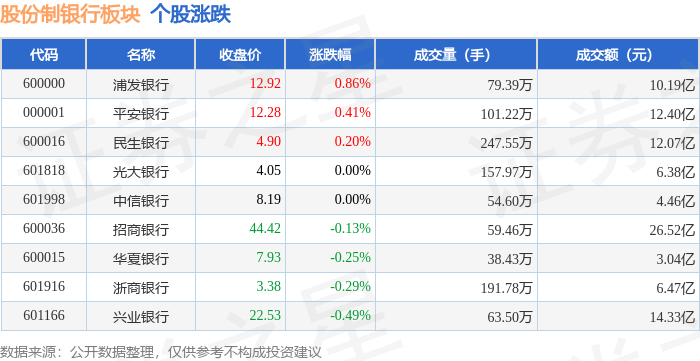
股份制银行板块8月1日涨0.02%,浦发银行领涨,主力资金净流入7.37亿元
Zheng Xing Xing Ye Ri Bao· 2025-08-01 08:42
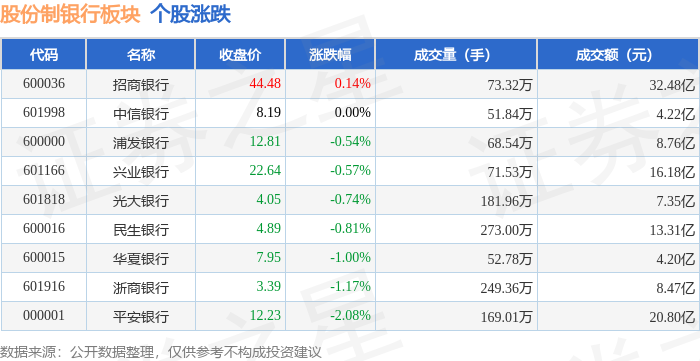
| 代码 | 名称 | 收盘价 | 涨跌幅 | 成交量(手) | 成交额(元) | | --- | --- | --- | --- | --- | --- | | 600000 | 浦发银行 | 12.92 | 0.86% | 79.39万 | 10.19亿 | | 000001 | 平安银行 | 12.28 | 0.41% | 101.22万 | 12.40 Z | | 600016 | 民生银行 | 4.90 | 0.20% | 247.55万 | 12.07亿 | | 601818 | 光大银行 | 4.05 | 0.00% | 157.97万 | 6.38亿 | | 866109 | 中信银行 | 8.19 | 0.00% | 54.60万 | 4.46 Z | | 600036 | 招商银行 | 44.42 | -0.13% | 59.46万 | 26.52亿 | | 600015 | 华夏银行 | 7.93 | -0.25% | 38.43万 | 3.04亿 | | 601916 | 浙商银行 | 3.38 | -0.29% | 191.78万 | 6.47亿 | | 601166 | 兴业银行 ...







YiwealthSMI |非“说教式”反诈内容屡上榜,捕捉热点是机构“破圈”秘诀
Di Yi Cai Jing· 2025-08-01 06:35
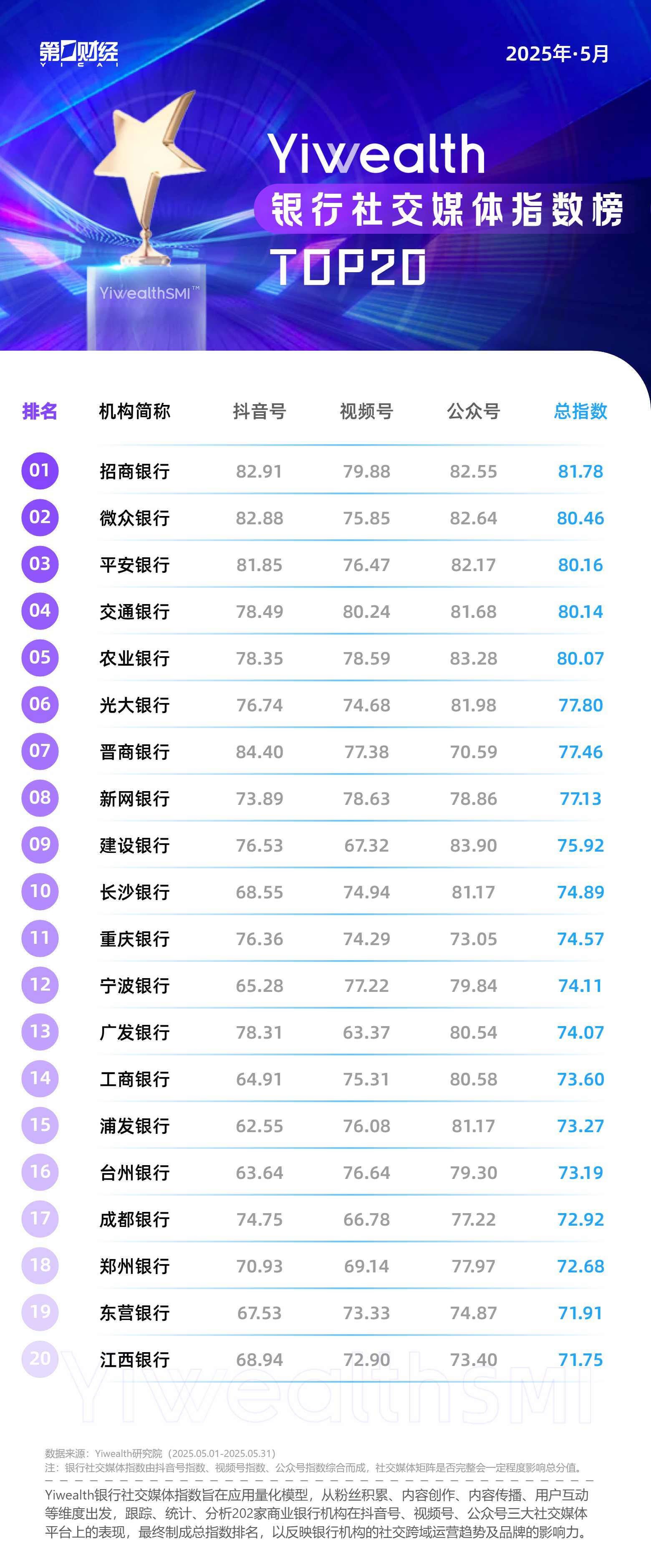
Group 1 - The May 2025 Bank Social Media Index (SMI) shows that the rankings are still concentrated at the lower end, primarily involving small and medium-sized banks [1] - Four banks, including Zheshang Bank and Hebei Bank, dropped out of the top rankings, while banks like Pudong Development Bank and Zhengzhou Bank entered the list [1] - The SMI is based on a quantitative model that tracks and analyzes the performance of 202 commercial banks across platforms like Douyin and WeChat [7][36] Group 2 - Popular Douyin videos from banks are closely tied to current hot topics and widely appealing themes, such as the Dragon Boat Festival and youth culture [2] - Notable content includes a series by WeBank that tells the story of a grandfather selling dumplings at a low price, which gained significant user engagement with 51,000 likes [2] - Banks are encouraged to move away from traditional promotional methods to attract user engagement, as demonstrated by Guangfa Bank's creative approach combining storytelling with anti-fraud education [2] Group 3 - The top-performing videos on video platforms often leverage holiday themes, with banks like Dongguan Bank promoting discounts during the Dragon Boat Festival and 618 shopping festival [3] - The WeChat public account rankings primarily focus on welfare and benefits for users [3] Group 4 - The rankings for Douyin and video platforms show that banks like China Merchants Bank and WeBank are leading in user engagement metrics [5][6] - The index reflects the banks' ability to create engaging content and accumulate followers across social media platforms [7][36] Group 5 - The public account rankings highlight various banks offering promotional activities, such as China Construction Bank providing benefits for members and China Agricultural Bank promoting commemorative coins [34][36] - The data indicates a trend where banks are increasingly utilizing social media to enhance customer engagement and promote their services [36]


美联储不加息了好多人在问买什么,这几个方向可能有机会
Sou Hu Cai Jing· 2025-08-01 05:07
Group 1: Financial Sector - The financial sector is expected to undergo a value reassessment due to the Fed's decision to maintain interest rates, which stabilizes banks' funding costs and profit margins [3] - The People's Bank of China announced a 50 basis point reserve requirement ratio cut in July, releasing significant liquidity that supports banks in expanding credit and maintaining interest margins [3] - Insurance stocks are also poised to benefit from a stable interest rate environment, which enhances investment returns and reduces overseas investment risks [3] Group 2: Import Consumption - The stabilization of the RMB exchange rate directly benefits import-dependent consumer companies, particularly in the aviation industry, which will see reduced operational costs [4] - The recovery of domestic tourism consumption further supports the aviation sector, creating a favorable environment for airline stocks [4] - Import companies in food and cosmetics will also benefit from stable exchange rates, although the impact on financial performance may be delayed [4] Group 3: Technology Sector - While the Fed's decision does not directly favor technology stocks, expectations of foreign capital inflow and increased domestic support for technological innovation provide a solid foundation for long-term growth [5] - The increase in the re-lending quota for technological innovation to 800 billion yuan significantly improves the financing environment for tech companies [5] - Key sectors such as artificial intelligence, semiconductors, and renewable energy are expected to receive more policy and financial support, indicating long-term growth potential despite short-term volatility [5] Group 4: Export Sector - The stability of the RMB exchange rate may reduce the price advantage for export companies, particularly those heavily reliant on the U.S. market, facing challenges amid unresolved tariff issues [8] - Traditional export industries like furniture, clothing, and toys have already been affected by tariffs, and without additional support from exchange rates, their competitiveness may weaken [8] - However, high-tech and differentiated product exporters may still maintain strong competitiveness in the market [8] Group 5: Investment Strategy - A cautious investment strategy is recommended, with a focus on benefiting sectors while avoiding blind chasing of trends [6] - Diversification across financial, consumer, and technology sectors is suggested to capture market opportunities while effectively managing investment risks [6]


银行业“反内卷”再掀浪潮!多地发文剑指房贷“返点”,“全员营销”缘何屡禁不止?
Xin Lang Cai Jing· 2025-07-31 10:51
Core Viewpoint - Recent self-regulatory agreements from various banking and insurance associations aim to combat "involution" in the industry, focusing on prohibiting loan rebates and enhancing the qualifications of marketing personnel [1][2][10]. Group 1: Self-Regulatory Agreements - Multiple banking associations have issued self-regulatory agreements emphasizing the prohibition of loan rebates for housing and car loans, marking a new phase in the industry's "anti-involution" campaign [2][5]. - The Guangdong Banking Association plans to implement a comprehensive system to address "involution" competition, including a negative list and self-regulatory measures [2][3]. - The Ningxia Banking Association has recognized the negative impact of personal housing loan rebates on the health of the banking sector and the real estate market, prompting the need for effective regulation [3][4]. Group 2: Impact on Banking Practices - The implementation of self-regulatory agreements is expected to halt any form of rebate practices, contributing to a healthier competitive environment [4][5]. - The banking sector has seen a narrowing decline in net interest margins, with fees and commissions from banking and insurance businesses reduced by 5% compared to the same period in 2024 [2][5]. Group 3: Regulatory Actions and Compliance - Regulatory bodies are intensifying efforts to combat "full-staff marketing" violations, with recent penalties imposed on banks for assigning deposit assessment targets to non-marketing departments [6][7]. - The Financial Regulatory Authority has mandated that financial institutions strengthen the management of sales personnel qualifications, effective from February 1, 2026 [7][9]. Group 4: Insurance Industry Developments - The insurance sector is also advancing its "anti-involution" efforts, with associations in various regions promoting self-regulatory agreements to prevent malicious price competition and false advertising [10][11]. - The recent adjustments in the insurance industry, including a reduction in the preset interest rate for life insurance products to 1.99%, aim to regulate pricing and mitigate financial risks [11].



金融Agent落地,谁能“敲开”银行的大门?
3 6 Ke· 2025-07-31 09:13
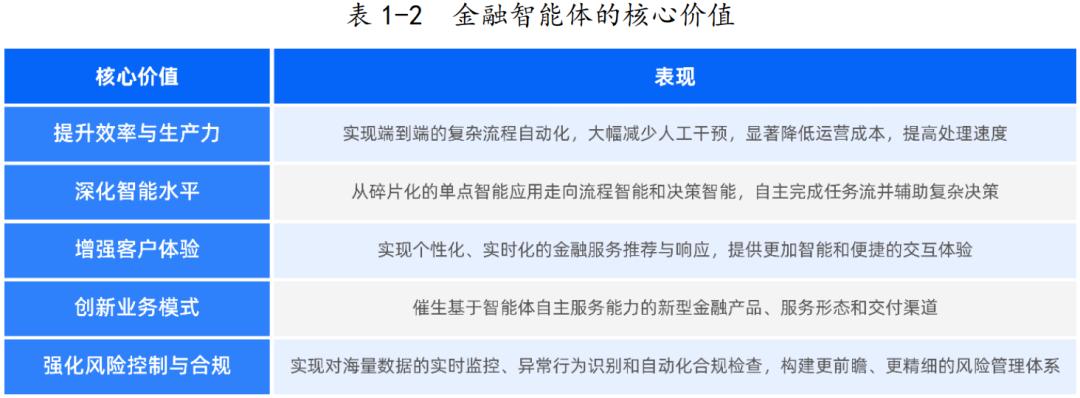
Core Insights - The Chinese banking industry is at a turning point with the emergence of AI technology, particularly AI Agents, which are set to revolutionize core banking functions such as credit and risk management by significantly enhancing productivity and efficiency [1][3][21] - AI Agents, built on large AI models, can autonomously perform tasks, assist in decision-making, and provide personalized financial services, thereby reducing manual intervention and operational costs [1][3][4] Group 1: AI Agent Implementation and Value - AI Agents are becoming a core focus for banks, with significant investments being made to develop and implement these technologies [4][6] - The core values of AI Agents include improving efficiency through end-to-end automation, enhancing decision-making capabilities, and providing personalized customer experiences [3][21] - Major banks like ICBC and Agricultural Bank of China are leading in financial technology investments, with ICBC planning to spend approximately 28.518 billion yuan in 2024 [6][8] Group 2: Bank-Specific Developments - Agricultural Bank of China has introduced the "Mosu Loan Scoring Card" AI Agent, which can generate credit reports in 30 seconds, significantly speeding up the due diligence process [8] - Postal Savings Bank is rapidly advancing its AI capabilities, achieving over 87.5% automation in alarm troubleshooting through its AI Agents [9] - Other banks, including China Merchants Bank and Ping An Bank, are also developing their own AI Agents to enhance data analysis and customer service [11][12] Group 3: Technology Partnerships - Banks are increasingly collaborating with technology companies to bridge the technological gap and enhance their AI capabilities [13][20] - Major tech players like Baidu, Alibaba, and Tencent are providing comprehensive AI solutions and infrastructure, which are crucial for the successful implementation of AI Agents in banking [14][15] - The partnership between banks and tech companies is essential for unlocking the potential of AI in the financial sector, especially for smaller banks [13][20] Group 4: Challenges and Future Outlook - Despite the rapid development of AI Agents, many banks are still focused on non-core applications, indicating a gap between potential and actual implementation [21][22] - The banking sector requires high accuracy and reliability from AI systems, which currently face challenges such as a 95% accuracy rate in leading financial models [23][24] - The transition to AI-driven banking is a long-term process that necessitates a solid AI strategy and collaboration between banks and technology providers to achieve significant ROI [30][31]


银行行业资金流入榜:农业银行、招商银行等净流入资金居前
Zheng Quan Shi Bao Wang· 2025-07-31 08:51
| 代码 | 简称 | 今日涨跌幅(%) | 今日换手率(%) | 主力资金流量(万元) | | --- | --- | --- | --- | --- | | 601288 | 农业银行 | 1.12 | 0.17 | 32637.20 | | 600036 | 招商银行 | 0.14 | 0.36 | 26861.57 | | 601398 | 工商银行 | 0.93 | 0.18 | 22617.27 | | 601939 | 建设银行 | 0.97 | 1.54 | 17738.39 | | 600016 | 民生银行 | -0.81 | 0.77 | 14577.83 | | 601009 | 南京银行 | -2.21 | 0.53 | 11566.19 | | 600926 | 杭州银行 | -1.89 | 1.02 | 10447.54 | | 601229 | 上海银行 | -1.25 | 0.51 | 7535.77 | | 601658 | 邮储银行 | 0.88 | 0.41 | 7029.01 | | 002966 | 苏州银行 | -1.61 | 0.86 | 5127.33 | | ...

股份制银行板块7月31日跌0.46%,平安银行领跌,主力资金净流入4.11亿元
Zheng Xing Xing Ye Ri Bao· 2025-07-31 08:32
证券之星消息,7月31日股份制银行板块较上一交易日下跌0.46%,平安银行领跌。当日上证指数报收于3573.21,下跌1.18%。深证成指报收于 11009.77,下跌1.73%。股份制银行板块个股涨跌见下表: | 代码 | 名称 | 主力净流入 (元) | 主力净占比 | 游资净流入(元) | 游资净占比 散户净流入(元) | | 散户净占比 | | --- | --- | --- | --- | --- | --- | --- | --- | | 600036 | 招商银行 | 2.53 亿 | 7.78% | -1.86 Z | -5.74% | -6641.60万 | -2.05% | | 600016 | 民生银行 | 1.19/Z | 8.92% | -6015.86万 | -4.52% | -5858.20万 | -4.40% | | 818109 | 光大银行 | 5346.41万 | 7.27% | -961.18万 | -1.31% | -4385.23万 | -5.97% | | 601166 | 兴业银行 | 4115.16万 | 2.54% | -7863.88万 | -4.86% ...

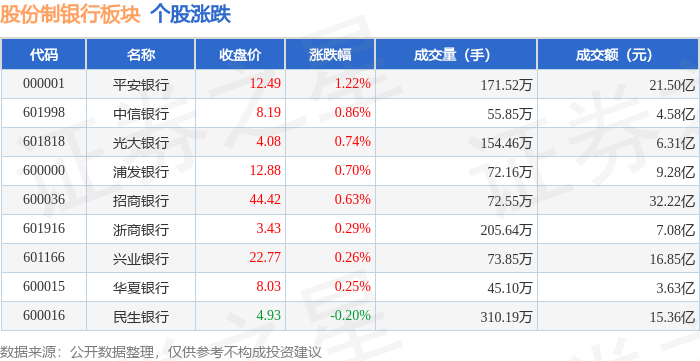
股份制银行板块7月30日涨0.59%,平安银行领涨,主力资金净流入4.95亿元
Zheng Xing Xing Ye Ri Bao· 2025-07-30 08:27
证券之星消息,7月30日股份制银行板块较上一交易日上涨0.59%,平安银行领涨。当日上证指数报收于 3615.72,上涨0.17%。深证成指报收于11203.03,下跌0.77%。股份制银行板块个股涨跌见下表: | 代码 | 名称 | 收盘价 | 涨跌幅 | 成交量(手) | 成交额(元) | | --- | --- | --- | --- | --- | --- | | 000001 | 平安银行 | 12.49 | 1.22% | 171.52万 | 21.50亿 | | 601998 | 中信银行 | 8.19 | 0.86% | 55.85万 | 4.58亿 | | 601818 | 光大银行 | 4.08 | 0.74% | 154.46万 | 6.31亿 | | 600000 | 浦发银行 | 12.88 | 0.70% | 72.16万 | 9.28 6 | | 600036 | 招商银行 | 44.42 | 0.63% | 72.55万 | 32.22 乙 | | 601916 | 浙商银行 | 3.43 | 0.29% | 205.64万 | 7.08亿 | | 601166 | 兴业银行 ...
42家上市银行分红大比拼:华夏银行股息率超5%,郑州银行“垫底”
Sou Hu Cai Jing· 2025-07-30 07:38
经济导报记者 刘勇 与此同时,多家银行已经披露2025年中期分红计划。 受访的业内人士认为,银行推出中期分红可以让投资者更早享受银行成长红利。"从已披露2025年半年度业绩快报看,部分银行上半年营业收入和归母净 利润均有所增长,因此中期分红的总额也会有一定程度的增长。"银行业分析师张鹏博表示。 7月22日,成都银行发布2024年年度权益分派实施公告。根据公告,本次利润分配以总股本42.38亿股为基数,每股派发现金红利0.891元(含税),合计派 发现金红利约37.76亿元。股权登记日为7月25日,除权(息)日及现金红利发放日均为7月28日。 | 证券代码 | 证券名称 | 2024年度分红总额(亿元) | 2024年度现金分红比例(%) | | --- | --- | --- | --- | | 000001.SZ | 平安银行 | 117.9880 | 26.5094 | | 001227.SZ | 兰州银行 | 5.7527 | 30.4727 | | 002142.SZ | 宁波银行 | 59.4323 | 21.9089 | | 002807.SZ | 江阴银行 | 4.9228 | 24.1691 ...