GREE(000651)

Search documents
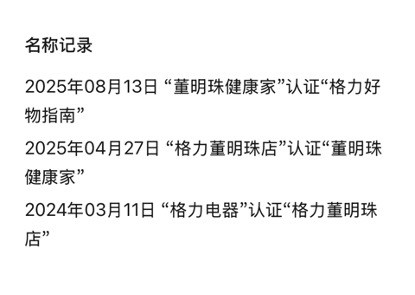
格力 “董明珠健康家” 更名引猜测 或为加码上线做铺垫
Xi Niu Cai Jing· 2025-08-19 09:15
Core Viewpoint - Gree Electric's recent renaming of its WeChat public account from "Dong Mingzhu Health Home" to "Gree Good Product Guide" has sparked speculation about the potential abandonment of the former name, but internal sources clarified that the change is part of preparations for the launch of an online store [1][2]. Group 1 - The renaming of the WeChat account is due to Tencent's platform rules that prevent two accounts from sharing the same name, necessitating the change to facilitate the upcoming online store [2]. - Dong Mingzhu, the leader of Gree, has been highly visible recently, making bold statements about the company's products, emphasizing the importance of using Gree appliances [2]. - Gree is actively reforming its distribution channels and focusing on enhancing its online sales presence, indicating a strategic shift towards e-commerce [2]. Group 2 - Gree has been diversifying its business beyond traditional air conditioning, venturing into refrigerators, washing machines, small appliances, and even the new energy vehicle sector, although air conditioning remains its primary revenue source [2]. - The public account was renamed back to "Dong Mingzhu Health Home" shortly after the initial change, indicating a possible reconsideration of branding strategy [3].


白色家电板块8月19日涨0.13%,长虹美菱领涨,主力资金净流入1.32亿元
Zheng Xing Xing Ye Ri Bao· 2025-08-19 08:32
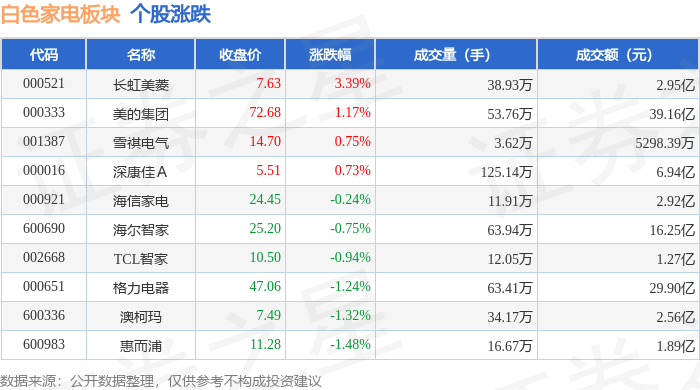
Market Overview - The white goods sector increased by 0.13% on August 19, with Changhong Meiling leading the gains [1] - The Shanghai Composite Index closed at 3727.29, down 0.02%, while the Shenzhen Component Index closed at 11821.63, down 0.12% [1] Stock Performance - Changhong Meiling (000521) closed at 7.63, up 3.39% with a trading volume of 389,300 shares [1] - Midea Group (000333) closed at 72.68, up 1.17% with a trading volume of 537,600 shares [1] - Other notable performances include: - Snowman Electric (001387) at 14.70, up 0.75% - Deep Blue Technology (000016) at 5.51, up 0.73% - Hisense Home Appliances (000921) at 24.45, down 0.24% - Gree Electric (000651) at 47.06, down 1.24% [1] Capital Flow - The white goods sector saw a net inflow of 132 million yuan from institutional investors, while retail investors experienced a net inflow of approximately 63.71 million yuan [1] - Notable capital flows include: - Midea Group had a net inflow of 88.14 million yuan from institutional investors [2] - Gree Electric saw a net inflow of 52.34 million yuan from institutional investors [2] - Changhong Meiling experienced a net outflow of 24.91 million yuan from retail investors [2]




格力高管回应“空调线上销量被小米超越”
Sou Hu Cai Jing· 2025-08-19 03:17
Core Viewpoint - The competition between Gree Electric and Xiaomi in the air conditioning market is intensifying, with conflicting reports on market share and sales performance [1][3][5]. Group 1: Market Share Data - According to a recent report, Xiaomi's online market share for air conditioners in July was 16.71%, while Gree's was 15.22%, placing them second and third respectively [3]. - However, Gree Electric's market director claimed that their data shows Gree still leads in the online market for July [1]. - Another source indicated that the market shares for July were: Midea at 19.98%, Gree at 16.41%, and Xiaomi at 13.50%, highlighting a nearly three percentage point gap between Xiaomi and Gree [5]. Group 2: Company Responses - Xiaomi's President, Lu Weibing, acknowledged the achievement of becoming the second in market share and expressed gratitude for consumer support [4]. - Gree Electric's market director refuted claims of Xiaomi surpassing them, emphasizing the importance of accurate data [1]. Group 3: Data Interpretation - The discrepancies in reported market shares stem from different data dimensions used by Gree and Midea, with Gree focusing on online sales and Midea including both online and offline channels [7]. - The data cited by both companies reflects different brand scopes, with Midea's figures encompassing multiple brands under its umbrella, while Gree's data pertains solely to its brand [7].

格力高管回应“空调线上销量被小米超越”
21世纪经济报道· 2025-08-19 03:08
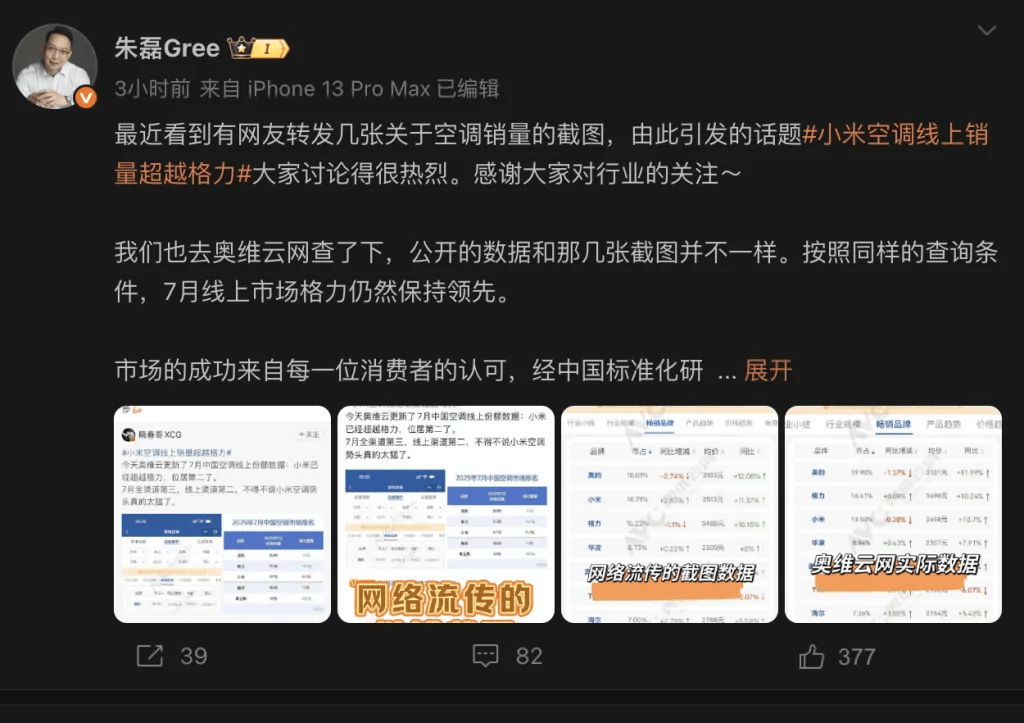
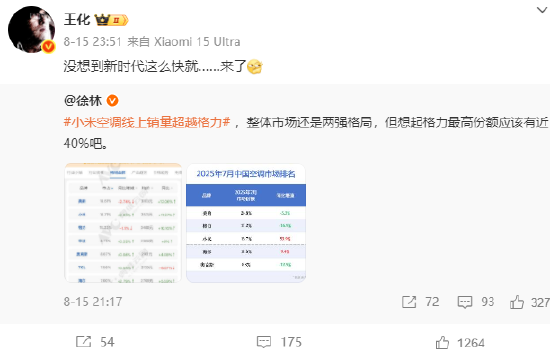
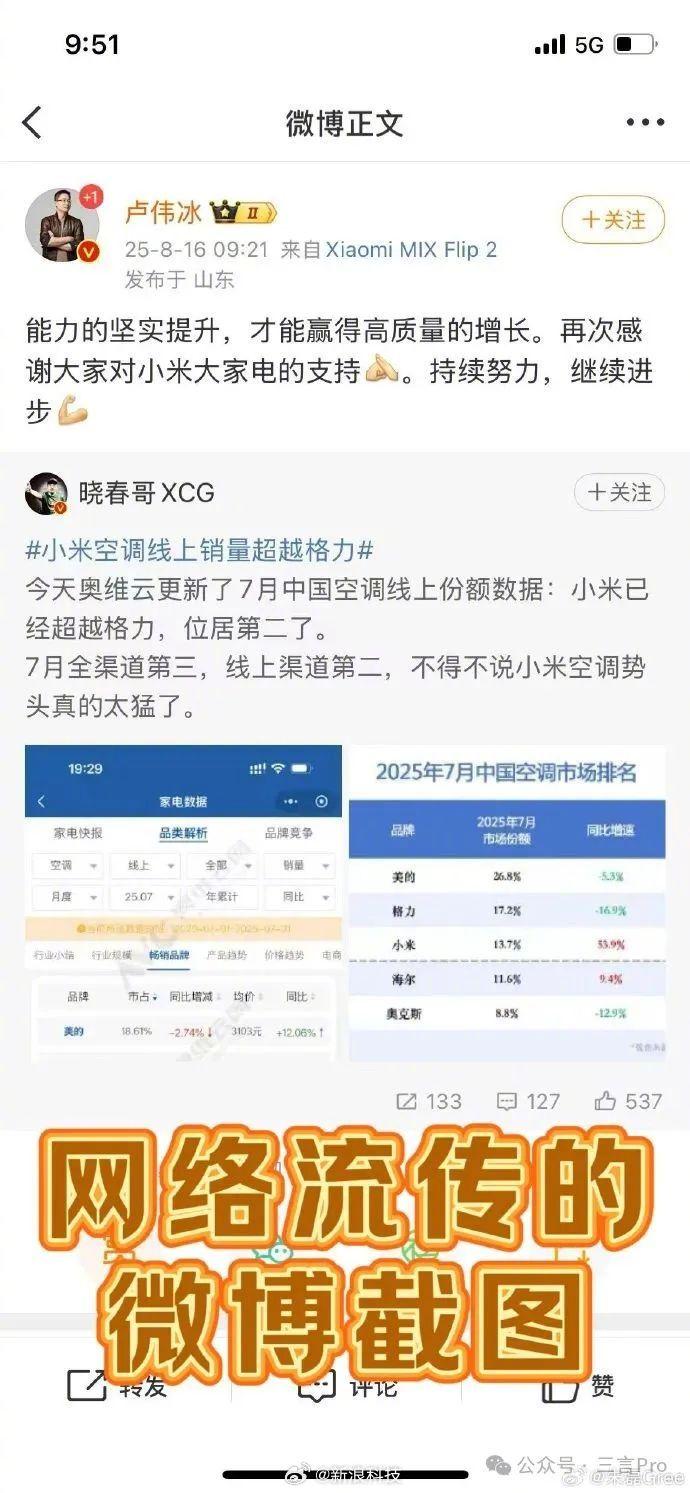
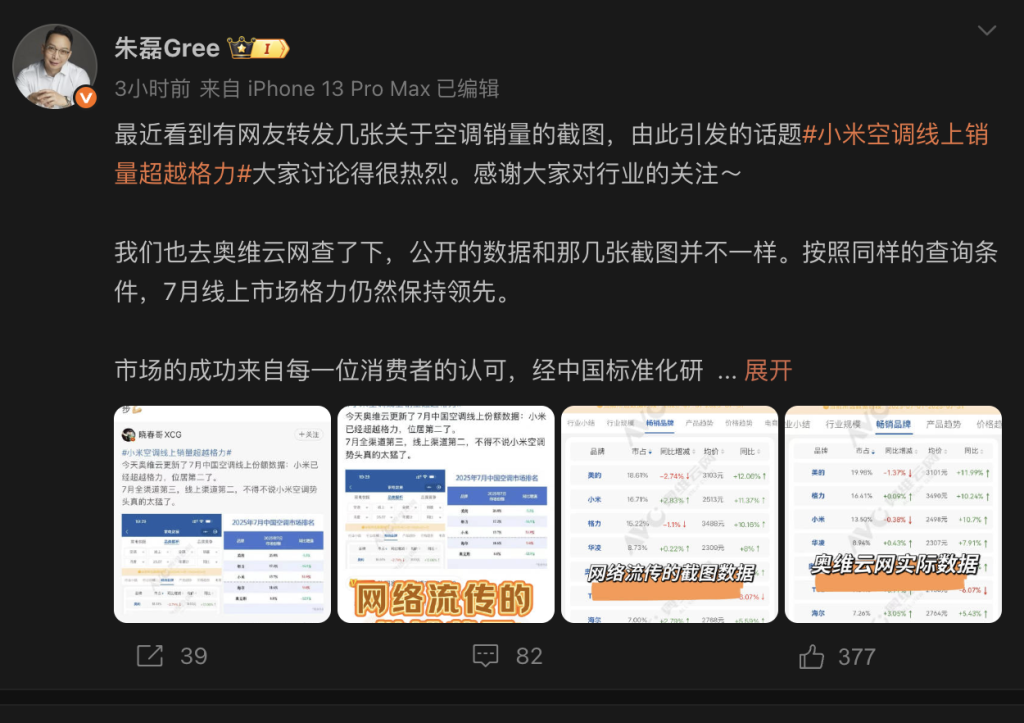
8月18日晚,格力电器市场总监朱磊在微博上发文反击"小米空调线上销量超越格力"说法,称"我们也去奥维云网查了下,公开的数据和那几张 截图并不一样。按照同样的查询条件7月线上市场格力仍然保持领先。" 近日,有网友发文称奥维云网更新了7月份中国空调线上份额数据,小米已经超越格力,位居第二。7月份全渠道第三,线上渠道第二。并且贴 出的截图显示:7月份线上空调,小米市场份额为16.71%,格力电器为15.22%,分别是第二、第三名。 8月16日,小米集团总裁卢伟冰转发了小米空调是第二名的信息并留言称"能力的提升,才能赢得高质量的增长,再次感谢大家对小米大家电的 支持。" 小米集团公关部总经理王化也转发了相关信息,称"没想到新时代这么快就……来了。" 南财快讯记者也查询了奥维云网的数据,查询结果显示:7月份线上空调市场份额第一名为美的(19.98%)、第二名为格力(16.41%),第三 名为小米(13.50%)。小米市场份额与格力电器还有近三个百分点差距。 (声明:文章内容仅供参考,不构成投资建议。投资者据此操作,风险自担。) 出品 | 2 1财经客户端 南财快讯工作室 记者丨黎雨桐 编辑 | 曾静娇 SFC 21君荐 ...
奥维数据乌龙搞出小米格力空调之争?总裁郭梅德曾表示“常年积累家详细零售数据”
Xin Lang Ke Ji· 2025-08-19 02:54
Core Viewpoint - Xiaomi's online air conditioner sales have reportedly surpassed Gree's, sparking a public response from both companies' executives [1][3]. Group 1: Sales Data Comparison - Xiaomi's online market share for air conditioners is reported at 16.71%, while Gree's is at 15.22% according to Xiaomi executives [1]. - Gree's market share, as cited by its marketing director, is 16.41%, which is higher than Xiaomi's reported 13.5% [3][6]. - The latest data from AVC (Aowei Cloud Network) confirms Gree's market share at 16.41% and Xiaomi's at 13.5% [3][6]. Group 2: Executive Responses - Xiaomi's executives expressed surprise and gratitude for the support received, indicating a strong belief in their growth capabilities [1]. - Gree's marketing director publicly disputed Xiaomi's claims, emphasizing that Gree remains the leader in online air conditioner sales [1][3]. Group 3: Market Trends - The overall market for air conditioners shows Gree leading with a slight increase in market share, while Xiaomi has experienced a decrease [4][6]. - Gree's average price for air conditioners is reported at 3,490 yuan, while Xiaomi's is significantly lower at 2,498 yuan, indicating a pricing strategy difference [4][6]. Group 4: Data Integrity Concerns - There are allegations regarding the accuracy of the data reported by Aowei Cloud Network, with claims that the data collection methodology may have changed [8]. - The original data shared by Xiaomi's executive was confirmed by industry insiders, suggesting that discrepancies in reported figures may not be due to fabrication [8]. Group 5: Company Background - Aowei Cloud Network is a significant player in the smart home data analytics sector, providing detailed retail data for the home appliance industry [9]. - The company has been operational for over 17 years and is recognized as a leading third-party data provider in the smart home field [9].
#小米空调线上销量超越格力#是奥维搞出的大乌龙?奥维暂无回应
Xin Lang Ke Ji· 2025-08-19 02:25
近日,"小米空调线上销量超越格力"登上微博热搜。 在8月15日、16日,小米高管卢伟冰、王化先后转发了奥维云网数据#小米空调线上销量超越格力#的消 息。 王化表示"没想到新时代这么快就来了"。卢伟冰则表示,"能力的坚实提升,才能赢得高质量的增长。 再次感谢大家对小米大家电的支持"。 对此,格力高管坐不住了。8月18日晚,格力电器市场总监朱磊在微博回应小米空调线上销量超越格力# 称,据奥维云网数据,7月格力空调在线上市场仍然领先小米。 可以看到,卢伟冰微博转发别人的截图中,小米空调线上销售市占率16.71%,高于格力的15.22%。但 朱磊查询的数据显示,格力的市占率16.41%,远高于小米的13.5%。 对此,新浪科技今日查阅奥维云网显示,与朱磊查询的数据一致,格力的市占率16.41%,远高于小米 的13.5%。 | | | 家电数据 | | ... O | | | --- | --- | --- | --- | --- | --- | | 家电快报 | | 品类解析 | | 品牌竞争 | | | 空调 ਚ | 线上 | V 全部 | | 销量 | 4 | | 月度 ਵ | 25.07 | V 年累计 | | ...
奥维数据更改致小米格力空调销量反转
Xin Lang Ke Ji· 2025-08-19 02:24
#奥维数据更改致小米格力销量反转#【破案了!#小米格力空调之争原来是奥维的锅#】近日,#小米空 调线上销量超越格力#一事引发争议,原因是小米和格力发布的第三方平台奥维云网的数据差距巨大。 小米高管@卢伟冰、@王化 最先转发的数据显示小米领先,而随后格力高管@朱磊Gree 发布的数据显 示格力远远超过小米。 可以看到,卢伟冰微博转发博主@晓春哥XCG 的截图中,小米空调线上销售市占率16.71%,高于格力 的15.22%。但朱磊查询的数据显示,格力的市占率16.41%,远高于小米的13.5%。当前,据媒体实测, 结果与格力公布的数据一致。 那么问题到底出在哪里呢?晓春哥XCG回应称:"这个事情,是奥维更改了数据罗盘的统计口径。" 他表示当时卢伟冰转发的截图数据确实是真的,不少同行都看到了,也有不少人截图,不存在编造数 据。"这个数据业内从业人员应该都可以看到,各大品牌也都有订阅,不是我瞎编的数据。"而目前,奥 维云网的最新数据与格力后来发布的截图一致。博主称不知道这种更改是不是频繁的。(三言Pro) Z 133 日 127 凸 537 | 19:29 | | | | 11 2 6 11 | | 2025年7月中 ...
到底谁是线上空调第二名?格力市场总监晒图:格力依旧领先小米
Feng Huang Wang· 2025-08-19 01:56
Core Viewpoint - The competition in the air conditioning market is intensifying, with Xiaomi reportedly surpassing Gree in online sales, although Gree disputes this claim based on its own data analysis [1][2]. Group 1: Market Share Data - In July, Xiaomi's online market share reached 16.71%, while Gree's was 15.22%, placing Xiaomi in second and Gree in third [1]. - Midea remains the market leader with a share of 19.98% [2]. - Xiaomi's average price for air conditioners was reported at 2,613 yuan, reflecting a year-on-year increase of 11.37% [1]. Group 2: Company Responses - Gree's marketing director, Zhu Lei, publicly refuted Xiaomi's claims, stating that Gree still leads in the online market according to their data [2]. - Xiaomi's executives expressed gratitude for the support received, highlighting their commitment to quality growth in the home appliance sector [2]. Group 3: Industry Dynamics - The air conditioning market is characterized by a differentiation in strategies, with Xiaomi focusing on cost-effective products while Gree targets the mid-to-high-end segment [2]. - Gree emphasizes its long-standing customer satisfaction, having ranked first in customer satisfaction for 16 consecutive years according to the China Standardization Research Institute [2][3].
小米空调线上销量超越格力?双方回应
财联社· 2025-08-19 01:44
Core Viewpoint - The competition between Gree Electric and Xiaomi in the air conditioning market is intensifying, with Xiaomi reportedly surpassing Gree in online sales for July, according to data from Aowei Cloud Network [5][8]. Group 1: Market Position - In July, Xiaomi's online market share reached 16.71%, placing it second, while Gree's share was 15.22%, ranking third [5][8]. - Gree Electric's market director, Zhu Lei, refuted claims of Xiaomi's overall dominance, stating that Gree still leads in the online market as of July [1][5]. Group 2: Industry Dynamics - Zhu Lei emphasized that healthy competition benefits both the industry and consumers, expressing optimism about the ongoing investments from competitors that drive industry progress [2][5]. - Xiaomi's president, Lu Weibing, acknowledged the importance of capability enhancement for achieving high-quality growth and thanked consumers for their support [7][10].

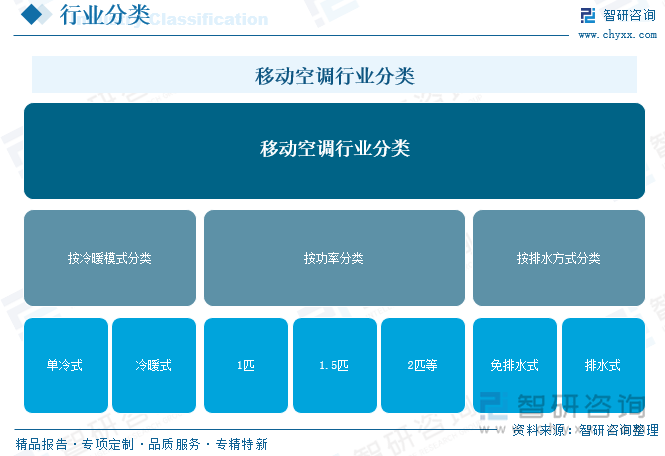
趋势研判!2025年中国移动空调行业整体发展形势分析:我国是全球移动空调主要供应国家,在政策支持下,研发供给能力不断增强,市场前景良好[图]
Chan Ye Xin Xi Wang· 2025-08-19 01:30
Core Viewpoint - The global demand for portable air conditioners is expected to rise significantly due to the impact of the El Niño climate phenomenon, with a projected increase in demand from 6.94 million units in 2023 to 7.52 million units in 2024, and further to 8.03 million units in 2025 [1][6]. Industry Overview - Portable air conditioners are defined as movable cooling devices that do not require fixed installation, making them suitable for temporary settings such as rental homes and outdoor events [2][4]. - The market for portable air conditioners is characterized by a growing demand in high-latitude regions, particularly in Europe and North America, driven by rising temperatures [6][8]. Market Demand and Supply - In 2024, China's production of portable air conditioners is expected to reach 6.50 million units, with a domestic demand of only 0.89 million units, resulting in a net export of 5.62 million units [8][10]. - The demand for portable air conditioners in China is projected to grow to 0.95 million units by 2025, with production increasing to 6.62 million units [10][19]. Market Segmentation - In 2024, the demand for portable air conditioners in China is segmented as follows: 32,000 units (35.98%) for 1 HP and below, 46,610 units (52.41%) for 1 to 1.5 HP, and 10,330 units (11.61%) for above 1.5 HP [10]. - The market size for portable air conditioners in China is estimated at 1 billion yuan in 2024, with the largest segment being 1 to 1.5 HP units [10]. Competitive Landscape - The portable air conditioner market in China is highly competitive, with major players including Gree Electric Appliances, Midea Group, Haier Smart Home, Hisense, and Changhong Meiling [16][18]. - These companies leverage technological advancements and brand reputation to maintain market leadership, while emerging brands seek differentiation through unique strategies [16]. Industry Trends - Future trends in the portable air conditioner industry include increased focus on smart technology integration, personalized designs, and environmentally friendly practices throughout the product lifecycle [19].