BOE(000725)

Search documents
英特尔:与京东方共同开发创新显示技术
Xin Lang Cai Jing· 2025-10-29 06:25
Core Viewpoint - Intel and BOE are collaborating to develop AI-based energy-saving solutions for laptop display screens, aiming to balance energy efficiency and visual quality while extending battery life and ensuring excellent visual experience [1] Group 1 - The new technology is expected to be implemented in OEM products using Intel platforms by 2026 [1]


未盈利上市首日涨近200%,68岁京东方创始人再获千亿IPO
2 1 Shi Ji Jing Ji Bao Dao· 2025-10-29 01:44
Core Viewpoint - Xi'an Yiswei Materials Technology Co., Ltd. (referred to as Xi'an Yicai) successfully listed on the Sci-Tech Innovation Board, raising a total of 4.636 billion yuan through the issuance of 537.8 million shares at an initial price of 8.62 yuan per share, with a first-day stock price surge of 361.48% to 39.78 yuan per share, closing at 25.75 yuan, representing a 198.72% increase, resulting in a total market capitalization of 103.973 billion yuan [1][3][12]. Group 1 - Xi'an Yicai is one of the first companies registered under the newly established Sci-Tech Growth Tier on the Sci-Tech Innovation Board, alongside He Yuan Bio and Biotech [3]. - The company is the first unprofitable enterprise to be accepted for listing on the Sci-Tech Innovation Board since the introduction of the "Sci-Tech Eight Articles" by the China Securities Regulatory Commission in June 2024 [3]. - Xi'an Yicai reported net losses of 533 million yuan, 683 million yuan, and 738 million yuan for the years 2022 to 2024, respectively, but showed a 46% year-on-year revenue growth in the first half of 2025, reaching 1.3 billion yuan, with a reduced net loss of 340 million yuan [3][12]. Group 2 - The management team of Xi'an Yicai has a notable "BOE System" background, with key figures having previously held executive positions at BOE Technology Group [7][8]. - The company focuses on the research, manufacturing, and sales of 12-inch silicon single crystal polished wafers and epitaxial wafers, which are essential for various semiconductor applications [10]. - Xi'an Yicai aims to challenge the global oligopoly in the 12-inch silicon wafer market, which is currently dominated by Japanese companies [10][11]. Group 3 - The company plans to use the funds raised from the IPO for the construction of the second phase of the Xi'an Yiswei Silicon Industry Base, with total investments for the first and second factories amounting to 11 billion yuan and 12.5 billion yuan, respectively [12]. - Xi'an Yicai is projected to become the largest 12-inch silicon wafer manufacturer in mainland China and the sixth globally, with a market share of approximately 6% in monthly shipments and 7% in production capacity by the end of 2024 [11][12]. - The company anticipates a prolonged period of gross margin losses, typically lasting 4 to 6 years for new market entrants, with expectations of achieving profitability around 2027 [12].


CINNO Research:三季度全球AMOLED手机面板出货量约2.5亿片 同比增长11.7% 环比增长20.3%
智通财经网· 2025-10-28 23:52
Core Insights - The upcoming third quarter is expected to see a significant increase in demand for OLED panels due to the launch of flagship products by Apple and major domestic brands, with a projected shipment of approximately 250 million AMOLED smartphone panels globally, marking a year-on-year growth of 11.7% and a quarter-on-quarter growth of 20.3% [1] Market Overview - In the third quarter of 2025, the global AMOLED smartphone panel shipment from South Korea is expected to account for 51.6% of the total, showing a year-on-year decrease of 0.8 percentage points but a quarter-on-quarter increase of 4.2 percentage points, primarily driven by short-term demand from Apple’s new device preparations; domestic manufacturers will hold a 48.4% share [4] - Samsung Display (SDC) is projected to see a year-on-year shipment growth of 7.1%, with its market share decreasing from 45.2% to 43.4%, reflecting a 1.8 percentage point decline; despite its technological advantages in LTPO backplanes, SDC is losing orders in the mid-range market [5] - BOE's AMOLED smartphone panel shipments are expected to grow by 30.8% year-on-year, with its market share increasing by 2.3 percentage points to 15.7%, benefiting from penetration in the mid-range market and continued breakthroughs in the high-end market [5] - Visionox's AMOLED smartphone panel shipments are anticipated to grow by 16.7% year-on-year, with a market share increase of 0.5 percentage points to 12.7%, attributed to effective operational strategies and stable demand in the mid-range market [5] - Tianma's AMOLED smartphone panel shipments are projected to grow by 28.4% year-on-year, with a market share increase of 1.3 percentage points to 10.0%, driven by stable demand from key customers and improvements in production technology and yield [5] Flexible Panel Insights - In the third quarter of 2025, flexible AMOLED smartphone panels are expected to account for 80.1% of total AMOLED smartphone panel shipments, reflecting a year-on-year increase of 3.6 percentage points and a quarter-on-quarter increase of 3.1 percentage points; South Korea's share will be 43.8%, down 1.4 percentage points year-on-year, while domestic manufacturers will hold 56.2% [6] - SDC's flexible AMOLED smartphone panel shipments are projected to grow by 9.3% year-on-year and 40.4% quarter-on-quarter, with a market share of 33.5%, down 2.3 percentage points year-on-year, facing increasing competition from domestic manufacturers [6] - BOE's flexible AMOLED smartphone panel shipments are expected to grow by 30.8% year-on-year and 9.3% quarter-on-quarter, with a market share of 19.7%, reflecting a 2.1 percentage point increase year-on-year, driven by significant growth in high-end flexible screen orders [8] - Visionox's flexible AMOLED smartphone panel shipments are anticipated to grow by 16.2% year-on-year and 54.2% quarter-on-quarter, with a market share of 13.7%, significantly above the industry average in terms of production line utilization [8] - Tianma's flexible AMOLED smartphone panel shipments are projected to grow by 28.4% year-on-year and 8.3% quarter-on-quarter, with a market share of 12.5%, reflecting a 1.1 percentage point increase year-on-year [8]


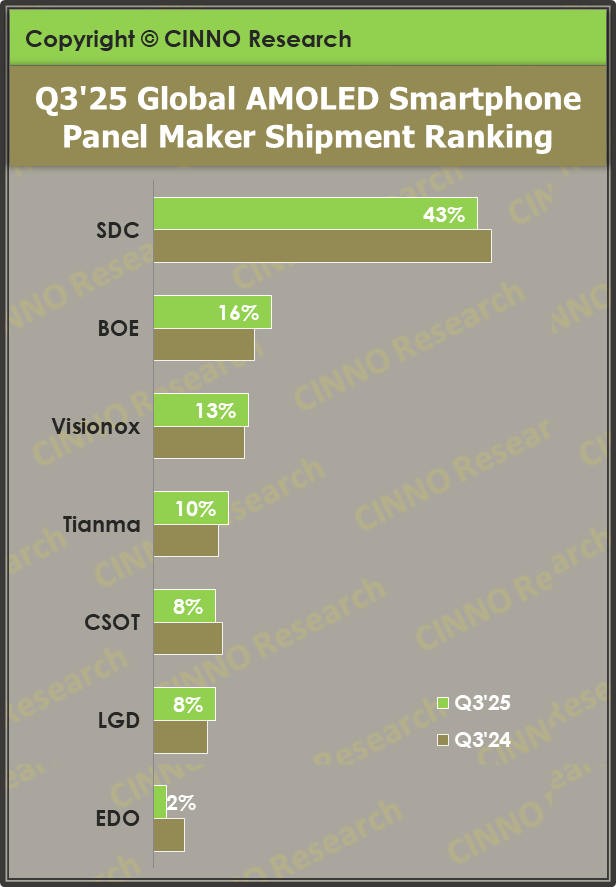
Q3’25全球AMOLED手机面板出货量同比、环比双增长
CINNO Research· 2025-10-28 23:42
Core Viewpoint - The global AMOLED smartphone panel shipment in Q3 2025 reached approximately 250 million units, showing a year-on-year growth of 11.7% and a quarter-on-quarter growth of 20.3%, indicating a continuous recovery in market conditions [1][2]. Market Demand and Trends - The arrival of the traditional sales peak in Q3, along with the launch of flagship products by Apple and major domestic brands, significantly boosted the demand for OLED panels [2]. - The market for AMOLED smartphone panels is experiencing a dual growth trend both year-on-year and quarter-on-quarter, reflecting a sustained recovery in market conditions [2]. Regional Shipment Analysis - In Q3 2025, the shipment share of AMOLED smartphone panels in South Korea accounted for 51.6%, showing a year-on-year decline of 0.8 percentage points but a quarter-on-quarter increase of 4.2 percentage points, primarily driven by short-term demand from Apple’s new device preparations [3]. - Domestic manufacturers held a shipment share of 48.4% in the same period [3]. Company Performance - Samsung Display (SDC) saw a year-on-year shipment growth of 7.1%, but its market share decreased from 45.2% to 43.4%, indicating a 1.8 percentage point decline, attributed to intensified order losses in the mid-range market despite its technological advantages in LTPO backplanes [3]. - BOE's AMOLED smartphone panel shipments grew by 30.8% year-on-year, marking the largest increase among major manufacturers, with its market share rising by 2.3 percentage points to 15.7%, driven by penetration in the mid-range market and breakthroughs in the high-end market [3]. - Tianma's AMOLED smartphone panel shipments increased by 28.4% year-on-year, with its market share rising by 1.3 percentage points to 10.0%, supported by stable demand from key customers and continuous improvements in production technology and yield [5]. Flexible Panel Shipment Insights - In Q3 2025, flexible AMOLED smartphone panels accounted for 80.1% of total shipments, reflecting a year-on-year increase of 3.6 percentage points and a quarter-on-quarter increase of 3.1 percentage points [8]. - SDC's flexible AMOLED panel shipments grew by 9.3% year-on-year and 40.4% quarter-on-quarter, but its market share fell by 2.3 percentage points to 33.5%, facing competitive pressure from domestic manufacturers [9]. - BOE's flexible AMOLED panel shipments increased by 30.8% year-on-year and 9.3% quarter-on-quarter, with its market share rising by 2.1 percentage points to 19.7%, driven by significant growth in high-end flexible screen orders [9].

北京东方园林环境股份有限公司关于重整计划预留股份拟引入投资人的进展公告
Shang Hai Zheng Quan Bao· 2025-10-28 23:17
Core Viewpoint - Beijing Oriental Garden Environment Co., Ltd. plans to introduce 9 investors through the allocation of 700 million reserved shares to support its main business development, with a lock-up period of 24 months for the investors [2][12]. Group 1: Investment Details - The company intends to use the proceeds from the introduction of investors to support its main business development [2]. - The 9 investors will not cause any changes in the company's controlling shareholder or actual controller [2]. - The investment does not constitute a major asset restructuring as defined by the relevant regulations [2]. Group 2: Investor Information - All 9 investors have completed their business registration, with specific details provided for each investor, including their investment amounts and structures [3][7][10]. - The investors include entities such as Tianjin Yunxin Yongying New Energy Equity Investment Partnership and Tianjin Wucheng Yingmao Enterprise Management Consulting Partnership, among others [3][7][10]. - The investors are primarily backed by central or local state-owned enterprises, providing a solid credit foundation for the share subscription [12]. Group 3: Payment and Compliance - The company will send a payment notice to the investors within ten working days after the agreement is signed, requiring full payment to be made to a designated bank account [13]. - Each investor has confirmed their legal qualifications and compliance with relevant laws and regulations, ensuring the legitimacy of the investment funds [12].

全球四条8.6代OLED线投产时间预测出炉
WitsView睿智显示· 2025-10-28 07:51
Core Viewpoint - The global IT OLED panel market is entering a phase of diverse investment plans, with major players like Samsung Display, BOE, Visionox, and TCL Huaxing launching their 8.6-generation OLED production lines, indicating a competitive landscape ahead [2][5][6][7][9]. Group 1: Samsung Display - Samsung Display initiated its 8.6-generation line investment in 2023, utilizing traditional FMM evaporation technology and planning to incorporate Tandem OLED processes to enhance screen longevity. The equipment installation is complete, and products are expected to be introduced in the new MacBook Pro series by Apple in 2026, with mass production anticipated in Q2 2026 [5]. Group 2: BOE - Following Samsung, BOE announced its 8.6-generation OLED line investment by the end of 2023, also employing FMM evaporation technology and Tandem OLED configurations. Equipment installation is set to be completed gradually starting from Q2 2025, with production expected to commence in the first half of 2026 [6]. Group 3: Visionox - Visionox is entering the FMM-free camp with its self-developed ViP (Visionox Intelligent Pixelization) technology, which promises higher pixel density and aperture ratio compared to traditional FMM. The company plans to establish its 8.6-generation OLED line by Q2 2024, aiming for completion of the facility by Q4 2025 and volume production to start in Q1 2027 [7]. Group 4: TCL Huaxing - TCL Huaxing is adopting inkjet printing (IJP) technology, which simplifies the process compared to traditional FMM and theoretically reduces material waste by about 30%. Following the groundbreaking ceremony for its 8.6-generation OLED line, TCL Huaxing targets volume production by Q4 2027 [9]. Group 5: Market Dynamics - The investment plans for both FMM and non-FMM generation lines are proliferating, indicating a competitive environment in the IT OLED panel supply chain. The FMM camp benefits from established customer relationships and production experience, while the non-FMM camp, despite facing challenges like lower yield rates and material development, has the potential to catch up due to high market interest [9].


TrendForce:IT OLED面板大世代竞争升温 FMM阵营领跑、FMM-free阵营加速推进
智通财经网· 2025-10-28 06:24
Group 1 - The global IT OLED panel investment landscape is entering a phase of diversification, with both FMM and non-FMM camps planning significant investments in large-generation production lines [1] - The FMM camp benefits from strong customer relationships and production experience, while the non-FMM camp, including technologies like ViP and IJP, faces challenges such as low yield rates and material development [1] - Samsung Display Corporation (SDC) is a market leader, having initiated the 8.6-generation OLED production line investment using traditional FMM deposition processes [2] Group 2 - SDC plans to introduce Tandem OLED processes to enhance screen longevity, with products expected to be integrated into the new MacBook Pro series by 2026 [2] - BOE has also announced its 8.6-generation OLED production line investment, adopting FMM deposition and Tandem OLED technology, with production expected to commence in the first half of 2026 [2] - Visionox is developing its 8.6-generation OLED production line using its proprietary ViP technology, aiming for mass production to start in Q1 2027 [3] Group 3 - TCL CSOT is utilizing inkjet printing (IJP) technology for its 8.6-generation OLED production line, which is expected to reduce material waste by approximately 30% [3] - TCL CSOT's production line is targeted to begin mass production in Q4 2027 following the recent groundbreaking ceremony [3]
TCL华星、京东方、天马等面板厂卡位Micro LED车载显示
WitsView睿智显示· 2025-10-27 10:10
Core Viewpoint - The article discusses the evolution of Head-up Display (HUD) technology in smart cockpits, highlighting the increasing interest in Micro LED technology due to its high brightness and contrast, which meets the growing demands of automotive displays [2][3][4]. Group 1: Evolution of HUD Technology - HUD technology originated in military aircraft to provide pilots with critical information without looking down [3]. - The introduction of HUD in the automotive sector faced challenges due to high manufacturing costs and limited product maturity [3]. - Recent advancements in smart cockpits and ADAS have increased the need for HUDs to display various information, making them essential for safety and information access [3][4]. - The evolution of HUDs includes transitions from traditional C-HUD to W-HUD, AR-HUD, and P-HUD, with increasing requirements for brightness, contrast, and reliability [3][4]. Group 2: Micro LED Technology - Micro LED technology is characterized by high brightness, contrast, and transparency, making it suitable for AR-HUD and P-HUD applications in vehicles [4]. - The demand for Micro LED HUDs is driven by the need for better integration of virtual and real information in automotive settings [4]. Group 3: Panel Manufacturers' Involvement - Major panel manufacturers such as TCL, BOE, and others are rapidly entering the Micro LED HUD market, launching new products and technologies [5][15]. - The competition among panel manufacturers is intensifying as they aim to establish a foothold in the emerging HUD technology market [5][15]. Group 4: Product Highlights - TCL has introduced a 10.25-inch Micro LED HUD with a brightness of 20,000 nits in 2023 and plans to launch a 14.3-inch version by 2025 [6][7]. - BOE has launched a 6.2-inch RGB Micro LED HUD with a brightness of 30,000 nits and a monochrome version with a peak brightness of 300,000 nits [8]. - Other manufacturers like Deepinma and Innolux are also developing high-brightness Micro LED HUD products, emphasizing high resolution and contrast [10][13]. Group 5: Market Dynamics and Financial Performance - The automotive display market is seen as a stable and profitable sector compared to the volatile consumer electronics market, with high reliability and long certification cycles [15][16]. - Deepinma reported a revenue of 17.475 billion yuan in the first half of the year, with a 27% growth in automotive display revenue [16][17]. - BOE's automotive display business achieved a revenue of 6.245 billion HKD, reflecting a 9% increase year-on-year [16][17]. Group 6: Strategic Shifts in the Panel Industry - The panel industry is transitioning from traditional LCD technologies to advanced solutions like Micro LED, driven by the need for higher value-added products [18][20]. - The restructuring of the automotive supply chain allows panel manufacturers to engage directly with automakers, enhancing their competitive position [19][20]. - Manufacturers are investing in Micro LED production lines to prepare for future market demands [21]. Group 7: Future Outlook - Micro LED HUDs are expected to first appear in high-end vehicles before becoming more accessible in mid-range models as technology matures and costs decrease [22]. - The article emphasizes the importance of overcoming technical challenges in the Micro LED industry, such as high costs and yield rates, to succeed in the automotive display market [22].

权重股兆易创新涨停,消费电子ETF(561600)涨超3%,近一周净流入同类第1
Xin Lang Cai Jing· 2025-10-27 06:23
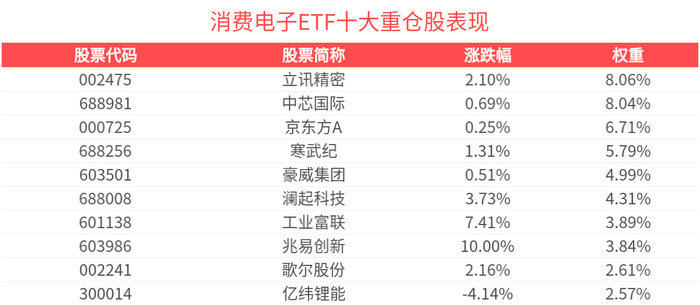
Core Insights - The China Securities Consumer Electronics Theme Index (931494) has seen a strong increase of 2.89% as of October 27, 2025, with significant gains in constituent stocks such as Jingwang Electronics (603228) and Zhaoyi Innovation (603986), both rising by 10.00% [1][2] - The Consumer Electronics ETF (561600) has also risen by 2.90%, with a recent price of 1.31 yuan, and has accumulated a 9.16% increase over the past week [1][2] Market Activity - The Consumer Electronics ETF experienced a turnover rate of 10.85% during trading, with a transaction volume of 46.21 million yuan, indicating active market participation [2] - Over the past week, the ETF's shares increased by 11 million, ranking it in the top fifth among comparable funds [2] Index Composition - The China Securities Consumer Electronics Theme Index includes 50 listed companies involved in component production and consumer electronics design and manufacturing, reflecting the overall performance of the sector [2] - As of September 30, 2025, the top ten weighted stocks in the index accounted for 55.93% of the total, with notable companies including Luxshare Precision (002475) and SMIC (688981) [2][4]





2025绵阳企业50强发布!附完整榜单
Sou Hu Cai Jing· 2025-10-25 21:05
Core Insights - The 2025 Mianyang Top 50 Enterprises list was released, showcasing the resilience and growth of local companies despite a complex external environment [4][6] - The total revenue of the top 50 enterprises reached 492.57 billion, with total assets exceeding 1.1 trillion, reflecting a year-on-year growth of 4.99% [4] - The report highlights the dominance of the secondary industry, with 72% of enterprises and 84.91% of revenue coming from this sector, particularly in electronics, food and beverage, and advanced materials [4][6] Summary by Category Overall Performance - The top 50 enterprises achieved a net profit of 7.47 billion, showing a slight increase of 0.23% [4] - There are 2 enterprises with revenues exceeding 100 billion and 7 with revenues over 10 billion, indicating strong leadership within the sector [4] Industry Structure - The secondary industry comprises 72% of the enterprises, contributing 84.91% of total revenue, underscoring the industrial dominance [4] - The electronics industry alone generated 236.57 billion, making it a key driver of regional economic development [4] Ownership Structure - State-owned enterprises account for 52% of the total number, contributing 65.1% of revenue and 84.84% of tax revenue, highlighting their significant role [6] - Private enterprises make up 48% of the total, contributing 34.9% of revenue, showcasing their vitality [6] Regional Distribution - The majority of the top 50 enterprises are concentrated in Fucheng District, Science City New District, Anzhou District, and Jiangyou City, which together account for 66% of the top enterprises and 93.54% of total revenue [6] Future Outlook - The Mianyang Enterprise Home and the Mianyang Enterprise Federation aim to enhance services to address challenges in financing, labor, and market expansion, fostering a supportive environment for growth [15]