ZGXT(000831)

Search documents
这家公司的,拥有建设“灯塔工厂”的小模型!| 1009 张博划重点
Hu Xiu· 2025-10-09 15:02
Core Viewpoint - The Chinese government has expanded export controls on superhard materials, certain rare earth equipment, and lithium battery components, indicating a strategic move to strengthen domestic industry competitiveness and control over critical technologies [2][3]. Group 1: Export Control Scope - The scope of export controls has widened to include dual-use items requiring export licenses, particularly those involving rare earth materials and technologies used in military applications [3]. - Specific items under control include artificial diamond micro-powder, rare earth production equipment, and lithium negative electrode materials [2][3]. Group 2: Focus on Key Areas - Export applications related to military, lethal weapons, and terrorism are generally not permitted, highlighting the government's focus on national security [3]. - The announcement emphasizes controls on technologies related to chip manufacturing and artificial intelligence, particularly for processes involving 14nm logic chips and 256-layer storage chips [3]. Group 3: Technology Control - Export controls now explicitly cover rare earth mining, smelting, and recycling technologies, extending to the assembly, debugging, maintenance, and upgrading of related production lines [4]. - The controls include not just the products but also technical data such as design blueprints and process specifications, indicating a comprehensive approach to safeguarding advanced manufacturing capabilities [4]. Group 4: Industry Impact - The tightening of export controls is expected to significantly impact the rare earth industry, particularly in the deep processing of magnetic materials, ensuring that high-value processes remain within China [4]. - Key companies in this sector include Guangsheng Nonferrous, China Rare Earth, and Northern Rare Earth, with notable players in the magnetic materials field such as Zhenghai Magnetic Materials and Ningbo Yunsheng [4].


暴涨超70%!云汉芯城盘中狂飙!可控核聚变概念崛起
Zheng Quan Shi Bao Wang· 2025-10-09 09:20
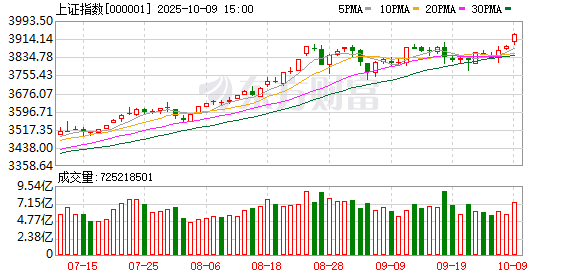
Market Overview - On October 9, the A-share market saw a strong rally, with the Shanghai Composite Index rising over 1% to surpass 3900 points, marking a 10-year high [2] - The Shenzhen Component Index increased by 1.47% to 13725.56 points, while the ChiNext Index rose by 0.73% to 3261.82 points [2] - The total trading volume in the Shanghai and Shenzhen markets reached 26,723 billion yuan, an increase of 4,748 billion yuan compared to the previous trading day [2] Sector Performance - The non-ferrous metals sector experienced significant gains, with stocks like Tongling Nonferrous Metals, Northern Copper, and Yunnan Copper hitting the daily limit [2][6] - The controlled nuclear fusion concept saw a surge, with stocks such as Changfu Co., Yingjie Electric, and Western Superconducting also reaching the daily limit [9] - The rare earth sector strengthened, with companies like China Rare Earth and Northern Rare Earth hitting the daily limit [8] Specific Stock Movements - Newly listed stock Yunhan Chip City (301563) closed up 40.89% at 164.56 yuan per share, with an intraday high exceeding 70% [3] - In the Hong Kong market, Xin Mining Resources surged over 120%, while other notable gainers included Hang Seng Bank and Lenovo Group [5] Gold and Precious Metals - International gold prices broke the $4000 per ounce mark, driven by factors such as the U.S. government shutdown and ongoing expectations of interest rate cuts [6][8] - Analysts suggest that the rise in gold prices is linked to increased concerns over U.S. dollar credit and sovereign debt [8] Semiconductor Sector - The storage chip sector showed renewed strength, with stocks like CanSemi and Huahong Semiconductor hitting the daily limit [12] - A report from CFM Flash Market indicates that server eSSD prices are expected to rise by over 10% in Q4 2025, driven by increased demand from cloud service providers [14][15] Controlled Nuclear Fusion - The controlled nuclear fusion concept gained traction, with significant stock price increases for companies involved in this sector [9][11] - The upcoming International Atomic Energy Fusion Energy Conference in Chengdu is anticipated to bring major developments in the fusion industry [11] Rare Earth Export Controls - The Ministry of Commerce announced new export controls on certain rare earth-related items, further tightening the supply chain [8] - Analysts expect that these measures will lead to a significant increase in the importance of rare earth recycling technologies by 2025 [8]



暴涨超70%!301563,盘中狂飙!
证券时报· 2025-10-09 09:08
Market Overview - On October 9, the A-share market saw a strong rally, with the Shanghai Composite Index rising over 1% to break through 3900 points, marking a 10-year high [1][2] - The Shenzhen Component Index increased by 1.47% to 13725.56 points, while the ChiNext Index rose by 0.73% to 3261.82 points [2] - The total trading volume in the Shanghai and Shenzhen markets reached 26,723 billion yuan, an increase of 4,748 billion yuan compared to the previous trading day [2] Sector Performance - The non-ferrous metals sector experienced significant gains, with stocks like Tongling Nonferrous Metals, Northern Copper, and Yunnan Copper hitting the daily limit [6][8] - The controlled nuclear fusion concept saw a surge, with stocks such as Changfu Co., Yinjie Electric, and Western Superconducting also reaching the daily limit [11][13] - The rare earth sector rallied, with companies like China Rare Earth and Northern Rare Earth hitting the daily limit [9][10] Gold Market - On October 8, international spot gold prices exceeded $4000 per ounce, reaching a historical high [8] - Factors contributing to the rise in gold prices include concerns over U.S. government shutdowns, political uncertainties in Japan, and expectations of continued interest rate cuts by the Federal Reserve [8] Semiconductor Sector - The storage chip concept gained momentum, with stocks like Canxin Co. and Huahong Semiconductor seeing significant increases, with Canxin hitting the daily limit [14][16] - A report from CFM Flash Market indicated that prices for server eSSD and DDR5 RDIMM are expected to rise by over 10% in Q4 2025 due to increased demand from cloud service providers [16][17] Policy Impact - The Ministry of Commerce announced new export controls on certain rare earth-related items, further tightening the supply chain for these materials [9] - Analysts expect that the new regulations will lead to a long-term bullish outlook for the rare earth and magnetic materials sectors due to supply constraints [9]


进一步遏制规避行为,中国稀土相关管制公告五大重点梳理|专家热评
Di Yi Cai Jing· 2025-10-09 08:54
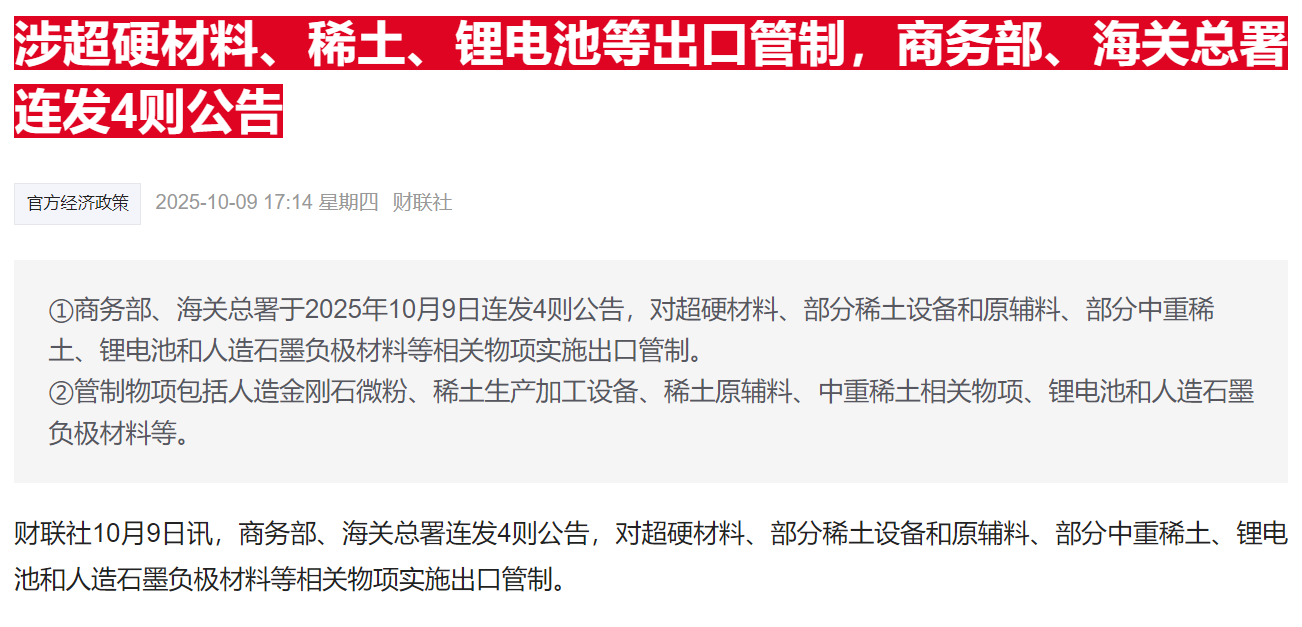
Core Viewpoint - The recent announcements by the Chinese Ministry of Commerce regarding export controls on rare earth items and related technologies aim to refine the regulatory framework and address violations by companies attempting to circumvent existing measures [1][2]. Group 1: Key Content of the Announcements - The implementation of the "minimum percentage" rule and "direct product" rule marks the first application of Article 49 of the Export Control Law, which includes foreign-manufactured products containing 0.1% value of Chinese-origin rare earth items [4]. - The licensing application details focus on a "blacklist" and military-related uses, with a general principle of denying licenses for entities on the control list or involved in military applications [5][6]. - A compliance notification mechanism has been established, requiring exporters of rare earth items to provide a compliance notice to importers or end-users, enhancing supply chain management [7]. Group 2: Additional Regulatory Measures - The implementation of Article 12 of the Export Control Law expands restrictions on Chinese citizens and entities participating in overseas rare earth manufacturing activities, including those not listed in the control list [8]. - Certain categories of rare earth-related technologies are exempt from controls, while subsequent disclosures of technologies not yet in the public domain will be subject to approval [9][10]. - Overall, the announcements reflect a selective borrowing of international practices in export control, indicating potential future expansions of the regulatory framework as China's industrial and technological capabilities grow [11].

小金属板块10月9日涨7.63%,北方稀土领涨,主力资金净流入35.4亿元
Zheng Xing Xing Ye Ri Bao· 2025-10-09 08:53
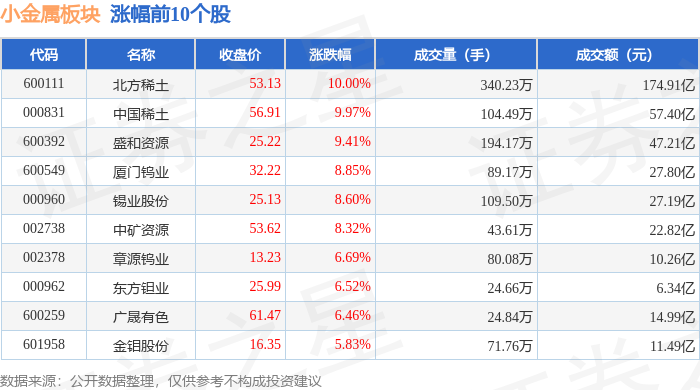
证券之星消息,10月9日小金属板块较上一交易日上涨7.63%,北方稀土领涨。当日上证指数报收于 3933.97,上涨1.32%。深证成指报收于13725.56,上涨1.47%。小金属板块个股涨跌见下表: 从资金流向上来看,当日小金属板块主力资金净流入35.4亿元,游资资金净流出15.92亿元,散户资金净 流出19.48亿元。小金属板块个股资金流向见下表: | 代码 | 名称 | 主力净流入(元) | 主力净占比 游资净流入 (元) | | 游资净占比 散户净流入(元) | | 散户净占比 | | --- | --- | --- | --- | --- | --- | --- | --- | | 600111 | 北方稀土 | 26.58亿 | 15.20% | -14.28亿 | -8.16% | -12.30 Z | -7.04% | | 600392 | 盛和资源 | 3.59 Z | 7.61% | -7697.49万 | -1.63% | -2.82 Z | -5.98% | | 000831 | 中国稀土 | 3.13 Z | 5.46% | -1.21 乙 | -2.11% | -1.92 Z | ...


中国加强稀土出口管制,金力永磁、北方稀土等稀土概念股集体拉升
Feng Huang Wang· 2025-10-09 08:19
Core Viewpoint - The recent announcement by the Ministry of Commerce regarding export controls on rare earth materials and technologies has led to a significant surge in the stock prices of rare earth permanent magnet companies in China, indicating a strong market reaction to regulatory changes [1][2][3]. Group 1: Market Reaction - On October 9, rare earth permanent magnet stocks collectively surged, with companies like Antai Technology (涨停), Jinli Permanent Magnet (up 12.48%), and others seeing increases of over 8% [1]. - The announcement of export controls has triggered a positive market sentiment towards companies involved in rare earth production and technology [1]. Group 2: Export Control Details - The Ministry of Commerce issued announcements on October 9, detailing export controls on specific rare earth items and related technologies, requiring exporters to obtain licenses for certain transactions [2][3]. - Export applications to military users and those on control lists will generally not be approved, emphasizing the strategic importance of rare earth materials [2][3]. Group 3: Strategic Importance of Rare Earths - Rare earths, comprising 17 metal elements, are critical for various strategic industries, including advanced weaponry, aerospace, renewable energy, and smart manufacturing [5]. - China holds approximately 49% of the world's rare earth reserves, with a production share of nearly 70%, underscoring its dominance in the global rare earth market [5]. Group 4: Regulatory Context - The Ministry of Commerce highlighted that the export controls align with international practices and are aimed at safeguarding national security and interests [4]. - The controls are part of a broader strategy to prevent illegal acquisition of rare earth technologies by foreign entities, particularly for military applications [4].


稀土产业政策点评:稀土出口管控持续强化,二次资源回收正式进入管控范畴
Western Securities· 2025-10-09 08:13
Investment Rating - The industry investment rating is "Overweight" [5][10] Core Viewpoints - The recent announcements from the Ministry of Commerce regarding export controls on rare earth materials and technologies are aimed at protecting national security and interests, particularly against military applications [2][3] - The new regulations include strict controls on the export of rare earth materials with Chinese components and related technologies, which are expected to significantly impact the supply chain and market dynamics [4] - The report anticipates that by 2025, the contribution of secondary resource recycling to rare earth supply will reach 27%, indicating a new high and a complete control over the supply side [4] Summary by Sections Export Control Policies - The export control measures target specific rare earth materials and technologies, requiring exporters to obtain licenses for items containing at least 0.1% Chinese-origin components [2] - The controlled materials primarily include heavy and medium rare earth metals such as samarium, dysprosium, gadolinium, and others [2] Impact on Industry - The report suggests that the comprehensive control over the supply side will limit the potential for sudden increases in supply, thereby supporting long-term bullish sentiment on the rare earth and magnetic materials sectors [4] - Recommended companies in the upstream rare earth materials include Northern Rare Earth, China Rare Earth, and Shenghe Resources, while midstream magnetic material companies include Jinli Permanent Magnet and Zhenghai Magnetic Materials [4]
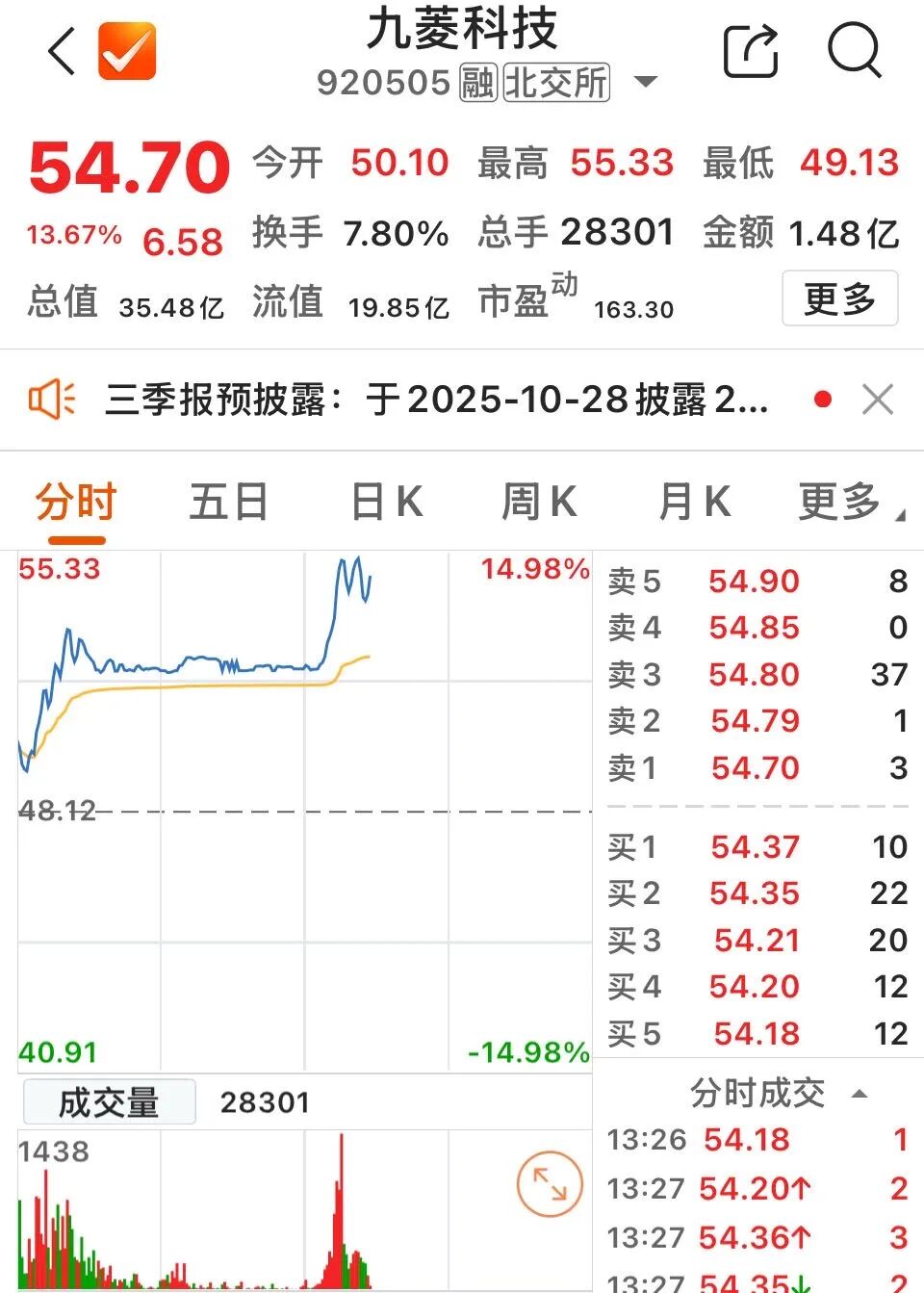
稀土概念发力走高,中国瑞林、北方稀土涨停,九菱科技等大涨
Zheng Quan Shi Bao Wang· 2025-10-09 07:08
Core Viewpoint - The recent announcements from the Ministry of Commerce regarding export controls on rare earth-related items have led to a significant surge in the stock prices of companies in the rare earth sector, indicating a bullish outlook for the industry [1] Group 1: Market Reaction - On October 9, stocks such as Jiuling Technology rose over 19%, San Chuan Wisdom and Jinli Permanent Magnet increased by more than 13%, while companies like China Rare Earth and Northern Rare Earth hit the daily limit [1] - The overall rare earth sector is approaching a daily limit increase, with Zhongkuang Resources rising over 9% [1] Group 2: Regulatory Changes - The Ministry of Commerce issued two announcements to strengthen export controls on rare earth-related items, including restrictions on certain overseas rare earth items containing Chinese components and on rare earth-related technologies [1] - This announcement is seen as a further tightening of export controls initiated in April, aiming to manage the entire supply chain related to these metals, including technologies for recycling rare earth secondary resources [1] Group 3: Supply Chain Implications - According to SMM data, it is projected that by 2025, the contribution of secondary recycling to rare earth supply will reach 27%, marking a new high [1] - The new regulations have fully controlled the supply side of rare earths, making it difficult for significant unexpected increases in supply to occur without government intervention [1] Group 4: Legal Restrictions - The regulations impose strict limitations on Chinese citizens, legal entities, and non-legal entities from providing any substantial assistance or support for overseas rare earth-related activities without permission, effectively cutting off the possibility for foreign companies to rapidly expand production through Chinese technical personnel [1] Group 5: Investment Outlook - Companies in the rare earth and magnetic materials sectors are expected to benefit from the comprehensive control of the supply side due to these policies, leading to a long-term bullish outlook for the sector [1]


午后,稀土板块爆发
Shang Hai Zheng Quan Bao· 2025-10-09 06:01
Core Viewpoint - The rare earth permanent magnet sector in A-shares has seen significant gains, driven by new export control announcements from the Chinese Ministry of Commerce regarding rare earth-related items and technologies [1][5][8]. Group 1: Market Performance - As of 13:30, the rare earth permanent magnet concept index rose over 4%, with notable stock performances including Jiuling Technology up over 13%, Jieli Permanent Magnet up over 11%, and Antai Technology hitting the daily limit [1]. - Other companies in the sector, such as Northern Rare Earth, Zhongmin Resources, Baogang Co., and China Rare Earth, also experienced gains [1]. Group 2: Export Control Announcements - The Ministry of Commerce issued two announcements regarding the export control of certain rare earth-related items, with the first announcement (2025 No. 61) targeting items containing Chinese components and the second (2025 No. 62) focusing on rare earth-related technologies [5][8]. - The measures are aimed at protecting national security and interests, as well as fulfilling international obligations related to non-proliferation [8].
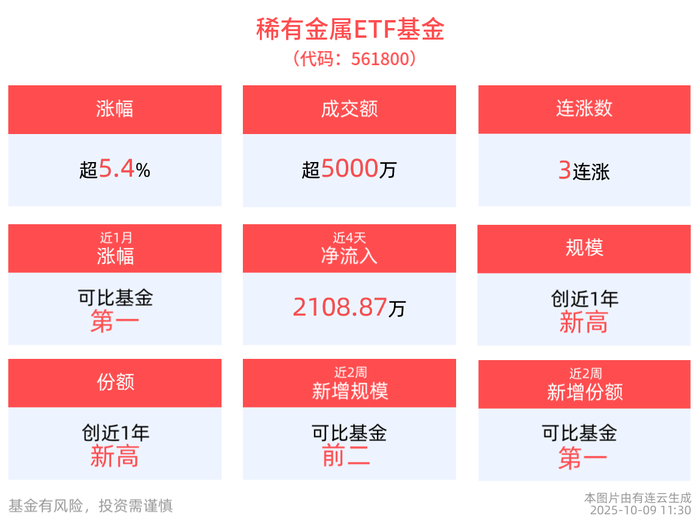
稀土再迎大消息!稀有金属ETF基金(561800)盘中最高涨超5%,近2周涨幅同类居首!
Xin Lang Cai Jing· 2025-10-09 05:15
Core Insights - The Chinese Ministry of Commerce announced export controls on rare earth-related technologies to safeguard national security and interests, effective October 9, 2025 [1] - The rare metal ETF index (930632) surged by 6.23% as of October 9, 2025, with significant gains in constituent stocks such as Western Superconducting (up 18.79%) and Ganfeng Lithium (up 9.15%) [1] - The rare metal ETF fund (561800) has seen a cumulative increase of 10.36% over the past two weeks, ranking first among comparable funds [1][3] Industry Performance - As of September 30, 2025, the rare metal ETF fund recorded a highest monthly return of 24.02% since its inception, with an average monthly return of 8.58% during rising months [3] - The rare earth prices, particularly for praseodymium and neodymium oxides, are expected to remain high, contributing to strong performance in the rare earth industry in the second half of the year [3] - The supply-demand dynamics in the rare earth sector are improving, with domestic supply growth lagging behind demand expansion due to regulatory measures on mining and separation [3] - Demand is driven by industries such as robotics, low-altitude economy, and military applications, while high refining costs abroad support price expectations [3] Key Stocks - The top ten weighted stocks in the rare metal index include Northern Rare Earth, Luoyang Molybdenum, and Ganfeng Lithium, collectively accounting for 59.91% of the index [4][5] - Notable stock performances include Salt Lake Co. (up 6.76%), Northern Rare Earth (up 7.31%), and Luoyang Molybdenum (up 9.04%) [7]