
ZGXT(000831)

Search documents
中国稀土跌5.47%,成交额39.87亿元,近5日主力净流入-13.22亿
Xin Lang Cai Jing· 2025-09-18 10:50
Core Viewpoint - The Chinese rare earth market experienced a decline of 5.47% on September 18, with a trading volume of 3.987 billion yuan and a turnover rate of 7.11%, leading to a total market capitalization of 55.406 billion yuan [1] Company Overview - The company primarily engages in the production and operation of rare earth oxides and provides rare earth technology research and consulting services [2][8] - The company is controlled by the State-owned Assets Supervision and Administration Commission of the State Council, categorizing it as a state-owned enterprise [3][4] Financial Performance - For the first half of 2025, the company achieved a revenue of 1.875 billion yuan, representing a year-on-year growth of 62.38%, and a net profit attributable to shareholders of 162 million yuan, marking a 166.16% increase [8] - Cumulative cash dividends since the company's A-share listing amount to 346 million yuan, with 124 million yuan distributed over the past three years [9] Market Activity - The main capital flow for the day showed a net outflow of 580 million yuan, with the industry ranking 23 out of 24 in terms of capital inflow, indicating a continuous reduction in main capital over three days [5][6] - The average trading cost of the stock is 53.55 yuan, with the current price approaching a support level of 51.78 yuan, suggesting potential volatility if this support is breached [7] Shareholder Structure - As of June 30, 2025, the top ten circulating shareholders include Hong Kong Central Clearing Limited and Southern CSI 500 ETF, with notable increases in their holdings [10]

稀土永磁概念下跌2.94%,14股主力资金净流出超亿元
Zheng Quan Shi Bao Wang· 2025-09-18 09:35
Market Performance - As of September 18, the rare earth permanent magnet sector declined by 2.94%, ranking among the top declines in concept sectors [1] - Notable decliners in the sector included Wolong New Energy, Xiangming Intelligent, and China Rare Earth, while four stocks saw price increases, with Fangbang Co., Yujing Co., and Longci Technology rising by 2.22%, 1.61%, and 1.56% respectively [1] Capital Flow - The rare earth permanent magnet sector experienced a net outflow of 5.879 billion yuan, with 45 stocks seeing net outflows and 14 stocks exceeding 100 million yuan in outflows [2] - The largest net outflow was from Northern Rare Earth, amounting to 1.487 billion yuan, followed by China Rare Earth, Lingyi Intelligent Manufacturing, and Jinli Permanent Magnet with net outflows of 609 million yuan, 592 million yuan, and 409 million yuan respectively [2] Stock Performance - The top stocks with significant net outflows included Northern Rare Earth (-4.45%), China Rare Earth (-5.47%), and Lingyi Intelligent Manufacturing (-3.27%) [3] - Conversely, stocks with net inflows included Huicheng Environmental Protection, Xinlaifu, and Yujing Co., with net inflows of 107 million yuan, 1.732 million yuan, and 1.070 million yuan respectively [4]


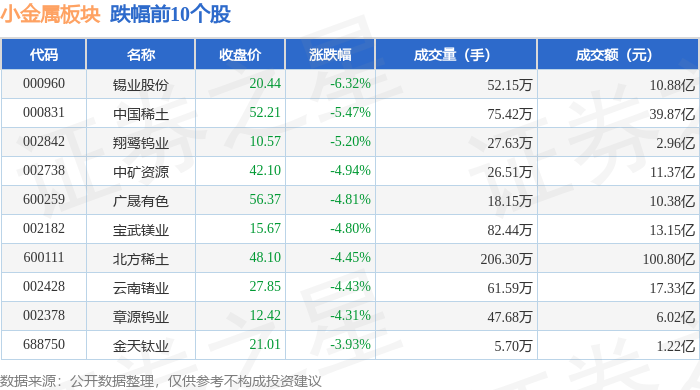
小金属板块9月18日跌4.27%,锡业股份领跌,主力资金净流出43.21亿元
Zheng Xing Xing Ye Ri Bao· 2025-09-18 08:46
Market Overview - On September 18, the small metals sector experienced a decline of 4.27%, with Xiyegongye leading the drop [1] - The Shanghai Composite Index closed at 3831.66, down 1.15%, while the Shenzhen Component Index closed at 13075.66, down 1.06% [1] Individual Stock Performance - Aluminum Corporation (000960) closed at 20.44, down 6.32% with a trading volume of 521,500 shares [1] - China Rare Earth (000831) closed at 52.21, down 5.47% with a trading volume of 754,200 shares [1] - Xianglu Tungsten Industry (002842) closed at 10.57, down 5.20% with a trading volume of 276,300 shares [1] - Zhongkuang Resources (002738) closed at 42.10, down 4.94% with a trading volume of 126,510 shares [1] - Guangsheng Nonferrous (600259) closed at 56.37, down 4.81% with a trading volume of 181,500 shares [1] - Baowu Magnesium (002182) closed at 15.67, down 4.80% with a trading volume of 824,400 shares [1] - Northern Rare Earth (600111) closed at 48.10, down 4.45% with a trading volume of 2,063,000 shares [1] - Yunnan Cuo Industry (002428) closed at 27.85, down 4.43% with a trading volume of 615,900 shares [1] - Zhiyuan Tungsten Industry (002378) closed at 12.42, down 4.31% with a trading volume of 476,800 shares [1] - Jintian Titanium Industry (688750) closed at 21.01, down 3.93% with a trading volume of 57,000 shares [1] Capital Flow Analysis - The small metals sector saw a net outflow of 4.321 billion yuan from main funds, while speculative funds had a net inflow of 902 million yuan, and retail investors saw a net inflow of 3.419 billion yuan [1] - Northern Rare Earth (600111) had a main fund net outflow of 1.519 billion yuan, accounting for -15.07% of its total [2] - China Rare Earth (000831) experienced a main fund net outflow of 636 million yuan, representing -15.96% [2] - Yunnan Cuo Industry (002428) had a main fund net outflow of 252 million yuan, which is -14.55% [2] - Xiyegongye (000960) reported a main fund net outflow of 194 million yuan, equating to -17.81% [2]


中国稀土股价跌5.03%,同泰基金旗下1只基金重仓,持有1.44万股浮亏损失4万元
Xin Lang Cai Jing· 2025-09-18 02:14
Group 1 - The core point of the news is the decline in the stock price of China Rare Earth, which dropped by 5.03% to 52.45 CNY per share, with a trading volume of 1.59 billion CNY and a turnover rate of 2.83%, resulting in a total market capitalization of 55.66 billion CNY [1] - China Rare Earth Group Resources Technology Co., Ltd. is located in Jiangxi Province and was established on June 17, 1998, with its listing date on September 11, 1998. The company's main business involves rare earth smelting separation and rare earth technology research and services [1] - The revenue composition of the company includes rare earth oxides at 63.51%, rare earth metals and alloys at 35.95%, other revenues at 0.35%, and technical service income at 0.18% [1] Group 2 - From the perspective of fund holdings, one fund under Tongtai Fund has a significant position in China Rare Earth, with Tongtai Huiying Mixed A (008178) holding 14,400 shares, accounting for 4.07% of the fund's net value, making it the largest holding [2] - The estimated floating loss for Tongtai Huiying Mixed A (008178) today is approximately 40,000 CNY. The fund was established on November 26, 2019, with a current size of 4.188 million CNY, and has achieved a year-to-date return of 19.73% [2] - The fund's performance over the past year shows a return of 39.55%, ranking 4,393 out of 7,980 in its category, and since its inception, it has returned 8.64% [2]
中国稀土9月16日获融资买入5.25亿元,融资余额26.76亿元
Xin Lang Cai Jing· 2025-09-17 23:13
Group 1 - The core viewpoint of the news highlights a decline in China's rare earth market, with a 3.70% drop in stock price on September 16, resulting in a trading volume of 4.66 billion yuan [1] - On September 16, the financing buy-in amount for China Rare Earth was 525 million yuan, while the financing repayment was 648 million yuan, leading to a net financing buy-in of -123 million yuan [1] - As of September 16, the total financing and securities lending balance for China Rare Earth was 2.698 billion yuan, with a financing balance of 2.676 billion yuan, accounting for 4.63% of the circulating market value, indicating a high level compared to the past year [1] Group 2 - As of August 29, the number of shareholders for China Rare Earth was 165,000, a decrease of 2.66%, while the average circulating shares per person increased by 2.73% to 6,430 shares [2] - For the first half of 2025, China Rare Earth achieved an operating income of 1.875 billion yuan, representing a year-on-year growth of 62.38%, and a net profit attributable to shareholders of 162 million yuan, up 166.16% year-on-year [2] Group 3 - China Rare Earth has distributed a total of 346 million yuan in dividends since its A-share listing, with 124 million yuan distributed over the past three years [3] - As of June 30, 2025, Hong Kong Central Clearing Limited was the fourth largest circulating shareholder of China Rare Earth, holding 19.6025 million shares, an increase of 3.8909 million shares compared to the previous period [3] - The Southern CSI 500 ETF ranked as the fifth largest circulating shareholder, holding 11.0663 million shares, an increase of 1.4870 million shares from the previous period [3]
中国稀土(00769.HK)将与所有相关方紧密合作以恢复股份买卖
Ge Long Hui· 2025-09-17 15:09
Core Viewpoint - China Rare Earth (00769.HK) is actively discussing with its professional advisors to explore and consider available opportunities for formulating a comprehensive and feasible resumption proposal to address the matters outlined in the resumption guidance [1] Group 1 - The company is committed to closely collaborating with all relevant parties to restore its share trading [1] - The company will keep shareholders and potential investors informed about the progress in achieving the resumption guidance [1] - Trading of the company's shares remains suspended [1]
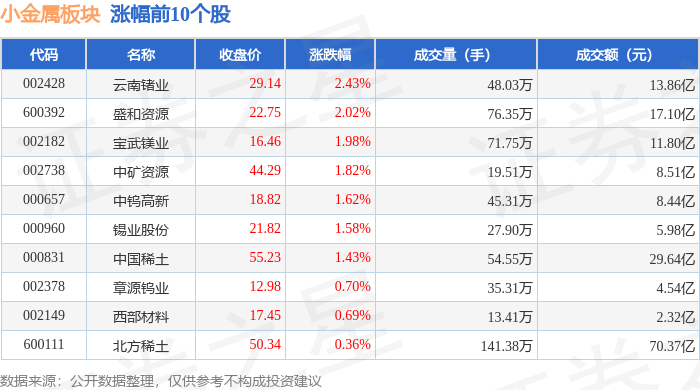
小金属板块9月17日涨0.69%,云南锗业领涨,主力资金净流出4.95亿元
Zheng Xing Xing Ye Ri Bao· 2025-09-17 08:42
Market Overview - On September 17, the small metals sector rose by 0.69%, with Yunnan Zhenye leading the gains [1] - The Shanghai Composite Index closed at 3876.34, up 0.37%, while the Shenzhen Component Index closed at 13215.46, up 1.16% [1] Small Metals Sector Performance - Key stocks in the small metals sector showed varied performance, with Yunnan Zhenye closing at 29.14, up 2.43%, and Shenghe Resources at 22.75, up 2.02% [1] - Other notable performers included Baowu Magnesium at 16.46, up 1.98%, and Zhongkuang Resources at 44.29, up 1.82% [1] Trading Volume and Value - Yunnan Zhenye had a trading volume of 480,300 shares, with a transaction value of 1.386 billion yuan [1] - Shenghe Resources recorded a trading volume of 763,500 shares, with a transaction value of 1.710 billion yuan [1] Capital Flow Analysis - The small metals sector experienced a net outflow of 495 million yuan from institutional investors, while retail investors saw a net inflow of 395 million yuan [2][3] - Speculative funds had a net inflow of 101 million yuan into the sector [2] Individual Stock Capital Flow - Yunnan Zhenye had a net inflow of 12.9 million yuan from institutional investors, while it faced a net outflow of 16.33 million yuan from speculative funds [3] - Shenghe Resources saw a net inflow of 78.11 million yuan from institutional investors, but a net outflow of 4.63 million yuan from speculative funds [3]


政策利好不断,储能行业或迎黄金发展期,央企现代能源ETF(561790)涨超0.5%
Sou Hu Cai Jing· 2025-09-17 07:06
Core Viewpoint - The recent developments in China's energy sector, particularly in new energy storage, indicate a significant growth phase driven by policy support, market demand, and technological advancements [3][4]. Group 1: Market Performance - As of September 17, 2025, the China Securities National New State-Owned Enterprise Modern Energy Index rose by 0.28%, with notable increases in stocks such as China Coal Energy (up 4.10%) and China Western Power (up 2.03%) [3]. - The Central State-Owned Enterprise Modern Energy ETF (561790) increased by 0.52%, with a latest price of 1.17 yuan, and has seen a cumulative increase of 2.93% over the past month [3]. Group 2: Policy Developments - The National Development and Reform Commission and the National Energy Administration have issued the "New Energy Storage Scale Construction Special Action Plan (2025-2027)", aiming for market-oriented development and technological innovation in the energy storage sector by 2027 [3][4]. - Additional policies released in September include notifications to improve pricing mechanisms for renewable energy and guidelines for the continuous operation of electricity spot markets, emphasizing the importance of energy storage [4]. Group 3: Industry Outlook - Experts suggest that the confluence of policy incentives, surging market demand, rapid technological iterations, and strategic capacity layouts are propelling the energy storage industry into a "golden development period" characterized by simultaneous increases in volume and price [4]. - The index tracking the Central State-Owned Enterprise Modern Energy ETF includes 50 listed companies involved in green energy and fossil energy, with the top ten stocks accounting for 48.28% of the index [4].



路透:欧洲企业正在为中国稀土管控做出更多准备
Sou Hu Cai Jing· 2025-09-17 05:46
Group 1 - The China-EU Chamber of Commerce reported that despite an agreement reached in July to expedite rare earth exports to the EU, strict export controls from China are expected to lead to more shutdowns and losses for European companies [1][3] - Jens Eskelund, the chairman of the China-EU Chamber of Commerce, stated that members are still facing significant bottlenecks despite the commitments made during the July 24 summit [3] - China has implemented export controls on certain rare earths and rare earth magnets following the tariffs announced by former U.S. President Trump, causing production delays and large-scale shutdowns for automotive manufacturers in Europe and other regions [3] Group 2 - The majority of the world's rare earths are processed and refined in China, which are widely used in automotive manufacturing and defense industries [3] - Although China agreed to expedite export licenses for critical raw materials during the summit with EU Commission President Ursula von der Leyen, this has not met the EU's demands for extended license periods or the cancellation of export licenses [3] - Since the summit, the approval process for licenses has begun to slow down, leading to an increase in complaints and requests for assistance from members of the China-EU Chamber of Commerce [4]
中国稀土(000831) - 2025年第三次临时股东大会决议公告
2025-09-16 11:15
证券代码:000831 证券简称:中国稀土 公告编号:2025-057 中国稀土集团资源科技股份有限公司 2025 年第三次临时股东大会决议公告 本公司及董事会全体成员保证信息披露内容的真实、准确、完整, 没有虚假记载、误导性陈述或重大遗漏。 特别提示: 1、本次股东大会没有出现否决提案的情形; 2、本次股东大会不涉及变更以往股东大会已通过的决议。 一、会议召开和出席情况 1、会议召开情况 (1)召开时间:现场会议召开时间:2025 年 9 月 16 日(星期二)14:50。 网络投票时间:2025 年 9 月 16 日(星期二)。其中,通过深交所交易系统进行 网络投票的具体时间为 2025 年 9 月 16 日 9:15~9:25,9:30~11:30,13:00~ 15:00;通过深交所互联网投票系统投票的具体时间为 2025 年 9 月 16 日 9:15~ 15:00 期间的任意时间。 (2)召开地点:江西省赣州市章贡区章江南大道 18 号豪德银座 A 栋 14 层 (3)召开方式:现场记名投票和网络投票相结合的方式。同一股份只能选 择现场投票和网络投票的一种表决方式,表决结果以第一次有效投票结果为准 ...