
ZGXT(000831)

Search documents
中国稀土(000831) - 2025年第三次临时股东大会的法律意见书
2025-09-16 11:15
北京市嘉源律师事务所 关于中国稀土集团资源科技股份有限公司 2025 年第三次临时股东大会的 法律意见书 西城区复兴门内大街 158 号远洋大厦 4 楼 中国·北京 嘉 濾 霍师事务 所 IA YUAN LAW OFFICES 北京 BEIJING · 上海 SHANGHAI · 深圳 SHENZHEN · 香港 HONG KONG · 广州 GUANGZHOU · 西安 XI'AN 致:中国稀土集团资源科技股份有限公司 北京市嘉源律师事务所 关于中国稀土集团资源科技股份有限公司 2025年第三次临时股东大会的法律复见书 嘉源(2025)-04-681 北京市嘉源律师事务所(以下简称"本所")接受中国稀土集团资源科技股 份有限公司(以下简称"公司")委托,根据《中华人民共和国公司法》(以下 简称"《公司法》")《上市公司股东会规则》(以下简称"《股东会规则》") 等现行有效的法律、行政法规、部门规章、规范性文件(以下简称"法律法规") 以及《中国稀土集团资源科技股份有限公司公司章程》(以下简称"《公司章程》") 的有关规定,指派本所律师对公司 2025年第三次临时股东大会(以下简称"本 次股东大会")进行见证 ...

有色金属行业资金流出榜:北方稀土、紫金矿业等净流出资金居前
Zheng Quan Shi Bao Wang· 2025-09-16 09:23
Market Overview - The Shanghai Composite Index rose by 0.04% on September 16, with 21 out of the 28 sectors experiencing gains. The top-performing sectors were Comprehensive and Machinery Equipment, with increases of 3.62% and 2.06% respectively. Conversely, the Agriculture, Forestry, Animal Husbandry, and Fishery sector and the Banking sector saw declines of 1.29% and 1.15% respectively [2]. Fund Flow Analysis - The main funds in the two markets experienced a net outflow of 37.426 billion yuan. Among the sectors, 11 saw net inflows, with the Machinery Equipment sector leading with a net inflow of 5.508 billion yuan, while the Computer sector also saw a rise of 2.06% with a net inflow of 4.945 billion yuan [2]. - The sectors with the largest net outflows included the Non-ferrous Metals sector, which had a net outflow of 10.335 billion yuan, followed by the Power Equipment sector with an outflow of 8.913 billion yuan. Other sectors with significant outflows included Banking, Non-bank Financials, and Pharmaceutical & Biological sectors [2]. Non-ferrous Metals Sector Performance - The Non-ferrous Metals sector declined by 0.99%, with a total net outflow of 10.335 billion yuan. Out of 137 stocks in this sector, 41 stocks rose while 92 stocks fell. Notably, 26 stocks experienced net inflows, with 12 stocks seeing inflows exceeding 10 million yuan. The top stock for net inflow was Baowu Magnesium Industry, with an inflow of 90.8021 million yuan [3]. - The stocks with the largest net outflows included Northern Rare Earth, Zijin Mining, and China Rare Earth, with outflows of 1.9335 billion yuan, 1.304 billion yuan, and 705.1 million yuan respectively [3][5]. Top Gainers in Non-ferrous Metals - The top gainers in the Non-ferrous Metals sector included: - Baowu Magnesium Industry: +3.99%, 9.28% turnover, 90.8021 million yuan inflow - Xiaocheng Technology: +5.61%, 31.89% turnover, 38.4626 million yuan inflow - Xingye Silver Tin: +2.30%, 3.97% turnover, 28.5589 million yuan inflow [4]. Top Losers in Non-ferrous Metals - The stocks with the largest losses in the Non-ferrous Metals sector included: - Northern Rare Earth: -4.02%, 6.63% turnover, -1.932887 billion yuan outflow - Zijin Mining: -0.71%, 1.52% turnover, -1.3037478 billion yuan outflow - China Rare Earth: -3.70%, 8.13% turnover, -705.4113 million yuan outflow [5][6].




小金属板块9月16日跌2.56%,广晟有色领跌,主力资金净流出47.29亿元
Zheng Xing Xing Ye Ri Bao· 2025-09-16 08:46
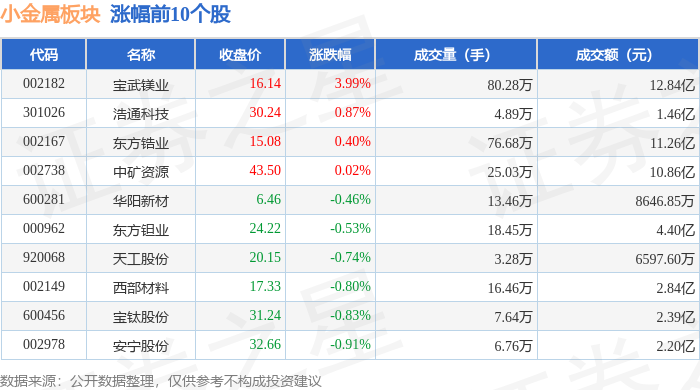
Group 1 - The small metal sector experienced a decline of 2.56% on September 16, with Guangsheng Nonferrous Metals leading the drop [1][2] - The Shanghai Composite Index closed at 3861.87, up 0.04%, while the Shenzhen Component Index closed at 13063.97, up 0.45% [1] - Major stocks in the small metal sector showed mixed performance, with Baowu Magnesium rising by 3.99% and Guangsheng Nonferrous Metals falling by 4.68% [1][2] Group 2 - The small metal sector saw a net outflow of 4.729 billion yuan from main funds, while retail investors contributed a net inflow of 3.898 billion yuan [2][3] - The trading volume and turnover for key stocks varied significantly, with Baowu Magnesium achieving a turnover of 1.284 billion yuan and Guangsheng Nonferrous Metals at 1.231 billion yuan [1][2] - The net inflow from retail investors was notable in several stocks, including Huayang New Materials, which saw a net inflow of 142.386 million yuan [3]

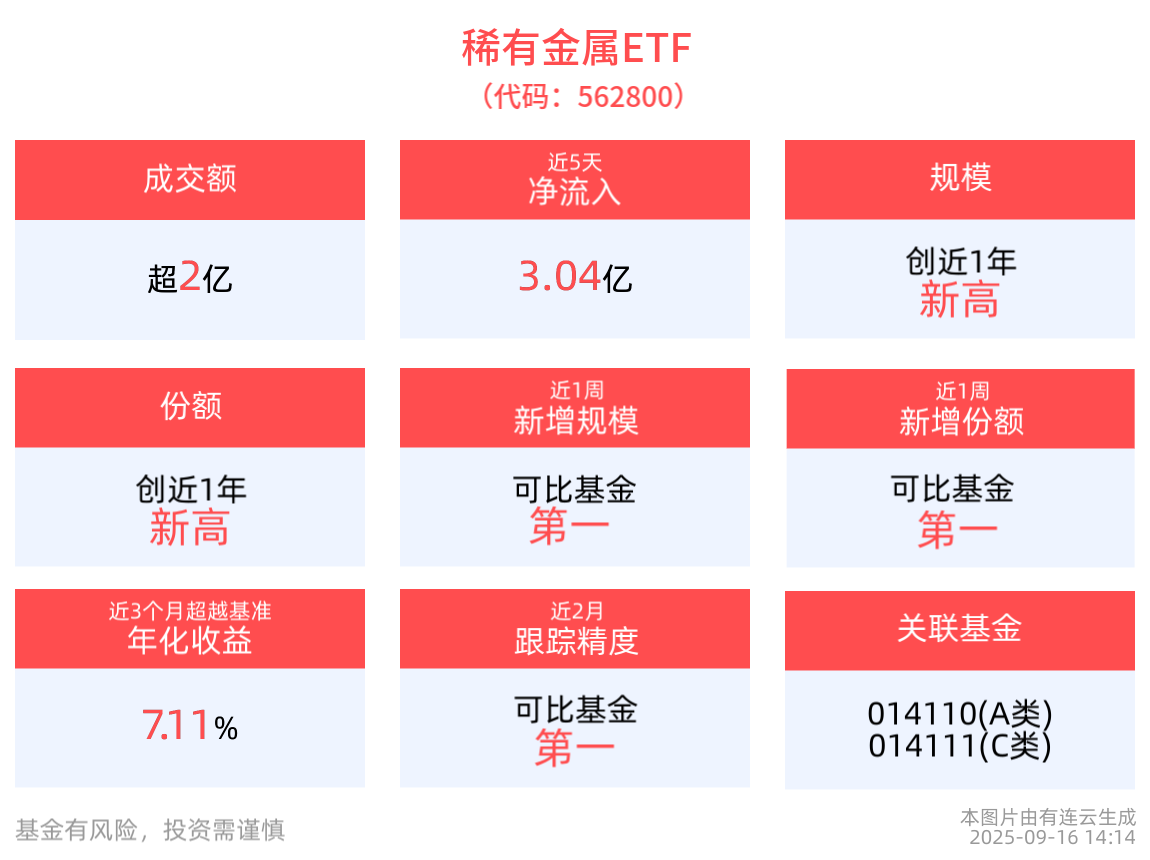
稀土板块回调,稀有金属ETF(562800)获资金逢低布局,最新单日“吸金”2.31亿元
Xin Lang Cai Jing· 2025-09-16 06:40
Core Viewpoint - The rare metals sector is experiencing a mixed performance, with recent regulatory changes and supply-demand dynamics influencing market trends [1][4][5]. Group 1: Market Performance - As of September 16, 2025, the China Securities Rare Metals Theme Index has decreased by 2.23%, with leading stocks such as Guangsheng Nonferrous Metals and Northern Rare Earths showing declines [1]. - The Rare Metals ETF (562800) has seen a 13.27% increase over the past month, indicating a strong recovery trend [1]. - The Rare Metals ETF has achieved a record high in scale, reaching 2.735 billion yuan, and a record high in shares at 3.558 billion, leading among comparable funds [4]. Group 2: Trading Activity - The Rare Metals ETF recorded an intraday turnover of 8.19%, with a transaction volume of 218 million yuan [4]. - Over the past week, the ETF has maintained an average daily transaction volume of 230 million yuan, ranking first among comparable funds [4]. - The ETF has seen a net inflow of 231 million yuan recently, with three out of the last five trading days showing positive net inflows totaling 304 million yuan [4]. Group 3: Supply and Demand Dynamics - The supply side remains tight, with upstream raw ore separation enterprises maintaining stable operations, although some face reduced operating rates due to raw material supply constraints [5]. - Demand from downstream magnetic material companies remains strong, with major manufacturers maintaining high operating rates and sufficient order reserves [5]. - Recent data indicates a 3.4% month-on-month decrease in China's rare earth exports in August, while export value increased by 51%, reflecting a "volume decrease, price increase" trend [4]. Group 4: Key Stocks - The top ten weighted stocks in the rare metals index account for 57.58% of the total index, with Northern Rare Earths and Luoyang Molybdenum being the most significant contributors [5]. - Notable declines in stock prices include Northern Rare Earths down by 3.98% and Guangsheng Nonferrous Metals down by 1.66% [7].




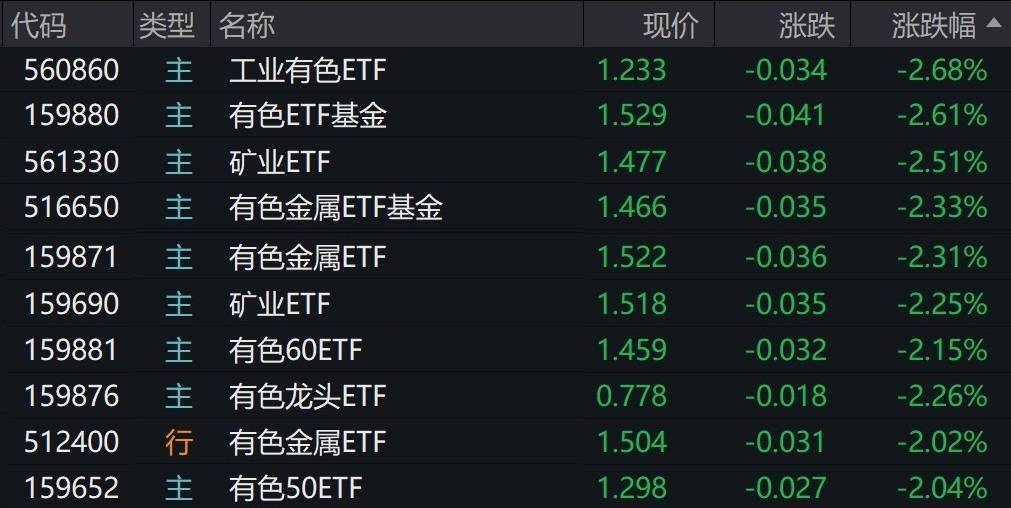
有色金属概念股早盘走低,有色、矿业相关ETF跌超2%
Sou Hu Cai Jing· 2025-09-16 03:36
Group 1 - The core viewpoint indicates that non-ferrous metal stocks are experiencing a decline, with significant drops in Chinese rare earths and other related companies [1] - The market impact shows that related ETFs in the non-ferrous and mining sectors have fallen over 2% [1] - Specific declines include over 5% drop in Chinese rare earths, and more than 4% drop in companies like Northern Rare Earth and Luoyang Molybdenum [1] Group 2 - Various non-ferrous metal ETFs have reported declines, with the Industrial Non-Ferrous ETF down 2.68% and the Non-Ferrous Metal ETF down 2.61% [2] - A broker has indicated that the non-ferrous metal sector will continue to face high market volatility risks in 2025 due to uncertainties from both demand and supply sides [2] - Emerging demand in the downstream structure of copper and aluminum is expected to support a long-term upward shift in non-ferrous metal prices [2]



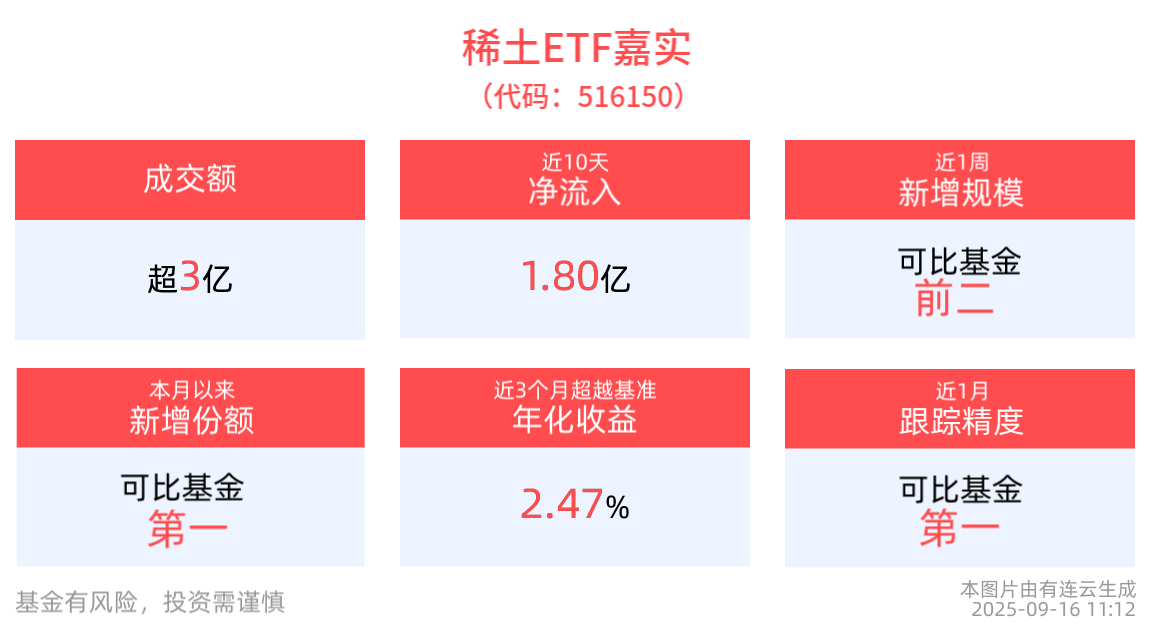
全市场规模最大稀土ETF嘉实(516150)调整蓄势,成分股大洋电机10cm涨停,机构:稀土或步入第三阶段供改行情
Sou Hu Cai Jing· 2025-09-16 03:36
Group 1: Liquidity and Fund Performance - The liquidity of the Rare Earth ETF managed by Jiashi has a turnover rate of 4.11% and a transaction volume of 340 million yuan [3] - Over the past month, the average daily transaction volume of the Rare Earth ETF reached 559 million yuan, ranking first among comparable funds [3] - The fund's scale increased by 23.8 million yuan in the past week, with a total share growth of 94.5 million shares this month, also ranking first among comparable funds [3] - In the last 10 trading days, the Rare Earth ETF attracted a total of 180 million yuan in inflows [3] - As of September 15, the fund's net value has increased by 124.59% over the past year, placing it in the top 3.12% among 3013 index equity funds [3] - The highest monthly return since inception was 41.25%, with the longest consecutive monthly gain being 4 months and a maximum increase of 83.89% [3] Group 2: Market Trends and Demand Drivers - The average spot prices for praseodymium and neodymium metals were 540,000 yuan/ton and 441,000 yuan/ton respectively in the first half of the year, reflecting year-on-year increases of 11.9% and 12.7% [4] - Demand for rare earth materials is rapidly growing due to policies promoting "carbon neutrality," as well as the recovery in traditional manufacturing and the acceleration of humanoid robot deployment [4] - Guojin Securities believes that the rare earth sector may enter a third phase of supply-side reform, with significant increases in magnetic material exports observed in July, up 75% month-on-month and 6% year-on-year [4] - The combination of price increases, supply-side reforms, and supply disruptions is expected to enhance the strategic attributes of the rare earth sector, leading to a dual increase in valuation and performance [4] Group 3: Key Stocks and Weightings - The top ten weighted stocks in the China Rare Earth Industry Index account for a total of 62.15%, including Northern Rare Earth, China Rare Earth, Lingyi Zhi Zao, and others [3] - Notable stock performances include Northern Rare Earth down 4.76% and China Rare Earth down 4.67%, with respective weights of 13.22% and 5.63% [6]



兴业证券:中国稀土供给端优势难以取代 拥有稀缺资源端和冶炼端产能及配额的企业或将收益
Zhi Tong Cai Jing· 2025-09-16 02:45
Core Insights - China maintains a dominant position in the global rare earth supply chain, with significant advantages in both the industrial chain and resource quantity [1][2][3] Group 1: Supply Chain Advantages - China possesses the only complete rare earth industrial chain globally, with mining, separation, and refining capabilities that other countries lack [1][2] - The US and Australia have rich rare earth reserves but limited refining capacity, making them reliant on Chinese supply [1][2] Group 2: Supply Quantity - According to USGS data, in 2024, global rare earth reserves are approximately 90.8845 million tons, with China holding about 44 million tons, accounting for 48.41% [2] - China's rare earth production in 2024 is projected to be 270,000 tons, representing about 68.54% of the global total of 394,000 tons [2] Group 3: Supply Optimization Measures - China's rare earth supply is being optimized through measures such as slowing growth in total control indicators, with mining and refining quotas expected to increase by only 5.88% and 4.16% respectively in 2024 [3] - New regulations, including the 2024 Rare Earth Management Regulations, will strictly control production and circulation, enhancing China's control over global supply [3] Group 4: Overseas Supply Challenges - Current overseas rare earth production is primarily from the US, Australia, and Myanmar, with limited growth expected due to slow capacity release [4] - The US relies on the MP mine, which is expected to expand to 60,000 tons by 2026-2027, but lacks sufficient domestic refining capacity [4] - Australia's Lynas operates with limited capacity and high costs, while Myanmar's production is affected by regional instability [4]

稀土指数盘中跌超4%,成分股普遍走低
Mei Ri Jing Ji Xin Wen· 2025-09-16 02:39
Core Viewpoint - The rare earth index experienced a significant decline, dropping over 4% during intraday trading, indicating a bearish trend in the sector [1]. Group 1: Market Performance - The rare earth sector saw widespread declines among its constituent stocks, with notable drops including China Rare Earth down 5.64%, Northern Rare Earth down 5.09%, Guangsheng Nonferrous down 4.30%, Shenghe Resources down 3.96%, and Xiamen Tungsten down 3.48% [1].

稀土永磁概念震荡走低,中国稀土跌超5%
Mei Ri Jing Ji Xin Wen· 2025-09-16 02:39
Group 1 - The rare earth permanent magnet sector experienced a decline, with Chinese rare earth prices dropping over 5% [1] - Companies such as Northern Rare Earth, Guangsheng Nonferrous, Jinchuan Magnetics, Xiamen Tungsten, and Shenghe Resources also saw a decrease in their stock prices [1]
中国稀土专家电话会议-China Sustainability_ China Rare Earths Expert Call
2025-09-15 13:17
Summary of Key Points from the Expert Call on China's Rare Earths Market Industry Overview - The focus of the call was on China's rare earths market and its implications for the global supply chain, highlighting China's dominance in reserves and refining capabilities [1][2]. Core Insights 1. **China's Dominance in Rare Earths**: - China accounts for approximately 60-70% of global mine output and controls about 90% of global refining capacity, maintaining a technological lead of around 20 years in refining and separation processes [2][3]. - Production costs in China are roughly one-third of those of overseas competitors [2]. 2. **Demand Drivers**: - Structural demand growth is primarily driven by electric vehicle (EV) traction motors (approximately 3.5 kg of NdPr per vehicle), wind turbines (around 600 kg of NdFeB per unit), humanoid robotics, and low-altitude aviation [2]. - NdPr oxide prices are projected to stabilize between RMB 600k–700k per ton (approximately USD 80–95 per kg) through 2028, with Dysprosium and Terbium showing stronger upward price momentum [2]. 3. **Tightening Export Controls**: - Starting in 2024, China has expanded export restrictions to include seven heavy rare earths: Samarium, Europium, Dysprosium, Terbium, Holmium, Erbium, and Thulium, along with stricter licensing for magnets [3]. - Shipments to the U.S., India, and Taiwan are largely blocked, impacting U.S. defense applications that require Dysprosium and Terbium, with inventories only covering about three months of demand [3]. 4. **Challenges of Overseas Expansion**: - Companies like MP Materials in the U.S. and Lynas in Australia face significant commercial challenges, with overseas refining and separation costs estimated to be at least 40% higher than in China [4]. - Heavy rare earth dependence on China is expected to persist, with MP Materials heavily reliant on government subsidies and unlikely to achieve profitability within five years, while Lynas may remain profitable without subsidies [4]. 5. **Recycling Developments**: - China is rapidly developing a closed-loop recycling system, currently accounting for about 60% of global recycled rare earths with recovery rates of 90-95% [5]. - By 2028, recycling could contribute approximately 35% of global supply, with key applications in EV motors, wind turbines, and electronics [5]. - The U.S. and Europe are lagging in recycling efforts due to outdated technology and higher environmental costs, while substitution efforts remain in the R&D stage and are unlikely to disrupt demand in the next decade [5]. Additional Important Points - The expert emphasized that substitution risks appear distant, indicating that rare earth permanent magnets will remain essential in various applications [5]. - The call highlighted the strategic importance of China's rare earths market in the context of global supply chains, particularly in light of geopolitical tensions and trade restrictions [1][3].