
ZGXT(000831)

Search documents
外交部:中波双方讨论了中国稀土相关物项对波出口许可事宜
Xin Lang Cai Jing· 2025-09-15 12:48
Core Points - The fourth plenary session of the China-Poland Intergovernmental Cooperation Committee was held in Warsaw, co-chaired by Chinese Foreign Minister Wang Yi and Polish Deputy Prime Minister and Foreign Minister Sikorski [1] - Both sides recognized the potential for economic and trade cooperation and agreed to work together for sustainable development of bilateral trade and diversification of goods and services [1] - Discussions included China's rare earth export licensing to Poland, with a commitment to enhance communication between export control authorities and promote compliant trade of dual-use items [1] - The two countries will promote the lifting of animal epidemic restrictions based on biosafety and work towards facilitating the entry of Polish agricultural and food products into China, aiming to expand the scale of bilateral agricultural and food trade [1]
小金属板块9月15日跌2.12%,章源钨业领跌,主力资金净流出34.46亿元
Zheng Xing Xing Ye Ri Bao· 2025-09-15 08:43
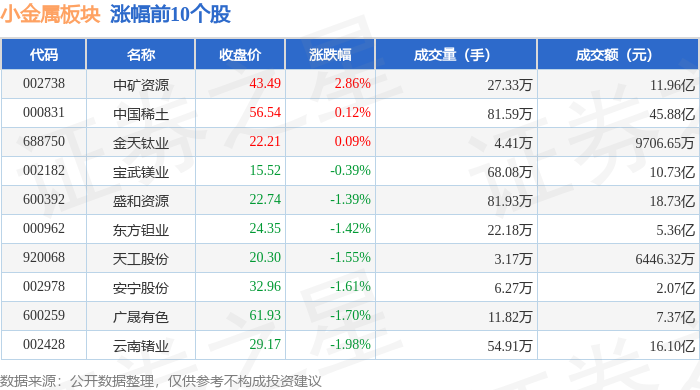
Market Overview - The small metals sector experienced a decline of 2.12% on September 15, with Zhangyuan Tungsten leading the drop [1] - The Shanghai Composite Index closed at 3860.5, down 0.26%, while the Shenzhen Component Index closed at 13005.77, up 0.63% [1] Individual Stock Performance - Zhongkuang Resources (002738) rose by 2.86% to close at 43.49, with a trading volume of 273,300 shares and a transaction value of 1.196 billion [1] - China Rare Earth (000831) saw a slight increase of 0.12%, closing at 56.54, with a trading volume of 815,900 shares [1] - Other notable declines included Caonong Tungsten (002378) down 5.89% to 13.11, and Huaxi Nonferrous (600301) down 5.32% to 32.19 [2] Capital Flow Analysis - The small metals sector experienced a net outflow of 3.446 billion in main funds, while retail investors saw a net inflow of 2.121 billion [2] - The table of capital flow indicates that major funds were predominantly exiting, while retail investors were entering the market [2][3] Detailed Stock Capital Flow - China Rare Earth (000831) had a net inflow of 36.1354 million from main funds, while retail investors contributed a net inflow of 11.0657 million [3] - Anning Shares (002978) faced a significant net outflow of 22.0635 million from main funds, despite a retail net inflow of 18.4799 million [3] - Huayang New Materials (600281) showed a stark contrast with a net outflow of 32.3273 million from main funds, while retail investors contributed a net inflow of 28.6828 million [3]


中国稀土股价连续4天上涨累计涨幅9.19%,德邦基金旗下1只基金持14.5万股,浮盈赚取69.02万元
Xin Lang Cai Jing· 2025-09-15 07:28
Core Insights - China Rare Earth's stock price has increased by 9.19% over the past four days, currently trading at 56.54 CNY per share with a market capitalization of 600.01 billion CNY [1] Group 1: Company Overview - China Rare Earth Group Resources Technology Co., Ltd. was established on June 17, 1998, and listed on September 11, 1998 [1] - The company is primarily engaged in rare earth smelting separation and rare earth technology research and services [1] - Revenue composition includes 63.51% from rare earth oxides, 35.95% from rare earth metals and alloys, 0.35% from other sources, and 0.18% from technical services [1] Group 2: Fund Holdings - Debon Fund has a significant holding in China Rare Earth, with its Debon Minyu Progressive Quantitative Selected Flexible Allocation Mixed A fund (005947) holding 145,000 shares, unchanged from the previous period [2] - This fund's holdings represent 8.43% of its net asset value, making it the third-largest holding [2] - The fund has generated a floating profit of approximately 69,020 CNY during the four-day price increase [2] Group 3: Fund Performance - Debon Minyu Progressive Quantitative Selected Flexible Allocation Mixed A fund was established on June 22, 2018, with a current size of 57.2577 million CNY [2] - Year-to-date return is 36.86%, ranking 1804 out of 8246 in its category, while the one-year return is 53.13%, ranking 2781 out of 8054 [2] - The fund manager, Zhu Huilin, has been in position for 3 years and 88 days, with the best return during this period being 35.15% and the worst being -21.13% [2]
央企现代能源ETF(561790)盘中涨近1%,冲击3连涨,电力设备行业景气度获政策支撑
Sou Hu Cai Jing· 2025-09-15 05:45
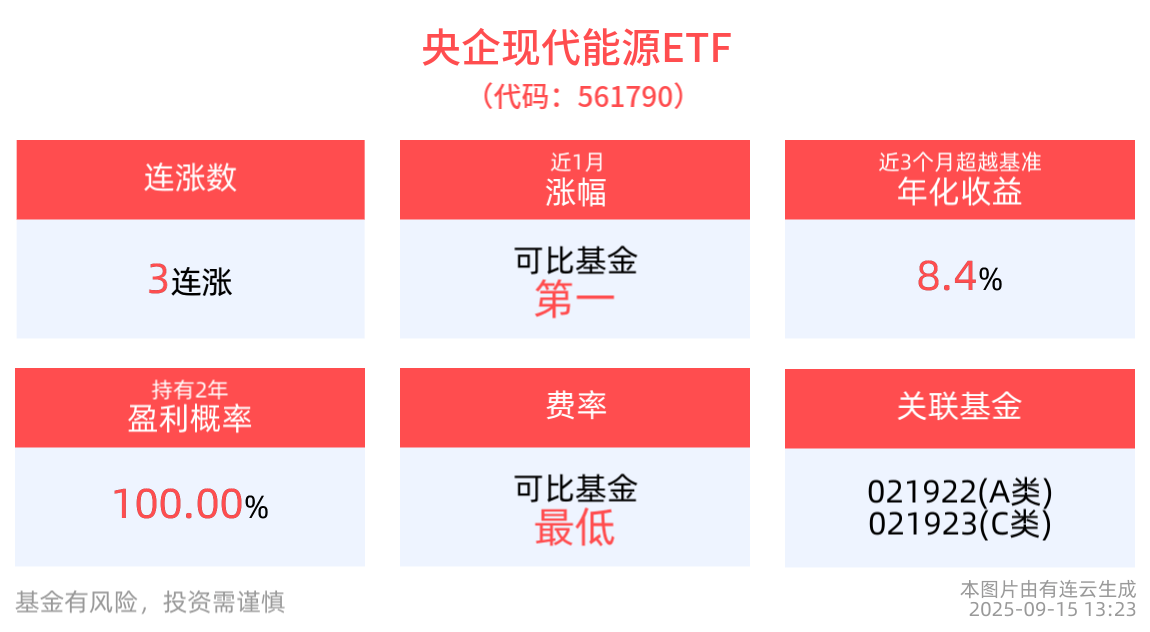
Core Viewpoint - The news highlights the performance of the Central State-Owned Enterprises Modern Energy Index and its related ETF, emphasizing the integration of artificial intelligence in the energy sector to enhance operational efficiency and support high-quality development [2][3]. Group 1: Market Performance - As of September 15, 2025, the Central State-Owned Enterprises Modern Energy Index increased by 0.48%, with notable gains from Shanghai Electric (+8.60%), China National Materials Technology (+4.70%), and others [2]. - The Central State-Owned Enterprises Modern Energy ETF (561790) rose by 0.69%, marking its third consecutive increase, with the latest price at 1.18 yuan [2]. - Over the past week, the ETF has accumulated a rise of 1.92%, ranking in the top third among comparable funds [2]. Group 2: Liquidity and Trading Volume - The ETF recorded a turnover rate of 0.88% during the trading session, with a transaction volume of 399,500 yuan [2]. - The average daily trading volume of the ETF over the past year was 6.4154 million yuan [2]. Group 3: Policy and Industry Development - On September 8, the National Development and Reform Commission and the National Energy Administration released implementation opinions to promote "Artificial Intelligence + Energy" for high-quality development, outlining phased goals and 37 key tasks across various energy applications [2]. - In the electric power equipment sector, the policy aims to establish an innovative system by 2027, focusing on intelligent forecasting of power supply and demand, and enhancing the management capabilities of the power grid [3]. Group 4: Index Composition - The Central State-Owned Enterprises Modern Energy Index, customized by Guoxin Investment Co., includes 50 listed companies involved in green energy, fossil energy, and energy transmission and distribution, reflecting the overall performance of state-owned enterprises in the modern energy sector [3]. - As of August 29, 2025, the top ten weighted stocks in the index accounted for 48.28% of the total index weight, including companies like Yangtze Power, China National Power, and China Nuclear Power [3].



业绩暴增+股价创历史新高的优质股,21股上榜
Zheng Quan Shi Bao Wang· 2025-09-15 04:50
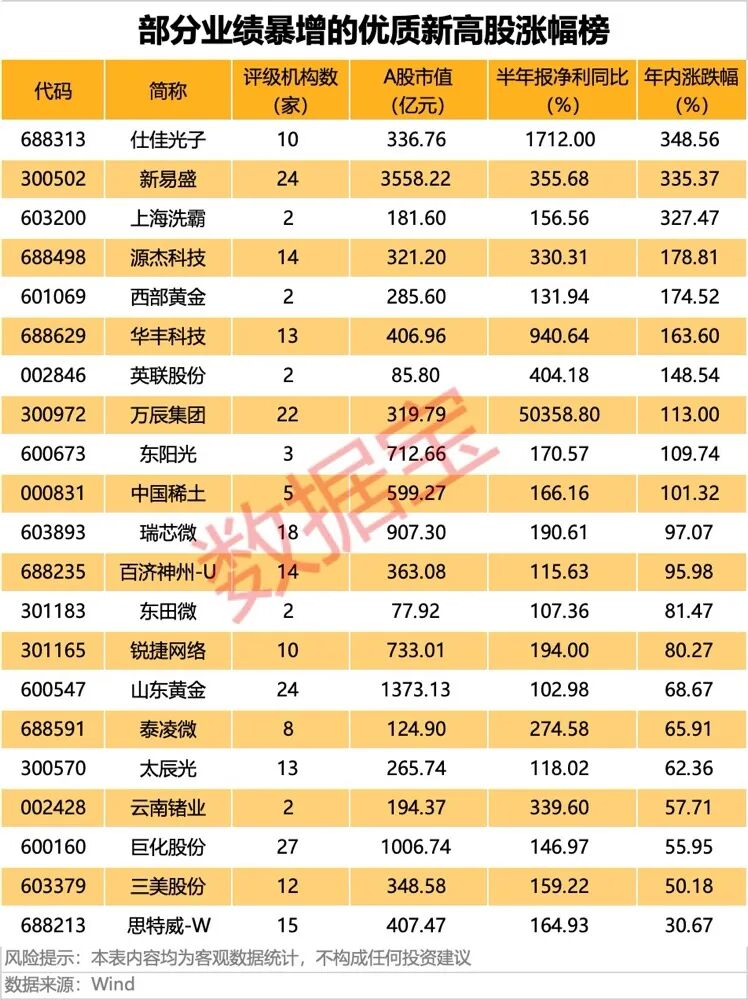
Core Viewpoint - The A-share market is experiencing a bullish atmosphere, with the Shanghai Composite Index reaching a new high on September 12. Stocks with significant earnings growth and recent historical price highs are of particular interest for future performance [1]. Group 1: Stock Performance and Industry Insights - In September, 21 stocks reached historical price highs, with over 100% net profit growth in the first half of the year, primarily in AI hardware, non-ferrous resources, and refrigerant sectors [1]. - The refrigerant industry is seeing a continuous upward trend, with leading companies reporting impressive performance in the first half of the year. The supply side is tightening due to reduced production quotas for second-generation refrigerants by 2025, while downstream demand is steadily recovering [1][2]. - Dongyangguang's net profit surged nearly 171% year-on-year in the first half of the year, driven by rising refrigerant prices and increased demand for electronic components in data centers and energy storage [1][2]. Group 2: Company Developments - Dongyangguang announced a significant investment of 7.5 billion yuan to acquire 100% of Qinhuai Data, a leading player in the IDC industry, with a total transaction value of 28 billion yuan. This acquisition aims to enhance national data security and integrate resources in various fields [2]. - The chairman of Dongyangguang emphasized that this acquisition is a crucial step in integrating into the national computing network and aims to build a comprehensive digital infrastructure ecosystem [2]. Group 3: Stock Performance Metrics - The average increase for the 21 stocks in the first half of the year was approximately 131%, significantly outperforming the broader market. Notable performers include Shijia Photon, Xinyi Technology, and Shanghai Xiba, each increasing over 300% [3]. - A detailed performance table shows that Shijia Photon had a staggering 1712% year-on-year net profit growth, while other companies like Xinyi Technology and Shanghai Xiba also reported substantial increases [4].




重视银金比修复,内外共振铜铝普涨突破
Changjiang Securities· 2025-09-14 23:30
Investment Rating - The report maintains a "Positive" investment rating for the industry [9] Core Insights - The report emphasizes the recovery of the silver-gold ratio and the simultaneous rise in copper and aluminum prices due to both domestic and international factors [5][6] - Weak employment data in the U.S. has led to increased expectations for a 50 basis point rate cut in September, which is expected to boost precious metals [5][6] - The report suggests that while gold remains a focus for investment, the recovery of the silver-gold ratio indicates potential for silver as well [5][6] Summary by Sections Precious Metals - The report highlights the weak performance of the U.S. labor market and its implications for precious metals, particularly gold and silver [5][6] - It suggests that gold stocks may experience a quarterly-level resonance in terms of price, valuation, and style due to anticipated rate cuts [5][6] - For silver, the report advises attention to its potential to converge with gold as inflation expectations rise [5][6] Industrial Metals - Industrial metals have seen a broad increase, with LME copper rising by 1.7% and aluminum by 3.8% [6][27] - The report notes that domestic policies aimed at stabilizing growth are expected to enhance demand outlook [6] - It indicates that while demand for copper and aluminum may decline in the second half of the year, supply constraints will limit the extent of this decline [6] Strategic and Minor Metals - The report discusses the strategic reassessment of rare earths and tungsten, with a focus on their long-term value due to government policies and market dynamics [7] - It highlights the upward price trend for cobalt and nickel, driven by supply constraints and increasing demand in the battery sector [7] - The report also mentions the bottoming out of lithium prices, with a cautious outlook on future price movements [7]




瑞银会议纪要:中国稀土主导全球供应链格局难以撼动
Zhi Tong Cai Jing· 2025-09-12 14:01
Core Insights - The core conclusion of the meeting is that China's dominant position in rare earth reserves and refining processes is unlikely to be challenged in the short term [1] Supply Side - China currently contributes 60-70% of global rare earth production, with a critical role in the refining and separation stage, accounting for approximately 90% of global capacity and being at least 20 years ahead in technology compared to overseas [3] - The cost advantage is significant, with China's refining and separation costs being only one-third of those of foreign counterparts, creating a "technology + cost" dual barrier that makes global rare earth supply highly dependent on China [3] Demand Side - The demand for rare earths is driven by three main sectors: electric vehicles, wind power, and robotics [4] - Each electric vehicle requires 3.5 kg of neodymium-praseodymium (NdPr), while each wind turbine requires 600 kg of neodymium-iron-boron (NdFeB) magnets [4] - The price forecast for NdPr oxide is expected to remain between 600,000 - 700,000 yuan per ton (approximately 80-95 USD per kg) by 2028, with heavy rare earths like dysprosium priced around 330 USD per kg and terbium at 1,000 USD per kg, indicating strong upward momentum [4] Overseas Projects - Despite attempts by overseas companies to break China's dominance in the rare earth sector, challenges such as high costs, limited scale, and environmental pressures make it difficult to disrupt China's position in the short term [5] - MP Materials, a U.S. strategic project, faces commercial viability concerns, with refining costs at least 40% higher than China's and a current scale of only 1,000 tons, far below the 10,000-ton target [6] - Lynas, an Australian project, is considered competitive without subsidies but still faces environmental compliance pressures and remains reliant on China for heavy rare earth supply [7] - The conclusion emphasizes that the reliance on heavy rare earths from China is unlikely to change in the short term due to the immaturity of overseas mining and refining technologies and high costs [8] Recycling and Alternative Technologies - China is rapidly building a closed-loop recycling system for rare earths, currently accounting for 60% of global rare earth recycling volume, with a recovery rate of 90-95% [10] - By 2028, recycled rare earths are expected to meet about 35% of global supply demand, effectively alleviating pressure on primary mining [10] - In contrast, the U.S. and Europe lag in recycling technology and face high environmental costs, resulting in slower progress in their recycling industries [10] - Concerns regarding alternative materials remain, as they are still in the research and development phase and are unlikely to pose a significant threat to rare earth demand within the next decade [11]
中国稀土:马兆杰已获委任为独立非执行董事
Zhi Tong Cai Jing· 2025-09-12 13:10
马兆杰(曾用名:马文威)已获委任为独立非执行董事、审核委员会、提名委员会及独立调查委员会各自 之成员以及薪酬委员会主席。 中国稀土(000831)(00769)发布公告,由2025年9月12日起:康帅杰已辞任独立非执行董事、公司审核 委员会、公司提名委员会及公司独立调查委员会各自的成员以及公司薪酬委员会主席,以便投入更多时 间于其他业务承担;及 ...
中国稀土(00769.HK):马兆杰获委任为独立非执行董事

Ge Long Hui· 2025-09-12 13:09
Core Viewpoint - China Rare Earth (00769.HK) announced significant changes in its board composition, effective September 12, 2025, with the resignation of a director and the appointment of a new independent non-executive director [1] Group 1 - Kang Shuai Jie will resign from his position as an independent non-executive director, as well as from the audit committee, nomination committee, independent investigation committee, and as the chairman of the remuneration committee to focus more on other business commitments [1] - Ma Zhao Jie has been appointed as the new independent non-executive director and will also serve on the audit committee, nomination committee, independent investigation committee, and as the chairman of the remuneration committee [1]
中国稀土(00769):马兆杰已获委任为独立非执行董事
智通财经网· 2025-09-12 13:04
Core Viewpoint - China Rare Earth (00769) announced the resignation of Kang Shuai Jie as an independent non-executive director and various committee member roles to focus on other business commitments, while Ma Zhao Jie has been appointed to these positions [1] Group 1 - Kang Shuai Jie will resign from his roles effective September 12, 2025 [1] - Ma Zhao Jie, formerly known as Ma Wen Wei, has been appointed as an independent non-executive director and will serve on multiple committees including the audit, nomination, independent investigation, and compensation committees [1]