HIKVISION(002415)

Search documents
AI内容标识新规即将实施,数字水印迎关键爆发期
Xuan Gu Bao· 2025-08-19 08:14
Group 1 - The "Measures for Identifying AI-Generated Synthetic Content" will be implemented starting September 1, 2025, requiring companies to clearly distinguish AI-generated content from real content through explicit and implicit labeling [1] - The policy is expected to drive advancements in digital watermarking technology, creating market opportunities in compliant service scenarios [1] - Companies are likely to increase R&D investments in digital watermarking technology to capture the emerging implicit labeling market driven by compliance needs [1] Group 2 - Digital watermarking technology allows for the embedding of digital information into content without affecting its visual quality, ensuring that watermark information remains intact even after editing or sharing [2] - The digital watermarking market is projected to exceed 6.5 billion RMB by 2025, with a compound annual growth rate (CAGR) of over 20% [2] - The first national standard for digital watermarking (GB/T 45909-2025) will be implemented in January 2025, providing authoritative support for AI-generated content identification applications [3] Group 3 - Several companies are actively involved in digital watermarking technology, including Hanbang High-Tech, which has developed a comprehensive application system for video, audio, and image watermarking [6] - Other notable companies include Han Yi Co., which has been researching digital watermarking since 2020, and Shanghai Steel Union, which is building a blockchain platform integrated with digital watermarking technology [6] - Key players in the AI generation field include Guotou Intelligent, Hikvision, and Dahua Technology, focusing on AI-based content verification and identification solutions [6]


百亿私募二季度重仓股曝光,海康威视等多只个股遭减持
Di Yi Cai Jing· 2025-08-19 08:10
Group 1 - As of August 18, 15 billion private equity firms appeared among the top ten circulating shareholders of 28 listed companies, with a total holding value exceeding 29 billion yuan [1] - Nearly 130 listed companies have disclosed their mid-year reports, with over 660 companies reporting, indicating a significant presence of private equity in the market [1] - The top holdings of private equity firms include companies in various sectors, primarily in industrial and information technology [4] Group 2 - In the second quarter, 14 stocks were increased in holdings by billion private equity firms, while 6 stocks were reduced, indicating a mixed sentiment towards certain investments [2][3] - High Yi Asset's top holdings reached approximately 12.3 billion yuan, with significant reductions in holdings for three stocks, including Guoci Materials and Dongcheng Pharmaceutical [2] - The average stock price increase for nearly 130 private equity heavy stocks has reached 41% year-to-date, with over 80% of these stocks experiencing price increases [5] Group 3 - The industry distribution of private equity heavy stocks shows a concentration in industrial, information technology, materials, consumer discretionary, and healthcare sectors [4] - The majority of private equity firms' heavy stocks are focused on small to mid-cap companies, with over 70% of total market value below 10 billion yuan [5] - The performance of private equity firms has been strong, with over 80% of firms reporting positive returns this year, averaging a return rate of 20% [5]
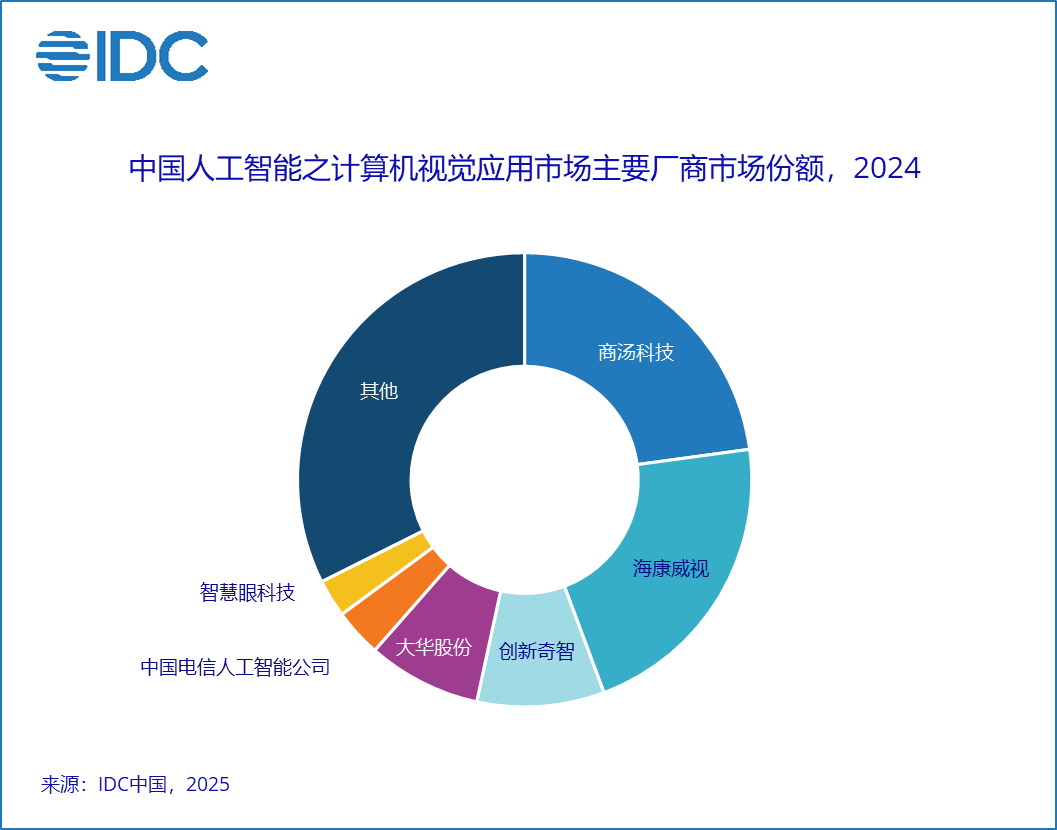
IDC:2024年中国计算机视觉应用市场规模达123.4亿元人民币 同比增长21.2%
智通财经网· 2025-08-19 06:08
Group 1: Computer Vision Market - The computer vision application market in China is projected to reach 12.34 billion RMB in 2024, reflecting a growth rate of 21.2% compared to 2023 [1] - The top five companies in the market include SenseTime, Hikvision, Innovusion, Dahua Technology, and China Telecom AI [1] - The highest year-on-year growth is expected from China Telecom AI, followed by Hikvision, with applications spanning smart security, urban emergency response, and OCR [1] Group 2: Voice and Semantic AI Market - The voice and semantic AI market in China is expected to reach 14.93 billion RMB in 2024, showing a growth of 30.4% from 2023 [3] - Key players in this market include iFlytek, Baidu Smart Cloud, Alibaba Cloud, and Tencent Cloud [3] Group 3: Machine Learning Platform Market - The machine learning platform market in China is anticipated to grow to 3.45 billion RMB in 2024, marking a 22.7% increase from 2023 [5] - The leading companies in this sector are Fourth Paradigm, Huawei Cloud, Innovusion, JiuZhang Cloud, and StarRing Technology [5] Group 4: Recommendations for Technology Providers - Companies are advised to build core competitive advantages in the era of AI, focusing on developing software based on AI agents across various business domains [7] - Emphasis on AI governance is crucial due to the increasing role of AI systems in high-risk decisions, necessitating transparency and accountability [7] - There is a shift towards AI-driven business value, with companies prioritizing measurable ROI and faster time-to-market for AI projects [7] - The AI software market is transitioning from small models to generative AI applications based on large models, which could significantly alter the technology market ecosystem [7]
机构调研、股东增持与公司回购策略周报(20250811-20250815)-20250819
Yuan Da Xin Xi· 2025-08-19 03:26
Group 1: Institutional Research on Popular Companies - The top twenty companies with the highest number of institutional research visits in the past 30 days include Dongpeng Beverage, Zhongchong Co., Hikvision, Defu Technology, and Xinyi Technology [10][11] - In the last five days, the most popular companies for institutional research include Nanwei Medical, Anjisi, Jinchengzi, New Strong Union, and Baiya Co. [10][11] - Among the top twenty companies in the past 30 days, twelve companies had ten or more rating agencies, including Dongpeng Beverage, Zhongchong Co., Ninebot, Baiya Co., Hikvision, Jereh, Xinyi Technology, Hongfa Technology, Nanwei Medical, Baijia Shenzhou, Huaming Equipment, and Shijia Photon [10][11] - Companies such as Xinyi Technology, Dongpeng Beverage, Zhongchong Co., and Ninebot are expected to see significant growth in net profit attributable to shareholders in 2024 compared to 2023 [10][11] Group 2: Shareholder Increase and Buyback Situations - From August 11 to August 15, 2025, five companies announced significant shareholder increases, but the average proposed increase amount was less than 1% of the market value on the announcement date [14] - From January 1 to August 15, 2025, a total of 251 companies announced shareholder increases, with 67 having ten or more rating agencies. Among these, 19 companies had an average proposed increase amount exceeding 1% of the latest market value, including Xinjie Energy, Tunnel Co., Sailun Tire, and Wanrun Co. [15] - During the same period, 1,662 companies announced buyback progress, with 364 having ten or more rating agencies. Among these, 99 companies had a proposed buyback amount exceeding 1% of the market value [19] Group 3: Buyback Progress - From August 11 to August 15, 2025, 51 companies announced buyback progress, with 10 having ten or more rating agencies. Only two companies, Baolong Technology and Fuanna, had a proposed buyback amount exceeding 1% of the market value [18] - From January 1 to August 15, 2025, 99 companies were in the board proposal stage for buybacks, including Liu Gong, Sanor Biotech, Shantui, Haixing Electric, Jiayi Co., and Gaoneng Environment [19] Group 4: Institutional Fund Flow - During the week of August 11 to August 15, 2025, sectors such as power equipment, electronics, real estate, non-bank financials, public utilities, computers, home appliances, building materials, light industry manufacturing, and banking received net inflows from institutional funds [24]



中证互联网指数上涨4.61%,前十大权重包含浪潮信息等
Jin Rong Jie· 2025-08-18 15:58
Group 1 - The core viewpoint of the news is the significant performance of the China Internet Index, which has shown substantial growth over the past month, three months, and year-to-date, indicating a strong recovery in the internet sector [1] - The China Internet Index has increased by 12.94% in the last month, 30.75% in the last three months, and 22.77% year-to-date, reflecting positive market sentiment [1] - The index consists of 50 listed companies involved in various internet-related sectors, including hardware, cloud computing, and content services, with a base date of June 29, 2012, set at 1000.0 points [1] Group 2 - The top ten weighted companies in the China Internet Index include NewEase (10.56%), Zhongji Xuchuang (10.06%), and ZTE (5.38%), among others, indicating a concentration of investment in these firms [1] - The market composition of the index shows that 75.85% of the holdings are from the Shenzhen Stock Exchange, while 24.15% are from the Shanghai Stock Exchange, highlighting the dominance of Shenzhen-listed companies [2] - The industry breakdown of the index reveals that Information Technology accounts for 50.37% and Communication Services for 49.63%, showcasing a balanced representation of these sectors [3] Group 3 - The index samples are adjusted biannually, with changes implemented on the next trading day following the second Friday of June and December, ensuring the index remains reflective of the current market [3] - Public funds tracking the internet sector include Southern China Internet C and Southern China Internet A, indicating investor interest in this segment [4]




中证国新央企科技引领指数上涨1.82%,前十大权重包含上海贝岭等
Jin Rong Jie· 2025-08-18 13:53
Core Viewpoint - The China Securities Index for Central State-Owned Enterprises in Technology has shown significant growth, with a 7.34% increase over the past month and a 14.86% increase over the past three months, reflecting strong performance in the technology sector [1][2] Group 1: Index Performance - The index opened high and closed at 1401.72 points, with a trading volume of 67.462 billion yuan [1] - Year-to-date, the index has risen by 8.78% [1] Group 2: Index Composition - The index is composed of 50 listed companies in sectors such as aerospace, defense, computer, electronics, semiconductors, and communication services, reflecting the overall performance of central state-owned enterprises in technology [1][2] - The top ten weighted companies in the index include Hikvision (9.26%), Changdian Technology (6.49%), and AVIC Shenyang Aircraft (6.48%) [1] Group 3: Market Segmentation - The index's holdings are primarily listed on the Shanghai Stock Exchange (57.58%) and Shenzhen Stock Exchange (42.42%) [1] - In terms of industry distribution, information technology accounts for 49.93%, industrials for 37.98%, and communication services for 12.08% [2] Group 4: Index Adjustment and Fund Tracking - The index samples are adjusted biannually, with adjustments occurring on the second Friday of June and December [2] - Several public funds track the index, including E Fund and Yinhua funds, which offer various share classes [2]


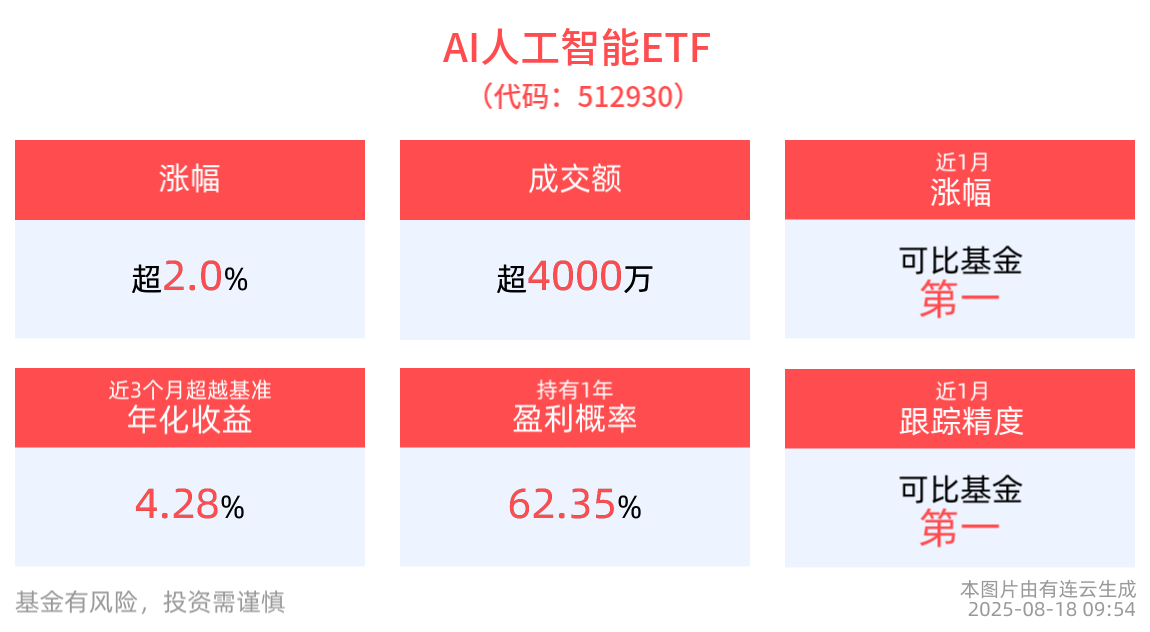
涨超2.0%,AI人工智能ETF(512930)近1周涨幅排名可比基金首位
Sou Hu Cai Jing· 2025-08-18 02:22
费率方面,AI人工智能ETF管理费率为0.15%,托管费率为0.05%,费率在可比基金中最低。 跟踪精度方面,截至2025年8月15日,AI人工智能ETF近1月跟踪误差为0.006%,在可比基金中跟踪精度最高。 AI人工智能ETF紧密跟踪中证人工智能主题指数,中证人工智能主题指数选取50只业务涉及为人工智能提供基础资源、技术以及应用支持的上市公司证券作 为指数样本,以反映人工智能主题上市公司证券的整体表现。 数据显示,截至2025年7月31日,中证人工智能主题指数(930713)前十大权重股分别为中际旭创(300308)、新易盛(300502)、寒武纪(688256)、科大讯飞 (002230)、海康威视(002415)、豪威集团(603501)、中科曙光(603019)、澜起科技(688008)、金山办公(688111)、浪潮信息(000977),前十大权重股合计占比 55.52%。 截至2025年8月18日 09:54,中证人工智能主题指数(930713)强势上涨2.31%,成分股石头科技(688169)上涨11.27%,协创数据(300857)上涨7.99%,大华股份 (002236)上涨6.96%,恒 ...



12家百亿私募持仓超180亿元 冯柳加仓安琪酵母
Zheng Quan Shi Bao Wang· 2025-08-18 00:00
Core Viewpoint - The article highlights the recent adjustments made by well-known private equity fund managers in response to the disclosure of half-year reports by listed companies, indicating significant investment movements in the A-share market [1] Group 1: Investment Movements - A total of 12 private equity funds with over 10 billion yuan in assets have appeared among the top ten circulating shareholders of 18 A-share listed companies, with a combined holding value exceeding 18 billion yuan [1] - Gao Yi Asset's fund manager Feng Liu has increased his stake in Angel Yeast (600298), with the holding value rising to 1.23 billion yuan by the end of June [1] - Feng Liu has also slightly reduced his holdings in Hikvision (002415) and Dongcheng Pharmaceutical (002675) [1] Group 2: New Entrants - Ruijun Asset has newly entered the top ten circulating shareholders of Daozhi Technology (300409) [1] - Yinye Investment has also newly entered the top ten circulating shareholders of Haooubo [1] - Emerging institution Lexi Private Equity has invested over 500 million yuan to become the fifth largest circulating shareholder of Ninebot [1]


多家知名私募持仓揭晓
Zheng Quan Shi Bao· 2025-08-17 10:40
Group 1: A-Share Market Overview - As of August 15, 2025, 505 A-share listed companies have disclosed their mid-year reports, with 106 companies showing private equity firms among their top ten circulating shareholders, collectively holding a market value of 25.164 billion yuan [1] Group 2: Hikvision (002415) Financial Performance - Hikvision reported a revenue of 41.818 billion yuan for the first half of 2025, representing a year-on-year growth of 1.48%, and a net profit attributable to shareholders of 5.657 billion yuan, up 11.71% year-on-year [2] - High Yi Asset has reduced its holdings in Hikvision, with its fund holding 338 million shares as of the end of Q2 2025, down by 12 million shares from the end of Q1 2025, resulting in a holding value of 9.373 billion yuan [2][3] Group 3: High Yi Asset's Investment Activities - High Yi Asset has continuously reduced its holdings in Hikvision for three consecutive quarters, totaling over 74 million shares since Q4 2024 [3] - In addition to Hikvision, High Yi Asset also reduced its stake in Dongcheng Pharmaceutical (002675), holding 17.5 million shares as of Q2 2025, down by 4 million shares, with a holding value of 252 million yuan [4] - High Yi Asset increased its holdings in Angel Yeast (600298) to 35 million shares by the end of Q2 2025, with a holding value of 1.231 billion yuan [4] Group 4: Other Private Equity Holdings - Freshwater Spring and Ying Shui Investment have disclosed their latest holdings, with Freshwater Spring holding 9.0333 million shares of Shengyi Technology (600183) valued at 272 million yuan, unchanged from Q1 2025 [5] - Ying Shui Investment holds shares in Yifan Pharmaceutical (002019), Sujiao Science (300284), and Hengwei Technology (603496), with a total of 24.67 million shares in Yifan Pharmaceutical valued at 321 million yuan, also unchanged from Q1 2025 [5] - Ying Shui Investment's funds are also present in Sujiao Science, holding 65.6691 million shares valued at 597 million yuan, with no change from Q1 2025 [5]
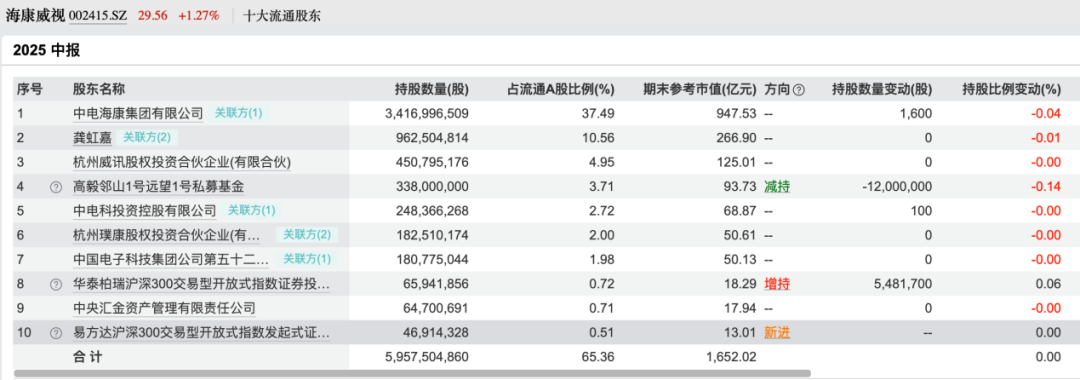
多家知名私募持仓揭晓
证券时报· 2025-08-17 10:31
Core Viewpoint - The article highlights the recent disclosures of A-share listed companies' mid-year reports for 2025, revealing significant movements in private equity holdings, particularly the reduction of stakes by prominent private equity firms in companies like Hikvision and Dongcheng Pharmaceutical [1][2][3]. Group 1: A-share Listed Companies Mid-Year Reports - As of August 15, 2025, 505 A-share listed companies have disclosed their mid-year reports, with 106 companies showing private equity firms among their top ten shareholders, collectively holding a market value of 25.164 billion yuan [1]. - Hikvision reported a revenue of 41.818 billion yuan for the first half of 2025, reflecting a year-on-year growth of 1.48%, while net profit attributable to shareholders was 5.657 billion yuan, up 11.71% year-on-year [3]. Group 2: Hikvision Shareholding Changes - High Yi Asset has reduced its holdings in Hikvision, decreasing its shares by 12 million to 338 million, with a market value of 9.373 billion yuan as of the end of Q2 2025 [3][4]. - High Yi Asset has been consistently reducing its stake in Hikvision for three consecutive quarters, totaling over 74 million shares since Q4 2024 [4]. Group 3: Dongcheng Pharmaceutical Shareholding Changes - High Yi Asset also reduced its stake in Dongcheng Pharmaceutical, holding 17.5 million shares as of Q2 2025, down by 4 million shares, with a market value of 252 million yuan [5]. - The fund initially entered Dongcheng Pharmaceutical's top ten shareholders in Q2 2022 and had increased its holdings to 35 million shares before the recent reduction [5]. Group 4: Other Private Equity Movements - High Yi Asset increased its holdings in Angel Yeast, reaching 35 million shares with a market value of 1.231 billion yuan by the end of Q2 2025 [6]. - Other private equity firms, such as Danshuiquan and Ying Shui Investment, have also disclosed their major holdings, including investments in companies like Shengyi Technology and Yifan Pharmaceutical, with stable shareholding numbers compared to Q1 2025 [8][9].