
KHPG(002773)

Search documents
基金持仓重回底部,建议持续加配医药底部资产
ZHONGTAI SECURITIES· 2026-01-25 13:14
Investment Rating - The industry investment rating is maintained at "Overweight" [2] Core Insights - The report highlights that the pharmaceutical sector is showing resilience, with a focus on capturing opportunities from companies that can deliver on their growth potential. The report suggests that investors should continue to allocate to pharmaceutical bottom assets as fund holdings have returned to a low level [3][10] - The report indicates that the A-share funds' top ten holdings in the pharmaceutical sector account for 9.15%, a decrease of 1.93 percentage points from the previous period. Excluding pharmaceutical funds, the allocation drops to 3.43%, down 1.39 percentage points [3][10] - The report emphasizes the strong performance of certain pharmaceutical companies, particularly in innovative drugs and upstream life sciences, with notable profit growth forecasts for companies like Zhaoyan New Drug and Kangchen Pharmaceutical [3][10] Summary by Sections Market Dynamics - The pharmaceutical sector has outperformed the broader market, with a return of 6.66% compared to the CSI 300's 1.57% since the beginning of 2026, indicating a 5.10 percentage point advantage [14] - Recent performance shows a mixed trend, with pharmaceutical commercial, traditional Chinese medicine, and medical devices showing positive growth, while chemical pharmaceuticals and medical services have declined [10][14] Valuation Metrics - The current valuation of the pharmaceutical sector is at 23.3 times PE based on 2026 earnings forecasts, which is a premium of 11.3% compared to the overall A-share market (excluding financials) at approximately 21.0 times PE [17] - Using the TTM valuation method, the pharmaceutical sector is valued at 30.3 times PE, which is below its historical average of 34.9 times PE, indicating a relative premium of 11.2% over the broader market [17] Recommended Stocks - Key recommended stocks include WuXi Biologics, Sangfor Technologies, Tigermed, and others, with an average increase of 13.41% in January, outperforming the pharmaceutical sector by 6.74 percentage points [26][27] - The report notes that the top ten pharmaceutical stocks held by public funds include companies like Hengrui Medicine and WuXi AppTec, with a strong preference for innovative drugs and leading players in niche markets [3][10]



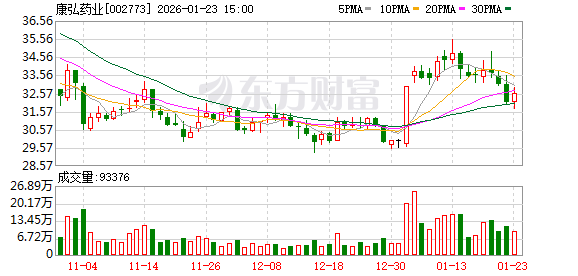
康弘药业:KH110项目Ⅲ期临床试验正在多家医院开展,招募对象为50~80岁轻、中度阿尔茨海默病患者
Mei Ri Jing Ji Xin Wen· 2026-01-23 08:28
Core Viewpoint - The company is currently conducting a Phase III clinical trial for its KH110 project, targeting patients aged 50 to 80 with mild to moderate Alzheimer's disease [2] Group 1 - The clinical trial is being carried out at multiple hospitals across the country [2] - The recruitment criteria for the trial specify that participants must be between the ages of 50 and 80 [2] - Information regarding the trial has been registered and made publicly available on the National Medical Products Administration's clinical trial registration platform [2] Group 2 - The company encourages interested individuals or their families to check the registration platform for specific inclusion criteria [2] - Participants are advised to visit nearby research hospitals for evaluation if they wish to join the trial [2]

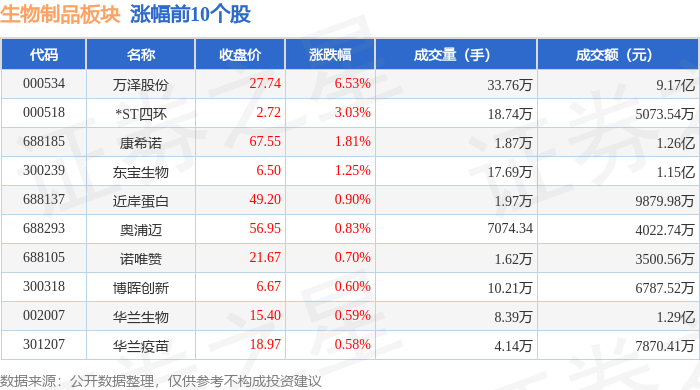
生物制品板块1月22日跌0.73%,艾迪药业领跌,主力资金净流出5.51亿元
Zheng Xing Xing Ye Ri Bao· 2026-01-22 09:01
Market Overview - The biopharmaceutical sector experienced a decline of 0.73% on January 22, with Aidi Pharmaceutical leading the drop [1] - The Shanghai Composite Index closed at 4122.58, up 0.14%, while the Shenzhen Component Index closed at 14327.05, up 0.5% [1] Individual Stock Performance - Wanze Co., Ltd. (000534) saw a significant increase of 6.53%, closing at 27.74 with a trading volume of 337,600 shares and a transaction value of 917 million [1] - Aidi Pharmaceutical (688488) reported a substantial decrease of 13.48%, closing at 18.17 with a trading volume of 281,700 shares and a transaction value of 537 million [2] - Other notable performers included ST Sihuan (000518) with a rise of 3.03% and Kanghong Pharmaceutical (002773) with a decline of 3.03% [1][2] Capital Flow Analysis - The biopharmaceutical sector experienced a net outflow of 551 million from institutional investors, while retail investors saw a net inflow of 279 million [2] - The main capital inflow was observed in Wanze Co., Ltd. with 81.16 million from institutional investors, while Kanghong Pharmaceutical had a net outflow of 50.59 million from retail investors [3]


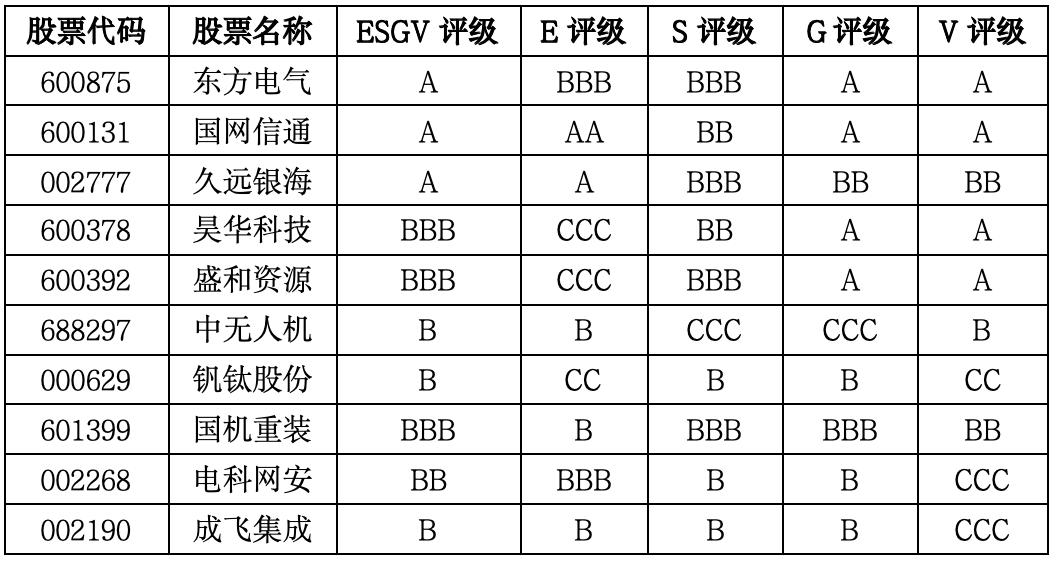
四川上市公司ESG-V评级出炉:资源型经济如何走向价值型定价?|上市公司观察
Xin Lang Cai Jing· 2026-01-22 05:49
Core Insights - Sichuan plays a unique role in the western economic landscape, possessing rare energy, mineral, and agricultural resources, along with a concentration of leading enterprises in sectors like liquor, equipment manufacturing, biomedicine, and electronic information [1] - The recent ESG-V rating report by Jiaan Jinxin evaluates Sichuan's listed companies on environmental, social, governance, and value dimensions, addressing the critical question of how resource advantages can be transformed into sustainable governance and long-term value [1][2] - The ESG-V rating system introduces "value" as a key variable, assessing whether companies can achieve sustainable profitability and stable capital returns, highlighting a structural differentiation among Sichuan's listed companies [1][2] ESG-V Ratings Overview - New Yiseng is the only company in Sichuan to receive the highest ESG-V rating of AAA, demonstrating strong governance and value dimensions, indicative of a technology-intensive enterprise with controllable resource consumption [2] - The AA tier includes companies like Wuliangye, Kanghong Pharmaceutical, and Xinhua Wencuan, which, despite not having absolute advantages in environmental dimensions, exhibit strong governance structures and value stability [2] - The majority of Sichuan's listed companies fall into the A and BBB rating categories, indicating established compliance and governance frameworks but facing challenges in environmental performance and value stability [3] Industry Challenges and Transition - Many energy, mining, and heavy manufacturing companies face significant pressure in the environmental dimension, while some firms have a foundation in social responsibility but need to improve capital efficiency [3] - The overall ESG-V structure of Sichuan's listed companies reflects a transition from a resource-based economy to a value-based pricing model, with leading firms establishing stable long-term value through technology and governance [3][4] - The ESG-V rating list serves as a "health report" for regional capital structures, emphasizing that long-term investment should focus on companies that integrate resource advantages, governance capabilities, and value creation [4]




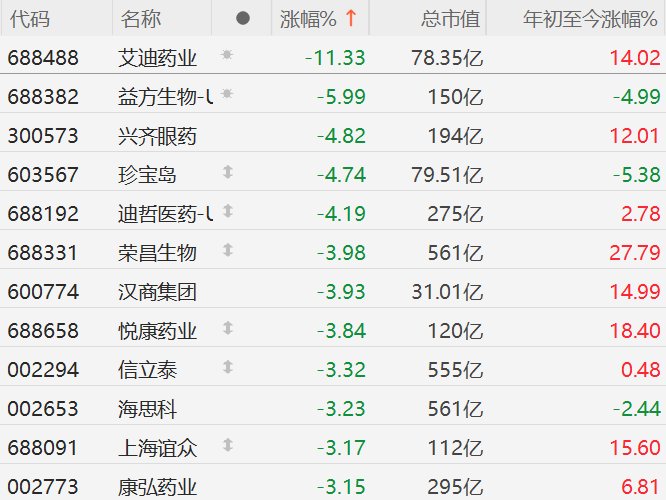
A股创新药概念股普跌,艾迪药业跌超11%
Ge Long Hui A P P· 2026-01-22 05:31
Group 1 - The A-share market saw a significant decline in innovative drug concept stocks, with notable drops including Aidi Pharmaceutical down over 11% and Yifang Bio down over 5% [1] - Other companies such as Xingqi Pharmaceutical, Zhenbaodao, and Dize Pharmaceutical experienced declines of over 4%, while Rongchang Bio, Hanshang Group, Yuekang Pharmaceutical, Xinlitai, Haishike, Shanghai Yizhong, and Kanghong Pharmaceutical fell by over 3% [1] Group 2 - Aidi Pharmaceutical (688488) reported a decline of 11.33%, with a total market value of 7.835 billion and a year-to-date increase of 14.02% [2] - Yifang Bio (688382) decreased by 5.99%, with a market capitalization of 15 billion and a year-to-date decline of 4.99% [2] - Xingqi Pharmaceutical (300573) fell by 4.82%, with a market value of 19.4 billion and a year-to-date increase of 12.01% [2] - Zhenbaodao (603567) dropped by 4.74%, with a market capitalization of 7.951 billion and a year-to-date decline of 5.38% [2] - Dize Pharmaceutical (688192) decreased by 4.19%, with a market value of 27.5 billion and a year-to-date increase of 2.78% [2] - Rongchang Bio (688331) fell by 3.98%, with a market capitalization of 56.1 billion and a year-to-date increase of 27.79% [2] - Hanshang Group (600774) decreased by 3.93%, with a market value of 3.101 billion and a year-to-date increase of 14.99% [2] - Yuekang Pharmaceutical (688658) dropped by 3.84%, with a market capitalization of 12 billion and a year-to-date increase of 18.40% [2] - Xinlitai (002294) fell by 3.32%, with a market value of 55.5 billion and a year-to-date increase of 0.48% [2] - Haishike (002653) decreased by 3.23%, with a market capitalization of 56.1 billion and a year-to-date decline of 2.44% [2] - Shanghai Yizhong (688091) dropped by 3.17%, with a market value of 11.2 billion and a year-to-date increase of 15.60% [2] - Kanghong Pharmaceutical (002773) fell by 3.15%, with a market capitalization of 29.5 billion and a year-to-date increase of 6.81% [2]




生物制品板块1月21日涨0.19%,近岸蛋白领涨,主力资金净流入7704.07万元
Zheng Xing Xing Ye Ri Bao· 2026-01-21 08:53
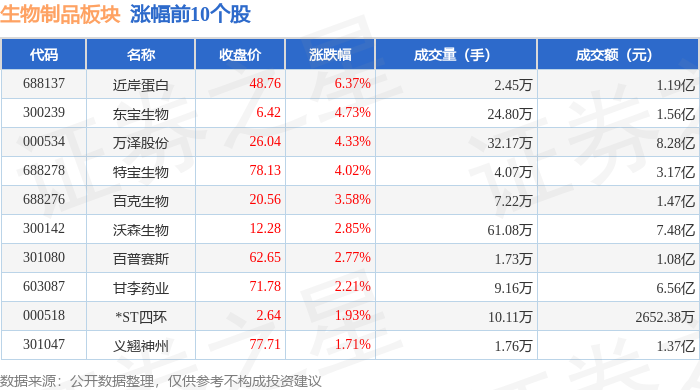
Group 1 - The biopharmaceutical sector increased by 0.19% on January 21, with Nearshore Protein leading the gains [1] - The Shanghai Composite Index closed at 4116.94, up 0.08%, while the Shenzhen Component Index closed at 14255.12, up 0.7% [1] - Key stocks in the biopharmaceutical sector showed significant price increases, with Nearshore Protein rising by 6.37% to a closing price of 48.76 [1] Group 2 - The biopharmaceutical sector experienced a net inflow of 77.04 million yuan from institutional investors, while retail investors saw a net outflow of 284 million yuan [2] - Major stocks like Watson Bio and Ganli Pharmaceutical attracted significant institutional investment, with net inflows of 64.45 million yuan and 55.25 million yuan, respectively [3] - Retail investors showed a negative trend in several stocks, with Watson Bio and Ganli Pharmaceutical experiencing net outflows of 33.30 million yuan and 39.14 million yuan, respectively [3]


研报掘金丨信达证券:首予康弘药业“买入”评级,眼科基因治疗领域前瞻性布局
Ge Long Hui· 2026-01-20 06:05
Group 1 - Core viewpoint: Kanghong Pharmaceutical is a leading enterprise in the domestic ophthalmic innovative drug sector, with a product portfolio covering various therapeutic areas including ophthalmology, psychiatry/neuroscience, digestion, respiration, hypertension, and diabetes [1] - The company has over 25 marketed drugs, with 11 being exclusive products, 20 included in the national medical insurance catalog, and 10 in the national essential drug catalog [1] - The core product, Conbercept injection, has been approved for four major retinal diseases since its launch in 2013 [1] Group 2 - The company has 13 research pipelines in clinical stages, with rapid progress in KH110 (Phase III), KH109 (Phase III), and KH631 (Phase II) [1] - Financial performance is stable, with revenue of 3.624 billion yuan for the first three quarters of 2025, a year-on-year increase of 6.23%, and a net profit attributable to the parent company of 1.033 billion yuan, up 6.08% year-on-year [1] - The comprehensive gross margin remains around 90%, with good cost control leading to a steady increase in net profit margin to 29% [1] Group 3 - The company is proactively positioning itself in the field of gene therapy for ophthalmology, with KH631 in Phase II clinical trials and KH658 in Phase I, leading the research progress domestically [1] - The initial coverage of the company has been rated as "Buy" [1]

康弘药业(002773)首次覆盖报告:深耕眼科黄金赛道 基因治疗创新管线打开新空间
Xin Lang Cai Jing· 2026-01-20 00:29
Core Insights - Kanghong Pharmaceutical is a leading enterprise in the domestic ophthalmic innovative drug sector, with a product portfolio covering various therapeutic areas including ophthalmology, psychiatry/neuroscience, digestion, respiratory, hypertension, and diabetes [1] - The company has over 25 marketed drugs, with 11 being exclusive products, 20 included in the national medical insurance catalog, and 10 in the national essential drug list [1] - The core product, Conbercept, has been approved for four major retinal diseases since its launch in 2013 and has achieved cumulative sales of 13 billion yuan [2] Financial Performance - For the first three quarters of 2025, the company reported revenue of 3.624 billion yuan, a year-on-year increase of 6.23%, and a net profit attributable to shareholders of 1.033 billion yuan, up 6.08% year-on-year [1] - The gross profit margin remains around 90%, with a steady increase in net profit margin to 29% [1] Market Potential - The global ophthalmic drug market is expected to exceed 70 billion USD by 2030, with the domestic market projected to surpass 20 billion yuan [2] - Conbercept holds a market share of approximately 40.55% as of the first half of 2025, indicating significant growth potential as its penetration rate is only 0.6% [2] Innovation Pipeline - The company has 13 research and development pipelines in clinical stages, with rapid progress in KH110 and KH109 (both in Phase III) and KH631 (in Phase II) [1][4] - In the field of gene therapy, the company is advancing with KH631 in Phase II and KH658 in Phase I, leading the domestic progress [4] Earnings Forecast - Revenue projections for the company are 4.889 billion yuan, 5.126 billion yuan, and 5.418 billion yuan for 2025-2027, with net profits of 1.254 billion yuan, 1.337 billion yuan, and 1.431 billion yuan respectively [4] - Corresponding EPS estimates are 1.36, 1.45, and 1.55 yuan, with PE ratios of 24.84, 23.31, and 21.78 [4]
康弘药业:深耕眼科黄金赛道,基因治疗创新管线打开新空间-20260120
Xinda Securities· 2026-01-20 00:25
Investment Rating - The investment rating for the company is "Buy" [2] Core Insights - The company is a leading player in the domestic ophthalmic innovative drug sector, with a product portfolio covering various therapeutic areas including ophthalmology, psychiatry/neuroscience, digestion, respiratory, hypertension, and diabetes. It has over 25 marketed products, with 11 being exclusive varieties and 20 included in the national medical insurance catalog [5][6] - The company has a robust financial performance, achieving a revenue of 3.624 billion yuan in the first three quarters of 2025, representing a year-on-year growth of 6.23%, and a net profit of 1.033 billion yuan, with a net profit margin steadily increasing to 29% [5][6] - The global ophthalmic drug market is expected to exceed $70 billion by 2030, with the domestic market projected to surpass 20 billion yuan. The company's core product, Conbercept, has maintained a market share of approximately 40.55% as of the first half of 2025, with significant growth potential due to low penetration rates [6][19] Summary by Sections Company Overview - The company has transitioned from traditional pharmaceuticals to innovative drug development, establishing itself as a leader in the ophthalmic sector. It was founded in 1996 and has evolved through various stages, including the establishment of subsidiaries focused on biopharmaceuticals and gene therapy [23][25] Product Pipeline - The company has 13 research and development pipelines in clinical stages, with key products including KH110 (Alzheimer's disease) and KH109 (anxiety) in Phase III, and KH631 (gene therapy for nAMD) in Phase II. The gene therapy products are positioned to disrupt traditional treatment methods in ophthalmology [8][32] Market Potential - The company is well-positioned in the ophthalmic disease market, which is characterized by high unmet clinical needs. The penetration rate of Conbercept is currently only 0.6%, indicating substantial room for growth as the market expands [6][19] Financial Projections - Revenue projections for the company are 4.889 billion yuan for 2025, 5.126 billion yuan for 2026, and 5.418 billion yuan for 2027, with corresponding net profits of 1.254 billion yuan, 1.337 billion yuan, and 1.431 billion yuan respectively. The earnings per share (EPS) are expected to grow from 1.36 yuan in 2025 to 1.55 yuan in 2027 [9][10]
JPM亮点归纳,年报预告陆续披露,积极把握超预期机会
ZHONGTAI SECURITIES· 2026-01-19 04:40
Investment Rating - The report maintains an "Overweight" rating for the pharmaceutical and biotechnology industry [2]. Core Insights - The report highlights the ongoing performance of the pharmaceutical sector, with a focus on the upcoming annual earnings forecasts and the potential for exceeding expectations. The sector has shown a return of 7.08% since the beginning of 2026, outperforming the CSI 300 index by 4.88% [8][12]. - Key catalysts in the industry include significant partnerships and acquisitions, such as AbbVie’s $6.5 billion upfront payment for RC148 and a $1 billion collaboration between Eli Lilly and NVIDIA to accelerate AI drug development [4][10]. - The report emphasizes the importance of innovative drug chains and the AI+ theme, suggesting that these areas will continue to attract investment and yield positive results [4][5]. Summary by Sections Industry Overview - The pharmaceutical sector's total market capitalization is approximately 74,744.70 billion yuan, with a circulating market value of 68,522.64 billion yuan [2]. - The report notes that the pharmaceutical sector is currently valued at 23.4 times PE based on 2026 earnings forecasts, which is a premium of 13.7% compared to the overall A-share market [15]. Market Dynamics - The report indicates that the pharmaceutical sector has experienced a mixed performance, with medical services up by 3.29% while other segments like medical devices and traditional Chinese medicine have seen declines [8][12]. - The report also mentions that the market is transitioning to a more rational and steady growth phase, moving away from the initial volatility seen at the start of the year [4]. Key Company Performances - Notable companies such as WuXi Biologics, Sangamo Therapeutics, and Tigermed have been highlighted for their strong performance, with WuXi Biologics showing a significant increase of 26.53% in January [24]. - The report suggests continued monitoring of companies involved in AI and small nucleic acid technologies, as they are expected to lead future growth in the sector [5][9]. Investment Recommendations - The report recommends focusing on companies that are well-positioned within the innovative drug chain and AI+ sectors, as these are anticipated to provide substantial returns [4][5]. - Specific stocks recommended include WuXi Biologics, Sangamo Therapeutics, and Tigermed, which have shown promising growth trajectories [24].