Asymchem(002821)

Search documents
10月23日生物经济(970038)指数跌0.06%,成份股京新药业(002020)领跌
Sou Hu Cai Jing· 2025-10-23 09:56
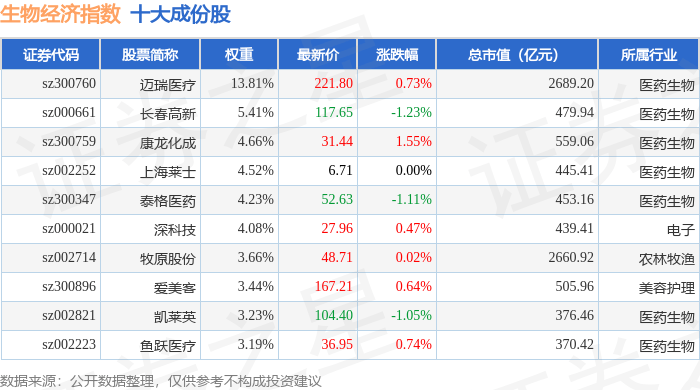
Core Viewpoint - The Biotech Index (970038) closed at 2259.94 points, down 0.06%, with a trading volume of 17.182 billion yuan and a turnover rate of 1.24% on October 23 [1] Group 1: Index Performance - The Biotech Index had 26 stocks rising and 22 stocks falling on the day, with Huace Testing leading the gainers at a 3.03% increase, while Jingxin Pharmaceutical led the decliners with a 4.17% drop [1] - The top ten constituent stocks of the Biotech Index include: - Mindray Medical (13.81% weight, latest price 221.80, market cap 268.92 billion yuan) [1] - Changchun High-tech (5.41% weight, latest price 117.65, market cap 47.994 billion yuan) [1] - Kanglong Chemical (4.66% weight, latest price 31.44, market cap 55.906 billion yuan) [1] - Others include Shishi Yushang, Biao Ge Pharmaceutical, and more, all within the biotech and related sectors [1] Group 2: Capital Flow - The Biotech Index constituents experienced a net outflow of 502 million yuan from main funds, while retail investors saw a net inflow of 354 million yuan [3] - Detailed capital flow for key stocks includes: - Deep Technology: Main fund net inflow of 82.5949 million yuan, retail net inflow of 21.4 million yuan [3] - Mindray Medical: Main fund net inflow of 66.9479 million yuan, retail net outflow of 3.6088 million yuan [3] - Other stocks like Muyuan Foods and Kanglong Chemical also showed varying levels of net inflow and outflow from different investor categories [3]





2026年中国医药外包(CXO)行业政策、运行现状、细分市场、竞争格局及未来发展趋势研判:创新药融资与BD交易双升,CXO行业景气度持续向上[图]
Chan Ye Xin Xi Wang· 2025-10-23 01:26
Core Insights - The CXO (Contract X Organization) model allows pharmaceutical companies to outsource drug development, production, or sales to specialized institutions, enhancing efficiency and reducing costs while sharing the benefits of pharmaceutical innovation [1][2][4] - The global CXO market is projected to reach $196.6 billion by 2025, with a CAGR of 14.0% from 2021 to 2025, while the Chinese market is expected to grow to 247.7 billion yuan, with a remarkable CAGR of 26.56% from 2020 to 2025 [1][7][9] - Recent policies in China, such as the MAH (Marketing Authorization Holder) system, are optimizing resource allocation and encouraging innovation, providing a robust support system for the CXO industry [5][10] CXO Industry Overview - CXO encompasses various outsourcing services including CRO (Contract Research Organization), CMO (Contract Manufacturing Organization), CDMO (Contract Development and Manufacturing Organization), and CSO (Contract Sales Organization) [2][4] - The CXO industry is characterized by a full-process collaboration model that integrates services from early research to commercial production, significantly improving client R&D efficiency [4][10] Policy Analysis - Recent Chinese policies have created a favorable environment for the CXO industry, promoting innovation and optimizing the pharmaceutical supply chain [5][10] - The implementation of the MAH system has separated drug marketing and production licenses, enhancing specialization and reducing redundant investments [5][10] Global Market Trends - The global CXO market is experiencing rapid expansion, driven by increased R&D investments from innovative pharmaceutical companies [6][9] - By 2025, the global CRO market is expected to reach approximately $98 billion, while the CDMO market is projected to reach $99 billion, indicating strong growth potential [6][9] Chinese Market Dynamics - China's CXO market is rapidly expanding, with a projected market size increase from 76.3 billion yuan in 2020 to 247.7 billion yuan by 2025, reflecting a strong domestic market vitality [7][9] - In the first eight months of 2025, domestic innovative drug financing reached $7.75 billion, a year-on-year increase of 89%, highlighting the growing investment interest in the sector [9][10] Competitive Landscape - The Chinese CXO industry features a clear competitive hierarchy, with leading companies like WuXi AppTec and Kanglong Chemical expanding their market share through comprehensive service capabilities [10] - The first-tier companies are establishing a global delivery system, while second-tier companies are focusing on niche areas to build competitive advantages [10] Future Development Trends - The CXO industry is expected to evolve around three main directions: technological advancement, global operations, and ecosystem integration [10][12] - Leading companies will focus on high-tech areas such as ADC and gene therapy, while also enhancing their global operational resilience [12][13] - The integration of AI in drug development will drive new service models and reshape the competitive landscape, with larger firms consolidating their positions while smaller firms must specialize to survive [14]




10月22日生物经济(970038)指数跌0.81%,成份股普洛药业(000739)领跌
Sou Hu Cai Jing· 2025-10-22 10:24
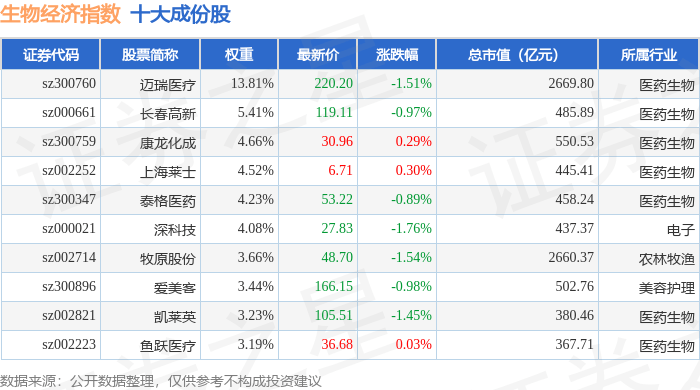
Core Insights - The Biotech Economy Index (970038) closed at 2261.4 points, down 0.81%, with a trading volume of 16.635 billion yuan and a turnover rate of 1.19% [1] - Among the index constituents, 19 stocks rose while 30 stocks fell, with Meihao Medical leading the gainers at 6.53% and Prolo Pharma leading the decliners at 5.41% [1] Index Performance - The Biotech Economy Index experienced a decline of 0.81% on the reporting day [1] - The total market capitalization of the index constituents was significant, with major players like Mindray Medical valued at 266.98 billion yuan [1] Top Constituents - The top ten constituents of the Biotech Economy Index include: - Mindray Medical (13.81% weight, 220.20 yuan, -1.51% change, 2669.80 billion yuan market cap) [1] - Changchun High-tech (5.41% weight, 119.11 yuan, -0.97% change, 485.89 billion yuan market cap) [1] - Kanglong Chemical (4.66% weight, 30.96 yuan, +0.29% change, 550.53 billion yuan market cap) [1] - Other notable constituents include Taige Pharmaceutical, Muyuans, and Aimeike, all within the biotech and healthcare sectors [1] Capital Flow - The net outflow of main funds from the Biotech Economy Index constituents totaled 0.893 billion yuan, while retail investors saw a net inflow of 0.75 billion yuan [1] - Specific stocks like Kanglong Chemical and Meihao Medical experienced varying levels of net inflow and outflow from different investor categories [2]

医疗服务板块10月22日跌0.9%,三博脑科领跌,主力资金净流出6.15亿元
Zheng Xing Xing Ye Ri Bao· 2025-10-22 08:19
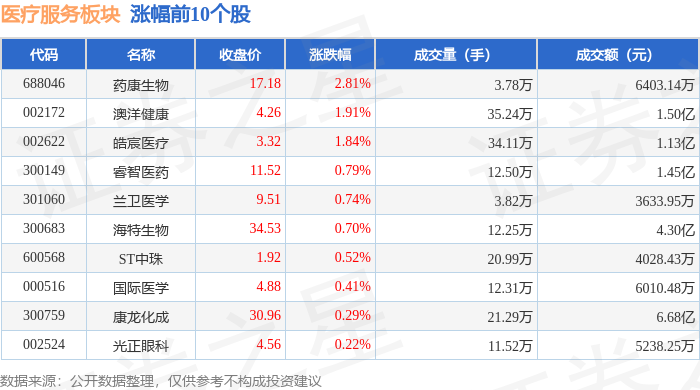
Market Overview - The medical services sector experienced a decline of 0.9% on October 22, with Sanbo Brain Science leading the drop [1] - The Shanghai Composite Index closed at 3913.76, down 0.07%, while the Shenzhen Component Index closed at 12996.61, down 0.62% [1] Stock Performance - Notable gainers in the medical services sector included: - Yaokang Biological (688046) with a closing price of 17.18, up 2.81% [1] - Aoyang Health (002172) with a closing price of 4.26, up 1.91% [1] - Haochen Medical (002622) with a closing price of 3.32, up 1.84% [1] - Significant decliners included: - Sanbo Brain Science (301293) with a closing price of 57.19, down 4.67% [2] - Chengda Pharmaceutical (301201) with a closing price of 33.98, down 4.50% [2] - XD Haoyuan Medical (688131) with a closing price of 79.90, down 2.07% [2] Capital Flow - The medical services sector saw a net outflow of 615 million yuan from institutional investors, while retail investors contributed a net inflow of 370 million yuan [2][3] - Key stocks with notable capital flows included: - Kanglong Chemical (300759) with a net inflow of 46.59 million yuan from institutional investors [3] - Aoyang Health (002172) with a net inflow of 10.44 million yuan from institutional investors [3] - Yaokang Biological (688046) with a net inflow of 9 million yuan from institutional investors [3]





10月20日生物经济(970038)指数涨0.08%,成份股我武生物(300357)领涨
Sou Hu Cai Jing· 2025-10-20 09:42
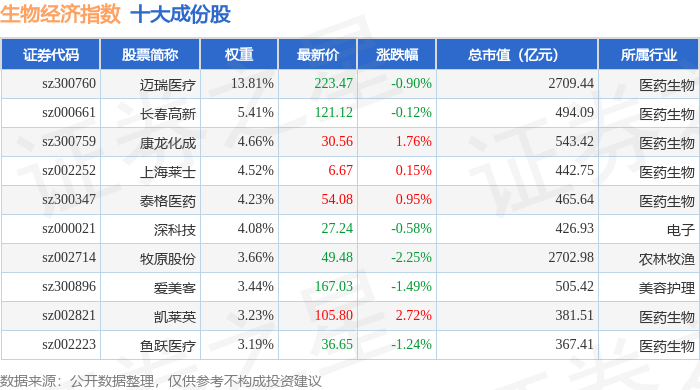
Core Points - The Bioeconomy Index (970038) closed at 2262.82 points, up 0.08%, with a trading volume of 19.253 billion yuan and a turnover rate of 1.3% [1] - Among the index constituents, 27 stocks rose, with Iwubio leading at a 10.07% increase, while 22 stocks fell, with Yifan Pharmaceutical leading the decline at 4.45% [1] Index Constituents Summary - The top ten constituents of the Bioeconomy Index include: - Mindray Medical (sz300760) with a weight of 13.81%, latest price at 223.47, down 0.90%, and a market cap of 270.944 billion yuan [1] - Changchun High-tech (sz000661) with a weight of 5.41%, latest price at 121.12, down 0.12%, and a market cap of 49.409 billion yuan [1] - Kanglong Chemical (sz300759) with a weight of 4.66%, latest price at 30.56, up 1.76%, and a market cap of 54.342 billion yuan [1] - Shizhu Aoshi (sz002252) with a weight of 4.52%, latest price at 6.67, up 0.15%, and a market cap of 44.275 billion yuan [1] - Biao Ge Shi Medicine (sz300347) with a weight of 4.23%, latest price at 54.08, up 0.95%, and a market cap of 46.564 billion yuan [1] - Shenzhen Technology (sz000021) with a weight of 4.08%, latest price at 27.24, down 0.58%, and a market cap of 42.693 billion yuan [1] - Muyuan Foods (sz002714) with a weight of 3.66%, latest price at 49.48, down 2.25%, and a market cap of 270.298 billion yuan [1] - Aimeike (sz300896) with a weight of 3.44%, latest price at 167.03, down 1.49%, and a market cap of 50.542 billion yuan [1] - Kailai Ying (sz002821) with a weight of 3.23%, latest price at 105.80, up 2.72%, and a market cap of 38.151 billion yuan [1] - Color Egg Therapy (sz002223) with a weight of 3.19%, latest price at 36.65, down 1.24%, and a market cap of 36.741 billion yuan [1] Capital Flow Summary - The Bioeconomy Index constituents experienced a net outflow of 599 million yuan from institutional investors and 215 million yuan from retail investors, while retail investors saw a net inflow of 814 million yuan [3] - Notable capital flows include: - Kanglong Chemical saw a net inflow of 74.766 million yuan from institutional investors, while retail investors experienced a net outflow of 49.703 million yuan [3] - Hualan Biological had a net inflow of 42.164 million yuan from institutional investors, with retail investors seeing a net outflow of 33.5328 million yuan [3] - Lepu Medical had a net inflow of 40.927 million yuan from institutional investors, while retail investors had a net outflow of 32.1814 million yuan [3] - Kailai Ying had a net inflow of 38.867 million yuan from institutional investors, with retail investors experiencing a net outflow of 16.4533 million yuan [3] - Iwubio had a net inflow of 23.192 million yuan from institutional investors, while retail investors saw a net outflow of 5.9208 million yuan [3]



高盛闭门会-医药的地缘风险已下降,亚洲CDMO及医疗行业展望
Goldman Sachs· 2025-10-19 15:58
Investment Rating - The report indicates a stable demand outlook for the CDMO industry, with new growth points emerging from weight loss drugs, peptide drugs, and GLP-1 drugs, leading to a positive investment sentiment towards the sector. Core Insights - The geopolitical risks in the pharmaceutical industry have decreased, allowing investors to focus more on the performance, order momentum, and delivery capabilities of CDMO companies [1][4] - Chinese CDMO companies are actively expanding capacity and investing in new technologies, with firms like WuXi AppTec and Kelun Biotech accelerating overseas capacity construction to balance cost-effectiveness and maintain profit margins [1][5] - The rise of Chinese biotech firms is increasing global competition, emphasizing the importance of technical capabilities and execution quality [1][4] Summary by Sections Demand and Growth Opportunities - Overall demand in the CDMO sector remains robust, with expectations for improvement in the second half of the year, particularly driven by weight loss drugs, peptide drugs, and GLP-1 drugs [2] - ADC (antibody-drug conjugates) and bispecific antibodies are also showing new demand in the R&D sector, indicating future growth potential [2] Capacity Expansion and Profitability - The trend of overseas capacity expansion is becoming increasingly important, with many Asian companies prioritizing this despite high construction costs and long cycles due to its flexibility and risk reduction advantages [4][6] - Companies are shifting high-automation production processes overseas while leveraging domestic operational advantages to achieve cost-effectiveness [6] Company Strategies - WuXi AppTec plans to accelerate the construction of small molecule factories in Singapore and the U.S., with the Singapore facility expected to be operational by January 2027 [5] - Kelun Biotech is expanding its capacity from 30,000 liters to 44,000 liters, with multiple clinical projects progressing to mid-late stages [8] - BoroPharma is focusing on expansion through acquisitions rather than starting from scratch, utilizing shared services for operational flexibility [5] Market Trends and Policy Impact - The U.S. MFN pricing policy has had a limited initial impact, primarily affecting Medicaid, with overall drug price effects being minimal [3][10] - Tariff policies mainly target patented drugs, with manageable impacts on Chinese CDMO companies, especially those with established U.S. facilities [12] - The Chinese biotech pharma sector is performing strongly, driven by innovative pipelines and rising valuations, with significant interest in metabolic and autoimmune diseases [14]
天津海关完成首批高新技术企业真空包装网备平台备案
Zhong Guo Xin Wen Wang· 2025-10-17 11:24
Core Insights - Three high-tech companies, including Kailaiying Pharmaceutical Group (Tianjin) Co., Ltd., have successfully completed online registration to utilize the "Vacuum Packaging and High-Tech Goods Control Inspection Smart Network Platform" [1][2] Group 1: Policy and Implementation - The vacuum packaging inspection model is designed by the General Administration of Customs to promote foreign trade growth and optimize the business environment for high-tech enterprises [1] - This model allows for the transfer of some inspection directives to the destination during import checks and limits export checks to visual or machine inspections, reducing the risk of damage to high-tech goods [1][2] Group 2: Benefits to Companies - The new policy aligns with the stringent storage requirements for raw materials and pharmaceutical intermediates, providing a protective measure for product quality [2] - Non-invasive inspections ensure product quality, and the application process through the vacuum packaging platform is more efficient, enhancing delivery speed to global customers [2] Group 3: Performance Metrics - As of now, 45 companies have registered for the vacuum packaging model in the Tianjin Customs area, with a total import and export value of 49.248 billion yuan from January to September, reflecting a year-on-year increase of 44.56% [2]
中国CDMO-2025 年第三季度前瞻:关注新订单与盈利韧性,以应对地缘政治不确定性-China Healthcare CDMOs_ 3Q25 preview_ Eyes on New Order and Earnings Resilience to Navigate Geopolitical Uncertainty
2025-10-17 01:46
Summary of Conference Call Notes on China Healthcare CDMOs Industry Overview - The focus is on the Contract Research Organization (CRO) and Contract Development and Manufacturing Organization (CDMO) sectors, particularly in China - Investor interest has increased due to strong performance in the second quarter of 2025, with a 27% growth compared to a 15% growth in the MXCN index [1][2] Key Points and Arguments 1. **Earnings Growth Expectations**: - Earnings growth for 3Q25 may moderate due to a high base effect, but sequential improvement is anticipated as projects progress and new capacity comes online [2][3] - Forecasted sales growth for major players: WuXi Apptec (+10%), Asymchem (+19%), and Pharmaron (+8%) compared to their 2Q25 growth rates of +20%, +28%, and +14% respectively [3] 2. **New Order Momentum**: - New order momentum is expected to remain resilient, supported by CMO projects and emerging modalities such as GLP-1/peptide capacity and Antibody-Drug Conjugates (ADCs) [2][8] - Anticipated improvements in 2026 as funding conditions recover following interest rate cuts [2] 3. **Policy and Geopolitical Factors**: - Ongoing policy uncertainty, particularly related to the US Biosecure Act, is likely to drive near-term share price volatility [2][11] - The Senate passed the FY26 NDAA with the US Biosecure Act included, which may impact companies identified as Chinese military entities operating in the US [11][12] 4. **Operational Excellence**: - Companies are focusing on operational excellence and technological advancements to secure client orders amidst geopolitical uncertainties [2][11] 5. **Capex and Investment**: - Major Chinese CDMO players are expected to maintain their FY25 capital expenditure budgets, continuing investments in peptide, ADCs, and global expansion [3][6] Additional Important Insights - **Backlog and Order Growth**: - WuXi Apptec's backlog growth in peptide and small molecule oral GLP-1 is a key focus area, along with Asymchem's order growth from peptides and ADCs [8] - The recovery in early-stage R&D remains mixed, with expectations of improvement in 2026 driven by funding recovery [8] - **Valuation and Price Targets**: - Target prices for companies such as Asymchem, Pharmaron, WuXi Apptec, WuXi Biologics, and WuXi XDC have been adjusted based on market conditions and company performance [20][23][24][25] - **Risks**: - Key risks include sensitivity to loss of key clients, pricing pressure, regulatory risks, and geopolitical tensions, particularly between the US and China [21][22][23][24][25] - **Expansion Plans**: - Chinese CDMOs are actively expanding operations overseas, with significant investments in the US and Europe [19] This summary encapsulates the critical insights from the conference call regarding the current state and future outlook of the China healthcare CDMO industry, highlighting both opportunities and risks.
凯莱英20251015
2025-10-15 14:57
Key Points Summary of Kailaiying Conference Call Company Overview - Kailaiying was founded by Dr. Hong in 1998, with a development path similar to WuXi AppTec, listed on Shenzhen Stock Exchange in 2016 and Hong Kong Stock Exchange in 2021 [7][10] Industry and Business Segments - The company operates in the CDMO (Contract Development and Manufacturing Organization) sector, focusing on small molecules and emerging businesses such as large molecule CDMO, formulation CDMO, clinical CRO, and synthetic biology [2][4] - Emerging businesses currently account for approximately 20% of total revenue and are expected to grow rapidly, significantly contributing to overall performance [2][4] Financial Performance - Revenue growth is projected to be in the double digits from 2025 to 2027, with profit growth potentially slightly faster [6][16] - The small molecule CDMO segment is robust, contributing about 70% to 80% of total revenue, with a high gross margin of 90% [3][8] - The company reported a recovery in revenue and profit growth in Q4 2024, with expectations for strong growth in 2025 [5][16] Market Position and Strategy - Kailaiying's overseas revenue dominates, with only 26% from China, approximately 60% from the US, and around 13% from Europe, making it less affected by domestic price wars [9] - The company employs a leasing model for overseas expansion to mitigate financial risks associated with direct acquisitions, reflecting a cautious and stable growth strategy [5][17] Emerging Business Insights - The emerging business segment includes significant growth in the chemical large molecule area, with production capacity expected to reach 30,000 liters by the end of the year, indicating rapid expansion [12] - Key factors for growth in emerging businesses include large clients and orders in the peptide sector, which are crucial for future product sales [15] Management and Governance - Dr. Hong holds 32% of the company's shares and has extensive industry experience, supported by a management team with a strong background [10] - The company has implemented an equity incentive plan for over 600 employees, granting nearly 5 million restricted shares, demonstrating confidence in future growth [10] Clinical and Technological Advancements - Kailaiying has made significant breakthroughs in various clinical fields, including oncology, immunology, and rare diseases, with a strong order growth in large molecules [13][14] - The company is also innovating through CFCT technology and applying synthetic biology across multiple sectors, including food and cosmetics [14] Financial Health - As of the end of 2024, Kailaiying's cash reserves are close to 60 billion RMB, with a high proportion of financial assets [16] - The company is expected to see a revenue growth rate of over 40% in emerging businesses, with profit growth anticipated to outpace revenue growth [16]
10月15日生物经济(970038)指数涨1.32%,成份股博腾股份(300363)领涨
Sou Hu Cai Jing· 2025-10-15 09:53
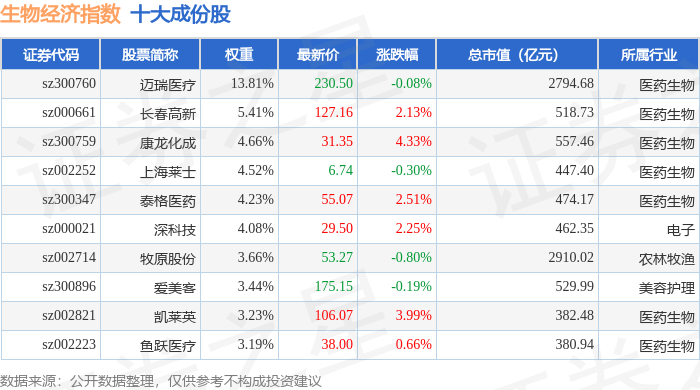
Core Points - The Bioeconomy Index (970038) closed at 2319.65 points, up 1.32%, with a trading volume of 23.929 billion yuan and a turnover rate of 1.64% [1] - Among the index constituents, 39 stocks rose while 11 fell, with Boteng Co., Ltd. leading the gainers at 6.85% and Dabo Medical leading the decliners at 2.94% [1] Index Constituents Summary - The top ten constituents of the Bioeconomy Index include: - Mindray Medical (sz300760) with a weight of 13.81%, latest price at 230.50, and a market cap of 279.468 billion yuan [1] - Changchun High-tech (sz000661) with a weight of 5.41%, latest price at 127.16, and a market cap of 51.873 billion yuan [1] - Kanglong Chemical (sz300759) with a weight of 4.66%, latest price at 31.35, and a market cap of 55.746 billion yuan [1] - Other notable constituents include Taige Pharmaceutical, Deep Technology, and Muyuan Foods, each with varying weights and market caps [1] Capital Flow Analysis - The Bioeconomy Index constituents experienced a net inflow of 265 million yuan from institutional investors, while retail investors saw a net outflow of 72.932 million yuan [3] - Key stocks with significant capital flow include: - Mindray Medical with a net inflow of 79.5868 million yuan from institutional investors [3] - Xintai (002294) with a net inflow of 66.974 million yuan, but a net outflow of 87.6434 million yuan from retail investors [3] - Changchun High-tech also saw a net inflow of 66.9424 million yuan from institutional investors, with a notable outflow from retail investors [3]