Asymchem(002821)

Search documents
凯莱英:公司首次覆盖报告小分子CDMO龙头,多肽与小核酸共筑新增长极-20260129
KAIYUAN SECURITIES· 2026-01-29 07:25
医药生物/医疗服务 凯莱英(002821.SZ) 2026 年 01 月 28 日 投资评级:买入(首次) | 日期 | 2026/1/27 | | --- | --- | | 当前股价(元) | 99.98 | | 一年最高最低(元) | 125.50/59.90 | | 总市值(亿元) | 360.80 | | 流通市值(亿元) | 316.94 | | 总股本(亿股) | 3.61 | | 流通股本(亿股) | 3.17 | | 近 3 个月换手率(%) | 87.67 | 股价走势图 -30% 0% 30% 60% 90% 2025-02 2025-06 2025-10 凯莱英 沪深300 数据来源:聚源 小分子 CDMO 龙头,多肽与小核酸共筑新增长极 ——公司首次覆盖报告 余汝意(分析师) yuruyi@kysec.cn 证书编号:S0790523070002 小分子基石稳固,常规业务韧性凸显,签单企稳回升 凯莱英是全球领先的小分子 CDMO 企业,深耕行业二十五年,正处于从单一小 分子业务向"小分子+新兴业务"双轮驱动转型的关键期。随着公司新兴业务快速 放量,业绩韧性凸显。短期看,大订单高基数影 ...
国信证券医药生物业2026年投资策略:关注创新出海 重视新技术方向
智通财经网· 2026-01-27 02:48
Group 1 - The core viewpoint is that innovative drugs are expected to show significant excess returns in 2025, driven by continuous BD overseas expansion, excellent clinical data, and policy support [1] - The CXO sector is anticipated to experience substantial growth due to the recovery in demand and improved investment environment in the global pharmaceutical industry [1] - The report emphasizes the importance of focusing on new technologies, particularly bispecific antibodies, small nucleic acid drugs, AI healthcare, and brain-computer interface innovations [3] Group 2 - Domestic supply and demand are relatively stable, with national health expenditure showing a year-on-year growth of 4.7% from January to November 2025, marking a positive turnaround after two years of decline [2] - The medical insurance fund's income and expenditure growth rates continue to decline, with total income of 2.63 trillion yuan (+2.9%) and expenditure of 2.11 trillion yuan (+0.5%) from January to November [2] - The report suggests that the commercialization of new drug forms is entering a critical phase, with significant clinical data supporting the application of B-cell depletion therapies in autoimmune diseases [3] Group 3 - Investment recommendations include focusing on innovative overseas expansion and new technology directions, with suggested stocks such as Mindray Medical, WuXi AppTec, and others [4] - The report highlights the potential for explosive growth in the global market for brain-computer interfaces, supported by policy incentives and technological breakthroughs [3]






医药生物行业2026年投资策略:关注创新出海,重视新技术方向
Guoxin Securities· 2026-01-26 15:27
Core Insights - The report emphasizes the importance of innovation in the pharmaceutical and biotechnology industry, particularly focusing on the overseas expansion of innovative drugs and the adoption of new technologies [1][4]. - The investment rating for the sector is maintained at "outperform the market" [2]. Group 1: Market Overview and Trends - The overseas market for innovative drugs and the CXO industry is expected to perform exceptionally well in 2025, driven by continuous business development (BD) activities, strong clinical data, and supportive policies [4]. - The domestic supply and demand remain stable, with a shift in payment systems favoring innovation. National health expenditure increased by 4.7% year-on-year in the first 11 months of 2025, marking a recovery after two years of decline [4]. - The report highlights the significant growth potential in new drug forms such as dual antibodies and small nucleic acid drugs, as well as innovations in AI healthcare and brain-machine interfaces [4]. Group 2: Investment Recommendations - The report recommends focusing on companies with global competitiveness and differentiated innovation capabilities, as well as domestic CXO leaders with high barriers in cost control, technology accumulation, and production capacity [4]. - Recommended stocks include Mindray Medical, WuXi AppTec, Kelaiying, Aier Eye Hospital, and several others, with specific mention of H-shares like Kelun-Bio and CanSino Biologics [4][5]. Group 3: Financial Performance and Projections - The report provides a detailed strategy portfolio for 2026, listing companies along with their projected net profits and price-to-earnings (PE) ratios, indicating a generally positive outlook for the sector [5]. - The pharmaceutical sector's overall performance in 2025 was strong, with significant gains in sub-sectors such as medical services and chemical pharmaceuticals, driven by BD collaborations and clinical data releases [12][23]. Group 4: Fund Holdings and Market Sentiment - As of Q4 2025, the net asset value of pharmaceutical funds decreased by 9.0%, with a notable shift where passive funds surpassed active funds for the first time since 2019 [25][32]. - The report indicates a decline in the proportion of pharmaceutical holdings in both active and non-pharmaceutical funds, with a concentration in chemical preparations and other biological products [32][40].


凯莱英(06821)根据H股限制性股票计划发行28.13万股
智通财经网· 2026-01-26 13:30
智通财经APP讯,凯莱英(06821)发布公告,该公司于2026年1月26日根据H股限制性股票计划向受托人 发行并配发股份28.13万股。 ...
凯莱英根据H股限制性股票计划发行28.13万股
Zhi Tong Cai Jing· 2026-01-26 13:27
Core Viewpoint - The company Kailaiying (002821)(06821) announced the issuance and allocation of 281,300 shares to a trustee under its H-share restricted stock plan on January 26, 2026 [1] Group 1 - The company will issue 281,300 shares [1]
凯莱英(06821) - 翌日披露报表
2026-01-26 13:12
FF305 翌日披露報表 (股份發行人 ── 已發行股份或庫存股份變動、股份購回及/或在場内出售庫存股份) 表格類別: 股票 狀態: 新提交 呈交日期: 2026年1月26日 如上市發行人的已發行股份或庫存股份出現變動而須根據《香港聯合交易所有限公司(「香港聯交所」)證券上市規則》(「《主板上市規則》」)第13.25A條 / 《香港聯合交易所有限公司GEM證券 上市規則》(「《GEM上市規則》」)第17.27A條作出披露,必須填妥第一章節 。 | 第一章節 | | | | | | | | --- | --- | --- | --- | --- | --- | --- | | 1. 股份分類 | 普通股 | 股份類別 H | | 於香港聯交所上市 | 是 | | | 證券代號 (如上市) | 06821 | 說明 H股 | | | | | | A. 已發行股份或庫存股份變動 | | | | | | | | | | 已發行股份(不包括庫存股份)變動 | | 庫存股份變動 | | | | 事件 | | 已發行股份(不包括庫存股份)數 目 | 佔有關事件前的現有已發 行股份(不包括庫存股 份)數目百分比 (註3) | ...
没想到吧,除了稀土,我们还有一张“王牌”……
虎嗅APP· 2026-01-25 09:33
Core Viewpoint - The article emphasizes China's dominant position in the global pharmaceutical supply chain, particularly in the production of Active Pharmaceutical Ingredients (APIs) and Key Starting Materials (KSMs), which poses a significant asymmetric threat to U.S. national security [4][5]. Group 1: China's Dominance in Pharmaceutical Supply Chain - China holds a near-monopoly in the production of various pharmaceutical raw materials, with over 90% of global antibiotic intermediates supplied by China [18]. - Approximately 70%-80% of global vitamin production capacity is controlled by China, making it a critical player in the pharmaceutical industry [19]. - China's low-cost, high-output chemical manufacturing capabilities create significant barriers for competitors, allowing it to define prices and capacities in the market [21]. Group 2: Impact of Geopolitical Tensions - The U.S.-China trade tensions have led to concerns about the dependency of the U.S. on Chinese pharmaceutical supplies, which could lead to drug shortages in critical situations [9][10]. - The article illustrates a hypothetical scenario where geopolitical tensions could disrupt the supply of essential medications, highlighting the risks of "asymmetric interdependence" [7][9]. - The ongoing drug shortage issues in the U.S. are exacerbated by the complex global supply chain, where many active ingredients are sourced from China [10][11]. Group 3: Historical Context and Strategic Decisions - The article discusses the historical context of the pharmaceutical industry's shift, where Western companies outsourced low-margin API production to lower-cost countries, primarily China, while retaining high-margin R&D and marketing functions [23][24]. - This outsourcing has led to a significant loss of industrial capability in the West, as the foundational skills and infrastructure for API production have diminished [32]. Group 4: Challenges for India as an Alternative - India, often referred to as the "world's pharmacy," lacks the complete supply chain necessary for API production, relying heavily on Chinese intermediates [36][38]. - Despite efforts to establish a domestic API supply chain, India's progress is hindered by infrastructure challenges and the dominance of Chinese suppliers [37][39]. Group 5: Future Outlook and Strategic Recommendations - The article suggests that China is transitioning from merely being a low-cost producer to becoming a leader in technology and standards within the pharmaceutical industry [43]. - As geopolitical tensions rise, the need for China to innovate in green technologies and maintain its competitive edge in the pharmaceutical supply chain becomes critical [55][56]. - The future of the pharmaceutical industry will focus on balancing efficiency and safety, with the ability to provide cost-effective and safe drugs being a key determinant of success [58].



2025年中国医药研发外包(CRO)行业政策分析 药审改革推动行业发展提速【组图】
Qian Zhan Wang· 2026-01-23 09:08
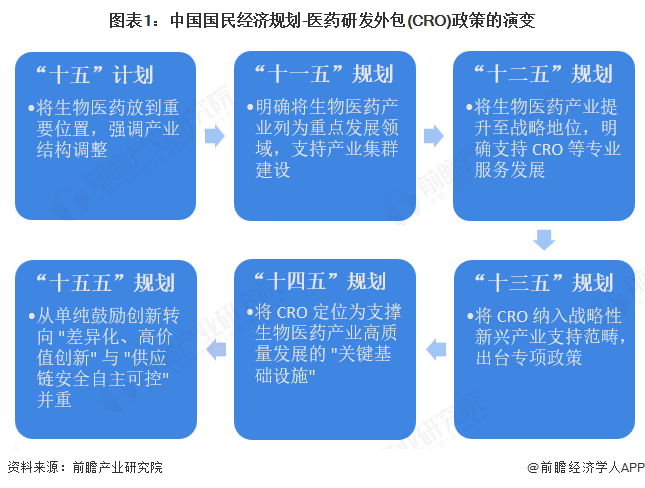
Core Viewpoint - The report highlights the significant growth and development of China's Contract Research Organization (CRO) industry, driven by a comprehensive policy framework and regulatory reforms that enhance innovation and operational efficiency in the pharmaceutical sector [1][3][9]. Group 1: Industry Overview - The main listed companies in China's CRO industry include WuXi AppTec (603259.SH), Kanglong Chemical (300759.SZ), Tigermed (300347.SZ), Kelaiying (002821.SZ), Zhaoyan New Drug (603127.SH), Jiuzhou Pharmaceutical (603456.SH), Haoyuan Pharmaceutical (688131.SH), Boteng Co., Ltd. (300363.SZ), Chengdu XianDao (688222.SH), and Yaoshi Technology (300725.SZ) [1]. - The CRO industry is recognized as a strategic emerging industry that supports pharmaceutical innovation, transitioning China from a major pharmaceutical market to a strong one [1]. Group 2: Policy Framework - The policy framework for the CRO industry is centered around the National Medical Products Administration (NMPA) and includes collaboration with other regulatory bodies such as the National Health Commission (NHC) and the Drug Administration (CDR) [3]. - Key regulatory measures include the Marketing Authorization Holder (MAH) system, implicit licensing for clinical trials, Good Laboratory Practice (GLP) and Good Clinical Practice (GCP) certifications, and priority review and approval processes [3]. Group 3: Industry Support Policies - National policies provide financial support through initiatives like the "Major New Drug Creation" program, tax reductions for high-tech enterprises, and increased deductions for R&D expenses, which lower operational costs for the industry [6]. - Local governments implement differentiated policies that align with regional industrial characteristics, including subsidies for innovative drug development and funding for CRO platform construction [6]. Group 4: Drug Review Reforms - Recent reforms in drug review processes have significantly improved approval efficiency, reducing the average clinical trial review time from 420 days to 30 days in pilot areas, and addressing a backlog of 22,000 cases [9][12]. - The definition of new drugs has shifted from "China New" to "Global New," aligning with international standards and enhancing the quality of innovation [12]. Group 5: Future Trends - The future of the CRO industry in China is expected to be driven by a robust policy framework, with trends including deeper collaboration in service models, increased application of AI and digital platforms, and a focus on specialized market segments [13]. - The competitive landscape is anticipated to evolve with the rise of domestic leaders and accelerated internationalization, benefiting from improved mechanisms for mutual recognition of clinical trial data [13].



中欧基金葛兰:一季度医药板块有望延续结构性行情,看好创新药械产业链出海、消费医疗等投资机会
Sou Hu Cai Jing· 2026-01-23 06:53
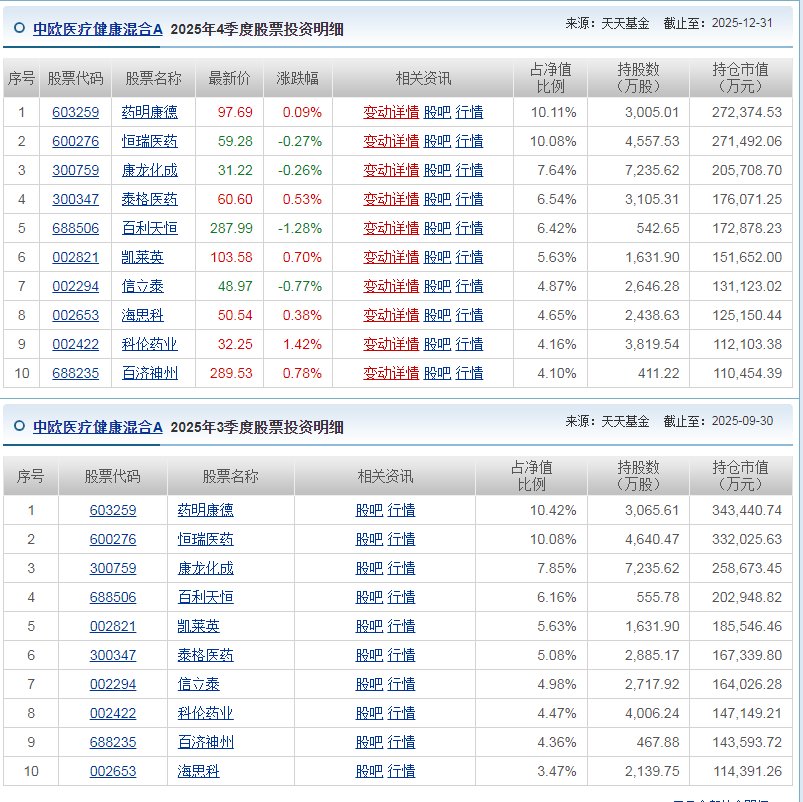
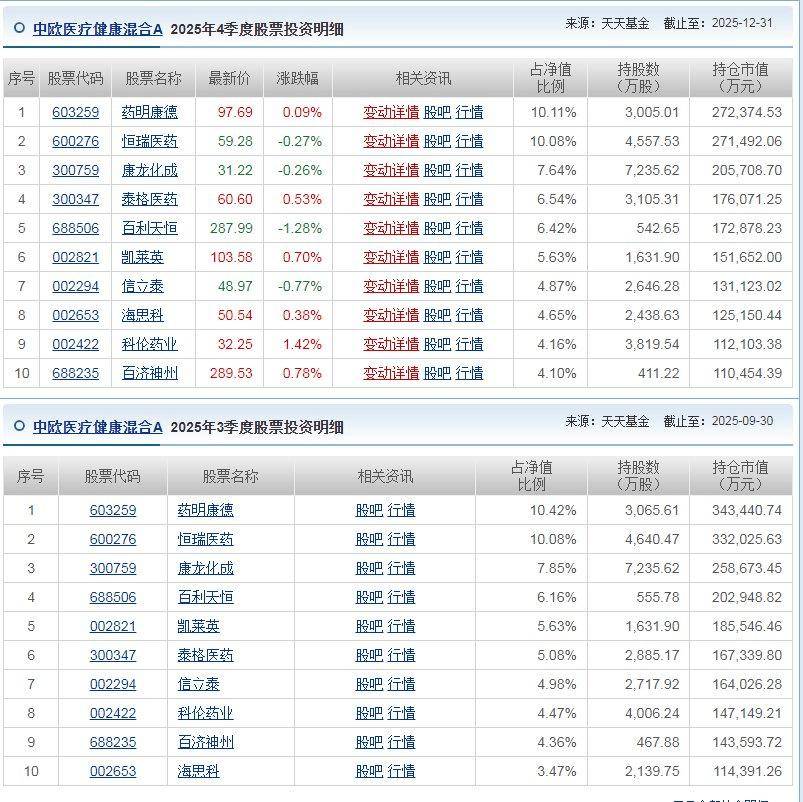
Core Viewpoint - The report highlights the performance of the China Europe Medical Health Mixed Fund managed by Ge Lan and Zhao Lei, indicating a decline in total fund size and negative returns compared to benchmarks [1][4]. Fund Performance - As of December 31, 2025, the total size of the funds managed by Ge Lan decreased from 43.544 billion to 35.389 billion yuan [1]. - The A-class share of the China Europe Medical Health Mixed Fund recorded a net value growth rate of -14.81%, while the C-class share saw a decline of -14.98%, both underperforming the benchmark return of -8.21% [1][3]. Holdings Overview - The top ten holdings of the China Europe Medical Health Fund include WuXi AppTec, Heng Rui Medicine, and Kanglong Chemical, with notable increases in holdings for Hai Si Ke and Tai Ge Medicine, while reductions were seen in stocks like Ke Lun Pharmaceutical and Xin Li Tai [1][2]. Market Context - In Q4 2025, the CSI Pharmaceutical Index fell by 12.7%, underperforming the CSI 300 Index, which declined by only 0.2%. The report notes significant differentiation within sub-sectors, with innovative industries experiencing corrections while traditional Chinese medicine and pharmaceutical commerce remained relatively stable [3]. Future Outlook - Looking ahead to Q1 2026, improvements in global liquidity are expected to boost investment and financing in innovative pharmaceuticals, supported by domestic policy enhancements. The innovative drug and device industry is anticipated to maintain a high level of activity, with several key domestic drugs approaching critical data readouts [4][5]. - The report suggests that the pharmaceutical sector may continue to experience structural trends due to macroeconomic improvements, supportive industry policies, and ongoing innovation, with investment opportunities focusing on the progress of innovative drug and device exports, domestic substitution in equipment, and recovery in consumer healthcare demand [5].

中欧基金葛兰:一季度医药板块有望延续结构性行情 看好创新药械产业链出海、消费医疗等投资机会
Zhi Tong Cai Jing· 2026-01-23 06:33
Core Viewpoint - The report highlights the performance of the China Europe Medical Health Mixed Fund, managed by Ge Lan and Zhao Lei, indicating a decline in total fund size and negative returns compared to benchmarks for the fourth quarter of 2025 [1][4]. Fund Performance - As of December 31, 2025, the total size of funds managed by Ge Lan decreased from 43.544 billion to 35.389 billion yuan [1]. - The net value growth rate for Class A shares of the China Europe Medical Health Mixed Fund was -14.81%, while the benchmark return was -8.21% [1]. - Class C shares experienced a net value growth rate of -14.98%, also underperforming the benchmark [1]. Holdings Overview - The top ten holdings of the China Europe Medical Health Mixed Fund include WuXi AppTec, Heng Rui Medicine, and Kanglong Chemical, with notable increases in holdings for Hai Si Ke and Tai Ge Medicine, while reductions were seen in stocks like Ke Lun Pharmaceutical and Xin Li Tai [1][2]. - The largest holding, WuXi AppTec, accounted for 10.11% of the fund's net value, with a market value of approximately 2.724 billion yuan [2]. Market Context - The CSI Medical Index fell by 12.7% in the fourth quarter of 2025, underperforming the Shanghai and Shenzhen 300 Index, which declined by only 0.2% [3]. - There was significant differentiation within sub-sectors, with the innovative industry chain entering a correction phase after previous gains, while traditional Chinese medicine and pharmaceutical commerce showed relative stability [3]. Future Outlook - Looking ahead to the first quarter of 2026, improvements in global liquidity are expected to boost investment and financing in innovative drugs, supported by domestic policy enhancements [4]. - The innovative drug and medical device industry chain is anticipated to maintain high levels of activity, with several key domestic drugs approaching critical data readout points [5]. - The CXO sector is expected to benefit from a recovery in biotechnology financing, leading to improved order conditions [5]. - The pharmaceutical sector is projected to experience structural trends driven by macroeconomic improvements, supportive industry policies, and ongoing innovation [5].