BANK OF SUZHOU(002966)

Search documents
苏州银行(002966) - 2025年第二次临时股东会决议公告
2025-11-17 11:15
2025 年第二次临时股东会决议公告 本行及董事会全体成员保证信息披露内容的真实、准确和完整,没有虚假 记载、误导性陈述或重大遗漏。 特别提示: (一)本次股东会无否决议案的情况; (二)本次股东会不存在变更前次股东会决议的情况。 一、会议召开情况 (一)召开时间 证券代码:002966 证券简称:苏州银行 公告编号:2025-089 苏州银行股份有限公司 1、现场会议召开时间:2025 年 11 月 17 日(星期一)下午 15:30。 2、网络投票时间:通过深圳证券交易所交易系统进行网络投票的时间为 2025 年 11 月 17 日上午 9:15-9:25、9:30-11:30,下午 13:00-15:00;通过深圳证券 交易所互联网投票系统投票的时间为 2025 年 11 月 17 日 9:15-15:00。 (二)会议地点:苏州工业园区钟园路 728 号苏州银行大厦 4 楼会议室。 (三)召开方式:采取现场投票和网络投票相结合的方式。 (四)召集人:苏州银行股份有限公司(以下简称"本行")董事会。 (五)主持人:本行董事长崔庆军先生。 (六)本次股东会的召开符合相关法律法规和本行章程的规定。 二、会议 ...
对近期重要经济金融新闻、行业事件、公司公告等进行点评:晨会纪要-20251117
Xiangcai Securities· 2025-11-17 02:29
Macro Strategy - Fixed asset investment in China showed a cumulative year-on-year decline of -1.70% for the first ten months of 2025, worsening from -0.50% in September. Key components such as infrastructure investment and manufacturing also experienced declines, with infrastructure down by 1.83 percentage points and manufacturing down by 1.30 percentage points. Real estate development investment saw a significant drop of -14.70% compared to -13.90% in September [2][4][5] Stock Market Overview - A-share indices experienced narrow fluctuations and slight declines from November 10 to November 14, 2025, with the Shanghai Composite Index down by 0.18% and the ChiNext Index down by 3.01%. The market is currently in a "slow bull" phase, with expectations of continued wide fluctuations and gradual upward movement in November [3][4][7] Industry Performance - Among the 31 first-level industries, most showed gains, with the top performers being comprehensive and textile sectors, which rose by 6.99% and 4.41% respectively. In contrast, the communication and electronics sectors faced declines of -4.77% each. Year-to-date, energy metals and components have seen significant increases of 92.91% and 85.55% respectively [5][6] Banking Sector Insights - The central bank's report emphasized maintaining reasonable growth in financial totals and solidifying credit support. The report indicated that recent weak credit growth is influenced by various factors, including local government debt replacement and the structural evolution of the economy. The central bank aims to keep financial totals, including credit and bond financing, growing steadily [14][15] - The central bank plans to enhance support for technology finance, which is a key focus of the 14th Five-Year Plan. This includes optimizing monetary policy tools to support technological innovation and ensuring that banks maintain reasonable net interest margins to facilitate continued support for the real economy [15][17] Investment Recommendations - The banking sector is expected to attract investment due to high dividend yields, with recommendations to focus on state-owned banks and potential valuation recovery opportunities in joint-stock and regional banks. Specific banks highlighted include Industrial and Commercial Bank of China, Bank of China, and others [17]





下周,多家银行派发“现金红包”
Zhong Guo Zheng Quan Bao· 2025-11-16 09:15
南京银行将于11月20日进行2025年中期现金红利发放。该次利润分配以方案实施前的该行总股本123.64 亿股为基数,每股派发现金红利0.3062元(含税),共计派发现金红利37.86亿元。 中信银行将于11月21日进行2025年中期现金红利发放。该次利润分配以截至股权登记日的该行普通股总 股本556.45亿股为基数,向全体股东每股派发现金红利0.188元(含税),共计派发现金红利104.61亿 元。其中A股股本为407.63亿股,派发A股现金红利76.63亿元。 自9月以来,多家银行2025年中期分红已陆续落地。截至11月15日,已有上海银行(601229)、平安银 行(000001)、张家港行(002839)、沪农商行(601825)、长沙银行(601577)、苏农银行 (603323)、民生银行(600016)、常熟银行(601128)8家银行已派发2025年中期现金红利。 下周,四家A股上市银行将实施2025年中期分红。苏州银行(002966)、杭州银行(600926)、南京银 行(601009)、中信银行(601998)将分别于11月17日、18日、20日、21日进行2025年中期分红,分红 金额合 ...


银行研思录25:银行股息率排名与中期分红进度梳理-20251114
CMS· 2025-11-14 03:02
Investment Rating - The report does not explicitly state an investment rating for the banking sector, but it provides detailed insights into dividend yields and distribution processes, which can inform investment decisions. Core Insights - The report outlines the latest dividend yields and mid-term dividend processes for A and H shares of listed banks, emphasizing the importance of accurately calculating dynamic dividend yields to avoid discrepancies across periods [1][2]. - It details the two processes for mid-term dividends following the 2023 revision of the regulatory guidelines, highlighting the conventional and simplified processes for implementing mid-term dividends [2]. - The report provides a comprehensive overview of key dates related to dividend distribution for both A and H shares, including the importance of purchasing shares before the ex-dividend date to qualify for dividends [3][4]. Summary by Sections Dynamic Dividend Yield Calculation - A simplified yet accurate method for calculating dynamic dividend yield is introduced, defined as "rolling 12-month EPS * cash dividend rate / share price," which helps avoid issues related to overlapping or missing annual and mid-term dividends [1]. - The report calculates the cash dividend rate using a standardized approach across different banks, resulting in a clear comparison of dividend yields as of November 13, 2025 [1]. Mid-Term Dividend Processes - The report explains the two processes for mid-term dividends: the conventional process requiring shareholder approval and a simplified process allowing for quicker implementation [2]. - The simplified process is designed to enhance flexibility for companies in distributing mid-term dividends, thereby improving shareholder returns [2]. Dividend Distribution Key Dates - For A shares, investors must purchase shares before the ex-dividend date to receive dividends on the same day, while H shares typically see a delay of about one month for dividend payments [3][4]. - The report outlines the differences in the dividend distribution timeline between A and H shares, emphasizing the need for investors to be aware of these timelines to maximize their returns [3][4]. Mid-Term Dividend Progress - As of November 13, 2025, 31 A-share banks have confirmed mid-term dividends, while 11 H-share banks have also confirmed their dividend distributions [9][11]. - The report categorizes banks based on their dividend status, detailing those that have implemented dividends, those that are pending, and those that have opted not to distribute dividends [9][10][11]. - It highlights that the end of 2025 and early 2026 is expected to be a peak period for mid-term dividend distributions, suggesting potential investment opportunities for dividend-seeking investors [11].




城商行板块11月13日跌0.02%,长沙银行领跌,主力资金净流出6796.93万元
Zheng Xing Xing Ye Ri Bao· 2025-11-13 08:45
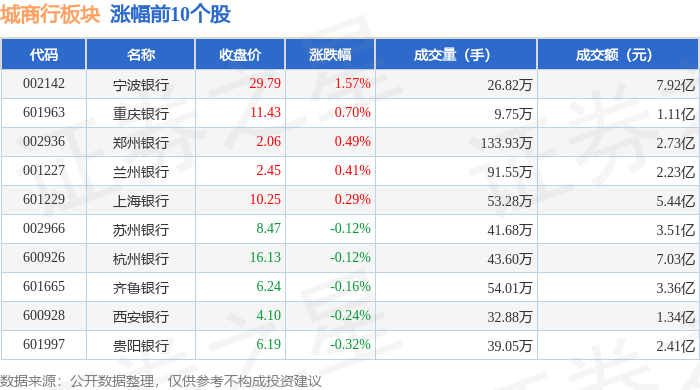
Core Points - The city commercial bank sector experienced a slight decline of 0.02% on November 13, with Changsha Bank leading the drop [1] - The Shanghai Composite Index closed at 4029.5, up 0.73%, while the Shenzhen Component Index closed at 13476.52, up 1.78% [1] Summary by Category Stock Performance - Ningbo Bank (002142) closed at 29.79, with an increase of 1.57% and a trading volume of 268,200 shares, totaling a transaction value of 792 million yuan [1] - Chongqing Bank (601963) closed at 11.43, up 0.70%, with a trading volume of 97,500 shares, totaling 111 million yuan [1] - Zhengzhou Bank (002936) closed at 2.06, up 0.49%, with a trading volume of 1,339,300 shares, totaling 273 million yuan [1] - Other banks such as Lanzhou Bank, Shanghai Bank, and Suzhou Bank showed minor fluctuations in their stock prices, with varying trading volumes and values [1] Capital Flow - The city commercial bank sector saw a net outflow of 67.9693 million yuan from main funds, while retail funds experienced a net outflow of 99.3293 million yuan [3] - Conversely, speculative funds recorded a net inflow of 166.7 million yuan [3]




城商行板块11月12日涨0.05%,长沙银行领涨,主力资金净流入2.2亿元
Zheng Xing Xing Ye Ri Bao· 2025-11-12 08:49
Core Insights - The city commercial bank sector experienced a slight increase of 0.05% on November 12, with Changsha Bank leading the gains [1] - The Shanghai Composite Index closed at 4000.14, down 0.07%, while the Shenzhen Component Index closed at 13240.62, down 0.36% [1] Stock Performance - Changsha Bank (601577) closed at 10.08, up 0.90% with a trading volume of 199,800 shares and a transaction value of 201 million yuan [1] - Shanghai Bank (601229) closed at 10.22, up 0.89% with a trading volume of 597,100 shares and a transaction value of 611 million yuan [1] - Other notable performances include: - Lanzhou Bank (001227) at 2.44, up 0.41% - Jiangsu Bank (616009) at 11.13, up 0.27% - Beijing Bank (601169) at 5.73, up 0.17% [1] Capital Flow - The city commercial bank sector saw a net inflow of 220 million yuan from main funds, while retail investors experienced a net outflow of 200 million yuan [2] - Key capital flows include: - Jiangsu Bank (600919) with a net inflow of 10.4 million yuan from main funds [2] - Beijing Bank (601169) with a net inflow of 62.5 million yuan from main funds [2] - Shanghai Bank (601229) with a net inflow of 58.5 million yuan from main funds [2]

这些上市银行获增持
Sou Hu Cai Jing· 2025-11-12 08:18
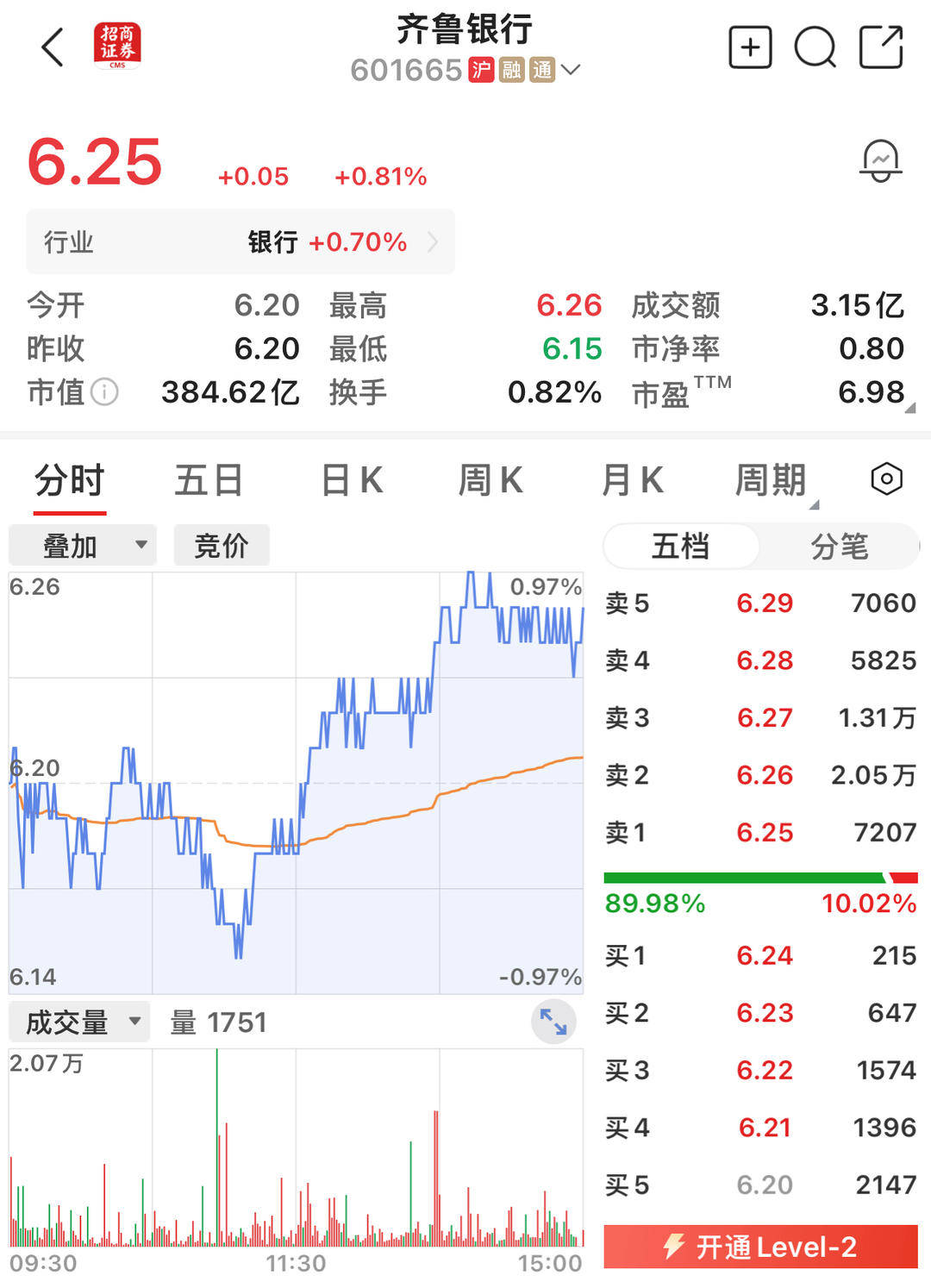
Core Insights - Multiple A-share listed banks have seen significant share purchases by executives and major shareholders since 2025, indicating confidence in the banking sector's long-term value [1][5] - Recent quarterly reports show that most city commercial banks have stabilized and improved their net interest margins compared to the end of the first half of the year [1] Group 1: Shareholder Activity - Over 10 banks have received share purchases from shareholders or executives, including Xiamen Bank, Suzhou Bank, Chengdu Bank, Chongqing Bank, Shanghai Bank, Everbright Bank, Lanzhou Bank, Postal Savings Bank, and Wuxi Bank, with city commercial banks being the majority [1] - On November 7, Qilu Bank reported that its directors, supervisors, and senior executives had collectively increased their holdings by approximately 3.15 million yuan, accounting for 90% of the planned increase [3] - Qingdao Bank's major shareholder, Guoxin Chanin Holdings, increased its stake through the Hong Kong Stock Connect, raising its total shareholding to 15.42%, making it the largest shareholder [5] Group 2: Financial Performance - Among the 42 listed banks, 35 reported a year-on-year increase in net profit for the first three quarters, with seven banks achieving double-digit growth, including Qingdao Bank, Qilu Bank, Hangzhou Bank, Jiangyin Bank, Changshu Bank, Shanghai Pudong Development Bank, and Chongqing Bank [5] - The recent quarterly reports reflect a positive performance for banks this year, contributing to market confidence [5]
AI走进指数投资,大模型青睐银行股、“易中天”
Di Yi Cai Jing Zi Xun· 2025-11-12 07:49
Core Insights - The integration of AI technology into the securities industry is accelerating, with a focus on utilizing large language models for investment decision-making and risk management [1][4] - The "Large Model Stable 50" index, launched by GaoHua Securities, has achieved a cumulative return of 23.2% since its inception, outperforming other indices [1][2] - The index primarily includes banking stocks, indicating a preference for stable, dividend-paying companies [2][6] Index Performance - The "Large Model Stable 50" index reached a point of 2007.24, with a monthly increase of 3.75% and a year-to-date increase of 16.8%, reflecting a historical annualized return of 20.5% [2] - The "Large Model New Quality Productivity" index, focusing on sectors like semiconductors and AI, has a year-to-date increase of 41.28% and a historical annualized return of 17.61% [2] - The top ten constituents of the "Large Model Stable 50" index are predominantly banks, with over 40% of the index's weight in the financial sector [2][3] Sector Focus - The "Large Model New Quality Productivity" index has a high concentration of technology stocks, with the top three constituents being New Yi Sheng, Hikvision, and Tianfu Communication [2][3] - The information technology sector comprises over half of the companies in the index, followed by communication services and industrial sectors [3] Investment Themes - The themes of dividends and growth are highlighted as significant for A-share investments, with a noted increase in the popularity of dividend-focused strategies over the past few years [6][7] - The integration of AI in investment strategies is expected to strengthen as the trend of index-based investing continues to grow [4][5] - The use of AI models for portfolio adjustments is based on comprehensive assessments of market data, fundamentals, and sentiment, ensuring a systematic approach to risk management [7]





城商行板块11月11日跌0%,上海银行领跌,主力资金净流入2.41亿元
Zheng Xing Xing Ye Ri Bao· 2025-11-11 08:46
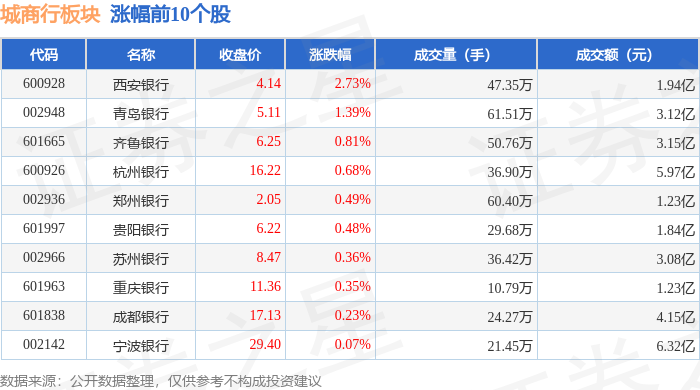
Market Overview - The city commercial bank sector experienced a slight decline of 0.0% on November 11, with Shanghai Bank leading the drop [1] - The Shanghai Composite Index closed at 4002.76, down 0.39%, while the Shenzhen Component Index closed at 13289.0, down 1.03% [1] Individual Bank Performance - Xi'an Bank saw the highest increase in share price, closing at 4.14 with a rise of 2.73% [1] - Qingdao Bank and Qilu Bank also reported positive performance, with increases of 1.39% and 0.81% respectively [1] - Shanghai Bank, on the other hand, closed at 10.13, down 0.98%, indicating a significant decline in its stock price [2] Trading Volume and Capital Flow - The city commercial bank sector recorded a net inflow of 241 million yuan from institutional investors, while retail investors saw a net outflow of 290 million yuan [2] - Jiangsu Bank attracted the highest net inflow from institutional investors at 113 million yuan, representing 11.75% of its trading volume [3] - In contrast, Zhengzhou Bank experienced a net outflow of 421,280 yuan from institutional investors, indicating a negative sentiment towards its stock [3]
真金白银!年内十余家上市银行获股东、高管增持,银行“防御性板块”角色要变?
Xin Lang Cai Jing· 2025-11-10 12:57
Core Viewpoint - The recent surge in share buybacks by various banks, including Qilu Bank and Qingdao Bank, reflects strong confidence in the long-term value of the banking sector, with over 10 listed banks participating in this trend [1][9][10]. Group 1: Share Buybacks - Qilu Bank announced that its directors, supervisors, and senior executives have collectively increased their holdings by 3.15 million yuan, accounting for 90% of the planned buyback amount [1]. - Qingdao Bank's major shareholder, Qingdao Guoxin Financial Holdings, increased its holdings by 957 million yuan, raising its stake to 15.42%, making it the largest shareholder [4]. - Xiamen Bank's executives completed a buyback plan exceeding the minimum target, with total contributions reaching 1.6857 million yuan [5]. Group 2: Market Sentiment - The buyback activities are interpreted as a recognition of the banking sector's valuation, with a current price-to-book ratio of 0.72 and a dividend yield of 3.99%, attracting long-term capital [10][12]. - The banking sector has seen a collective "self-purchase" phenomenon, with various regional banks also engaging in buybacks, indicating a broader trend across the industry [6][8]. Group 3: Performance and Valuation - Despite a slight decline in revenue and net profit for 42 A-share listed banks in the first quarter, 24 banks reported growth in both metrics, particularly city and rural commercial banks [10]. - The net interest margin for listed banks is projected to stabilize, with a simulated net interest margin of 1.32% for Q3 2025, marking a potential turning point after four years of decline [12]. - Long-term capital, particularly from insurance funds, has been increasingly allocated to the banking sector, with a reported increase of 8.36 billion shares held by insurance funds in Q3 2025 [12][13].