SIASUN(300024)

Search documents
美国主题研究:私人医疗展望- 医疗科技 生命科学:2026 年是手术机器人、脑机接口与 AI 诊断领域催化丰富的一年
2026-02-11 15:40
Summary of Key Points from the Conference Call Industry Overview - **Industry Focus**: Medtech/Life Sciences, specifically surgical robotics, brain-computer interfaces (BCIs), and AI diagnostics [2][4][15] - **Outlook for 2026**: Anticipated as a catalyst-rich year with significant updates expected to drive private investor interest [2] Core Themes and Insights Surgical Robotics - **Market Dynamics**: 2026 is viewed as pivotal for surgical robotics, with companies like Medtronic (MDT), CMR Surgical, and Johnson & Johnson (JNJ) launching competitive products [5][10] - **Growth Potential**: Expansion into high-volume, low-acuity procedures at ambulatory surgical centers (ASCs) is seen as a critical growth area [5][18] - **Investor Confidence**: Competitive dynamics will be crucial for investor confidence in the market, particularly regarding the ability of new entrants to compete with established players like Intuitive Surgical (ISRG) [5][10] Brain-Computer Interfaces (BCIs) - **Investor Interest**: Significant investor interest in BCIs, with over $1 billion raised in 2025 [27] - **Neuralink's PRIME Study**: Follow-up data from Neuralink's PRIME study in 2026 is expected to be a key catalyst for investor confidence in the efficacy of BCIs [5][10][31] - **Competition from China**: Increased government investment in BCIs in China poses potential challenges for US companies, raising questions about scalability and competition [9][25][26] AI Diagnostics - **Potential Benefits**: AI diagnostics could lead to earlier disease detection, improved patient outcomes, and increased procedure volumes [31][37] - **Challenges**: Reimbursement hurdles and integration into existing workflows remain significant challenges for widespread adoption [31][37] - **Provider ROI**: Increased procedures and workflow efficiencies are expected to provide financial incentives for hospital systems to adopt AI diagnostic technologies [31][37] Key Data Points Venture Capital Raises in 2025 - **Top VC Raises in Medtech**: - Neuralink: $650 million (Series E) [3] - Impulse Dynamics: $242 million [3] - Noah Medical: $230 million (Series B1) [3] - Synchron: $200 million (Series D) [3] - Lumicell: $198 million [3] - **Overall VC Deal Flow**: Down approximately 30% compared to 2023, but an increase from 2024 [21] Additional Insights - **Surgical Robotics Pricing Model Shift**: A shift towards a pay-per-procedure model is anticipated, focusing on revenue from disposables rather than the initial robot purchase [17][18] - **Emerging Technologies**: Interest in non-surgical and minimally invasive implants is growing, with advancements in AI and hardware making these technologies more viable [27] - **Healthcare System Constraints**: Capital constraints in hospital systems may favor multi-purpose robotic systems that can be utilized across various procedures and specialties [15] Conclusion - The medtech industry is poised for significant developments in 2026, particularly in surgical robotics, brain-computer interfaces, and AI diagnostics. Investor confidence will hinge on competitive dynamics, technological advancements, and the ability to navigate reimbursement and integration challenges.

唯科科技-机器人轻量化观点汇报
2026-02-11 15:40
Summary of Weike Technology & Robotics Lightweight Perspective Report Company Overview - Weike Technology started in the small home appliance sector and has expanded into the automotive industry, now reaching global markets with overseas revenue accounting for 46% of total revenue. It is expected to equal domestic market revenue by 2025, indicating strong globalization momentum [1][3]. Financial Performance - The company has shown steady revenue growth with a compound annual growth rate (CAGR) of 19% from 2020 to 2024. In the first three quarters of 2025, revenue is expected to grow by 25% due to recovering overseas demand [1][6]. - The total gross margin remains above 30%, with precision mold business margins increasing and health product outsourcing margins returning to industry averages. The selling expense ratio is maintained below 3%, indicating improved profitability [1][7]. - Financial health is strong, with inventory and accounts receivable turnover days kept under 100 days, and operating cash flow gradually recovering post-pandemic [1][9]. Business Segments - The main business segments include mold production, injection molding, and health product outsourcing, with close interrelations between mold and injection molding operations [1][6]. - Significant contributions to net profit come from subsidiaries such as Shanghai Kebi (automotive parts injection) and Xiamen Weike Health (health appliances outsourcing), with projected revenues of approximately 200 million and 560 million yuan respectively in 2024 [1][4]. Market Position and Industry Insights - The global injection molding market exceeds $300 billion, with a fragmented competitive landscape. Key applications include packaging (30%), consumer electronics (29%), medical (8%), and transportation (17%) [10][11]. - Weike Technology's largest downstream market is home appliances (32%), followed by new energy vehicles (18%) and consumer electronics (11%) [12]. Future Growth and Projections - Revenue growth is projected at 30% and 25% for 2026 and 2027, respectively, with expected revenues of approximately 3 billion and 3.85 billion yuan. Injection products are anticipated to grow over 30% due to increased demand for new energy vehicle components [2][17]. - The company is targeting a stock price of 95 yuan, corresponding to a price-to-earnings (PE) ratio of around 34, indicating a potential upside of 25% [2][18]. Strategic Initiatives - Weike Technology is actively expanding into robotics and data center sectors, producing PICK-related products and collaborating with international firms like Nidec and Kollmorgen. The company is also involved in the MPO fiber optic connector business for data centers, which is expected to grow significantly [1][15]. - The company’s core competencies include advanced injection molding techniques, a well-structured supply chain, and a diversified market presence across automotive, electronics, and consumer goods [14][16]. Risks and Challenges - Potential risks include fluctuations in international trade tariffs, declining global demand for new energy and home appliances, and management challenges in overseas subsidiaries. Additionally, there are concerns regarding margin compression and underperformance in profitability [21].
机器人板块近期更新和推荐汇报
2026-02-11 15:40
Summary of Key Points from the Conference Call Industry Overview - The robotics sector is entering a critical phase from 2021 to 2026, with Tesla's robots gaining significant attention due to their leading advantages. Domestic robotics development is limited, primarily following strategies rather than innovating. [1][4] - The market is cautious about "designated points," which are interpreted differently by various companies, with a focus on stable businesses capable of securing formal bulk orders. [2] Core Insights and Arguments - Tesla plans to begin mass production of robots in the second half of 2026, which is expected to trigger market anticipation for the release of the third-generation robots and a beta market. Investment opportunities are identified in certain supply chain segments and new technology iterations, such as AI and scalable manufacturing. [1][5] - The second half of 2026 is anticipated to bring sustained opportunities for application-related companies, contrasting with previous years where opportunities were short-lived due to a lack of production support. [6] - Key recommendations include Dechang Co. and Hengshuai Co., which are involved in the robotics motor segment. Dechang has rapidly grown its automotive EPS motor business, breaking Japan's Nidec monopoly, while Hengshuai is positioned to become a significant supplier for Tesla. [3][9][10] Investment Opportunities - Domestic robotics companies are expected to go public or enter counseling phases in the second half of the year, presenting merger and acquisition opportunities. However, caution is advised as many stock prices may already reflect these opportunities. [7] - The selection criteria for recommended companies include real progress in the robotics field, stable core business, strong cash flow, and the ability to meet overseas production capacity requirements for clients like Tesla. [8][17] Company-Specific Highlights - Dechang Co. is projected to grow its revenue from 70 million in 2020 to 400 million in 2024, with expectations of reaching 700 million by 2025. The company has also expanded into brake motors and has secured orders from a major brake system company. [9][10] - Hengshuai Co. specializes in non-safety motor components and has a gross margin exceeding 30%. The company collaborates with Tesla on the Robotaxi project, enhancing its investment appeal. [14] - Keda Li and Fengdiao Technology are also highlighted for their strong performance and potential in the robotics sector, with Keda Li expected to exceed 2 billion in net profit. [13] Market Predictions - The market outlook for the second half of 2026 is optimistic, with expectations of sustained opportunities for application-related companies as mass production begins. [6] - Current stock prices of recommended companies are seen as having limited downside potential, making it a favorable time for long-term investors to enter. [11] Conclusion - The selection of recommended companies is based on their robust business models, leading positions in niche markets, and stable partnerships with industry giants like Tesla, ensuring their growth potential and investment value. [17]

湾财晚报|“春节档”茅台领涨;机器人租赁火了 订单排到3月;何飚履新广电总局副局长
Nan Fang Du Shi Bao· 2026-02-11 14:31
Group 1 - Hangzhou United Rural Commercial Bank received a fine of 11.1 million yuan due to inadequate loan management and inaccurate data reporting, marking the first major penalty in the banking sector for the year [2] - The bank is currently in a critical period for its IPO guidance and has stated that it has largely rectified the issues and is improving its long-term management mechanisms [2] - The bank's asset scale is nearly 600 billion yuan, and it is under scrutiny regarding its compliance and governance structure following the penalty [2] Group 2 - Guangdong's insurance industry achieved a premium income of 570 billion yuan in 2025, reflecting a year-on-year growth of 6.68%, with total claims paid out reaching 218.4 billion yuan, up 8.82% [3] - The insurance sector is playing a significant role as a financial stabilizer for the economy, contributing to the economic strength of Guangdong province [3] Group 3 - Coca-Cola reported Q4 revenue of $11.822 billion, a 2% increase, with net profit at $2.316 billion, up 5%, although below market expectations [4] - For the full year 2025, Coca-Cola's revenue reached $47.941 billion, also a 2% increase, while net profit surged 23% to $13.137 billion [4] - The growth in Q4 was driven by a 4% increase in concentrate sales and a 1% rise in price/product mix [4] Group 4 - NetEase reported Q4 revenue of 27.5 billion yuan, a slight increase of 3%, with total annual revenue reaching 112.6 billion yuan, up 7% year-on-year [10] - The company's net profit attributable to shareholders was 33.8 billion yuan, reflecting a 13.8% increase, with significant R&D investment of 17.7 billion yuan [10] - AI has become a core capability for NetEase, significantly enhancing production efficiency and player interaction experiences [10] Group 5 - The robot rental market is experiencing a peak in business as the Chinese New Year approaches, with orders extending into March due to high demand [12] - Various robot rental companies are preparing for major events like the Spring Festival Gala, showcasing different technological innovations [12]


从机器人到电车:豆包春晚炸出科技礼包 字节跳动AI消费野心藏不住了
Mei Ri Jing Ji Xin Wen· 2026-02-11 14:12
Core Insights - ByteDance's AI application Doubao is entering the competitive landscape of the internet's AI battle during the Spring Festival, with plans to distribute cash red envelopes and over 100,000 tech gifts during the 2026 Spring Festival Gala [1][2] - The competition among major internet companies has intensified, with Tencent and Alibaba also launching significant cash and promotional campaigns to capture market share in the AI space [2][5] Group 1: Doubao's Strategy - Doubao's Spring Festival campaign includes two phases: the first phase starts on February 13, allowing users to engage with AI-generated greetings and participate in a lottery for cash prizes [2][3] - The second phase will coincide with the Spring Festival Gala on February 16, featuring live interactions and the distribution of tech gifts, including 17 popular products such as robots and drones [3][4] - Doubao's approach emphasizes integrating its AI capabilities with hardware products, aiming to create a deeper user experience and establish a foothold in the AI hardware market [4][6] Group 2: Competitive Landscape - Tencent is focusing on social interaction through its AI application Yuanbao, aiming to enhance user engagement by integrating music and video content into its platform [5][6] - Alibaba's strategy involves direct consumer subsidies through its AI application Qianwen, which has seen significant user engagement and rapid growth in daily active users [6][7] - The competition is not just about cash giveaways but also about establishing a comprehensive AI ecosystem that includes hardware, software, and user engagement strategies [2][5] Group 3: Market Analysis - Analysts suggest that while Tencent's approach may generate quick engagement, its long-term effectiveness in forming user habits is uncertain [7][8] - Alibaba's method is seen as more effective in creating immediate user engagement and establishing a value loop, while ByteDance's strategy is viewed as deeper but potentially slower to yield results [8] - The overall battle for AI market share during the Spring Festival reflects a shift from traditional marketing to a focus on creating sustainable user engagement and ecosystem integration [5][8]


北京开设首家机器人服务综合体
Bei Ke Cai Jing· 2026-02-11 14:09
新京报贝壳财经记者了解到,近期,陶朱新造局已与多家机器人领域重点企业签署战略合作协议,签约 合作方涵盖机器人研发、制造、系统集成及应用服务等多个环节。 陶朱新造局为首程控股旗下机器人消费体验品牌,2024年以来,首程控股已陆续参投宇树科技、云深 处、星海图、银河通用、松延动力等机器人企业。 首程控股联席总裁叶芊介绍,机器人产业正从"技术探索期"迈向"场景爆发期",现阶段行业仍处市场教 育期,而线下沉浸式体验店则成为市场的刚性基础设施,首程控股将依托陶朱新造局的平台,提前布 局,通过体验店与用户建立信任,搭建长期渠道与品牌壁垒。 新京报贝壳财经讯(记者张晓慧)2月11日,北京首家机器人科技体验、销售、维保、服务综合体在陶 朱新造局落成。 据陶朱新造局介绍,该综合体以"展示、体验、交易、交付、维修保养、服务"为核心逻辑,构建覆盖机 器人产品全生命周期的服务体系,重点聚焦居家照料、医疗辅助、教育、工业等六大核心应用场景,为 技术展示、产品选型、场景测试及售后保障提供一站式解决方案。 校对 杨许丽 ...
从机器人到电车:豆包春晚炸出科技礼包,字节跳动AI消费野心藏不住了
Mei Ri Jing Ji Xin Wen· 2026-02-11 14:04
每经记者|李宇彤 每经编辑|陈星 豆包杀入了硝烟弥漫的互联网春节AI(人工智能)大战。 2月10日,字节跳动旗下AI应用豆包官宣将登上中央广播电视总台2026年春晚。除夕夜当晚,豆包不仅 将通过总台春晚发放现金红包,还将为全国观众送出超过10万份接入了豆包大模型的科技好礼。 《每日经济新闻》记者注意到,这是字节跳动CEO(首席执行官)梁汝波在1月29日2026年首次全员会 议上定下新一年"勇攀高峰"关键词后的豆包首战,也是豆包首次大方亮出硬件矩阵。 据官方介绍,此次豆包送出的科技礼包囊括17款热门产品,包括宇树机器人、拓竹3D打印机、大疆无 人机、极米投影仪等多款产品,同时还涵盖上汽奥迪E5 Sportback和奔驰CLA两款电车使用权。 春节AI红包混战已战火纷飞。腾讯元宝携10亿元现金率先入场,希望重现微信红包的盛况。阿里千问 则以"春节30亿大免单"展开生态卡位。 相较之下,字节选择了另一条相对差异化的路径,将总台春晚的舞台转化为自身AI硬件生态的全民体 验场,豆包再次打响AI交互的硬件入口之战,其背后暗藏的是字节跳动在AI消费时代的生态布局野 心。 11年前,微信红包凭借总台春晚"摇一摇"的玩法完成对 ...
春节机器人租赁迎高峰,订单排到3月,租赁价格则“大跳水”
Nan Fang Du Shi Bao· 2026-02-11 13:43
临近春节,机器人租赁市场迎来一年中的业务高峰。刚忙完安徽某地晚会的机器人租赁商陈廷猛,正匆 忙赶往下一个目的地处理新订单。他不禁感慨:"最近市场太火了,我们都想再添两台机器人。"同样从 事这一行的黄焰领也告诉南都N视频记者,目前手中的订单从上月底就已排到3月份,"基本处于供不应 求的状态。"这不仅是他们个人的感受,也是多数机器人租赁厂商在农历新年前共同面临的"旺季"图 景。 除了订单激增,租赁厂商们还将目光投向了春晚这个最重磅的舞台。除老面孔宇树科技外,今年春晚还 吸引了魔法原子、银河通用、松延迟动力三家机器人厂商"登台竞技",且每家机器人都具有不同的技术 亮点与噱头。 回顾2021年初,宇树科技的机器人在牛年春晚上"一舞"出圈,迅速带火了"春晚同款机器人租赁"市场。 当时,各大电商与二手平台涌现不少相关卖家。有租赁厂商透露,仅靠转租宇树机器人,高峰期就曾创 下一天3万元的租赁价格,利润可观。 然而,这样的高价盛况如今已不复存在。多位从业者表示,机器人租赁价格经历大幅回落——从巅峰期 的每日3万元降至最低3000元左右,目前均价约为原来的十分之一。与此同时,行业结构也在悄然变 化:一些平台型企业开始进军机器人 ...
江波龙(301308.SZ):产品广泛应用于机器人、AI眼镜等各类新形态智能终端,展现出较强的市场竞争力
Ge Long Hui· 2026-02-11 13:16
Group 1 - The company, Jiangbolong (301308.SZ), has indicated that its products are widely used in various new forms of smart terminals, including robots and AI glasses, demonstrating strong market competitiveness [1] - However, the business related to robots and AI glasses is still in the early stages of development, and its contribution to the company's actual performance remains low [1]
阿里发布RynnBrain大模型,让机器人具备“思考大脑”!
Ge Long Hui· 2026-02-11 13:16
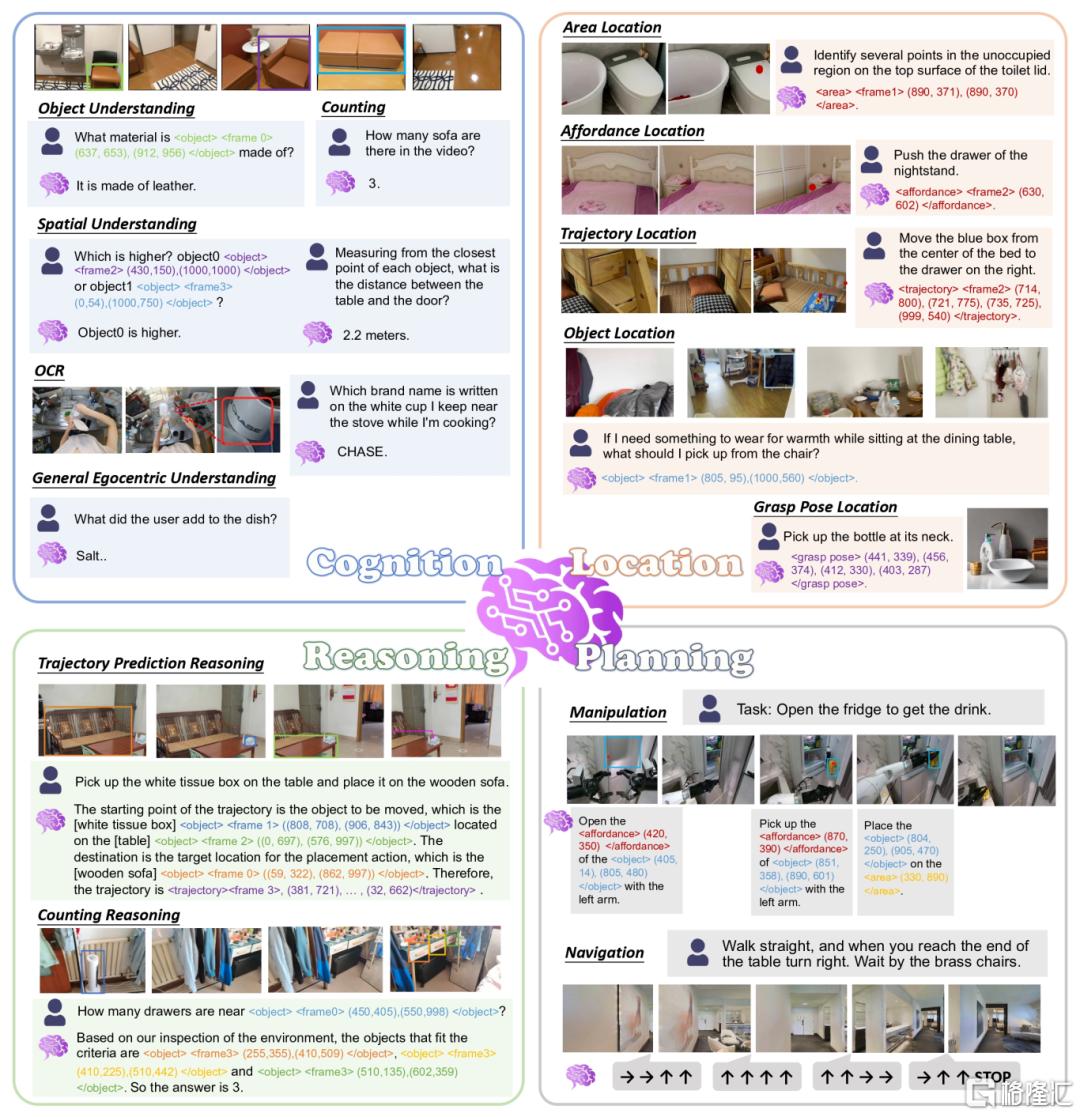
Core Insights - Alibaba's Damo Academy has released the RynnBrain foundational model for embodied intelligence, which includes seven models, notably the 30B MoE model, all of which are open-sourced [1][6] - RynnBrain significantly enhances robots' capabilities by introducing spatiotemporal memory and physical world reasoning, achieving state-of-the-art (SOTA) results in 16 embodied open-source evaluation benchmarks, surpassing leading models like Google's Gemini Robotics ER 1.5 [1][4] Model Capabilities - RynnBrain enables robots to locate objects and predict motion trajectories using its spatiotemporal memory, providing global recall capabilities [2] - The model employs a reasoning strategy that intertwines text and spatial positioning, effectively reducing hallucination issues during reasoning processes [2] - RynnBrain possesses multiple capabilities, including cognition, localization, reasoning, and planning [3] Training and Performance - Trained on the Qwen3-VL foundation using the proprietary RynnScale architecture, RynnBrain's training data exceeds 20 million pairs, resulting in a performance boost of two times with equivalent resources [4] - RynnBrain has set new records in various benchmarks, including environmental perception, object reasoning, first-person visual question answering, spatial reasoning, and trajectory prediction [4][5] Benchmark Results - RynnBrain outperforms other top models in multiple benchmarks, achieving scores such as 74.5 in VSI-Bench and 78.9 in EgoTaskQA, demonstrating its superior performance across various tasks [5] Scalability and Applications - RynnBrain exhibits excellent scalability, allowing for rapid fine-tuning to create various embodied models, such as navigation and planning models, with minimal data [6] - The model's architecture allows it to exceed the performance of Gemini 3 Pro with just a few hundred data points for fine-tuning [6] Open Source and Industry Impact - The open-sourcing of RynnBrain's complete reasoning and training code, including the first MoE architecture in the industry, positions it as a foundational model for the embodied intelligence sector [6][8] - Damo Academy aims to accelerate the transition of AI from digital to real-world applications, contributing to the development of deployable, scalable, and evolvable embodied intelligence systems [8]