Blue Focus(300058)

Search documents
昨日310股获融资买入超亿元 中际旭创获买入32.15亿元居首
Ge Long Hui A P P· 2025-11-25 04:41
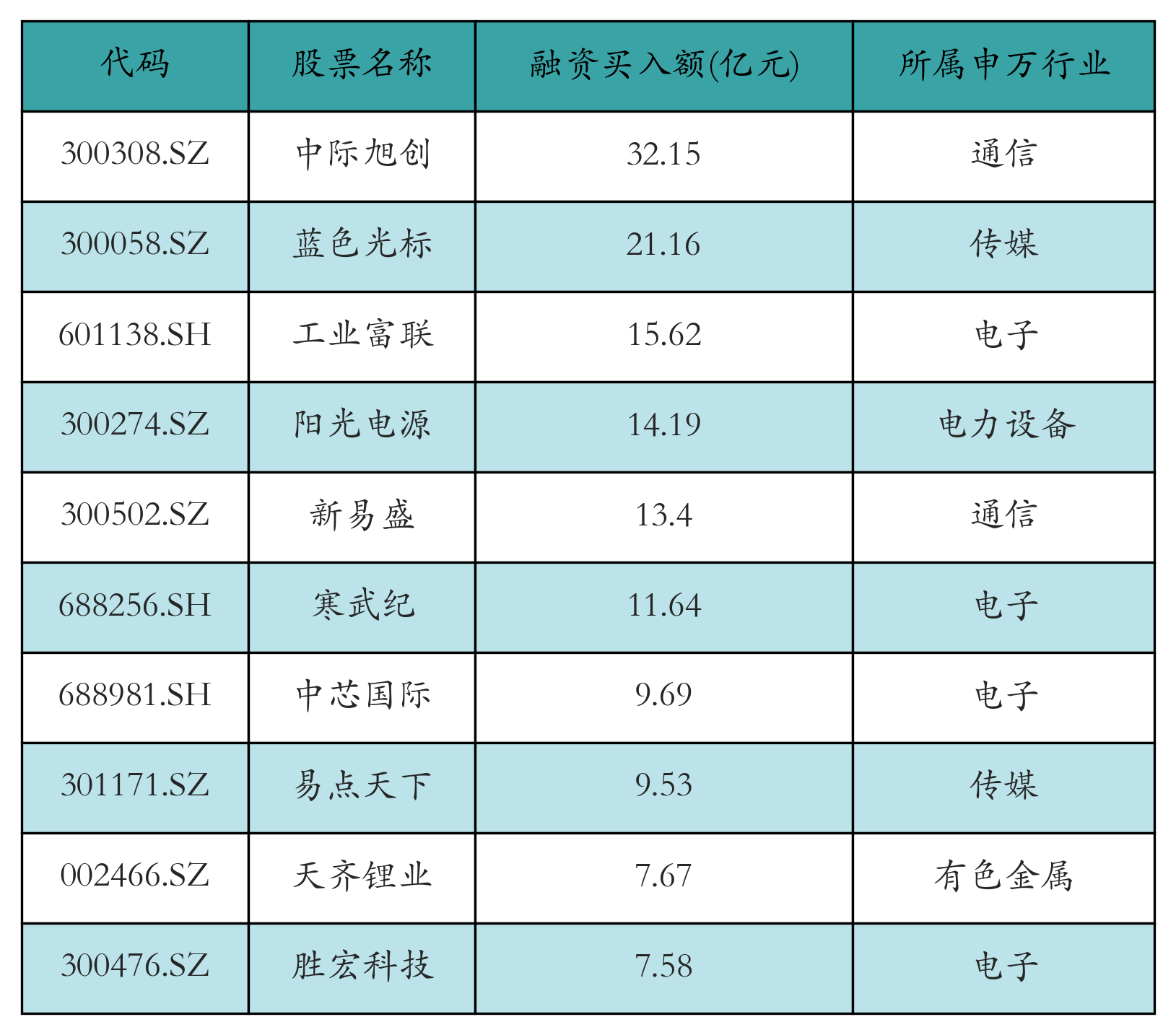
Group 1 - A total of 3738 stocks in the A-share market received financing purchases on November 24, with 310 stocks having purchase amounts exceeding 100 million yuan [1] - The top three stocks by financing purchase amount were Zhongji Xuchuang, BlueFocus, and Industrial Fulian, with amounts of 3.215 billion yuan, 2.116 billion yuan, and 1.562 billion yuan respectively [1] - Four stocks had financing purchase amounts accounting for over 30% of the total transaction amount, with Senying Windows, Pinggao Group, and Shisheng Intelligent leading at 42.73%, 41.08%, and 39.44% respectively [1] Group 2 - Seventeen stocks had net financing purchases exceeding 100 million yuan, with BlueFocus, Cambrian, and Tianqi Lithium ranking the highest at 393 million yuan, 290 million yuan, and 262 million yuan respectively [1]



A股午评:创业板指涨超2%,算力硬件概念延续强势
2 1 Shi Ji Jing Ji Bao Dao· 2025-11-25 03:57
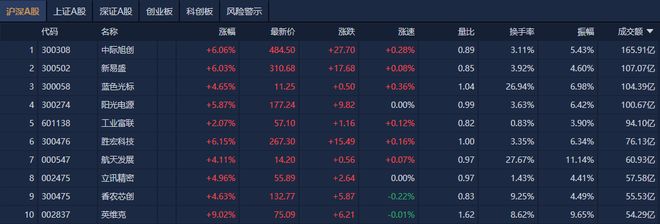
Market Overview - The market showed strong performance in the early session, with the Shanghai Composite Index rising over 1% and the ChiNext Index increasing over 2% [1] - By the end of the morning session, the Shanghai Composite Index was up 1.13%, the Shenzhen Component Index rose 2.04%, and the ChiNext Index gained 2.6% [1] Stock Performance - Nearly 4,900 stocks in the market experienced an increase [2] - The computing hardware sector continued to show strength, with stocks like TeFa Information achieving three consecutive trading limit ups, and Longi Green Energy and Huayou Cobalt hitting the daily limit [3] - The AI application sector saw a resurgence, with Shida Group achieving four consecutive trading limit ups and Rongji Software hitting six limit ups in seven days [3] - The anti-influenza sector was also active, with Guangji Pharmaceutical achieving two consecutive limit ups, and Te Yi Pharmaceutical and Peking University Pharmaceutical hitting the daily limit [3] Declining Stocks - The aquaculture sector experienced fluctuations, with stocks like Zhangzi Island and Zhongshui Fishery hitting the daily limit down [4] Trading Volume - The total trading volume in the Shanghai and Shenzhen markets reached 1.17 trillion yuan, an increase of 149.3 billion yuan compared to the previous trading day [5] Top Stocks by Trading Volume - Zhongji Xuchuang led with a trading volume exceeding 16.5 billion yuan, followed by Xinyi Sheng and BlueFocus with high trading volumes [6]




主力个股资金流出前20:蓝色光标流出6.68亿元、省广集团流出4.91亿元




Jin Rong Jie· 2025-11-25 03:36
Core Insights - The main focus of the article is on the significant outflow of capital from various stocks as of November 25, with specific amounts listed for the top 20 stocks experiencing the largest withdrawals [1] Group 1: Major Stocks with Capital Outflow - BlueFocus Communication Group saw a capital outflow of 668 million yuan [1] - Provincial Advertising Group experienced a withdrawal of 491 million yuan [1] - Industrial Fulian had a capital outflow of 467 million yuan [1] - 360 Security Technology faced a withdrawal of 325 million yuan [1] - Aerospace Development saw an outflow of 320 million yuan [1] Group 2: Additional Stocks with Notable Withdrawals - Guofeng New Materials had a capital outflow of 309 million yuan [1] - Zhongke Shuguang experienced a withdrawal of 305 million yuan [1] - Ganfeng Lithium saw an outflow of 292 million yuan [1] - Great Wall Military Industry faced a capital withdrawal of 210 million yuan [1] - Shida Group had an outflow of 208 million yuan [1] Group 3: Other Stocks in the Top 20 - GAC Group experienced a capital outflow of 201 million yuan [1] - Pingtan Development saw a withdrawal of 196 million yuan [1] - Data Port had an outflow of 193 million yuan [1] - China Shipbuilding Defense experienced a capital withdrawal of 182 million yuan [1] - Gree Electric Appliances saw an outflow of 180 million yuan [1] - Shiji Information faced a capital withdrawal of 168 million yuan [1] - Rongjie Co. experienced an outflow of 159 million yuan [1] - Tianqi Lithium saw a withdrawal of 153 million yuan [1] - Tianci Materials had a capital outflow of 152 million yuan [1] - Guomai Technology experienced a withdrawal of 148 million yuan [1]
主力资金流入前20:蓝色光标流入11.43亿元、数据港流入8.06亿元
Jin Rong Jie· 2025-11-25 03:24
Group 1 - The top 20 stocks with significant capital inflow as of November 24 include BlueFocus (1.143 billion yuan), DataPort (806 million yuan), and 360 (794 million yuan) [1] - Other notable stocks in the top 20 by capital inflow are Provincial Advertising Group (587 million yuan), China Shipbuilding (440 million yuan), and Zhangjiang Hi-Tech (403 million yuan) [1] - Additional companies with substantial inflows include Changxin Bochuang (357 million yuan), China Shipbuilding Defense (347 million yuan), and Leike Defense (317 million yuan) [1] Group 2 - The list also features Huajian Group (286 million yuan), Aerospace Development (269 million yuan), and ZTE Corporation (259 million yuan) [1] - Other companies in the top 20 include GAC Group (253 million yuan), Changying Precision (253 million yuan), and Great Wall Military Industry (248 million yuan) [1] - The final entries in the top 20 are Zhongfu Circuit (248 million yuan), Leo Group (243 million yuan), Kunlun Wanwei (240 million yuan), Midea Group (233 million yuan), and Nanwei Software (223 million yuan) [1]



融资资金买入中际旭创超32亿元丨资金流向日报
2 1 Shi Ji Jing Ji Bao Dao· 2025-11-25 03:15
Market Overview - The Shanghai Composite Index rose by 0.05% to close at 3836.77 points, with a daily high of 3854.33 points [1] - The Shenzhen Component Index increased by 0.37% to close at 12585.08 points, reaching a peak of 12655.29 points [1] - The ChiNext Index gained 0.31%, closing at 2929.04 points, with a maximum of 2951.43 points [1] Margin Trading and Securities Lending - The total margin trading and securities lending balance in the Shanghai and Shenzhen markets was 24511.26 billion yuan, with a financing balance of 24347.55 billion yuan and a securities lending balance of 163.71 billion yuan, reflecting a decrease of 27.05 billion yuan from the previous trading day [2] - The Shanghai market's margin trading balance was 12499.83 billion yuan, down by 6.24 billion yuan, while the Shenzhen market's balance was 12011.43 billion yuan, decreasing by 20.81 billion yuan [2] - A total of 3459 stocks had financing funds for purchase, with the top three being Zhongji Xuchuang (32.15 billion yuan), BlueFocus (21.16 billion yuan), and Industrial Fulian (15.62 billion yuan) [2][3] Fund Issuance - On the previous day, 29 new funds were issued, including various bond and mixed funds such as Ping An Tianyuan 6-Month Bond A and C, and Longxin Stable Benefit Bond A and C [4][5] - The issuance date for all listed funds was November 24, 2023 [5][6] Top Net Purchases on the Dragon and Tiger List - The top net purchases on the Dragon and Tiger list included BlueFocus with a net buy of 89827.37 million yuan, followed by Shenggu Group (20313.41 million yuan) and Huasheng Tiancai (17842.83 million yuan) [7][8] - Other notable net purchases included Langchao Software (11823.82 million yuan) and Haima Automobile (11424.96 million yuan) [8]
17股获融资净买入额超1亿元 蓝色光标居首
Zheng Quan Shi Bao Wang· 2025-11-25 01:28
Wind统计显示,11月24日,申万31个一级行业中有14个行业获融资净买入,其中,传媒行业获融资净 买入额居首,当日净买入8.47亿元;获融资净买入居前的行业还有国防军工、交通运输、银行、农林牧 渔、有色金属等。 个股方面,11月24日,有1745只个股获融资净买入,净买入金额在3000万元以上的有113股。其中,17 股获融资净买入额超1亿元。蓝色光标获融资净买入额居首,净买入3.93亿元;融资净买入金额居前的 还有寒武纪、天齐锂业、融捷股份、易点天下、张江高科、天海防务、华友钴业、长芯博创等股。 ...
310股获融资买入超亿元,中际旭创获买入32.15亿元居首
Di Yi Cai Jing· 2025-11-25 01:15
Wind数据显示,A股11月24日共有3738只个股获融资资金买入,有310股买入金额超亿元。其中,中际 旭创、蓝色光标、工业富联融资买入金额排名前三,分别获买入32.15亿元、21.16亿元、15.62亿元。 从融资买入额占当日总成交金额比重来看,有4只个股融资买入额占比超30%。其中森鹰窗业、品高股 份、视声智能融资买入额占成交额比重排名前三,分别为42.73%、41.08%、39.44%。 从融资净买入金额来看,有17只个股获融资净买入超亿元。其中,蓝色光标、寒武纪-U、天齐锂业融 资净买入金额排名前三,分别获净买入3.93亿元、2.9亿元、2.62亿元。 ...
蓝色光标龙虎榜数据(11月24日)
Zheng Quan Shi Bao Wang· 2025-11-24 13:16
| 买/ | 会员营业部名称 | 买入金额(万 | 卖出金额(万 | | --- | --- | --- | --- | | 卖 | | 元) | 元) | | 买一 | 国泰海通证券股份有限公司上海浦东新区海阳西路证券营 | 49583.22 | 5.23 | | | 业部 | | | | 买二 | 深股通专用 | 39551.47 | 21295.72 | | 买三 | 国泰海通证券股份有限公司上海静安区新闸路证券营业部 | 25450.39 | 3.14 | | 买四 | 国泰海通证券股份有限公司西安雁展路证券营业部 | 23018.84 | 1.49 | | 买五 | 华泰证券股份有限公司北京西三环国际财经中心证券营业 | 20957.92 | 29553.03 | | | 部 | | | | 卖一 | 华泰证券股份有限公司北京西三环国际财经中心证券营业 | 20957.92 | 29553.03 | | | 部 | | | | 卖二 | 深股通专用 | 39551.47 | 21295.72 | | 卖三 | 中信建投证券股份有限公司东三环中路证券营业部 | 48.97 | 14144.41 | 具 ...
24股特大单净流入资金超2亿元
Zheng Quan Shi Bao Wang· 2025-11-24 13:13
Market Overview - The net outflow of large orders in the two markets reached 321 million yuan, with 2,043 stocks experiencing net inflows and 2,660 stocks facing net outflows [1] - The Shanghai Composite Index closed up by 0.05% [1] Industry Performance - Among the 12 industries with net inflows, the defense and military industry led with a net inflow of 4.99 billion yuan and an index increase of 4.31% [1] - The media industry followed with a net inflow of 2.73 billion yuan and a rise of 3.49% [1] - Other notable industries with significant net inflows include construction decoration and computer sectors [1] - Conversely, 19 industries experienced net outflows, with the electronics sector seeing the highest outflow of 4.76 billion yuan [1] - The power equipment sector followed with a net outflow of 1.36 billion yuan [1] Individual Stock Performance - A total of 24 stocks had net inflows exceeding 200 million yuan, with BlueFocus leading at 1.706 billion yuan [2] - Great Wall Military Industry ranked second with a net inflow of 989 million yuan [2] - Other notable stocks with significant inflows include Provincial Advertising Group, 360 Security Technology, and Data Harbor [2] - On the outflow side, Industrial Fulian had the highest net outflow of 1.743 billion yuan [4] - Other stocks with significant outflows include Zhongji Xuchuang and Rongji Software, with outflows of 1.248 billion yuan and 679 million yuan, respectively [4] Stock Price Movements - Stocks with net inflows exceeding 200 million yuan saw an average increase of 9.94%, outperforming the Shanghai Composite Index [2] - Notable stocks that closed at their daily limit include Guangyun Technology and Provincial Advertising Group [2] Sector Concentration - The stocks with the highest net inflows are concentrated in the defense and military, computer, and communication sectors, with 6, 4, and 3 stocks respectively [2]

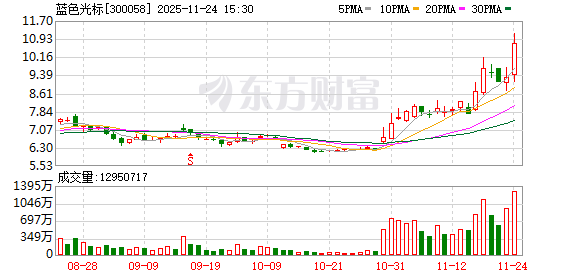
8.98亿资金抢筹蓝色光标,机构狂买大中矿业(名单)丨龙虎榜
2 1 Shi Ji Jing Ji Bao Dao· 2025-11-24 11:30
Core Viewpoint - On November 24, the Shanghai Composite Index rose by 0.05%, the Shenzhen Component Index increased by 0.37%, and the ChiNext Index went up by 0.31%. The most significant net inflow of funds was into BlueFocus Communication Group (300058.SZ), amounting to 0.898 billion yuan, while the largest net outflow was from Easy Point Technology (301171.SZ), totaling 0.325 billion yuan [2][4][6]. Group 1: Stock Performance - BlueFocus Communication Group saw a closing price increase of 15.72% with a turnover rate of 37.21% and a net buying amount of 0.898 billion yuan, accounting for 6.75% of the total transaction volume [4][6]. - Easy Point Technology closed up by 7.78% with a turnover rate of 44.82%, but experienced a net selling amount of 0.325 billion yuan, representing 4.63% of the total transaction volume [6][12]. Group 2: Institutional Activity - On November 24, 26 stocks appeared on the trading leaderboard with institutional involvement, where institutions had a net selling amount of 65.96 million yuan, buying 9 stocks and selling 17 stocks [6][15]. - The stock with the highest institutional net buying was Dazhong Mining (001203.SZ), which closed down by 10% with a turnover rate of 3.39% [7][10]. Group 3: Northbound Capital - Northbound capital participated in 23 stocks on the leaderboard, with a total net buying of 168 million yuan, where the highest net buying was also in BlueFocus Communication Group, amounting to 0.183 billion yuan [12][15]. - The stock with the highest net selling by northbound capital was Visual China (000681.SZ), with a net selling amount of 0.122 billion yuan, despite a closing increase of 0.87% [12][15]. Group 4: Common Trends - Both institutions and northbound capital jointly net bought stocks such as Haima Automobile, Worth Buying, Dazhong Mining, and Hainan Haiyao, while they jointly net sold stocks including Shengguang Group, Easy Point Technology, Jianglong Shipbuilding, and Visual China [15][16].