
Risen Energy(300118)

Search documents
A股异动丨马斯克力挺!太空光伏概念暴涨,爱旭股份、钧达股份等涨停
Ge Long Hui A P P· 2026-01-23 02:42
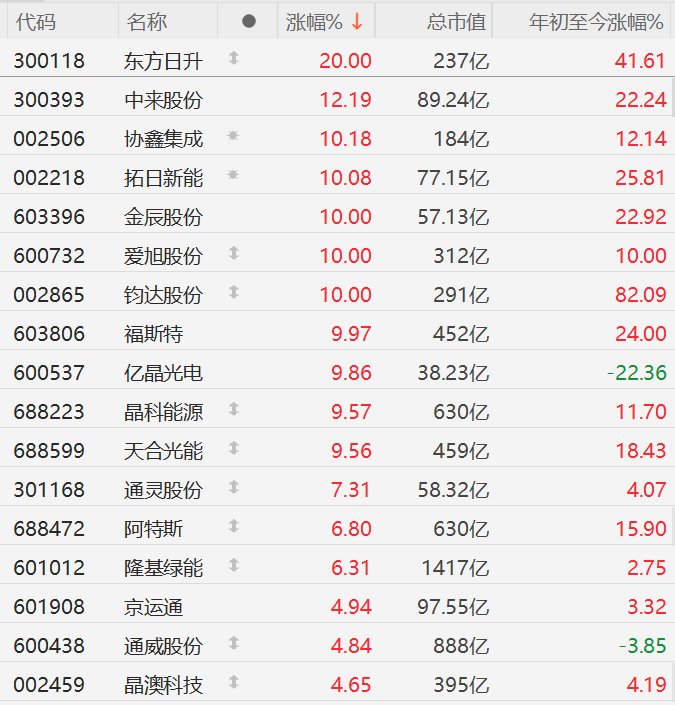
Group 1 - The A-share market has seen a significant surge in space photovoltaic concept stocks, with companies like Maiwei Co., Ltd. and Dongfang Risheng hitting the daily limit of 20%, while Zhonglai Co., Ltd. rose over 12% [1] - Tesla CEO Elon Musk expressed strong support for space photovoltaics during a discussion at the World Economic Forum, revealing plans for a solar manufacturing capacity of 100GW annually within three years [1] - Huaxi Securities highlighted that space photovoltaic energy involves utilizing solar technology in outer space to supply energy, marking a strategic solution for commercial aerospace and high-end applications [1] Group 2 - Shenwan Hongyuan's report indicated that over 200,000 satellite constellation applications have been submitted in China, signaling a new phase of large-scale deployment in commercial aerospace, which will drive long-term demand for space photovoltaics [2] - The technology evolution path for space photovoltaics is expected to transition from high-efficiency gallium arsenide to large-scale silicon-based HJT, and eventually to perovskite tandem cells [2] Group 3 - A detailed table of stock performance shows significant gains for various companies, with Dongfang Risheng at a 20% increase and a total market value of 23.7 billion, while Zhonglai Co., Ltd. has a market value of 8.9 billion and a year-to-date increase of 22.24% [3] - Other notable performers include Xiexin Integration with a 10.18% increase and a market value of 18.4 billion, and Tuorich New Energy with a 10.08% increase and a market value of 7.7 billion [3] - The overall trend indicates a positive momentum in the sector, with many companies experiencing substantial year-to-date gains, reflecting investor optimism in the space photovoltaic market [3]


商业航天,再掀涨停潮
第一财经· 2026-01-23 02:39
1月23日,商业航天概念延续昨日强势表现,截至发稿,巨力索具3连板,中超控股2连板,瑞华泰、 飞沃科技、东方日升、 睿创微纳 20%涨停,拓日新能、雪迪龙、 烽火通信、西部材料等均涨停。 德恩精工逼近20%涨停,乾照光电、信维通信、太力科技等多股涨超10%。 | 代码 | 名称 | : (cle n) | 息金额 | 图中值 | 14.17 | | --- | --- | --- | --- | --- | --- | | 688323 | 瑞华泰 | +20.01% | 3.86 Z | 46.647 | 25.91 | | 301232 | 沃科技 | +20.00% | 13.63 Z | 169.1 Z | 224.92 | | 300118 | 东方日升 | +20.00% | 24.52 Z | 236.7 Z | 20.76 | | 688002 | 睿创微纳 | +20.00% | 16.80 Z | 567.5 C | 123.31 | | 300780 | 德恩精工 | +19.92% | 11.32 Z | 45.91 Z | 31.32 | | 301 282 | 太力科技 | +18 ...



耀看光伏第13期:太空光伏:万亿蓝海市场,产业趋势明确
Changjiang Securities· 2026-01-23 02:33
Investment Rating - The report maintains a "Positive" investment rating for the space photovoltaic industry [3]. Core Insights - The space photovoltaic market is projected to reach a trillion-dollar scale, driven by the increasing demand from low Earth orbit (LEO) satellites and advancements in photovoltaic technology [8][41]. - The report highlights the transition from traditional gallium arsenide (GaAs) solar cells to silicon and perovskite technologies, indicating a shift towards cost-effective solutions in space applications [55][64]. Summary by Sections 1. Growth Drivers - The demand for space photovoltaics is significantly driven by communication and computing satellites, with LEO satellites becoming the mainstream development direction due to their lower costs and shorter development cycles [12]. - The Starlink project is expected to generate substantial revenue, with predictions of over 9 million customers by 2025, covering more than 155 countries [17]. 2. Technology Trends - GaAs multi-junction solar cells are currently the mainstream technology for space applications, achieving efficiencies over 30% [45]. - The report anticipates that silicon will become the next-generation technology, while perovskite is expected to emerge as the ultimate solution due to its high power-to-weight ratio and lower production costs [64]. 3. Material Innovations - The satellite power system consists of three main components: power generation units (solar wings), energy storage units (lithium-ion batteries), and control units [71]. - Flexible solar wings are gaining traction, with advancements in materials leading to the development of ultra-thin glass (UTG) and polyimide (PI) films for better performance in harsh space environments [81][84]. 4. Market Potential - The report estimates that the market space for low Earth orbit satellite photovoltaic systems could reach 275 billion yuan, while the market for space computing could exceed 1 trillion yuan by 2030 [41]. - The anticipated peak in satellite launches from 2030 to 2035 is expected to further drive the demand for space photovoltaics, with projections indicating over 18,000 satellites launched annually [23]. 5. Competitive Landscape - The report outlines the competitive landscape, highlighting key players in the space photovoltaic sector and their respective advancements in technology and materials [88].





未知机构:长江电新太空光伏三问三答太空光伏的市场空间有多大-20260123
未知机构· 2026-01-23 02:25
此外,数据中心迁移到太空是 【长江电新】太空光伏三问三答 【长江电新】太空光伏三问三答 太空光伏的市场空间有多大: 低轨卫星+太空算力双轮驱动,太空光伏远期市场可观。 低轨卫星已成为太空博弈的新赛道,各国纷纷推出星座计划,比如美国的星链、中国的国网和千帆、欧盟的IRIS2 等,预计2030年发射量在1.5万颗左右,若单颗卫星10kW,发电功率总额达到150MW,按照100元/W测算,对应市 场空间150亿。 晶硅技术成本低廉适合大规模部署,采用p型硅片提升抗辐射性能,通过降低硅片厚度提升比功率,HJT技术具有 天然优势,中期看渗透率有望提升。 钙钛矿或许是远期选择之一,转换效率有望突破30.6824%,比功率远高于晶硅和砷化镓,可实现太阳翼的柔性 化,而且抗辐射性能优异(如金属卤化物钙钛矿)。 哪些企业布局太空光伏领域: 1、迈为股份已与北美客户对接HJT设备,而且在当前银价高位背景下,HJT成本优势逐步显现。 太空光伏的市场空间有多大: 低轨卫星+太空算力双轮驱动,太空光伏远期市场可观。 低轨卫星已成为太空博弈的新赛道,各国纷纷推出星座计划,比如美国的星链、中国的国网和千帆、欧盟的IRIS2 等,预计203 ...

太空光伏板块暴涨!迈为股份、东方日升等20cm涨停,光伏龙头ETF(516290)劲爆拉升,涨超5%!目标100GW,马斯克最新发声!
Sou Hu Cai Jing· 2026-01-23 02:24
Core Insights - The article discusses the advancements in solar energy technology, particularly in the context of space applications, highlighting the potential of photovoltaic systems in outer space as a strategic solution for energy needs [5][6]. Group 1: Market Developments - Elon Musk announced that SpaceX and Tesla are increasing solar energy production capacity, aiming for an annual output of 100GW [4]. - The market for low-orbit communication satellites is expected to drive demand for solar wings, with the U.S. currently leading in this sector due to SpaceX's early advantages [6]. Group 2: Technological Advancements - Maiwei Co., Ltd. has achieved a significant breakthrough in the production of perovskite/silicon heterojunction stacked batteries (G12H), with a reported photoelectric conversion efficiency of 32.38% [4]. - The industry consensus is that perovskite stacked batteries will become the mainstream technology for space photovoltaic applications [5]. Group 3: Investment Opportunities - The photovoltaic sector is anticipated to experience a fundamental recovery, driven by new technologies and the emerging space photovoltaic market [8]. - The photovoltaic leader ETF (516290) is highlighted as a low-fee investment option, with management and custody fees significantly lower than the market average [8].
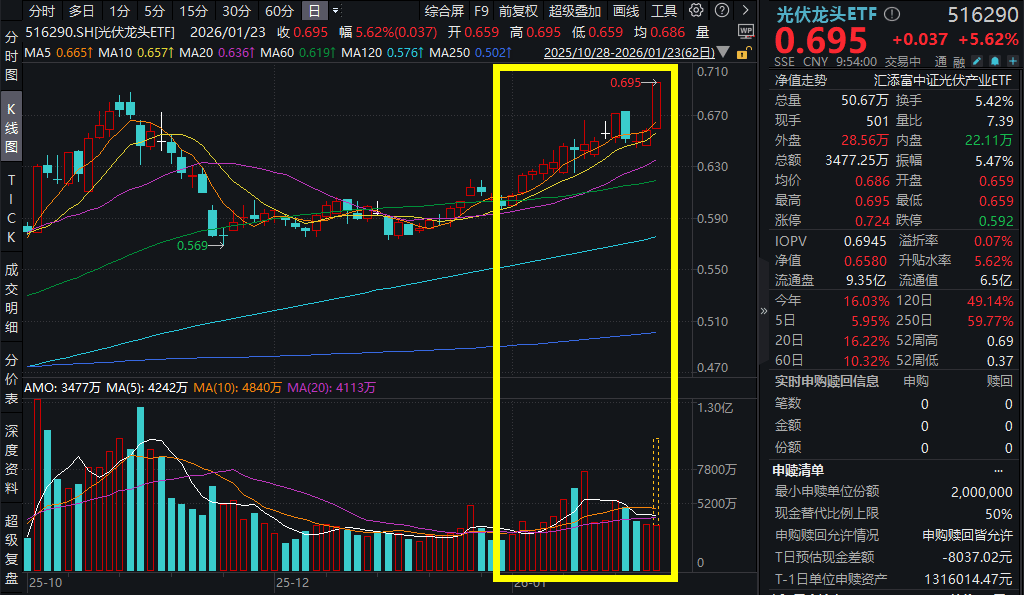
光伏ETF基金(516180)涨超5.1%,太空光伏全线爆发
Xin Lang Cai Jing· 2026-01-23 02:22
Core Viewpoint - The photovoltaic industry is experiencing significant growth, driven by innovations and a shift from price competition to innovation-driven competition, alongside emerging opportunities in space photovoltaic technology [1] Group 1: Market Performance - As of January 23, 2026, the China Securities Photovoltaic Industry Index (931151) surged by 5.09%, with key stocks such as Laplace rising by 20.01%, Maiwei Co. by 20.00%, and Dongfang Risen by 20.00 [1] - The Photovoltaic ETF Fund (516180) increased by 5.16%, with the latest price reported at 0.92 yuan [1] Group 2: Industry Developments - The State Administration for Market Regulation held a press conference on January 21, 2025, addressing the need to transition the photovoltaic industry from "price competition" to "innovation-driven" competition [1] - The low Earth orbit satellite market is expected to create nearly 10GW of demand for space photovoltaics, as indicated by Guangfa Securities [1] - Elon Musk's Twitter mentioned plans to deploy 100GW of AI computing satellites annually, with a white paper suggesting that space-based AI data centers could reduce total costs by 95% compared to ground-based solutions [1] Group 3: Index Composition - The China Securities Photovoltaic Industry Index comprises up to 50 representative listed companies involved in the photovoltaic industry chain, with the top ten weighted stocks accounting for 55.11% of the index [2]
光伏玻璃指数盘中大涨近5%,东方日升、拓日新能涨停
Mei Ri Jing Ji Xin Wen· 2026-01-23 02:07
(文章来源:每日经济新闻) 每经AI快讯,1月23日,光伏玻璃指数盘中大涨近5%。成分股中,东方日升、拓日新能涨停,金晶科 技、亚玛顿、福莱特等个股跟涨。 ...


光伏设备大幅高开!光伏ETF华夏(515370)大涨4.57%,东方日升、迈为股份20CM涨停
Sou Hu Cai Jing· 2026-01-23 02:05
Group 1 - The core viewpoint of the article highlights the significant impact of the Chinese government's announcement to cancel export tax rebates for photovoltaic products starting April 1, 2026, which aims to promote efficient resource utilization and reduce environmental pollution and carbon emissions [1] - The adjustment in export tax policy is expected to guide the rational adjustment of industrial structure, promote industrial transformation and upgrading, and alleviate "involution" competition, thereby fostering high-quality economic development [1] - Open Source Securities notes that the cancellation of the export tax rebate for photovoltaic products is intended to resolve the industry's "involution" issues, guide overseas market prices back to rational levels, reduce international trade friction risks, and alleviate national fiscal pressure [1] Group 2 - The Huaxia Photovoltaic ETF (515370) and its linked funds track the CSI Photovoltaic Industry Index, which encompasses upstream, midstream, and downstream enterprises in the photovoltaic industry, including silicon wafers, polysilicon, battery cells, cables, photovoltaic glass, battery modules, inverters, photovoltaic brackets, and photovoltaic power stations [2] - The index has a photovoltaic content of 83.64%, ranking first in the entire market dimension, thus better reflecting the overall performance of the photovoltaic industry [2]
HIT电池板块领涨,上涨2.92%
Mei Ri Jing Ji Xin Wen· 2026-01-23 01:57
(文章来源:每日经济新闻) 每经AI快讯,HIT电池板块领涨,上涨2.92%。其中,迈为股份上涨12.1%,明阳智能上涨10.01%,双良 节能上涨9.94%,东方日升、捷佳伟创、琏升科技涨超4%。 ...


转换效率跻身全球前三 东方日升HJT技术强势领跑太空能源赛道
Quan Jing Wang· 2026-01-23 01:08
Core Insights - The article highlights that Dongfang Risheng's HJT module, Vuxi Pro, has achieved a significant milestone by ranking among the top three globally in the TaiyangNews TOP SOLAR MODULES list, with a production power of 740Wp and a conversion efficiency of 23.8%, marking the highest power record in the history of the list [1] - The global photovoltaic module industry is transitioning from scale expansion to a focus on quality and efficiency, with conversion efficiency becoming a key competitive factor that directly influences market share and profitability [1] - The TOP SOLAR MODULES list employs strict criteria for inclusion, ensuring that only high-quality products with a conversion efficiency of at least 21.5% are considered, thus providing a reliable benchmark for assessing core competitiveness in the industry [1] Company Performance - Dongfang Risheng's Vuxi Pro module integrates key technologies such as 0BB busbarless design, stress-free interconnection, and ultra-thin silicon wafers, achieving both performance and cost-effectiveness improvements [2] - The company has demonstrated a high bifacial rate of 90%±5% and a low temperature coefficient of -0.24%/°C, leading the industry in various application scenarios, showcasing its product adaptability and reliability [2] - By the end of 2025, the cumulative shipment of the Vuxi series HJT products is expected to exceed 12GW, with sales in over 80 countries, reflecting strong market recognition and global competitiveness [2] Strategic Expansion - Dongfang Risheng is expanding its strategic vision to include the space sector, aiming for a dual-track development approach of "ground + space," which is expected to uncover new growth opportunities for the company [2] - The company's strategic move into the space sector is supported by its advanced technology reserves and commercialization capabilities, including the mass delivery of a 50μm ultra-thin p-type HJT battery, which is highly compatible with flexible solar wings for low Earth orbit satellite internet energy systems [3] - The development of perovskite/silicon heterojunction stacked solar cells with a conversion efficiency of 30.99% lays a solid foundation for future breakthroughs in space photovoltaic efficiency [3] Industry Trends - The commercial space sector is gaining significant attention in global capital markets, with companies like SpaceX advancing their IPO plans, indicating a robust market environment for related industries [3] - Domestic policies are increasingly supportive of the aerospace sector, with the "14th Five-Year Plan" emphasizing the cultivation of strategic emerging industries, which is expected to accelerate the commercialization of frontier scenarios like space data centers [3][4] - Dongfang Risheng's strategic partnership with Shanghai Port focuses on the research, validation, and industrialization of perovskite + p-type heterojunction battery stacking technology in the space energy field, aligning with national aerospace strategies and capitalizing on the explosive growth of the commercial space industry [4]