
Shandong Sinocera Functional Material (300285)

Search documents
东兴证券2026化工策略:行业底部有望回暖 供需格局或迎积极变化
智通财经网· 2025-12-18 09:16
智通财经APP获悉,东兴证券发布研报称,2025年,化工品价格指数小幅震荡下行,化工行业仍处于低 景气阶段,但目前全球能源类成本已从高位回落,同时,从供给、需求、库存角度看,行业已出现积极 变化。展望2026年国内化工行业,供需格局有望改善,建议关注行业景气有望回升的子行业,如钛白 粉、部分农药品种、化纤、制冷剂等;资本开支和研发共同驱动中长期增长的龙头企业;受益于需求增 加或国产替代持续推进的部分高端化工新材料,如电子化工材料、高端陶瓷材料等。 从需求端来看,国内制造业需求弱复苏,新兴领域或带来增量;此外,大规模设备更新、消费品以旧换 新等具体政策,也有助于拉动汽车、家电产业链相关化工品的需求。因此国内部分化工子行业的供需格 局有改善趋势,看好钛白粉、部分农药品种、化纤、制冷剂等子行业的供需格局有望逐步好转。 (2)资本开支和研发共同驱动中长期增长的龙头企业。经历供给侧改革之后,国内化工行业的集中度已 经有了较大的提升。未来,受到环保、安全、能耗等政策限制,化工行业资本开支向龙头集聚,投资方 向主要是聚焦原有产品产能扩张、围绕产业链向下游高附加值产品延伸、或通过研发驱动向更多高壁垒 的精细化学品和新材料领域 ...


化工行业2026年策略报告:行业有望底部回暖,供需格局或迎积极变化-20251218
Dongxing Securities· 2025-12-18 08:43
Group 1 - The core view of the report indicates that the chemical industry in China is expected to see a bottoming out and improvement in supply-demand dynamics, with a marginal recovery in industry prosperity anticipated for 2026 [4][5][45] - In 2025, the chemical price index is projected to decline slightly, remaining in a low prosperity phase, but global energy costs have retreated from their highs, leading to positive changes in supply, demand, and inventory [4][15][45] - The report highlights that supply-side investment growth in the chemical industry is slowing, driven by anti-competitive policies and the exit of outdated overseas production capacities, which alleviates supply-side pressure [4][30][37] Group 2 - The report identifies three key investment directions for 2026: sub-industries with improving supply-demand dynamics, leading companies driven by capital expenditure and R&D, and high-end chemical new materials benefiting from increased demand or domestic substitution [5][46][57] - Sub-industries expected to see recovery include titanium dioxide, certain pesticide varieties, chemical fibers, and refrigerants, as traditional demand stabilizes and new industries emerge [5][49][57] - Leading companies are expected to concentrate capital expenditure on capacity expansion and high-value downstream products, with significant capital expenditures noted for companies like China Petroleum and Wanhua Chemical [6][51][52] Group 3 - The report emphasizes the ongoing domestic substitution in high-end chemical new materials, particularly in electronic chemical materials and ceramics, driven by the growth of emerging industries such as AI and biomedical applications [7][54][56] - The demand for electronic chemical materials is anticipated to increase as domestic companies make technological advancements and penetrate supply chains for semiconductor and display panel materials [55] - The ceramic materials market is expected to grow significantly due to new applications in biomedical fields, providing a new growth engine for high-end ceramic materials [56]

化工行业2026年度投资策略:周期破晓,关注反内卷政策与国产替代两大主线
Huaan Securities· 2025-12-17 02:53
Investment Strategy Overview - The report emphasizes two main investment themes for the chemical industry: anti-involution policies and domestic substitution, which are expected to drive recovery and growth in the sector [4][5][6] Anti-Involution and Cycle Recovery - The report suggests that the chemical industry is at a turning point, with anti-involution measures leading to a recovery in the cycle. Key areas include the peak of new capacity in organic silicon, the end of PTA capacity expansion, and a rebound in prices for certain chemicals due to supply chain disruptions [4][5] - The China Chemical Product Price Index (CCPI) has decreased significantly, dropping to 3865 points by November 30, 2025, down 16.37% from early 2024 and 10.71% from the beginning of 2025 [4][20] Domestic Substitution as a Growth Driver - Domestic substitution is highlighted as a key growth driver, with significant support from national policies for bio-based materials and advancements in technology leading to a more robust domestic supply chain [4][6] - The report identifies several companies positioned to benefit from these trends, including KaiSai Bio and RuiFeng New Materials, which are making strides in bio-based materials and lubricant additives, respectively [5][6] Market Dynamics and Price Recovery - The report notes that while the chemical market is experiencing a downturn, certain segments are expected to see price recovery due to improved supply-demand dynamics and reduced capacity expansion [4][22] - Specific chemical products have shown varied price movements, with some experiencing significant declines while others are stabilizing or recovering [22] Manufacturing Sector Recovery - The manufacturing sector is showing signs of recovery, which is anticipated to support the chemical industry. The report mentions that the real estate market is stabilizing, and automotive production has increased, indicating a potential uptick in demand for chemical products [25][33] Capital Expenditure Trends - Capital expenditure growth in the chemical industry is slowing, with a notable decline in new projects. The report indicates that the total construction in progress for the chemical sector was 327.57 billion yuan in Q3 2025, down 17.64% year-on-year [34][39] Inventory and Consumption Trends - High inventory levels in the chemical sector are being addressed as consumer demand begins to recover. The report suggests that the inventory-to-revenue ratio for the basic chemical industry was 0.62 in Q3 2025, indicating a slight increase from the previous year [41][42] Profitability and Financial Performance - The report highlights a recovery in profitability for the chemical industry, with gross margins and return on equity (ROE) showing improvement in Q3 2025 compared to previous periods [56][60] - Specific sub-sectors, such as agrochemicals and fluorochemicals, have demonstrated significant profit growth, with some exceeding 100% year-on-year increases [55][56]


国瓷材料:关于公司第一大股东、实际控制人股权新质押的公告
Zheng Quan Ri Bao· 2025-12-16 13:12
(文章来源:证券日报) 证券日报网讯 12月16日晚间,国瓷材料发布公告称,公司于近日收到公司第一大股东、实际控制人张 曦先生的通知,获悉张曦先生将其持有的部分国瓷材料股份办理了股份新质押的相关业务,本次质押数 量合计3,330,000股。 ...

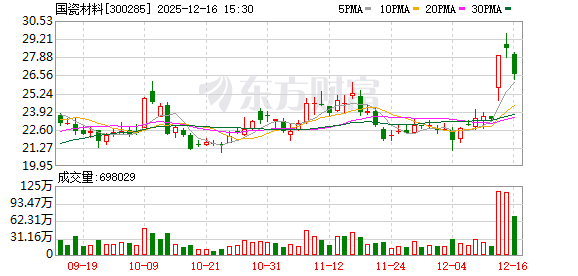
国瓷材料:实控人张曦质押0.33%公司股份
Xin Lang Cai Jing· 2025-12-16 09:47
国瓷材料公告,公司第一大股东、实际控制人张曦质押333万公司股份,占其所持股份比例为2.18%, 占公司总股本比例为0.33%。质押开始日为2025年12月15日,质押用途为融资。 ...
国瓷材料(300285) - 关于公司第一大股东、实际控制人股权新质押的公告
2025-12-16 09:36
注:张曦先生质押股份中限售股限售类型为高管锁定股 证券代码:300285 证券简称:国瓷材料 公告编号:2025-079 山东国瓷功能材料股份有限公司 关于公司第一大股东、实际控制人股权新质押的公告 本公司及董事会全体成员保证公告内容真实、准确和完整,没有虚假记 载、误导性陈述或重大遗漏。 山东国瓷功能材料股份有限公司(以下简称"公司"或"国瓷材料")于 近日收到公司第一大股东、实际控制人张曦先生的通知,获悉张曦先生将其持 有的部分国瓷材料股份办理了股份新质押的相关业务。具体情况如下: | 股东 | 是否为公司第 一大股东或实 | 本次质押数 | 占其所持股 | 占公司总股 | 是否为 | 是否为补 | 质押开始日 | 质押到期日 | 质权人 | 用途 | | --- | --- | --- | --- | --- | --- | --- | --- | --- | --- | --- | | 名称 | 际控制人 | 量(股) | 份比例 | 本比例 | 限售股 | 充质押 | | | | | | 张曦 | 是 | 1,340,000 | 0.876% | 0.134% | 否 | 否 | 2025.12.1 ...
石油与化工指数多数下跌(12月8日至12日)
Zhong Guo Hua Gong Bao· 2025-12-16 03:53
Group 1: Chemical Sector Performance - The chemical raw materials index decreased by 1.75%, while the chemical machinery index increased by 0.47%. The pharmaceutical index fell by 0.24%, and the pesticide and fertilizer index dropped by 1.48% [1] - In the petroleum sector, the petroleum processing index declined by 2.65%, the petroleum extraction index fell by 2.49%, and the petroleum trading index decreased by 7.22% [1] Group 2: Oil Price Trends - International crude oil prices decreased, with the NYMEX West Texas Intermediate crude oil futures settling at $57.44 per barrel, down 4.39% from December 5. The ICE Brent crude oil futures settled at $61.12 per barrel, down 4.13% from December 5 [1] Group 3: Petrochemical Product Price Changes - The top five petrochemical products with price increases were lithium battery electrolyte (up 5.50%), vitamin VA (up 5.21%), bisphenol A (up 4.42%), sulfuric acid (up 4.36%), and sulfur (up 4.21%) [1] - The top five petrochemical products with price decreases were liquid chlorine (down 32.88%), 2% biotin (down 5.45%), vitamin D3 (down 5.11%), aniline (down 4.36%), and DEG (down 4.15%) [1] Group 4: Capital Market Performance of Chemical Companies - The top five performing listed chemical companies were Zai Sheng Technology (up 61.19%), Guoci Materials (up 23.46%), Lanxiao Technology (up 18.13%), Qiaoyuan Co. (up 15.18%), and Yongguan New Materials (up 14.34%) [2] - The top five underperforming listed chemical companies were Fanli Technology (down 22.56%), Qingshuiyuan (down 18.42%), Hengtong Co. (down 16.12%), Letong Co. (down 15.53%), and Asia Pacific Industry (down 14.06%) [2]


国瓷材料:关于开展外汇衍生品交易业务的公告
Zheng Quan Ri Bao· 2025-12-15 13:46
Core Viewpoint - The company has approved a proposal to engage in foreign exchange derivative trading to mitigate risks associated with market fluctuations in exchange rates and interest rates [2] Summary by Categories Company Actions - The company convened its sixth board meeting on December 14, 2025, where it approved the proposal for foreign exchange derivative trading [2] - The board authorized the management to make decisions and sign agreements related to this trading activity [2] Financial Details - The company plans to conduct foreign exchange derivative trading with a cumulative amount not exceeding 40 million USD or equivalent foreign currency [2]
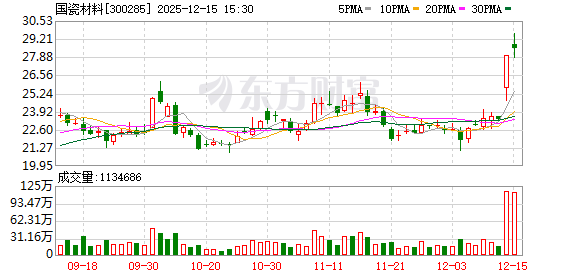
国瓷材料:关于公司2026年度向银行申请综合授信额度暨为全资子公司专项贷款提供担保的公告
Zheng Quan Ri Bao· 2025-12-15 13:46
(文章来源:证券日报) 证券日报网讯 12月15日晚间,国瓷材料发布公告称,公司第六届董事会第五次会议审议通过了《关于 公司2026年度向银行申请综合授信额度暨为全资子公司专项贷款提供担保的议案》。因公司发展需要, 2026年公司、全资子公司及控股子公司拟向相关银行申请总额不超过30亿元人民币或等值外币的授信额 度,综合授信额度期限自2026年1月1日至2026年12月31日。在此授信额度内由公司及全资子公司、控股 子公司根据实际资金需求进行银行借贷,在授信有效期内可循环使用。为解决全资子公司江苏国瓷金盛 陶瓷科技有限公司(简称"国瓷金盛")生产经营及发展的资金需求,公司第六届董事会第五次会议审议 通过了《关于公司2026年度向银行申请综合授信额度暨为全资子公司专项贷款提供授信担保的议案》, 同意公司为全资子公司国瓷金盛20,000万元的专项贷款提供银行担保,担保总额不超过20,000万元。 ...
国瓷材料:2025年12月31日将召开2025年第二次临时股东会
Zheng Quan Ri Bao· 2025-12-15 12:45
证券日报网讯 12月15日晚间,国瓷材料发布公告称,公司将于2025年12月31日召开2025年第二次临时 股东会。 (文章来源:证券日报) ...