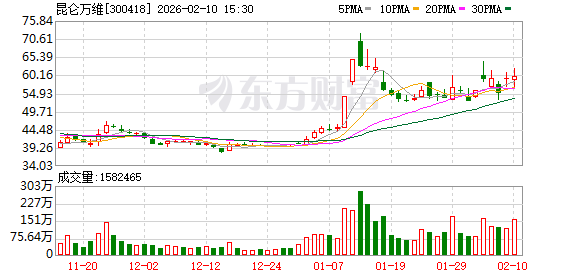
Kunlun(300418)

Search documents
未知机构:昆仑万维持续加码漫剧投入短剧平台份额提升东吴传媒海外张良卫团队-20260211
未知机构· 2026-02-11 02:05
风险提示:产品推广进展不及预期,竞争格局不确定。 事件描述:近日,昆仑万维宣布投入千万美金专项资金全面加码海外 AI 短剧赛道,同步启动「百万美金・剧启 AI」DramaWave AI 短剧创作扶持计划。 该计划面向全球个人、团队及机构创作者公开征集优质 AI 短剧,入围者不仅能斩获超高保底扶持与参赛奖金,更 将成为昆仑万维 AI 短剧官方年框战略合作伙伴,获得全方位技术与资金支持。 观点重申:1、公司是国内最早投入AI大模型的公司之一,投入体量在国内处于领先位置,在多模态、agent等领域 都有深厚技术储备,产品持续迭代优化产生规模收入体量;2、公司聚焦在skywork、mureka、linky三大产品管线, 随着模型能力提升,流水及收入正处于逐步放量阶段,对标minimax,收入有弹性,估值有空间;3、当前公司短剧 业务位居出海企业头部,增长迅猛排名持续提升,后续期待盈利能力改善带来业绩增量;4、公司过去进行了大量 的投资布局,涉及头部互联网公司、新兴科技领域,中长期将持续带来投资收益。 账面投资收益弹性空间大,原有盈利业务稳健发展。 昆仑万维:持续加码漫剧投入,短剧平台份额提升【东吴传媒海外 张良卫团队 ...

【明日主题前瞻】算力基础设施核心,AI浪潮下电力设备供需缺口进一步放大
Xin Lang Cai Jing· 2026-02-10 12:08
Group 1: AI and Power Equipment - Alphabet plans to raise $20 billion through bond issuance, exceeding previous expectations, to invest heavily in data centers crucial for its AI strategy [1] - The global demand for high-power, stable electricity supply for AI computing is increasing, leading to a supply-demand gap in high-voltage power equipment [1] - TBEA is a leading private transformer manufacturer in China, capable of integrated services in high-voltage cables and accessories [2] Group 2: AI and Security - The integration of AI into cybersecurity is creating new opportunities, with safety and trust becoming core themes in the industry [3] - The implementation of new cybersecurity regulations in China marks a shift towards more detailed governance in the sector [3] - Anheng Information has launched China's first AI security agent, enhancing its capabilities in various security scenarios [4] Group 3: Metal Prices - The price of indium has surged to its highest level in over a decade, with a significant increase of 88% from 2500 RMB/KG to 4700 RMB/KG [5] - China accounts for 70% of global indium production, and the supply growth has been limited, indicating potential for further price increases [5] - Xiyang Co. holds the largest indium resource reserves globally, producing 101.62 tons of indium [5] Group 4: Tourism Industry - The domestic tourism market is expected to see a 300% increase in planned trips during the upcoming Spring Festival, indicating a strong recovery [6] - Companies like Sanxia Tourism are expanding their offerings to meet diverse consumer demands, including high-end cruise services [7] Group 5: AI Content Creation - Reading Group is focusing on AI-driven content creation, aiming to enhance the efficiency and value of IP development [8] - Daily Interactive provides data intelligence services, catering to the short video and short drama sectors [9] Group 6: Automotive Industry - The Ministry of Commerce is implementing measures to boost automotive consumption, including trade reforms and policies to support vehicle replacement [11] - Companies like Feilong Co. and Xingyu Co. are positioned to benefit from the anticipated growth in the automotive sector [11]




昆仑万维:具体业绩数据将在公司2025年度报告中详细披露
Zheng Quan Ri Bao· 2026-02-10 11:37
(文章来源:证券日报) 证券日报网讯 2月10日,昆仑万维在互动平台回答投资者提问时表示,2025年,公司持续以"算力-大模 型-应用"全链条布局为根基,在市场推广和研发方面持续加大投入,对当期业绩造成一定影响。具体业 绩数据将在公司2025年度报告中详细披露,可关注后续公告。 ...

AI应用+IP生态双轮驱动,行业基本面有望持续向好
Shanxi Securities· 2026-02-10 08:54
资料来源:常闻 | 首选股票 | | 评级 | | --- | --- | --- | | 300418.SZ | 昆仑万维 | 买入-A | | 601595.SH | 上海电影 | 买入-A | | 603258.SH | 电魂网络 | 增持-A | 相关报告: 潘宁河 执业登记编码:S0760523110001 邮箱:panninghe@sxzq.com 林挺 执业登记编码:S0760524100003 邮箱:linting@sxzq.com 传媒 行业年度策略报告 领先大市-A(维持) AI 应用+IP 生态双轮驱动,行业基本面有望持续向好 2026 年 2 月 10 日 行业研究/行业年度策略 投资要点: 传媒业绩增速向上,AI、游戏驱动指数上涨。2025 年全年,传媒指数 累计上涨 27.17%,位于申万 31 个一级子行业的第 9 名。传媒子板块中,游 戏、电视广播涨幅分别为 60.50%、20.80%,涨幅较为领先。2025 年 Q1-Q3, 传媒行业实现营收 3872.78 亿元,同比+5.75%;实现归母净利润 321.09 亿元, 同比+37.88%。子板块中,影视、游戏行业板块利润表现 ...


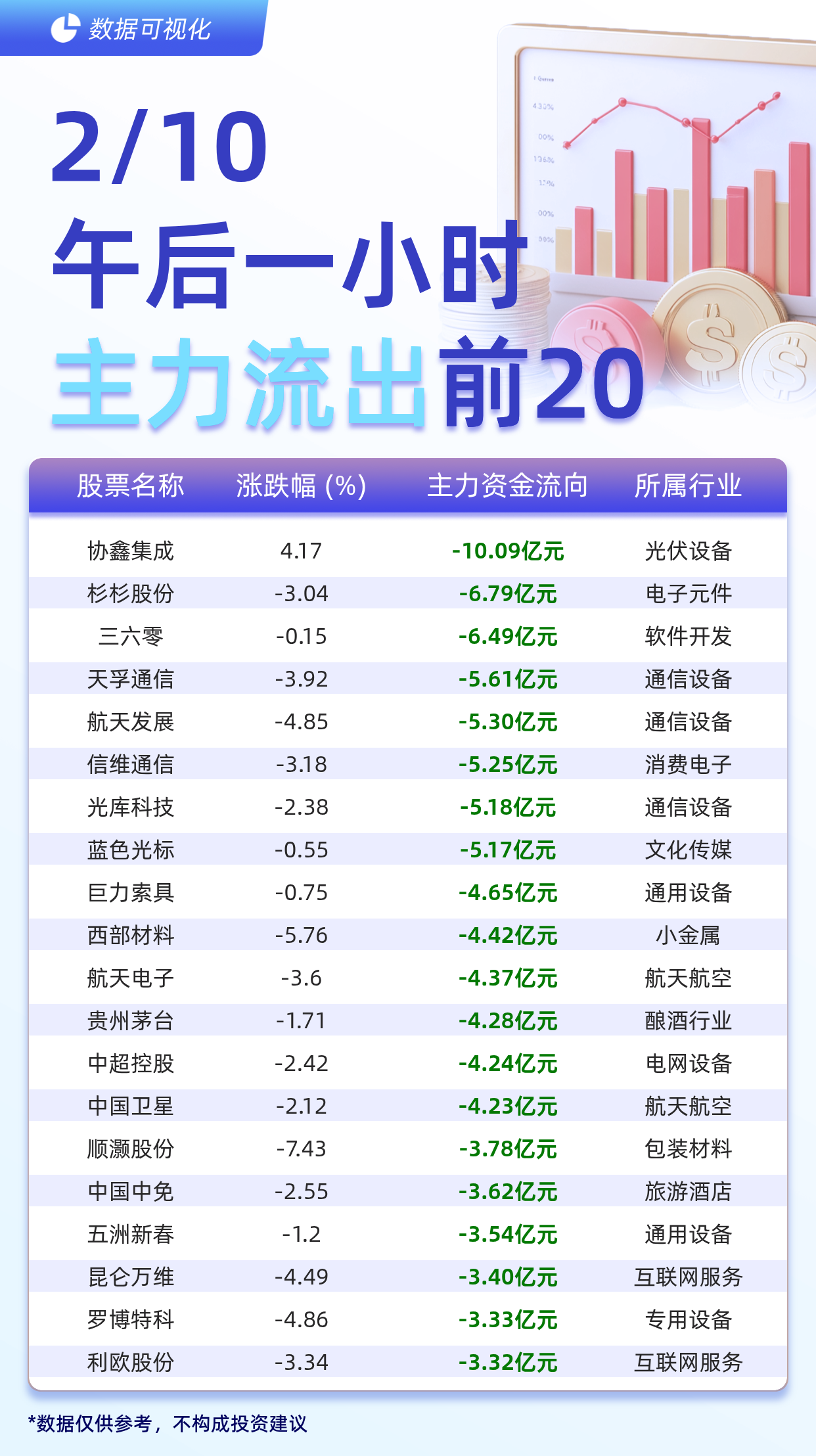
主力个股资金流出前20:协鑫集成流出10.09亿元、杉杉股份流出6.79亿元
Jin Rong Jie· 2026-02-10 06:35
Core Viewpoint - The data indicates significant outflows of capital from various stocks, with the top 20 stocks experiencing substantial withdrawals, highlighting potential concerns in investor sentiment and market dynamics [1][2][3] Group 1: Major Stocks with Capital Outflows - GCL-Poly Energy saw the largest outflow of -1.009 billion yuan, indicating a negative trend in the photovoltaic equipment sector [1][2] - Soshine Technology experienced an outflow of -679 million yuan, reflecting challenges in the electronic components industry [1][2] - 360 Security Technology had a capital outflow of -649 million yuan, suggesting potential issues in the software development sector [1][2] Group 2: Additional Stocks with Notable Withdrawals - Tianfu Communication faced an outflow of -561 million yuan, indicating pressures in the communication equipment sector [1][2] - Aerospace Development reported a capital outflow of -530 million yuan, which may reflect broader concerns in the aerospace and defense industry [1][2] - Kweichow Moutai experienced an outflow of -428 million yuan, raising questions about the performance in the liquor industry [1][3]





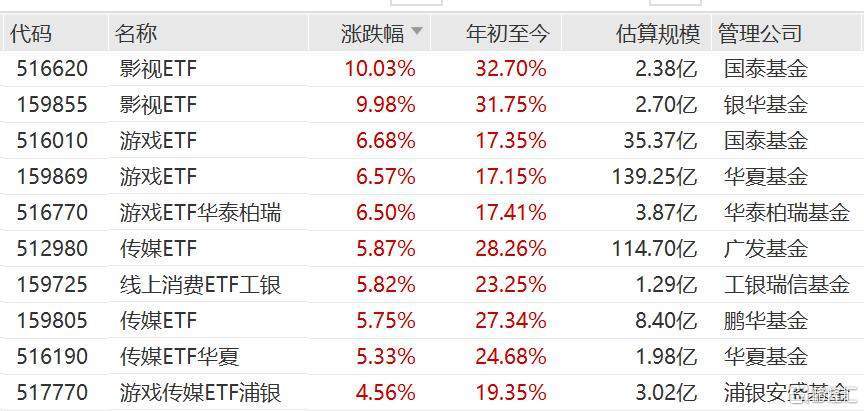
AI应用持续火热,影视ETF涨停,游戏ETF涨超6%,传媒ETF涨超5%
Sou Hu Cai Jing· 2026-02-10 04:17
Core Insights - The AI application in the media and gaming sectors is driving significant market activity, with various ETFs experiencing substantial gains, particularly the Film ETF which saw a limit-up increase [1] - ByteDance's launch of the AI video generation model Seedance 2.0 has sparked interest in AI-related stocks, although the model's ability to reference real human materials has been temporarily suspended for optimization [2] - The domestic gaming market is projected to continue its growth, with a notable increase in the number of game licenses issued, indicating a robust pipeline for future products [3] Group 1: ETF Performance - The Film ETF has increased by 10.03% year-to-date, with an estimated scale of 238 million [2] - The Gaming ETF has seen a rise of 6.68% year-to-date, with an estimated scale of 3.537 billion [2] - The Media ETF has grown by 5.87% year-to-date, with an estimated scale of 11.47 billion [2] Group 2: Market Trends - The pre-sale box office for new films during the 2026 Spring Festival has exceeded 86 million, indicating strong consumer interest [3] - The number of domestic game licenses issued in January increased by 33 compared to the previous month, and by 54 compared to the same period last year, suggesting improved approval processes [3] - The actual sales revenue of the domestic gaming market is projected to reach 350.79 billion in 2025, a year-on-year increase of 7.68% [3] Group 3: Industry Analysis - The gaming sector is expected to maintain a high growth trajectory, with the mobile gaming market projected to generate 257.08 billion in revenue, up 7.92% year-on-year [3] - The SW Media sector's allocation has shifted, with the gaming segment seeing an increase in overweight positions to 40.26% [4] - The revival of PC gaming and the increasing budget for mobile game development are expected to enhance the market's product offerings [5]



昆仑万维20260205
2026-02-10 03:24
Summary of Key Points from the Conference Call Company and Industry Overview - The conference call discusses **Kunlun Wanwei** and its product **Skywalk Desktop Version**, which is positioned within the **media and office automation industry** [1][2]. Core Insights and Arguments - **Document Processing Efficiency**: Skywalk Desktop Version significantly enhances document processing efficiency, particularly in tasks like renaming, rewriting, and generating new files. It simplifies upload steps and improves security [2][5]. - **Office Automation Performance**: The system performs well in office automation, especially in generating daily reports, adhering to user instructions and templates, although content accuracy requires further optimization [2][4]. - **Content Creation Challenges**: The product faces issues with "hallucination," where generated content may not meet expectations. Data extraction from PDFs is prone to errors, necessitating multiple corrections and manual checks, which increases labor costs and reduces efficiency [2][6]. - **Membership Limitations**: The Basic version limits users to 2-3 tasks daily, while the Plus version theoretically allows three times that but is still constrained by token limits. There is currently no option to purchase additional task limits [9]. - **Server Stability Issues**: The server performs well during the day but experiences slow response times and potential lag after 6 PM Beijing time due to increased user load [9]. - **Data Extraction Accuracy**: There are significant issues with data extraction accuracy, leading to substantial errors in underlying data. Some companies that did not issue earnings forecasts were incorrectly included, affecting the reliability of subsequent statistical analyses [10] [9]. Additional Important Content - **Media Industry Earnings Forecast Analysis**: The analysis process involves downloading earnings forecast data from A-share media companies, combining it with competitor strategies, and calculating net profit growth rates to predict future performance [8]. - **Report Generation Performance**: While Excel reports need accuracy improvements, Word documents are generally readable and meet requirements. However, underlying data issues affect the accuracy of final conclusions [11]. - **Overall Application Effectiveness**: Skywalk Desktop Version shows potential for productivity enhancement in research and investment work, particularly in document processing and office automation. However, it requires improvements in accuracy for high-precision data tasks [13].
未知机构:昆仑万维发布自主AI智能体SkyBot低门槛部署OpenClaw拓宽Agen-20260210
未知机构· 2026-02-10 02:10
特别是在 OpenClaw 近期曝出执行层安全漏洞的背景下,Skybot的安全优势有望更快获得客户的认可。 产品对比细节: 昆仑万维:发布自主AI智能体SkyBot,低门槛部署OpenClaw拓宽Agent能力边界【东吴传媒海外 张良卫团队】 事件描述:昆仑万维于 2026 年 2 月初正式发布的AI智能体Skybot,与开源社区标杆 OpenClaw(原 Clawdbot)相 比,Skybot 在数据隐私(本地虚拟机运行)与模型调度(ModelArray架构)上展现出显著的商业化优势。 特别是在 OpenClaw 近期曝出 昆仑万维:发布自主AI智能体SkyBot,低门槛部署OpenClaw拓宽Agent能力边界【东吴传媒海外 张良卫团队】 事件描述:昆仑万维于 2026 年 2 月初正式发布的AI智能体Skybot,与开源社区标杆 OpenClaw(原 Clawdbot)相 比,Skybot 在数据隐私(本地虚拟机运行)与模型调度(ModelArray架构)上展现出显著的商业化优势。 OpenClaw依赖单一模型 API 配置,虽具备极高的定制上限,但要求用户具备代码调试能力,且在多步复杂任务 (Mult ...
未知机构:Seedance及Kling模型突破有望进一步强化中国短漫剧全球领先地位东-20260210
未知机构· 2026-02-10 02:05
Summary of Conference Call Records Industry Overview - The Chinese short drama industry holds a significant global leading advantage, with platforms like Reelshort, Dramabox, and Dramawave outperforming local competitors in revenue generation, supported by the comprehensive strengths of Chinese cultural enterprises in web literature IP, short drama production, and promotional strategies. Short dramas have become a crucial category for Chinese cultural exports [1][1]. Key Insights 1. **Growth in Short Drama and Comic Drama Sectors**: The comic drama sector is expected to experience accelerated growth by Q4 2025, with a notable increase in the number of projects and materials being produced [2][2]. 2. **Dramatic Increase in Comic Drama Projects**: Data from DataEye-ADX indicates that the number of comic drama projects will surge from 234 in January to 17,944 by December 2025, representing a growth of over 76 times. Similarly, the number of comic drama materials will rise from 27,000 to 1,623,000, a growth of over 59 times [2][2]. 3. **Recognition of Seedance and Kling Models**: The Seedance 2.0 and Kling 3.0 models have gained significant industry recognition, enhancing their global influence. These models have shown remarkable advancements in key areas such as intelligent camera work, consistency, and audio-visual synchronization [2][2]. 4. **Investment Opportunities in Multi-modal Fields**: The advancements in video models present investment opportunities in the multi-modal sector, with industry leaders acknowledging the impressive capabilities of AI in understanding and integrating multi-modal information [2][2]. Recommendations - **Long-term Investment in Short/Comic Drama**: It is recommended to focus on long-term investment opportunities in the short and comic drama sectors, particularly in companies with strong IP accumulation and early positioning in the comic drama field, such as Chinese Online, Huayi Brothers, Kunlun Wanwei, and others [3][3]. - **Attractive Valuation for Kuaishou**: Kuaishou is highlighted as having an attractive valuation, with the release of the Ling 3.0 model expected to further enhance the company's AI business revenue and valuation [2][2]. Financial Projections - The projected non-IFRS net profits for the company from 2025 to 2027 are estimated at 20.6 billion, 22.9 billion, and 25.2 billion yuan, respectively. The current market capitalization corresponds to a valuation of only 12 times for 2026, maintaining a "buy" rating [3][3]. Risks - Potential risks include the pace of model technology iteration not meeting expectations, slow commercialization of AI applications, and regulatory policy risks within the industry [3][3].





头部模型密集升级+出海表现亮眼!文生视频赛道景气度拉满,成AI应用核心布局方向
Xin Lang Cai Jing· 2026-02-09 10:09
Group 1 - The article discusses the growing trend of AI-generated video content across various industries, highlighting companies leveraging AI technology to enhance content creation and distribution efficiency [1][2][3][4][5][6][7][8][9][10][11][12][13][14][15][16][17][18][19][20][21][22][23][24][25][26][27][28][29][30][31][32][33][34][35][36][37][38][39][40][41][42][43][44][45][46][47][48][49][50][51][52][53][54][55][56][57][58][59][60][61] Group 2 - Companies like 中文在线 and 捷成股份 are utilizing AI to transform scripts and text into video content, thereby reducing production barriers and enhancing IP monetization [1][2] - 万兴科技 and 流金科技 are focusing on AI video generation tools to support various sectors, including e-commerce and broadcasting, indicating a shift towards integrating AI in traditional industries [4][5] - The article emphasizes the potential for significant revenue growth as demand for AI-generated video content surges, with companies like 当虹科技 and 昆仑万维 already seeing rapid growth in their AI-related product revenues [9][10][11]