Kunlun(300418)

Search documents
软件概念爆发,创业板软件ETF华夏(159256)上涨3.86%
Xin Lang Cai Jing· 2026-02-09 06:28
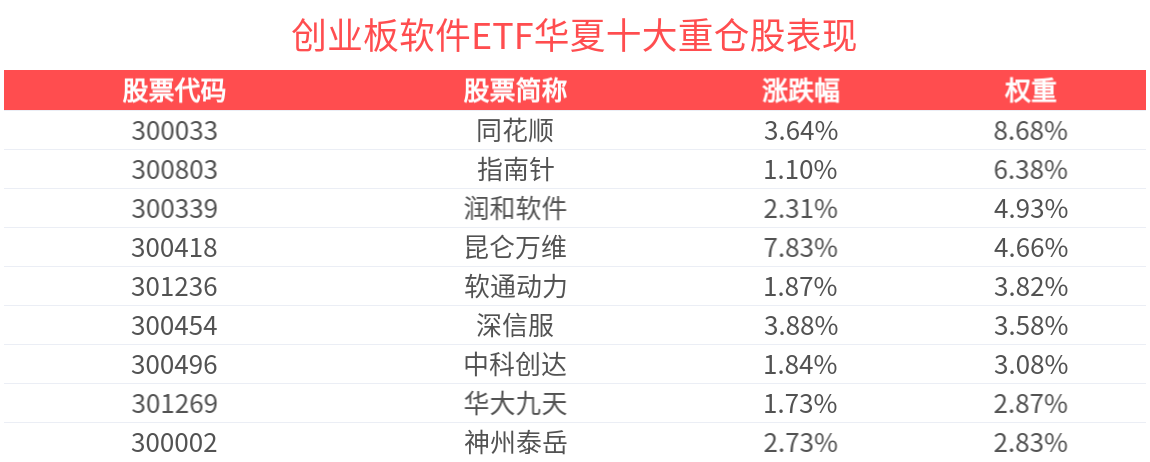
Group 1 - The software concept is experiencing a surge, with the ChiNext Software ETF (159256) rising by 3.86% as of February 9, 2026, and notable stocks like Dongfang Guoxin and Wanxing Technology increasing by 16.73% and 11.63% respectively [1] - In the past 21 trading days, the ChiNext Software ETF has attracted a total of 539 million yuan [1] - ByteDance has launched its latest video model, Seedance 2.0, which is now available on the Jiemeng platform, allowing users to generate videos from text/images and use video/audio as reference materials [1] Group 2 - The ChiNext Software ETF closely tracks the ChiNext Software Index, which as of January 30, 2026, has its top ten weighted stocks including Tonghuashun, Runze Technology, and Kunlun Wanwei, accounting for a total of 48.61% of the index [2] - The top ten stocks in the ChiNext Software Index are as follows: Tonghuashun (3.64% increase, 8.68% weight), Guiding Compass (1.10% increase, 6.38% weight), and Runhe Software (2.31% increase, 4.93% weight) among others [3]







传媒行业跟踪报告:2025Q4传媒行业重仓配置回落至低配,游戏板块备受青睐
Wanlian Securities· 2026-02-09 05:36
Investment Rating - The industry is rated as "Outperforming the Market" with an expected relative increase of over 10% in the industry index compared to the broader market within the next six months [47]. Core Insights - In Q4 2025, the SW Media Industry Index decreased by 4.92%, with a slight reduction in capital activity, yet it remains at a high level. The fund's heavy allocation in the media sector has shifted to an underweight status, while the gaming sector continues to attract market attention and remains overweight [1][2][10]. - The gaming sector occupies a significant portion of the top ten heavy stocks, indicating high market interest. Among the top ten heavy stocks, eight are from the gaming industry, with notable declines in stock prices for most, except for one stock that saw an increase [2][24]. Summary by Sections 1. Capital Activity - The SW Media Industry Index closed at 819.69 points at the end of Q4 2025, down from 862.14 points at the beginning of the quarter, reflecting a 4.92% decline. The average daily trading volume was 51.09 billion yuan, a decrease of 5.20 billion yuan from the previous quarter [10]. 2. Industry Allocation Status - The allocation ratio for the SW Media Industry in Q4 2025 was 1.63%, with a fund heavy allocation ratio of 1.22%, indicating a low allocation of 0.41%. This reflects a shift from overweight to underweight status [13][16]. - The number of heavy allocation stocks accounted for 50.77% of the total, showing a slight decrease in concentration, ranking 14th among all primary industries [17]. - The gaming sector maintained an overweight status with a 40.26% allocation, while other sub-sectors remained underweight [35][39]. 3. Fund Concentration - The concentration of fund heavy stocks decreased slightly, with the top five, ten, and twenty stocks accounting for 68.74%, 85.72%, and 97.33% of the total fund heavy stock value, respectively, indicating a high concentration in leading stocks [3][43]. 4. Investment Recommendations - Given the current fund allocation and valuation levels in the SW Media Industry, it is suggested to focus on leading companies in the gaming sector, particularly those with rich game license reserves and applications in AI [45].






AI人工智能ETF(512930)涨超3.5%,国产AI大模型扎堆上新
Xin Lang Cai Jing· 2026-02-09 05:32
Group 1 - The core viewpoint of the news highlights a significant rise in the AI sector, with the Zhongzheng AI Theme Index increasing by 3.70% and notable gains in individual stocks such as Chip Origin Co., Ltd. and Guanghua New Network [1] - The AI application concept stocks experienced a surge, driven by the anticipation of the release of Qwen3.5, a new model from Alibaba, which has sparked discussions in the global AI open-source community [1] - According to Zhongyin Securities, the AI industry may be poised for a rebound after a period of decline, with key updates from major domestic models expected around the Chinese New Year [2] Group 2 - The Zhongzheng AI Theme Index consists of 50 listed companies involved in providing resources, technology, and application support for AI, reflecting the overall performance of AI-related securities [3] - As of January 30, 2026, the top ten weighted stocks in the Zhongzheng AI Theme Index accounted for 57.27% of the index, indicating a concentration of investment in leading companies within the AI sector [3] - The AI ETF closely tracks the Zhongzheng AI Theme Index, providing investors with exposure to the performance of AI-related companies [3]


昆仑万维股价涨7.66%,诺安基金旗下1只基金重仓,持有178.96万股浮盈赚取751.63万元
Xin Lang Ji Jin· 2026-02-09 01:43
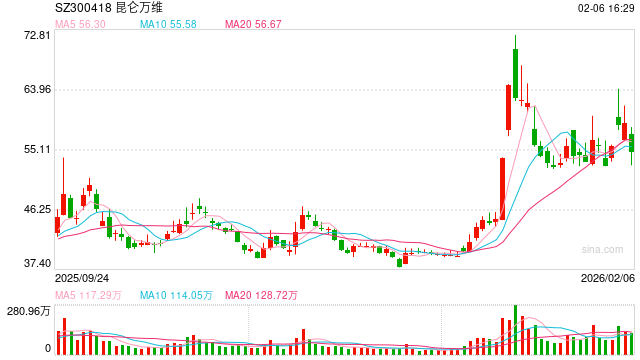
Group 1 - The core point of the news is that Kunlun Wanwei's stock price increased by 7.66% to 59.00 CNY per share, with a trading volume of 396 million CNY and a turnover rate of 0.54%, resulting in a total market capitalization of 74.066 billion CNY [1] - Kunlun Wanwei Technology Co., Ltd. was established on March 27, 2008, and listed on January 21, 2015. The company is based in Beijing and primarily engages in comprehensive internet value-added services and new energy investment [1] - The revenue composition of Kunlun Wanwei includes: 38.37% from online advertising, 18.51% from Opera search, 15.61% from short drama platforms, 13.92% from overseas social networks, 6.40% from gaming, 4.27% from casual social entertainment platforms, 1.75% from AI software technology, and 1.16% from other businesses [1] Group 2 - From the perspective of major fund holdings, one fund under Nuoan Fund has a significant position in Kunlun Wanwei. The Nuoan Active Return Mixed A Fund (001706) reduced its holdings by 438,900 shares in the fourth quarter, now holding 1.7896 million shares, which represents 4.31% of the fund's net value, making it the sixth-largest holding [2] - The Nuoan Active Return Mixed A Fund was established on September 22, 2016, with a current scale of 979 million CNY. Year-to-date, it has achieved a return of 10.46%, ranking 710 out of 8994 in its category; over the past year, it has incurred a loss of 2%, ranking 8106 out of 8194; since inception, it has returned 120.8% [2] - The fund manager of Nuoan Active Return Mixed A Fund is Liu Huiying, who has been in the position for 3 years and 192 days. The total asset scale of the fund is 19.259 billion CNY, with the best return during her tenure being 93.21% and the worst being 24.81% [3]
机构看涨昆仑万维至九百亿市值
2 1 Shi Ji Jing Ji Bao Dao· 2026-02-09 01:31
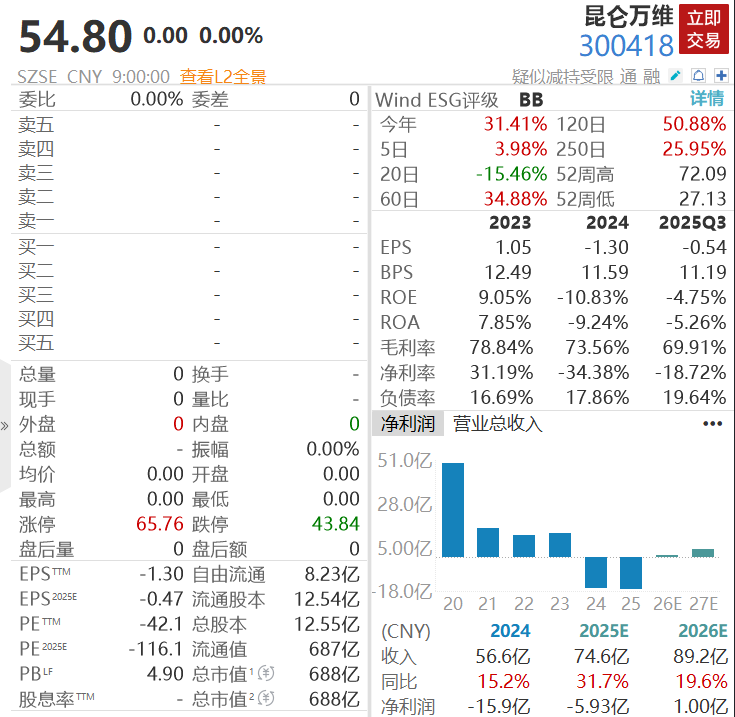
Core Viewpoint - Kunlun Wanwei is strategically shifting its focus from competing directly with major players in the AI field to building a differentiated competitive advantage in vertical markets and overseas expansion, aiming for long-term market positioning and ecological advantages rather than short-term profitability [2][5][9]. Financial Performance - For 2025, Kunlun Wanwei forecasts a net loss attributable to shareholders between 1.35 billion to 1.95 billion CNY, continuing the trend of losses from the previous year [2]. - The company expects a revenue growth of over 40% year-on-year for 2025, with an increasing proportion of revenue coming from overseas markets [2][3]. - In Q3 2025, the company achieved a net profit of 190 million CNY, marking a 180.13% year-on-year increase, but ended Q4 with losses [3][11]. Investment and R&D - From 2021 to 2024, Kunlun Wanwei's R&D expenditures increased from 628 million CNY to 1.598 billion CNY, with a total of 1.211 billion CNY spent in the first three quarters of 2025 [4]. - Sales expenses also rose significantly, reaching 2.891 billion CNY in the first three quarters of 2025, primarily for global promotion of AI applications [4]. Market Strategy - The company has opted for a differentiated competition strategy, focusing on vertical markets and AI application ecosystems rather than engaging in direct competition with leading firms in the general AI model space [5][6]. - Kunlun Wanwei has developed various AI models and applications, including the Skywork series and Mureka, which have shown significant advancements and commercial viability [6][7]. Growth Areas - The short drama segment has emerged as an unexpected growth point, with platforms like DramaWave and FreeReels achieving substantial user engagement and revenue growth [8]. - The company anticipates that its short drama business will generate 1.68 billion CNY in revenue for 2025, reflecting a 900% year-on-year increase [8]. Future Outlook - Analysts predict that 2026 will be a pivotal year for Kunlun Wanwei, with expectations of narrowing losses and potential profitability by 2027 [11]. - The company's total market value is currently estimated at 68.8 billion CNY, with a projected target market value of 93.2 billion CNY based on a sum-of-the-parts valuation approach [11].
机构看涨昆仑万维至九百亿市值
21世纪经济报道· 2026-02-09 01:27
Core Viewpoint - The article highlights Kunlun Wanwei's strategic shift towards overseas markets and application ecosystem development in AI, despite ongoing financial losses. The company aims to leverage cutting-edge AI technology to create scalable products and cash flow, focusing on long-term market positioning rather than short-term profitability [1][12]. Financial Performance - For 2025, Kunlun Wanwei forecasts a net profit loss of CNY 13.5 billion to CNY 19.5 billion, continuing the trend of losses from the previous year [1]. - The company expects a revenue increase of over 40% year-on-year for 2025, with a growing share of overseas income [1]. - In Q3 2025, the company achieved a quarterly profit of CNY 1.9 billion, a 180.13% increase year-on-year, but ended Q4 with losses estimated between CNY -6.85 billion and CNY -12.85 billion [3]. Investment and R&D - Kunlun Wanwei's R&D expenditures have increased significantly from CNY 6.28 billion in 2021 to CNY 15.98 billion in 2024, with CNY 12.11 billion spent in the first three quarters of 2025, focusing on AGI and AIGC [4]. - Sales expenses also rose, reaching CNY 28.91 billion in the first three quarters of 2025, primarily for global promotion of AI applications [4]. Competitive Strategy - The company has opted for a differentiated competition strategy, avoiding direct confrontation with major players in the general AI model space and instead focusing on vertical markets and AI application ecosystems [6]. - Kunlun Wanwei has developed various AI models and applications, including the Skywork series and the Skywork Super Agents, which aim to enhance productivity across multiple scenarios [6][7]. Market Expansion - The company has made significant strides in the AI music sector with Mureka, achieving a positive gross profit for the first time and generating an annual revenue of approximately USD 12 million [7]. - In the AI social domain, the Linky platform has improved its interactive capabilities, while the StarMaker platform integrates AI for music and video creation [7]. - The short drama segment has emerged as a surprising growth area, with platforms like DramaWave and FreeReels achieving substantial user engagement and revenue growth [8][9]. Future Outlook - Analysts predict that Kunlun Wanwei's short drama business will generate CNY 16.8 billion in revenue for 2025, marking a 900% increase, and will continue to accelerate growth into 2026 and 2027 [9]. - The company is expected to transition from an investment phase to a revenue-generating phase by 2026, with projections indicating a narrowing of losses to CNY 0.94 billion and a potential profit of CNY 4.38 billion by 2027 [12].

传媒行业周报2026年6期:AI大战一触即发,互联网普及率突破80%-20260208
GUOTAI HAITONG SECURITIES· 2026-02-08 07:14
Investment Rating - The report rates the industry as "Buy" [5] Core Insights - The AI application competition is intensifying, with major players like Yuanbao, Qianwen, and Doubao launching various promotional activities to capture AI traffic [2][8] - Internet penetration in China has surpassed 80%, with a user base of 1.125 billion, indicating a significant market for digital advertising [14][15] - The advertising market shows signs of recovery, with a notable increase in ad spending starting from July 2025, particularly during the November shopping festival [15] Summary by Sections AI Application Competition - During the 2026 Spring Festival, Yuanbao launched a 1 billion RMB cash red envelope campaign, while Qianwen initiated a 3 billion RMB promotional event focused on food delivery [8][10] - On February 6, 2026, these three AI applications dominated the iPhone app download charts, with Yuanbao and Qianwen reaching the top positions [10][12] Internet Penetration and Advertising Market - According to CNNIC, the internet penetration rate in China reached 80.1% in 2025, with 602 million users engaging with generative AI applications [14] - The advertising market has shown a recovery trend, with ad spending growth rates exceeding double digits from September to November 2025, peaking at 16.6% during the shopping festival [15][16] Recommended Stocks - The report recommends several companies across different sectors that are expected to benefit from the AI ecosystem, including: - **Gaming**: Century Huatong, Giant Network, Perfect World, and others [13] - **Film and Television**: Mango Super Media, Wanda Film, and Shanghai Film [13] - **Marketing**: Easy Point and Worth Buying [13] Industry Performance - The SW Media Index fell by 3.30% from February 2 to February 6, 2026, underperforming compared to major indices [5]


昆仑万维All in AI囧途:竞速、亏损与900亿梦想
2 1 Shi Ji Jing Ji Bao Dao· 2026-02-07 01:57
Core Viewpoint - The company Kunlun Wanwei is focusing on overseas market expansion and application ecosystem development rather than competing directly with major players in the AI field, aiming for long-term market positioning and ecological advantages despite short-term losses [3][10][22]. Financial Performance - For 2025, Kunlun Wanwei forecasts a net profit loss of between 1.35 billion to 1.95 billion yuan, continuing the trend of losses from the previous year [3][15]. - The company expects a revenue increase of over 40% year-on-year for 2025, with a growing proportion of revenue coming from overseas markets [3][15]. - In Q3 2025, the company achieved a net profit of 190 million yuan, a year-on-year increase of 180.13%, but ended Q4 with losses [4][16]. Investment Strategy - The company has adopted a "computing power - large model - application" strategy, significantly increasing its market promotion and R&D investments, which are essential for its survival in a competitive landscape [5][16]. - R&D expenditures from 2021 to 2024 were 628 million, 736 million, 1 billion, and 1.598 billion yuan respectively, with 2025's first three quarters seeing R&D spending of 1.211 billion yuan [17]. - Sales expenses from 2021 to 2024 were 1.473 billion, 1.566 billion, 1.62 billion, and 2.304 billion yuan, with 2025's first three quarters reaching 2.891 billion yuan [17]. Competitive Positioning - Kunlun Wanwei has chosen a differentiated competition strategy, focusing on vertical markets and AI application ecosystems rather than competing in the general large model arena [6][18]. - The company has developed various AI models and applications, including the Skywork series and the Skywork Super Agents, which serve multiple scenarios such as office productivity and multimedia content creation [19][20]. Market Expansion - The company has seen unexpected growth in its short drama products, with platforms like DramaWave and FreeReels achieving significant user engagement and revenue growth [21]. - Predictions indicate that the short drama business could generate 1.68 billion yuan in revenue for 2025, marking a 900% increase year-on-year [21]. Future Outlook - The company views the current investment phase in AI as a unique opportunity, with expectations of transitioning from losses to profitability by 2027 [11][23]. - The strategy emphasizes not just leading in general models but establishing advantages in specific fields and exploring global market opportunities [10][22].
昆仑万维All in AI 囧途:竞速、亏损与900亿梦想
2 1 Shi Ji Jing Ji Bao Dao· 2026-02-06 12:44
Core Viewpoint - Kunlun Wanwei is strategically shifting its focus from competing directly with major players in the AI field to building a differentiated competitive advantage in vertical markets and overseas expansion, aiming for long-term market positioning and ecological advantages rather than short-term profitability [2][9]. Financial Performance - For 2025, Kunlun Wanwei forecasts a net loss attributable to shareholders between 1.35 billion to 1.95 billion yuan, continuing the previous year's loss trend [2][3]. - The company expects a revenue increase of over 40% year-on-year for 2025, with a growing share of overseas revenue [2]. - The median loss forecast for 2025 is similar to the previous year's loss of 1.595 billion yuan [3]. Research and Development - Kunlun Wanwei's R&D expenditures from 2021 to 2024 were 628 million, 736 million, 1 billion, and 1.598 billion yuan respectively, with 2025's first three quarters seeing R&D spending of 1.211 billion yuan, primarily focused on AGI and AIGC [3][4]. Marketing and Sales - Sales expenses from 2021 to 2024 were 1.473 billion, 1.566 billion, 1.62 billion, and 2.304 billion yuan, with 2025's first three quarters reaching 2.891 billion yuan, aimed at global promotion of AI applications [4]. Product Development and Innovation - Kunlun Wanwei has developed various AI models and applications, including the Skywork series and the Skywork Super Agents, which focus on enhancing productivity and multi-modal content creation [5][6]. - The company has made significant advancements in AI music with Mureka, achieving a positive gross profit for the first time and generating an annual revenue of approximately 12 million dollars [6][7]. Market Positioning - The company has positioned itself as an "AI mid-tier" player, focusing on niche markets and avoiding direct competition with larger firms, which allows it to find survival space and opportunities for growth [3][9]. - The short drama segment has emerged as an unexpected growth point, with revenue expected to reach 1.68 billion yuan in 2025, reflecting a 900% year-on-year increase [8]. Future Outlook - Kunlun Wanwei anticipates that 2026 will be a pivotal year for transitioning from an investment phase to a revenue realization phase, with projections indicating a narrowing of losses and potential profitability by 2027 [10]. - The company's total market capitalization as of February 6 was 68.8 billion yuan, with a target market value estimated at 93.2 billion yuan based on a sum-of-the-parts valuation [11].
千问APP春节活动暴露算力瓶颈!板块机会凸显?周线十连阳后首阴,创业板人工智能ETF或迎配置窗口
Xin Lang Cai Jing· 2026-02-06 11:19
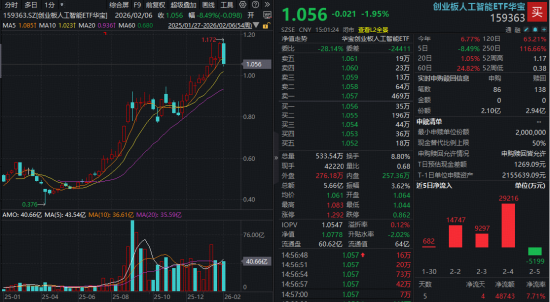
Market Overview - On February 6, A-shares experienced a volume contraction and consolidation, with the ChiNext AI sector turning negative in the afternoon, leading to declines in both computing power and AI applications [1][7] - Major components in the AI application sector saw significant losses, with Kunlun Wanwei dropping over 7%, Xinyi Sheng down 5%, and Zhongji Xuchuang falling 4% [1][7] - The ChiNext AI ETF (159363) closed down 1.95%, marking its first decline after ten consecutive weeks of gains, with a daily trading volume of 566 million yuan [1][7] Computing Power Sector - The IDC computing power leasing sector showed relative activity, with companies like Tongniu Information and Aofei Data rising over 5% during the trading session [1][7] - The Qianwen APP from Alibaba faced service interruptions during the Spring Festival promotion, highlighting a computing power bottleneck and revealing opportunities for domestic computing power [9] - National internet giants are engaged in a "red envelope war" to capture traffic for large models, indicating that computing resources are becoming a critical constraint in AI applications [9] AI Applications - The commercial model for AI applications is evolving towards large-scale implementation, with expectations for accelerated commercialization of AI agents by 2026 as the ecosystem matures [10] - The supply of AI agents is currently concentrated among leading model manufacturers, with high usage costs, suggesting that high-value scenarios on both consumer and business sides will be the first to achieve large-scale deployment [10] - The ChiNext AI ETF (159363) is positioned to benefit directly from the commercialization of AI technology, with approximately 60% of its portfolio allocated to computing power and 40% to AI applications [10]