
Forms Syntron(300468)

Search documents
四方精创:公司有欧洲地区的业务合作,但占比很小
Zheng Quan Ri Bao Wang· 2026-02-27 14:11
Group 1 - The company, Sifang Jingchuang (300468), has business cooperation in Europe, but it represents a small proportion of its overall operations [1] - The contribution of European business to the company's revenue is limited [1]

四方精创:乐寻坊暂未有开源计划
Mei Ri Jing Ji Xin Wen· 2026-02-27 09:59
Core Viewpoint - The company indicates that the internal incentive mechanism of its platform, known as "Bee Coins," will continue to be optimized and iterated in the future, with considerations for different user engagement levels in new activity designs [1] Group 1: Incentive Mechanism - The "Bee Coins" are part of the internal reward system of the platform [1] - Users can utilize their accumulated Bee Coins and Bee Gold to participate in platform activities [1] - There are no current plans for the platform to open source [1]
美股软件龙头大涨,高盛:软件反弹潮未止!拓维信息涨停,软件ETF汇添富(159590)大涨超2%!黄仁勋重磅发声
Xin Lang Cai Jing· 2026-02-27 05:30
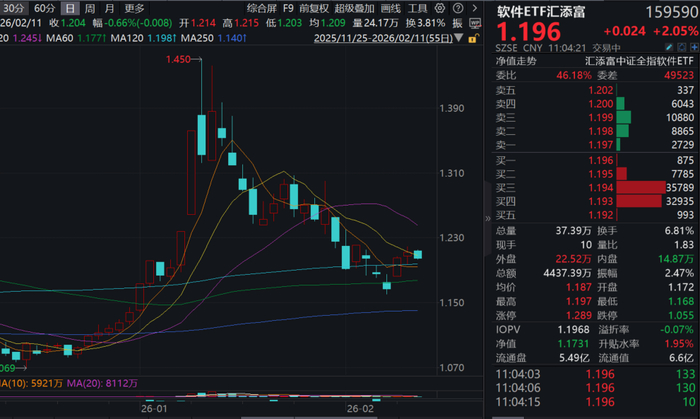
Group 1 - Salesforce, a leading software company, saw its stock rise over 4% after its earnings report, contributing to a strong rebound in the A-share software sector, with the software ETF Huatai (159590) increasing by over 2% and trading volume exceeding 50 million yuan [1][2] - Major component stocks of the software ETF showed positive performance, with Shunwang Technology rising over 11%, Tuo Wei Information hitting the daily limit, and Runhe Software increasing by over 6% [3] - The trading data for key stocks in the software sector indicates significant gains, with Tuo Wei Information at 10% increase and a transaction volume of 3.037 billion yuan, while Runhe Software and Shunwang Technology also reported substantial trading volumes [4] Group 2 - Multiple institutions believe that the recent decline in the software industry was excessive, and a rebound is likely to continue. Main Street Research's CIO noted that the software sector's sell-off has reached a bottom, while Goldman Sachs indicated that the recent rebound could persist despite high short-selling levels [5] - The AI model usage in China has surged, surpassing that of the U.S. for the first time, with a record 4.12 trillion tokens called in a week, indicating a strong growth momentum in the Chinese AI sector [6] - HSBC's report titled "Software Will Eat AI" argues that software will not be threatened by AI but will instead be the key means for large enterprises to leverage AI effectively. The report emphasizes that traditional software giants will lead in developing the best AI software due to their deep domain expertise and established customer trust [7][8] Group 3 - HSBC predicts that 2026 will mark the beginning of significant monetization in the software industry, which is currently undervalued. The report suggests that the total addressable market for software is on the verge of a large-scale expansion cycle [8] - Zhongyou Securities anticipates that AI agents will become a crucial commercial application of large models, with significant deployments across various industries, indicating a shift towards specialized applications in vertical fields [9] - Dongfang Securities acknowledges the rationality behind concerns that AI models may disrupt the software industry but suggests a "K" shaped differentiation in the future, where software with unique data resources will be less threatened compared to horizontal software lacking such advantages [10]



普元信息、格尔软件双双涨停,低费率的金融科技ETF华夏(516100)上涨1.38%
Sou Hu Cai Jing· 2026-02-27 03:33
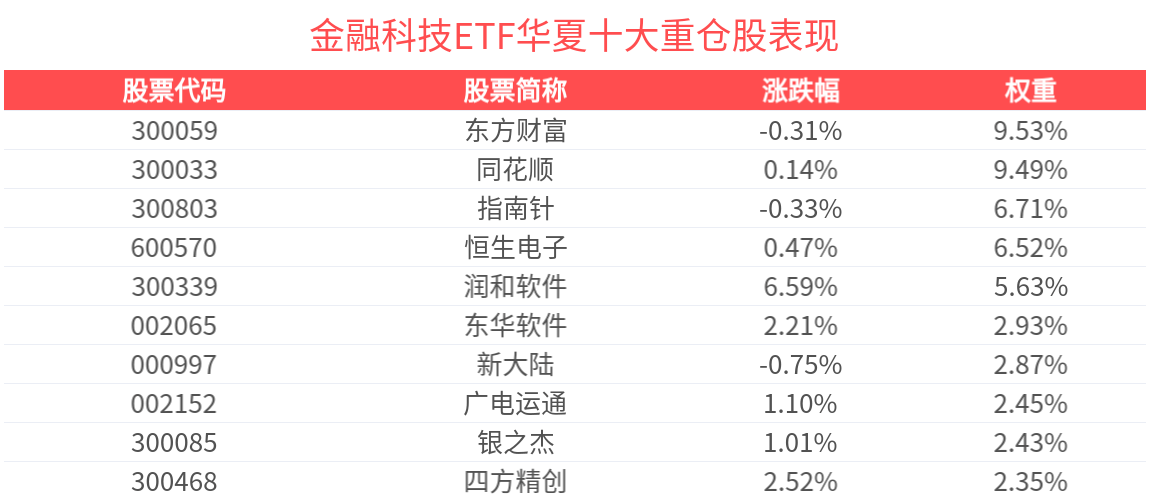
Core Viewpoint - The digital security and software sectors are experiencing significant growth, with the financial technology ETF Huaxia (516100) rising by 1.38% as of 11:01 AM, indicating a positive market sentiment towards fintech stocks [1] Group 1: Market Performance - The financial technology ETF Huaxia (516100) reported a latest price of 1.4 yuan, with key holdings such as Puyuan Information and Geer Software reaching their daily price limits [1] - Other stocks in the sector, including Xin'an Century and Runhe Software, also saw notable increases, with Xin'an Century rising by 7.58% [1] Group 2: Industry Outlook - Brokerages are optimistic about the long-term prospects of the fintech sector, anticipating a transition from "crypto accessories" to "global financial infrastructure" under a clearer regulatory framework [1] - Investment opportunities are primarily focused on compliant issuance platforms, cross-border payment service providers, and technologies and services related to the RWA ecosystem [1] Group 3: ETF Details - The management fee for the financial technology ETF Huaxia is 0.15%, and the custody fee is 0.05%, making it the lowest among comparable funds [1] - The ETF closely tracks the CSI Financial Technology Theme Index, which includes sectors such as software development, internet finance, and digital currency [1] - As of January 30, 2026, the top ten weighted stocks in the CSI Financial Technology Theme Index account for 51.68% of the index, with significant players including Tonghuashun, Dongfang Wealth, and Hengsheng Electronics [1][2]





数字人民币板块2月25日涨0.46%,四方精创领涨,主力资金净流出3322.8万元
Sou Hu Cai Jing· 2026-02-25 09:09
Group 1 - The digital RMB sector increased by 0.46% compared to the previous trading day, with Sifang Jingchuang leading the gains [1] - The Shanghai Composite Index closed at 4147.23, up 0.72%, while the Shenzhen Component Index closed at 14475.86, up 1.29% [1] - The main capital flow in the digital RMB sector showed a net outflow of 33.228 million yuan, while retail investors had a net inflow of 2.7607 million yuan [1] Group 2 - The net inflow from speculative funds in the digital RMB sector was 30.4673 million yuan [1] - A detailed table of individual stock performance and capital flow in the digital RMB sector was provided [1]


四方精创推进H股上市,控股股东减持计划部分实施
Jing Ji Guan Cha Wang· 2026-02-12 08:24
Group 1: Core Insights - The company Sifang Jingchuang (stock code: 300468) is actively pursuing a plan for overseas listing of H-shares on the Hong Kong Stock Exchange, with an application submitted on December 24, 2025 [2] - The controlling shareholder, Yiqun Group Holdings Limited, along with its concerted parties and director Chen Rongfa, announced a plan to reduce their holdings by up to 2.04% of the total share capital, with a partial reduction already executed [3] - The company was included in the Shenzhen Component Index on December 15, 2025, which may influence the flow of funds tracking certain indices [4] Group 2: Financial Performance - For the third quarter of 2025, the company reported a year-on-year revenue decline of 14.46%, while net profit increased by 27.36%, indicating a need for attention on the upcoming full-year performance announcement [4]
四方精创股价涨5.05%,鹏华基金旗下1只基金重仓,持有23.33万股浮盈赚取38.26万元
Xin Lang Ji Jin· 2026-02-04 02:15
Company Overview - Sifang Jingchuang, established on November 21, 2003, is located in Shenzhen, Guangdong Province, and was listed on May 27, 2015. The company primarily provides full-process solutions for financial institutions, focusing on digital transformation innovation and traditional business [1]. Business Segmentation - The company's revenue composition is as follows: software development and maintenance account for 95.86%, consulting services for 3.77%, and system integration for 0.36% [1]. Stock Performance - On February 4, Sifang Jingchuang's stock rose by 5.05%, reaching a price of 34.09 CNY per share, with a trading volume of 591 million CNY and a turnover rate of 3.35%. The total market capitalization is 18.09 billion CNY [1]. Fund Holdings - According to data, one fund under Penghua Asset Management holds Sifang Jingchuang as a top ten position. The Penghua CSI Financial Technology Theme ETF (563670) held 233,300 shares in the fourth quarter, representing 2.33% of the fund's net value, ranking as the tenth largest holding [2]. Fund Performance - The Penghua CSI Financial Technology Theme ETF (563670) has a total asset size of 388 million CNY. Since the beginning of the year, it has experienced a loss of 0.04%, ranking 4805 out of 5562 in its category. Since its inception, the fund has incurred a loss of 8.5% [2]. Fund Management - The fund manager of the Penghua CSI Financial Technology Theme ETF is Lin Song, who has been in the position for 2 years and 221 days. During this period, the best fund return was 46.06%, while the worst return was -20.08% [3].
四方精创控股股东方套现0.84亿 去年9月份套现4.2亿
Zhong Guo Jing Ji Wang· 2026-02-03 03:01
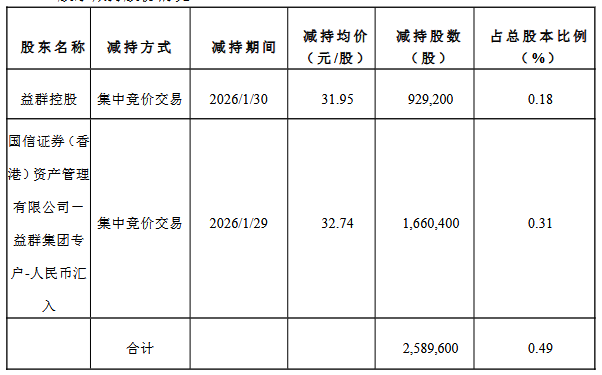
Core Viewpoint - The announcement details the share reduction plan by the controlling shareholder, Yiqun Group Holdings, which will reduce its stake in Sifang Jingchuang by up to 10,612,800 shares, representing 2% of the total share capital [1][2]. Group 1: Share Reduction Details - Yiqun Group Holdings plans to reduce its holdings through both centralized bidding and block trading methods, with a maximum of 10,612,800 shares to be sold [1]. - The reduction will occur within three months after the announcement, with specific limits on the number of shares that can be sold within any 90-day period [1]. - As of January 30, 2026, Yiqun Group has already reduced its holdings by 929,200 shares at an average price of 31.95 yuan, while its associated entity sold 1,660,400 shares at an average price of 32.74 yuan, totaling 2,589,600 shares [2][3]. Group 2: Current Shareholding Status - After the recent reductions, Yiqun Group Holdings holds 106,129,803 shares, which is 20.00% of the total share capital, maintaining its status as a major shareholder [3][4]. - The controlling shareholder and actual controller of the company remains unchanged, ensuring stability in governance and ongoing operations [4]. Group 3: Historical Context - In September 2025, Yiqun Group Holdings had previously reduced its stake by 11,939,400 shares, accounting for 2.25% of the total share capital, through similar trading methods [4][5]. - The total cash generated from the previous reductions was approximately 423,803,741.84 yuan [5].
四方精创(300468) - 关于控股股东权益变动触及1%及5%整数倍暨披露权益变动报告书的提示性公告
2026-02-02 12:09
证券代码:300468 证券简称:四方精创 公告编号:2026-002 深圳四方精创资讯股份有限公司 关于控股股东权益变动触及 1%及 5%整数倍暨 披露权益变动报告书的提示性公告 控股股东益群集团控股有限公司保证向本公司提供的信息内容真实、准确、 完整,没有虚假记载、误导性陈述或重大遗漏。 本公司及董事会全体成员保证公告内容与信息披露义务人提供的信息一致。 重要内容提示: ●本次权益变动主体为控股股东益群集团控股有限公司(以下简称"益群控 股")及其一致行动人"国信证券(香港)资产管理有限公司-益群集团专户-人民 币汇入"通过集中竞价减持股份,不触及要约收购; ● 本次权益变动后,益群控股合计持有公司106,129,803股,占公司总股本 比例为20.00%,仍是持有公司5%以上股份的股东; ● 本次权益变动情况不会导致公司控股股东、实际控制人的变化,不会对 公司治理结构及持续经营产生影响。 | 股 东 名 称 | 减 持 方 式 | 减 持 期 间 | 减 持 均 价 ( 元 /股 ) | 减 持 股 数 ( 股 ) | 占 总 股 本 比 例 ( %) | | --- | --- | --- | --- ...
四方精创(300468) - 简式权益变动报告书
2026-02-02 12:09
深圳四方精创资讯股份有限公司 简式权益变动报告书 上市公司名称:深圳四方精创资讯股份有限公司 股票上市地点:深圳证券交易所 股票简称:四方精创 股票代码:300468 信息披露义务人:益群集团控股有限公司、国信证券(香港)资产管理有限公司- 益群集团专户-人民币汇入 通讯地址:20/F GRAVITY 29 HING YIP STREET KWUN TONG KL 股份变动性质:股份减少 签署日期:2026年2月 1 信息披露义务人声明 一、本报告书依据《中华人民共和国证券法》《上市公司收购管理办法》《公 开发行证券的公司信息披露内容与格式准则第15号——权益变动报告书》及相关 法律、法规和规范性文件编写。 二、信息披露义务人签署本报告书已获得必要的授权和批准。 三、依据《中华人民共和国证券法》《上市公司收购管理办法》的规定,本 报告书已全面披露信息披露义务人在深圳四方精创资讯股份有限公司中拥有权 益的股份变动情况。 截至本报告书签署之日,除本报告书披露的信息外,上述信息披露义务人没 有通过任何其他方式增加或减少其在深圳四方精创资讯股份有限公司中拥有权 益的股份。 四、本次权益变动是根据本报告书所载明的资料进 ...