Three Squirrels(300783)

Search documents
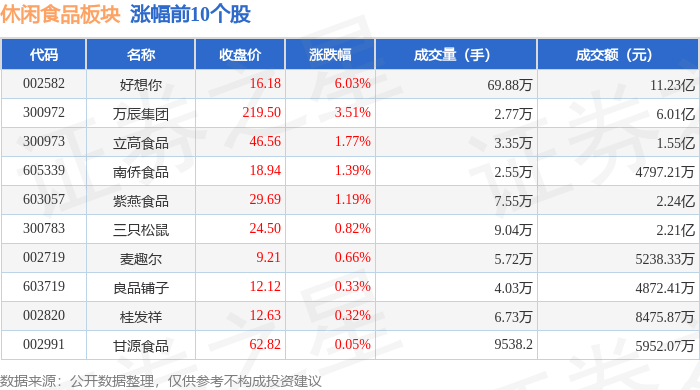
休闲食品板块1月23日涨0.73%,好想你领涨,主力资金净流出1.12亿元
Zheng Xing Xing Ye Ri Bao· 2026-01-23 09:04
Market Performance - The leisure food sector increased by 0.73% compared to the previous trading day, with "Good Idea" leading the gains [1] - The Shanghai Composite Index closed at 4136.16, up 0.33%, while the Shenzhen Component Index closed at 14439.66, up 0.79% [1] Individual Stock Performance - "Good Idea" (002582) closed at 16.18, up 6.03% with a trading volume of 698,800 shares and a transaction value of 1.123 billion yuan [1] - "Wancheng Group" (300972) closed at 219.50, up 3.51% with a transaction value of 601 million yuan [1] - "Lihigh Food" (300973) closed at 46.56, up 1.77% with a transaction value of 155 million yuan [1] - "Nanjiao Food" (605339) closed at 18.94, up 1.39% with a transaction value of 47.9721 million yuan [1] - "Purple Lotus Food" (603057) closed at 29.69, up 1.19% with a transaction value of 224 million yuan [1] - "Three Squirrels" (300783) closed at 24.50, up 0.82% with a transaction value of 221 million yuan [1] - "Maiqu'er" (002719) closed at 9.21, up 0.66% with a transaction value of 52.3833 million yuan [1] - "Liangpinpuzi" (603719) closed at 12.12, up 0.33% with a transaction value of 48.7241 million yuan [1] - "Guifaxiang" (002820) closed at 12.63, up 0.32% with a transaction value of 84.7587 million yuan [1] - "Ganyuan Food" (002991) closed at 62.82, up 0.05% with a transaction value of 59.5207 million yuan [1] Capital Flow - The leisure food sector experienced a net outflow of 112 million yuan from institutional investors, while retail investors saw a net inflow of 128 million yuan [2] - The capital flow for individual stocks shows varying trends, with "Wancheng Group" having a net inflow of 9.9595 million yuan from institutional investors [3] - "Lihigh Food" had a net inflow of 295.83 million yuan from retail investors, while "Salted Fish" (002847) saw a net outflow of 2.19959 million yuan from institutional investors [3]






三只松鼠线下分销部分坚果礼产品调整出厂价
Cai Jing Wang· 2026-01-21 05:54
Group 1 - The core point of the article is that Three Squirrels (Wuhu) Enterprise Management Co., Ltd. announced a price adjustment for its offline distribution of nut gift products due to rising logistics and labor costs as the Spring Festival approaches [1] - The price adjustment will take effect on January 19, 2026, and the new factory prices will be based on a specific pricing list [1] - A representative from Three Squirrels confirmed the authenticity of the news regarding the price adjustment [1]
休闲食品板块1月20日涨1.54%,万辰集团领涨,主力资金净流出6030.19万元
Zheng Xing Xing Ye Ri Bao· 2026-01-20 08:51
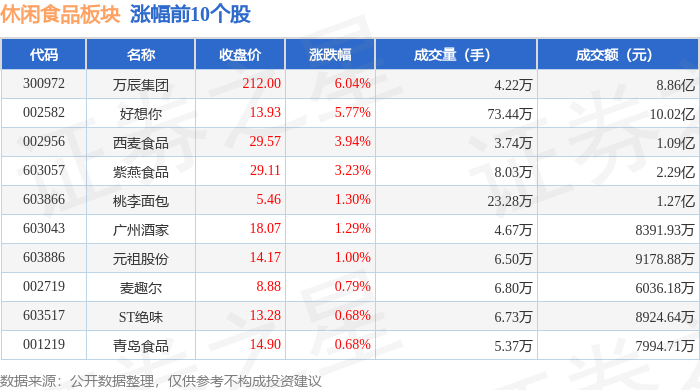
Group 1 - The leisure food sector increased by 1.54% on January 20, with Wancheng Group leading the gains [1] - The Shanghai Composite Index closed at 4113.65, down 0.01%, while the Shenzhen Component Index closed at 14155.63, down 0.97% [1] - Key stocks in the leisure food sector showed significant price movements, with Wancheng Group rising by 6.04% to a closing price of 212.00 [1] Group 2 - The leisure food sector experienced a net outflow of 60.30 million yuan from institutional investors, while retail investors saw a net inflow of 75.82 million yuan [2] - Notable declines were observed in stocks such as Three Squirrels, which fell by 2.07% to a closing price of 24.58 [2] - The trading volume and turnover for various stocks in the sector varied, with significant activity noted in stocks like Haoxiangni and Ximai Food [2] Group 3 - Haoxiangni had a net inflow of 79.89 million yuan from institutional investors, while it faced a net outflow of 78.76 million yuan from retail investors [3] - Ximai Food also saw a net inflow of 10.14 million yuan from institutional investors, with retail investors experiencing a net outflow [3] - The data indicates varying levels of investor interest across different stocks within the leisure food sector, highlighting the dynamics of institutional versus retail investment [3]

食品饮料行业:月聚焦:如何布局零食“春季躁动”?
GF SECURITIES· 2026-01-20 06:14
Group 1 - The report highlights the "Spring Excitement" in the snack sector, indicating a historical high relative win rate of 70% for the food and beverage sector in the 40 days leading up to the Spring Festival [7][16] - The report emphasizes that the "Spring Excitement" is not solely dependent on the annual beta of the food and beverage sector, as structural opportunities still exist despite a long-term adjustment period since 2021 [7][16] - Key catalysts for the upcoming Spring Festival include concentrated demand for gifts and gatherings, which leads to more planned channel stocking, creating a positive feedback loop of expectations and validations [7][16][28] Group 2 - In December, the food and beverage sector underperformed the market by 7.5 percentage points, with a decline of 5.2%, ranking last among 31 primary industries [7][61] - The report notes a divergence in performance among sub-sectors, with snacks and soft drinks showing gains while liquor and beer experienced declines [7][61][64] - The absolute and relative valuations of the food and beverage sector are at their lowest since 2010, indicating potential investment opportunities [7][61][64] Group 3 - The report tracks the recovery of consumer confidence, with a 0.9% year-on-year increase in retail sales in December, showing improvement from the previous month [7][63] - It highlights that the liquor sector is facing weak demand and declining prices, with the price adjustments for premium liquor nearing levels seen between 2011 and 2015 [7][63][64] - The report identifies structural differentiation in costs, with some packaging materials and agricultural products experiencing price increases [7][63][64] Group 4 - Investment recommendations include a focus on liquor stocks that have undergone a four-year adjustment period, with potential for a "valuation + performance" double bottom [7][64] - For consumer goods, the report anticipates a moderate increase in industry prices in 2026, with specific recommendations for companies like Anjuke Foods, Qianhe Flavor, and Eastroc Beverage [7][64] - The report suggests that the upcoming Spring Festival will provide a favorable environment for growth narratives, particularly in the restaurant supply chain and certain chain formats [7][64]




开心果贵了?三个月两度出手 三只松鼠坚果礼盒春节“踩点”涨价
Xin Jing Bao· 2026-01-20 05:47
Core Insights - The article discusses the recent price increase by Three Squirrels, attributed to rising logistics and labor costs, particularly ahead of the Spring Festival [2][4][5] - This marks the second price adjustment within three months, indicating a higher frequency of price changes compared to industry averages [2][7] Price Adjustment Details - The price increase affects specific products in offline distribution channels, particularly nut gift boxes and popular items, with adjustments ranging from 0.2 yuan to 10 yuan per item [3][5] - The adjustment was communicated to distributors with a three-day buffer for stock preparation, allowing them to lock in prices [4][5] Market Impact and Strategy - Distributors express concerns about the pressure of increased inventory and procurement costs, although they may not fully pass on the price increase to consumers due to competitive market conditions [3][4] - The price increase primarily impacts offline gift products, while online prices and other categories remain unaffected, suggesting limited consumer impact on purchasing decisions [4][5] Financial Performance Context - Three Squirrels has faced a "revenue without profit" situation in the first three quarters of 2025, with revenue of approximately 7.759 billion yuan, up 8.22%, but net profit down 52.91% to about 161 million yuan [9] - The company attributes profit pressure to rising raw material costs and increased market expenses, alongside changes in online platform traffic and fee structures [9]
8点1氪丨SK海力士向全体员工发放人均超64万元绩效奖金;深圳水贝市场推出投资铜条;茶颜悦色回应在北上深开店传闻
3 6 Ke· 2026-01-20 00:12
Group 1 - SK Hynix announced a record performance bonus of over 1.36 million KRW (approximately 640,000 RMB) per employee, benefiting from the AI boom, with stock prices increasing by 275% in 2025 [1] - The company has sold out all chip production capacity for 2026, indicating strong demand [1] Group 2 - Bubble Mart announced a share buyback plan, investing 251 million HKD to repurchase 1.4 million shares at prices ranging from 177.7 to 181.2 HKD per share [11] - Tencent and Taobao have invested in Zhijia Power Technology, a smart driving technology developer, indicating growing interest in AI and smart driving sectors [9] Group 3 - Tea Yan Yue Se is expanding its workforce in major cities, leading to speculation about market expansion, although the company clarified that this is part of regular personnel reserves [2][3] - The company currently operates 758 stores across four provinces and is known for its cautious expansion strategy [2] Group 4 - Vanke has been ordered to pay over 1.089 billion RMB due to enforcement actions, highlighting potential financial challenges [4] - The company is facing scrutiny as it navigates legal and financial obligations [4] Group 5 - The price of gold and silver has risen, with new investment copper bars being introduced in Shenzhen, although concerns about copper's investment viability were raised [2] - The market is reacting to rising commodity prices, which may influence consumer behavior and investment strategies [2]




临近春节三只松鼠部分产品再调价,零食“造流”同步趋向线下店打磨共振
Cai Jing Wang· 2026-01-19 14:57
Group 1 - Three squirrels have announced a price adjustment for offline distribution of nut gift products due to rising logistics and labor costs, effective January 19, 2026 [1] - This price adjustment is a routine practice for the company during the Spring Festival period, as confirmed by a company representative [1] - In October 2022, the company also raised prices on 35 products, with adjustments ranging from 0.2 to 10 yuan, primarily due to fluctuations in raw material costs [1] Group 2 - Three squirrels are expanding their offline presence by launching new community-oriented lifestyle stores, with 16 stores opened since June 2025 [2] - The newly opened mini lifestyle stores in Nanjing and Wuhu focus on high-density community areas and offer over 1,000 products, with a strong emphasis on fresh produce and self-owned brands [2] - The company plans to open an additional 9 mini lifestyle stores and 5 standard lifestyle stores in Nanjing and Anhui before the Lunar New Year [2] Group 3 - Other snack brands are also adapting to the market by enhancing their offline strategies, such as Laiyifen's financial support for franchisees to accelerate their "Ten Thousand Families" strategy [3] - Liangpinpuzi is focusing on regional development with its snack brand, while Qiaqia Foods is preparing for the Spring Festival by promoting new products through online and offline channels [3] - The snack industry is facing challenges in managing cost fluctuations while expanding their supply lines and enhancing their market presence [4]
三只松鼠回应临近春节涨价:属实
2 1 Shi Ji Jing Ji Bao Dao· 2026-01-19 13:15
Core Viewpoint - The company is adjusting the ex-factory prices of certain products in its offline distribution channel due to rising logistics and labor costs ahead of the Spring Festival, which is a routine practice. This adjustment is not expected to significantly impact overall operations, and the final retail prices may not necessarily increase [1][2]. Group 1: Price Adjustment - The company plans to adjust the ex-factory prices of some products in its offline distribution channel starting January 19, 2026, with specific prices to be confirmed in a detailed pricing table [1]. - This is the second price adjustment within three months, with the first adjustment occurring in October 2025, affecting various products with price changes ranging from 0.2 to 10 yuan [1]. Group 2: Financial Performance - For the first three quarters of 2025, the company reported an 8.22% year-on-year revenue growth, reaching 7.759 billion yuan, but the net profit attributable to shareholders plummeted by 52.91% to 161 million yuan [2]. - The company's core revenue source, the nut category, generated 2.731 billion yuan in revenue in the first half of 2025, accounting for nearly 50% of total revenue, but its gross margin decreased by 2.64 percentage points to 23.91% [2]. Group 3: Cash Flow and Future Strategy - The company's net cash flow from operating activities for the first three quarters of 2025 was -506 million yuan, a drastic decline of 1690.52% year-on-year [2]. - As of the end of the third quarter, the company's cash reserves were 242 million yuan, which was less than its short-term borrowings of 576 million yuan [2]. - The company is focusing on the development of offline "lifestyle stores" to boost performance, with 16 stores opened across eight locations in Jiangsu and Anhui provinces as of January 16, 2026 [2].
三只松鼠回应临近春节涨价:属实
21世纪经济报道· 2026-01-19 13:12
Core Viewpoint - The article discusses the recent price adjustment by Three Squirrels (300783.SZ) for certain offline distribution products, highlighting the company's ongoing challenges with profitability despite revenue growth [1][2]. Group 1: Price Adjustment - Three Squirrels plans to adjust the ex-factory prices of some offline distribution products starting January 19, 2026, due to rising logistics and labor costs, a common practice before the Spring Festival [1]. - The price adjustment will not cover all product categories and is specifically aimed at the B2B channel, with a buffer period for distributors [1]. - This marks the second price adjustment within three months, with the first occurring in October 2025, affecting various products with price changes ranging from 0.2 to 10 yuan [1]. Group 2: Financial Performance - For the first three quarters of 2025, Three Squirrels reported an 8.22% year-on-year revenue increase to 7.759 billion yuan, while net profit attributable to shareholders plummeted by 52.91% to 161 million yuan [2]. - The revenue growth for the first three quarters was 2.13%, 22.77%, and 8.91% respectively, but net profit showed a significant decline of 22.46%, 444.41%, and 56.79% in the same periods, indicating worsening profitability [2]. - The nut category, which is the core revenue source, generated 2.731 billion yuan in the first half of 2025, accounting for nearly 50% of total revenue, but its gross margin decreased by 2.64 percentage points to 23.91% [2]. Group 3: Cash Flow and Strategic Initiatives - The company's net cash flow from operating activities for the first three quarters of 2025 was -506 million yuan, a drastic decline of 1690.52% year-on-year [2]. - As of the end of the third quarter, the company's cash reserves were 242 million yuan, which is less than its short-term borrowings of 576 million yuan [2]. - The company is focusing on the development of offline "lifestyle stores" to boost performance, with 16 stores opened across eight locations in Anhui and Jiangsu provinces as of January 16, 2026 [2].
临近春节部分坚果礼产品涨价?三只松鼠回应称内容属实
Xi Niu Cai Jing· 2026-01-19 10:02
Group 1 - The company, Three Squirrels, plans to adjust the factory prices of certain nut gift products on January 19, 2026, due to rising logistics and labor costs as the Spring Festival approaches [2][4] - Industry insiders indicate that price adjustments in the consumer goods sector before the Spring Festival are normal, especially for nut gift boxes, which are in high demand during this peak season [4] - Two months prior, Three Squirrels had already implemented a price increase on November 1, 2025, affecting 35 products across various categories, citing significant and volatile increases in the costs of raw materials, packaging, and logistics [4]