Three Squirrels(300783)

Search documents
休闲零食春节档:坚果礼盒热卖,量贩装礼包“抢跑” 生产企业全力开工保供应
Xin Lang Cai Jing· 2026-02-06 06:56
Core Viewpoint - The upcoming Spring Festival is driving a surge in sales for leisure snacks, with strong demand for gift boxes and bulk snack packages, although the industry faces intense competition and cost pressures [1][5][6] Group 1: Sales Trends - Sales of gift boxes are booming, particularly for brands like Three Squirrels and Qiaqia Foods, with prices around 50 to 290 yuan [1][2] - Recent data indicates that the sales of "snack gift boxes" exceeded 1 billion yuan in the last 30 days, with core categories like "mountain walnuts/nuts/roasted goods" accounting for over 51.6% of sales [2][6] - Bulk snack packages are gaining popularity, with brands like Yanjinpuzi and Jinzhai Foods seeing strong sales ahead of traditional gift box sales [2][4] Group 2: Production and Supply Chain - Companies are ramping up production to meet demand, with Jinzhai Foods reporting a daily production capacity exceeding 10 million packages [4] - The industry is actively ensuring stable supply through sales forecasts and pre-fulfillment strategies, particularly for high-demand categories like gift boxes and nuts [4][5] Group 3: Pricing and Cost Pressures - Despite strong sales, companies are cautious about raising prices due to competitive pressures and rising raw material costs, which are impacting profit margins [5][6] - Three Squirrels and Qiaqia Foods have both projected significant declines in net profit for the year, attributed to increased raw material prices and structural changes in sales [5] - The industry is exploring upstream strategies to mitigate the impact of raw material price fluctuations, such as Qiaqia Foods' trial planting of sunflower seeds overseas [5] Group 4: Market Outlook - Analysts are optimistic about the first quarter, expecting double-digit revenue growth for many snack brands due to the favorable timing of the Spring Festival and returning consumer traffic [6]


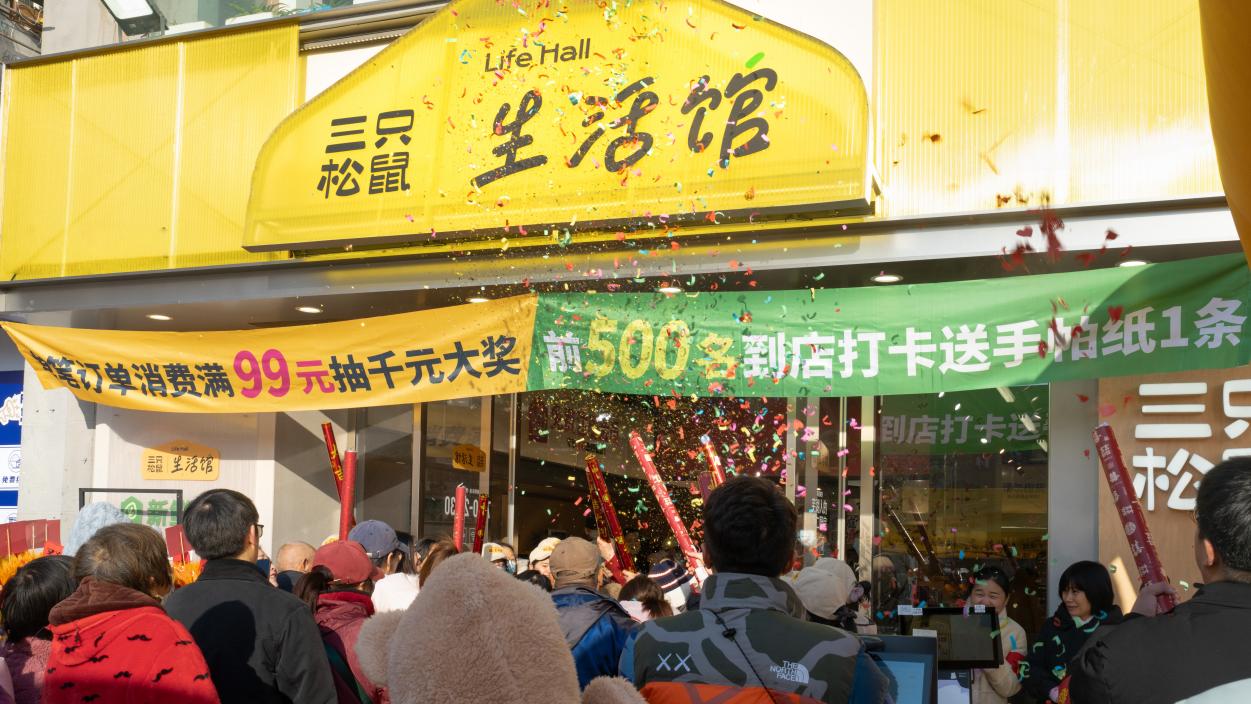
持续深耕皖苏 三只松鼠生活馆新拓3店补位区域布局
Zhong Guo Jing Ji Wang· 2026-02-06 04:57
Core Insights - The article highlights the strategic expansion of Three Squirrels' lifestyle stores in China, focusing on deepening their presence in local markets and enhancing operational efficiency to cater to diverse community ecosystems [1][6]. Group 1: Store Expansion and Differentiation - Three Squirrels has opened 25 stores since June 2025, including 1 flagship store, 16 standard stores, and 8 mini stores, indicating a strong commitment to market penetration in Anhui and Jiangsu provinces [2]. - The flagship and standard stores range from 300-600 square meters, targeting lower-tier markets with a focus on larger store formats to attract more customers [4]. - Mini stores, sized between 120-180 square meters, are strategically located within 500 meters of communities with 4,000 households, catering to higher-tier markets where shopping habits favor convenience [4]. Group 2: Regional Strategy and Market Penetration - The recent opening of stores in Bengbu marks the official entry into Northern Anhui, enhancing the brand's network effect and brand recognition across the region [6]. - In Nanjing, the launch of two mini stores targets densely populated areas with limited discount retail options, establishing a strong foothold in community commerce [6]. Group 3: Product Offering and Consumer Engagement - Three Squirrels positions itself as "the second kitchen at your doorstep," focusing on fresh, affordable products that meet daily consumer needs [7]. - The new Bengbu store features over 1,500 essential items, utilizing a layout that enhances shopping experience and product visibility [9]. - The product strategy emphasizes over 90% private label items and more than 70% new products, with competitive pricing on essentials like rice and fresh produce, driving customer loyalty [11]. Group 4: Supply Chain and Quality Control - The company is building a robust supply chain with direct sourcing from production areas, regional cold chain logistics, and proprietary brands to ensure quality and cost control [13]. - A central kitchen in Wuhu, covering over 4,000 square meters, supports the supply needs of surrounding stores, enhancing operational efficiency [13].
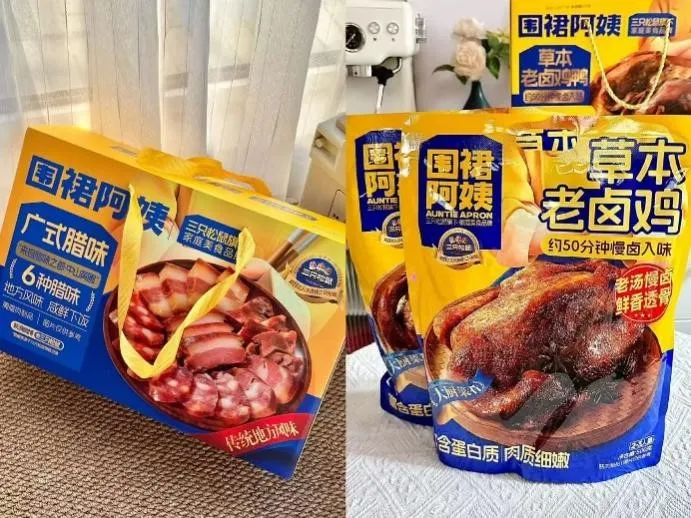
零食企业新春礼盒卡位多品牌矩阵组合,线上差异配置、线下市集景观共推渠道催化
Cai Jing Wang· 2026-02-05 08:28
Core Insights - The demand for snack gift boxes is surging ahead of the upcoming Spring Festival, with sales exceeding 1 billion in the last 30 days and a month-on-month growth of 383.84% [2] - Companies are leveraging a multi-brand and multi-category strategy to capture market share, focusing on innovative packaging and product offerings to meet consumer preferences [3][7] Group 1: Market Trends - The snack gift box market is a critical component of the Chinese food industry, with gift boxes accounting for 60% of sales for companies focused on this segment [1] - The overall retail sales for the Spring Festival in 2025 are projected to grow by 8.7% year-on-year, indicating a strong purchasing power among consumers [2] - The trend of combining various brands and product categories is becoming more pronounced, allowing companies to penetrate multiple consumer segments and occasions [2][3] Group 2: Company Strategies - Three Squirrels has introduced creative gift boxes, such as the "Golden Gourd" nut gift box, and expanded its offerings to include various themed gift boxes for different occasions [3] - Mondelez China has launched a "custom gift box" initiative, allowing distributors to create personalized gift boxes based on regional preferences [7] - Snack companies are increasingly collaborating with well-known brands to enhance their product visibility and appeal, as seen with Qiaqia Food's partnerships with Coca-Cola and Sprite [8] Group 3: Channel Development - Companies are adopting a multi-channel approach, integrating online and offline strategies to enhance consumer experience and drive sales [9][10] - Retailers are creating immersive experiences in physical stores, such as themed pop-up areas and interactive tasting stations, to stimulate immediate purchasing behavior [13] - The online sales channels are being optimized with tailored marketing strategies, including live streaming and social media promotions, to engage consumers effectively [9][14] Group 4: Future Outlook - The snack gift box segment is expected to continue its growth trajectory, becoming a long-term potential driver for the industry [14] - The overall snack market is projected to see a 3.9% sales growth, with gift boxes emerging as a significant breakthrough point for innovation and consumer engagement [14]

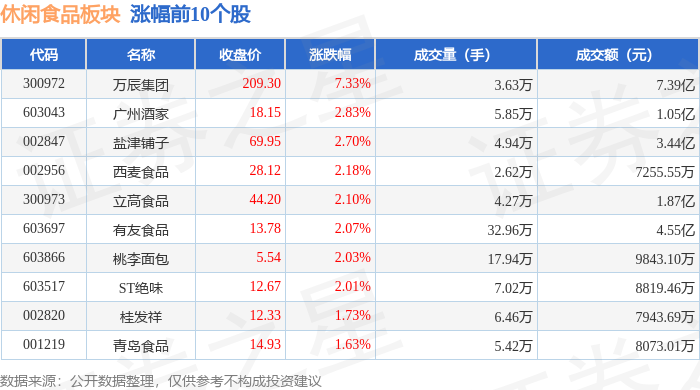
休闲食品板块2月4日涨2.4%,万辰集团领涨,主力资金净流出4624.39万元
Zheng Xing Xing Ye Ri Bao· 2026-02-04 08:56
Core Viewpoint - The leisure food sector experienced a 2.4% increase on February 4, with Wancheng Group leading the gains, while the overall market indices also showed positive movement [1]. Group 1: Market Performance - The Shanghai Composite Index closed at 4102.2, up 0.85% [1]. - The Shenzhen Component Index closed at 14156.27, up 0.21% [1]. Group 2: Individual Stock Performance - Wancheng Group (300972) closed at 209.30, with a rise of 7.33% and a trading volume of 36,300 lots, amounting to 739 million yuan [1]. - Guangzhou Restaurant (603043) closed at 18.15, up 2.83% with a trading volume of 58,500 lots, totaling 10.5 million yuan [1]. - Yanjin Puhui (002847) closed at 69.95, increasing by 2.70% with a trading volume of 49,400 lots, amounting to 344 million yuan [1]. - Other notable stocks include Ximai Food (002956) at 28.12 (+2.18%), Ligao Food (300973) at 44.20 (+2.10%), and Youyou Food (603697) at 13.78 (+2.07%) [1]. Group 3: Capital Flow Analysis - The leisure food sector saw a net outflow of 46.24 million yuan from institutional investors, while retail investors contributed a net inflow of 29.96 million yuan [2]. - Notable individual stock capital flows include Youyou Food with a net outflow of 36.51 million yuan from institutional investors and a net inflow of 3.84 million yuan from retail investors [3]. - Salted Food (002847) experienced a net inflow of 10.05 million yuan from institutional investors, while retail investors had a slight outflow [3].



2026年第5周:食品饮料行业周度市场观察
艾瑞咨询· 2026-02-04 00:08
Group 1: Canned Food Industry - The State Administration for Market Regulation has released draft recommendations for national standards for canned food to enhance industry standards and applicability [3] - The canned food industry in China is diverse but lacks innovation, particularly in attracting younger consumers, with Fujian province accounting for 36% of national production [3][4] - The industry is upgrading through the development of self-heating foods, high-end products like bird's nest canned food, and customized dining products [3][4] Group 2: New Beverage Trends - The sugar water shop has become a new franchise trend, with brands like Mai Ji Milk and Zhao Ji Chuan Cheng rapidly expanding, but facing challenges such as high costs and low-frequency consumption [5] - The Chinese herbal health water market is experiencing a sales surge due to hot weather, with products like red bean and coix seed water gaining popularity, potentially exceeding a market size of 10 billion yuan [6] - The beverage market is accelerating its health trend, with low-sugar and no-sugar products becoming standard, while traditional giants face declining sales [7] Group 3: Functional and Innovative Products - Vitamin drinks are gaining popularity among young consumers for their health benefits, with sales of Nongfu Spring's water-soluble C100 increasing by 34% year-on-year [9] - The rise of banana-flavored drinks from major brands reflects a growing market potential, leveraging high national recognition and health trends [10] - The global nutrition and health industry is set for a peak in raw material innovation and technological iteration by 2025, with a focus on standardized and stable ingredients [11] Group 4: Market Dynamics and Brand Strategies - The "medicinal food" trend is becoming a significant market, with a projected scale of 370 billion yuan, driven by policy support and technological advancements [12] - The rise of Chinese herbal health water reflects a shift in consumer behavior towards health-conscious products, but the industry faces challenges like exaggerated claims and quality control [14] - The dairy industry is shifting focus from consumer markets to B2B markets, driven by the growth of new consumption formats like tea and coffee [15] Group 5: Brand Developments and Challenges - The beverage brand Commune is preparing for an IPO, aiming to expand its presence while facing challenges like declining same-store sales and rising costs [24] - The acquisition of the beverage brand Dayao by KKR marks a shift towards capitalizing on efficiency over emotional branding, as the brand faces challenges in national expansion [25] - Dongpeng's coffee brand has achieved a market share of 14%, positioning itself among the top three in the ready-to-drink coffee market through a focus on quality and targeted marketing [26]







民生调查局 | 百草味、三只松鼠、良品铺子,部分坚果礼盒坚果重量仅三成
Zhong Guo Xin Wen Wang· 2026-02-03 13:19
Core Viewpoint - The article highlights the misleading marketing practices of several nut brands, where the actual nut content in gift boxes is significantly lower than advertised, raising concerns about consumer rights and product transparency [2][15]. Group 1: Misleading Product Content - Many nut gift boxes contain less than 50% nuts, with some brands including a high proportion of non-nut snacks and beverages [3][4]. - For instance, a 1800g nut gift box from a brand contains only small packages of nuts, with nearly 70% of the weight coming from red dates, peanuts, and other non-nut items [4]. - Another example shows a 2081g gift box where only 36% of the weight is from nuts, with the rest being beverages and other snacks [6]. Group 2: Consumer Confusion - The marketing strategies employed by these brands often lead to consumer confusion, as many gift boxes are labeled ambiguously, making it difficult for consumers to identify which products contain pure nuts [9][15]. - Some brands mix pure nut gift boxes with those containing non-nut items under the same product listing, further complicating consumer choices [9][11]. - Consumer reviews indicate dissatisfaction, with many expressing surprise at the high quantity of non-nut products included in the gift boxes [16]. Group 3: Legal and Regulatory Concerns - Legal experts suggest that these marketing practices may violate consumer protection laws, as they obscure the true nature of the products being sold [15][16]. - The article references a potential regulatory response to misleading advertising practices, emphasizing the need for clearer labeling and transparency in product content [16].

三只松鼠2025业绩预告:高端性价比筑牢长期韧性
Qi Lu Wan Bao· 2026-02-03 11:35
1月29日晚,三只松鼠(300783)发布2025年度业绩预告。去年全年,企业实现归属于上市公司股东的净利润1.35亿至1.75亿元之间。 此前,三只松鼠围绕"一区一品一链"供应链战略,已先后投资建设安徽无为华东供应链集约基地、芜湖弋江零食产业园、天津武清北区供应链集约基地、 四川简阳西南供应链集约基地,占地面积均超8万㎡,通过工厂、物流、研发、检测、渠道等要素集中,保障资源、管理、业务高效紧密协同,实现从坚 果到零食,从单一基地到全国化落子的供应链制造整体布局。 三只松鼠"主动掌控"产业链上游的动作还包括,通过与国际原料大农场的直采合作模式,在国内云南、广西、新疆、内蒙古、东北、安徽等多地建立坚果 果干原材料供给基地,锁定长周期价格,积极发挥规模集采效应。 在消费场景分化、行业普遍遭遇成本波动等挑战背景下,深剖三只松鼠的战略布局和业务本质,不难发现这一表现更多源于当下的行业特性与企业主动转 型的叠加效应。报告披露,经营业绩阶段性承压,主要源于坚果原料价格大幅上涨,企业2025年货节销售旺季结构性错档、主动调整销售结构及进军社区 新零售赛道的战略性投入等多方面因素。 数据之外,预告内容显示,2025年,三只松 ...

三只松鼠扣非降约80%三个月两涨价 一年12亿买流量
Chang Jiang Shang Bao· 2026-02-03 07:11
零食巨头三只松鼠(300783)(300783.SZ)喊了三年的"高端性价比"战略,似乎失灵了。 近日,三只松鼠发布业绩预告,公司预计2025年度实现归母净利润1.35亿元至1.75亿元,同比下降60% 左右;预计扣非净利润为4500万元至6500万元,同比下降80%左右。 2025年前三季度,公司实现的归母净利润、扣非净利润分别为1.61亿元、0.57亿元。 对比发现,第四季度,三只松鼠可能会出现亏损,即便盈利,也将是近四年最为糟糕的四季度业绩。 自2025年11月宣布涨价后,2026年1月19日,三只松鼠上调线下分销场景的部分坚果礼品类价格。 针对2025年经营业绩大幅下滑,三只松鼠解释称,2025年度,销售旺季(年货节)结构性错档、坚果原 料价格较大幅度上涨、主动调整销售结构等,再加上前期战略性投入,综合导致利润下滑。 值得一提的是,2024年,三只松鼠买流量的费用高达12亿元;2025年前三季度,公司销售费用超过16亿 元,同比增长24%,究其原因,也是因为买流量的费用增加。 第四季度业绩创近四年同期最差 三只松鼠的经营业绩大幅下滑。 根据近期发布的年度业绩预告,2025年度,三只松鼠预计实现归母净利 ...
三只松鼠扣非降约80%三个月两涨价 “高端性价比”或失灵一年12亿买流量
Chang Jiang Shang Bao· 2026-02-03 00:25
长江商报消息●长江商报记者 沈右荣 近日,三只松鼠发布业绩预告,公司预计2025年度实现归母净利润1.35亿元至1.75亿元,同比下降60% 左右;预计扣非净利润为4500万元至6500万元,同比下降80%左右。 2025年前三季度,公司实现的归母净利润、扣非净利润分别为1.61亿元、0.57亿元。 零食巨头三只松鼠(300783.SZ)喊了三年的"高端性价比"战略,似乎失灵了。 过去几年,三只松鼠的经营业绩出现过波动。2022年,公司实现的营业收入、归母净利润分别为72.93 亿元、1.29亿元,同比下降25.35%、68.61%。而在2021年,公司归母净利润为4.11亿元。 对比发现,第四季度,三只松鼠可能会出现亏损,即便盈利,也将是近四年最为糟糕的四季度业绩。 自2025年11月宣布涨价后,2026年1月19日,三只松鼠上调线下分销场景的部分坚果礼品类价格。 针对2025年经营业绩大幅下滑,三只松鼠解释称,2025年度,销售旺季(年货节)结构性错档、坚果原 料价格较大幅度上涨、主动调整销售结构等,再加上前期战略性投入,综合导致利润下滑。 值得一提的是,2024年,三只松鼠买流量的费用高达12亿元;20 ...
国盛证券:三只松鼠利润阶段性承压 维持买入评级
Xin Lang Cai Jing· 2026-02-02 09:47
报告认为,公司作为零食全品类零售商,对消费需求洞察深刻,正以差异化新品驱动成长。线上市场保 持优势同时,2025年将加速分销网络布局,生活馆业态探索多品类自有品牌供应体系,并挖掘即时零售 增量。在"高端性价比"战略基础上,公司向高端化、品质化、差异化升级,维持"买入"评级。 免责声明:本文内容与数据由观点根据公开信息整理,不构成投资建议,使用前请核实。 观点网讯:2月2日,国盛证券发布研报称,三只松鼠2025年预计实现归母净利润1.35亿至1.75亿元,同 比下降57.1%至66.9%;第四季度归母净利润区间为-0.26亿至0.14亿元,同比降幅78.5%至138.6%,利润 阶段性承压。 ...