
IMEIK(300896)

Search documents
爱美客:第三季度净利润3.04亿元 同比下降34.61%
Zheng Quan Shi Bao Wang· 2025-10-28 11:57
人民财讯10月28日电,爱美客(300896)10月28日发布2025年三季报,公司第三季度营业收入5.66亿 元,同比下降21.27%;净利润3.04亿元,同比下降34.61%。2025年前三季度营业收入18.65亿元,同比 下降21.49%;净利润10.93亿元,同比下降31.05%;基本每股收益3.63元。 ...

爱美客(300896) - 2025 Q3 - 季度财报
2025-10-28 11:50
爱美客技术发展股份有限公司 2025 年第三季度报告 证券代码:300896 证券简称:爱美客 公告编号:2025-043 爱美客技术发展股份有限公司 2025 年第三季度报告 爱美客技术发展股份有限公司 2025 年第三季度报告 本公司及董事会全体成员保证信息披露的内容真实、准确、完整,没有虚假记载、误导性陈述或重 大遗漏。 重要内容提示: 1.董事会、监事会及董事、监事、高级管理人员保证季度报告的真实、准确、完整,不存 在虚假记载、误导性陈述或重大遗漏,并承担个别和连带的法律责任。 2.公司负责人、主管会计工作负责人及会计机构负责人(会计主管人员)声明:保证季度报 告中财务信息的真实、准确、完整。 3.第三季度财务会计报告是否经过审计 □是 ☑否 1 一、主要财务数据 (一) 主要会计数据和财务指标 公司是否需追溯调整或重述以前年度会计数据 □是 ☑否 | | 本报告期 | 本报告期比上年同期 | 年初至报告期末 | 年初至报告期末比上 | | --- | --- | --- | --- | --- | | | | 增减 | | 年同期增减 | | 营业收入(元) | 565,783,495.32 | - ...
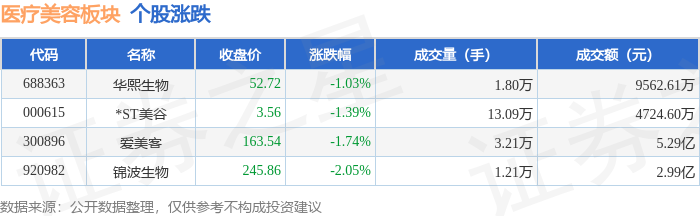
医疗美容板块10月28日跌1.44%,锦波生物领跌,主力资金净流出3539.69万元
Zheng Xing Xing Ye Ri Bao· 2025-10-28 08:40
Core Viewpoint - The medical beauty sector experienced a decline of 1.44% on October 28, with Jinbo Biological leading the drop. The Shanghai Composite Index closed at 3988.22, down 0.22%, while the Shenzhen Component Index closed at 13430.1, down 0.44% [1]. Group 1: Market Performance - The medical beauty sector's individual stock performance showed the following results: - Huaxi Biological closed at 52.72, down 1.03% with a trading volume of 18,000 shares and a transaction value of 95.6261 million yuan [1]. - *ST Meigu closed at 3.56, down 1.39% with a trading volume of 130,900 shares and a transaction value of 47.2460 million yuan [1]. - Aimeike closed at 163.54, down 1.74% with a trading volume of 32,100 shares and a transaction value of 529 million yuan [1]. - Jinbo Biological closed at 245.86, down 2.05% with a trading volume of 12,100 shares and a transaction value of 299 million yuan [1]. Group 2: Capital Flow - On the same day, the medical beauty sector saw a net outflow of 35.3969 million yuan from main funds, a net outflow of 24.4121 million yuan from speculative funds, and a net inflow of 59.809 million yuan from retail investors [2].


左手减肥针,右手化妆品,爱美客要当“六边形战士”?
Guan Cha Zhe Wang· 2025-10-23 10:44
Core Insights - The company has successfully completed the registration of its first cosmetic raw material, "Glycyrrhetinic Acid A," marking its entry into the cosmetic raw material sector [1][2] - The company is undergoing a strategic transformation from a focus on medical beauty injection products to a broader "medical + beauty" ecosystem [2][3] Financial Performance - In 2024, the company reported revenue of 3.026 billion yuan, a year-on-year increase of 5.45%, and a net profit of 1.956 billion yuan, also up by 5.47% [2] - In the first half of 2025, both revenue and net profit saw a decline of over 20% year-on-year [2] Market Challenges - The company's flagship products, "Haitai" and "Ruhua Tianzi," have experienced significant revenue declines of 23.79% and 23.99% respectively in the first half of 2025 [3][4] - The competitive landscape has intensified, with new entrants disrupting the market, leading to a shift from a monopoly to a multi-player competition [4][6] Strategic Initiatives - The company is diversifying its portfolio across various sectors, including weight loss drugs, botulinum toxin, photonic instruments, and cosmetics [3][9] - The "medical beauty transformation" strategy aims to leverage medical technology into the broader beauty market, with multiple skincare brands already launched [9][11] Legal and Operational Issues - The company is facing legal challenges related to its acquisition of REGEN Biotech, which has led to disputes over exclusive distribution rights for key products [6][8] - The company acknowledges the increasing competition and the need for quality and effectiveness in the evolving market landscape [6][8] Long-term Vision - The company has been strategically positioning itself in the biopharmaceutical sector since 2018, with a focus on leveraging its core capabilities in biotechnology for future growth [11][12]

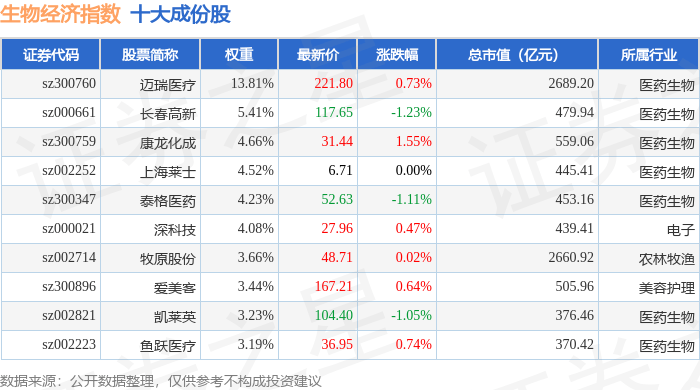
10月23日生物经济(970038)指数跌0.06%,成份股京新药业(002020)领跌
Sou Hu Cai Jing· 2025-10-23 09:56
Core Viewpoint - The Biotech Index (970038) closed at 2259.94 points, down 0.06%, with a trading volume of 17.182 billion yuan and a turnover rate of 1.24% on October 23 [1] Group 1: Index Performance - The Biotech Index had 26 stocks rising and 22 stocks falling on the day, with Huace Testing leading the gainers at a 3.03% increase, while Jingxin Pharmaceutical led the decliners with a 4.17% drop [1] - The top ten constituent stocks of the Biotech Index include: - Mindray Medical (13.81% weight, latest price 221.80, market cap 268.92 billion yuan) [1] - Changchun High-tech (5.41% weight, latest price 117.65, market cap 47.994 billion yuan) [1] - Kanglong Chemical (4.66% weight, latest price 31.44, market cap 55.906 billion yuan) [1] - Others include Shishi Yushang, Biao Ge Pharmaceutical, and more, all within the biotech and related sectors [1] Group 2: Capital Flow - The Biotech Index constituents experienced a net outflow of 502 million yuan from main funds, while retail investors saw a net inflow of 354 million yuan [3] - Detailed capital flow for key stocks includes: - Deep Technology: Main fund net inflow of 82.5949 million yuan, retail net inflow of 21.4 million yuan [3] - Mindray Medical: Main fund net inflow of 66.9479 million yuan, retail net outflow of 3.6088 million yuan [3] - Other stocks like Muyuan Foods and Kanglong Chemical also showed varying levels of net inflow and outflow from different investor categories [3]





医疗美容板块10月23日跌0.12%,锦波生物领跌,主力资金净流出3208.76万元
Zheng Xing Xing Ye Ri Bao· 2025-10-23 08:27
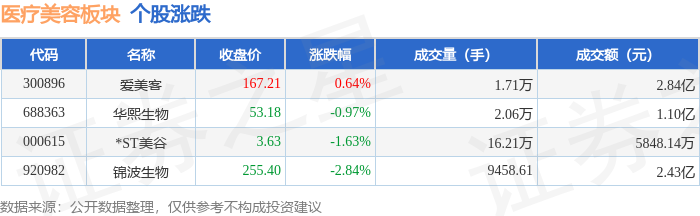
Group 1 - The medical beauty sector experienced a decline of 0.12% on October 23, with Jinbo Biological leading the drop [1] - The Shanghai Composite Index closed at 3922.41, up 0.22%, while the Shenzhen Component Index closed at 13025.45, also up 0.22% [1] - Key stocks in the medical beauty sector showed mixed performance, with Aimeike rising by 0.64% and Jinbo Biological falling by 2.84% [1] Group 2 - The net outflow of main funds in the medical beauty sector was 32.09 million yuan, while retail funds saw a net inflow of 10.22 million yuan [1] - Specific stock fund flows indicated that *ST Meigu experienced a main fund outflow of 6.29 million yuan, while retail funds had a net inflow of 6.18 million yuan [2] - Huaxi Biological also faced a main fund outflow of 10.03 million yuan, with retail funds showing a net inflow of 4.67 million yuan [2]
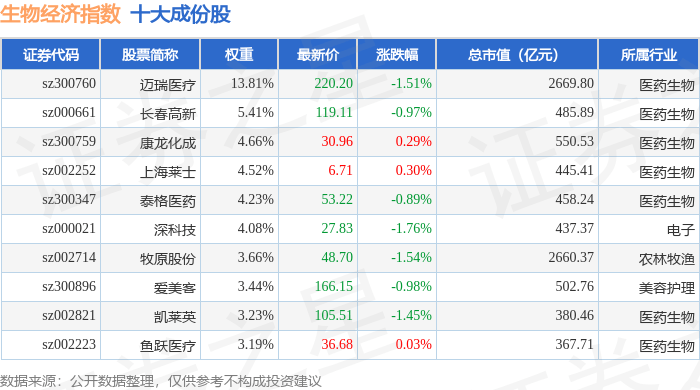
10月22日生物经济(970038)指数跌0.81%,成份股普洛药业(000739)领跌
Sou Hu Cai Jing· 2025-10-22 10:24
Core Insights - The Biotech Economy Index (970038) closed at 2261.4 points, down 0.81%, with a trading volume of 16.635 billion yuan and a turnover rate of 1.19% [1] - Among the index constituents, 19 stocks rose while 30 stocks fell, with Meihao Medical leading the gainers at 6.53% and Prolo Pharma leading the decliners at 5.41% [1] Index Performance - The Biotech Economy Index experienced a decline of 0.81% on the reporting day [1] - The total market capitalization of the index constituents was significant, with major players like Mindray Medical valued at 266.98 billion yuan [1] Top Constituents - The top ten constituents of the Biotech Economy Index include: - Mindray Medical (13.81% weight, 220.20 yuan, -1.51% change, 2669.80 billion yuan market cap) [1] - Changchun High-tech (5.41% weight, 119.11 yuan, -0.97% change, 485.89 billion yuan market cap) [1] - Kanglong Chemical (4.66% weight, 30.96 yuan, +0.29% change, 550.53 billion yuan market cap) [1] - Other notable constituents include Taige Pharmaceutical, Muyuans, and Aimeike, all within the biotech and healthcare sectors [1] Capital Flow - The net outflow of main funds from the Biotech Economy Index constituents totaled 0.893 billion yuan, while retail investors saw a net inflow of 0.75 billion yuan [1] - Specific stocks like Kanglong Chemical and Meihao Medical experienced varying levels of net inflow and outflow from different investor categories [2]


医疗美容板块10月22日跌0.17%,爱美客领跌,主力资金净流出2096.85万元
Zheng Xing Xing Ye Ri Bao· 2025-10-22 08:26
Core Insights - The medical beauty sector experienced a slight decline of 0.17% on October 22, with Ai Meike leading the drop [1] - The Shanghai Composite Index closed at 3913.76, down 0.07%, while the Shenzhen Component Index closed at 12996.61, down 0.62% [1] Sector Performance - The closing prices and performance of key stocks in the medical beauty sector are as follows: - *ST Meigu: Closed at 3.69, up 4.53% with a trading volume of 293,600 shares and a transaction value of 108 million yuan [1] - Huaxi Biological: Closed at 53.70, up 0.45% with a trading volume of 20,500 shares and a transaction value of 1.1017 million yuan [1] - Jinbo Biological: Closed at 262.87, down 0.38% with a trading volume of 6,168 shares and a transaction value of 163 million yuan [1] - Ai Meike: Closed at 166.15, down 0.98% with a trading volume of 17,500 shares and a transaction value of 292 million yuan [1] Capital Flow - The medical beauty sector saw a net outflow of 20.9685 million yuan from main funds, while retail investors contributed a net inflow of 11.5985 million yuan [1] - Detailed capital flow for key stocks: - Huaxi Biological: Main funds net inflow of 10.7629 million yuan (9.81% of total), retail net outflow of 8.6171 million yuan (-7.86% of total) [2] - *ST Meigu: Main funds net inflow of 719,200 yuan (0.66% of total), retail net outflow of 2.7039 million yuan (-2.49% of total) [2] - Ai Meike: Main funds net outflow of 32.4506 million yuan (-11.11% of total), retail net inflow of 22.9195 million yuan (7.84% of total) [2]

爱美客高调布局化妆品原料端,成色几何?
中国基金报· 2025-10-21 12:43
Core Viewpoint - Aimeike has completed its first new cosmetic ingredient filing, "Glycyrrhizic Chalcone A," derived from the traditional Chinese plant licorice, marking a significant step in its strategic expansion into the cosmetics sector [2][3][4]. Group 1: Business Development - Aimeike is actively expanding its cosmetics business, leveraging its technological advantages accumulated in the medical aesthetics field to drive innovation [4][8]. - The company reported a revenue of 1.299 billion yuan in the first half of 2025, a year-on-year decline of 21.6%, and a net profit of 789 million yuan, down 29.6%, indicating pressure on its core products [6]. - Aimeike has initiated a multi-line transformation strategy, including product diversification and pipeline expansion, with new products like "Gakola" and ongoing clinical trials for other products [6][8]. Group 2: Market Context - The cosmetic ingredient market is experiencing intense competition, with a 77.8% year-on-year increase in new ingredient filings in the first half of the year, highlighting the growing interest in this sector [11]. - Major players like Proya and Beautylife have also completed new ingredient filings, indicating a trend among domestic beauty giants to secure upstream raw material capabilities [11]. Group 3: Strategic Challenges - Aimeike faces significant challenges, including a lack of experience in managing cosmetic raw material supply chains and the need for time to transition from filing to commercialization [12]. - The company is also contending with established competitors who have first-mover advantages and the potential for regulatory hurdles during the three-year monitoring period following the new ingredient filing [12].
医疗美容板块10月21日涨0.63%,锦波生物领涨,主力资金净流出127.96万元
Zheng Xing Xing Ye Ri Bao· 2025-10-21 08:28
Group 1 - The medical beauty sector increased by 0.63% on October 21, with Jinbo Biological leading the gains [1] - The Shanghai Composite Index closed at 3916.33, up 1.36%, while the Shenzhen Component Index closed at 13077.32, up 2.06% [1] - Key stocks in the medical beauty sector showed varied performance, with Jinbo Biological closing at 263.87, up 1.10%, and Aimeike at 167.80, up 0.46% [1] Group 2 - The medical beauty sector experienced a net outflow of 127.96 thousand yuan from main funds and 928.94 thousand yuan from speculative funds, while retail investors saw a net inflow of 1,056.9 thousand yuan [1] - Aimeike had a main fund net inflow of 503.62 thousand yuan, but a net outflow of 971.83 thousand yuan from speculative funds [2] - Huaxi Biological faced a net outflow of 291.25 thousand yuan from main funds and 55.17 thousand yuan from speculative funds, with a net inflow of 346.42 thousand yuan from retail investors [2]
