AMD(AMD)

Search documents
intel和amd
小熊跑的快· 2026-01-22 01:11
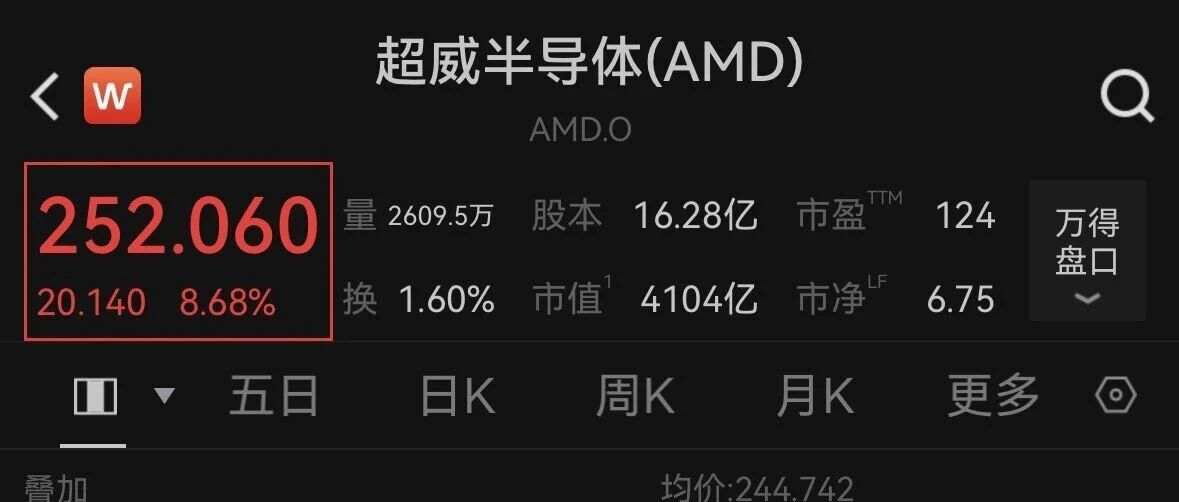
申明:除了阐述事实!什么观点都没有!继前一篇台积电涨价cpu之后的事实补充!没有观点,没意 见,什么观点都没有。几研究gpu的时候,看过amd的,这几年它市场份额扩张的很快。 2025年Q3 AMD x86 CPU总份额达25.6%(环比+1.4pct,同比+1.6pct),首次突破25%;台式机份额 33.6%(环比+1.4pct,同比+5.2pct),首次超1/3;服务器27.8%(环比微增);移动21.9%(环比 +1.3pct)。 中国区30%,美国30%,剩下中东+欧洲。 去年中国区数据中心业务翻倍了。 份额速览(Mercury Research 2025Q3) 增长趋势 2025Q1-Q3 x86从24%→24.2%→25.6%,台式机从30%→32.2%→33.6%,攀升。 若计入嵌入式/IoT/主机SoC,AMD x86整体份额30.9%(同比+5.9pct)。 • 总x86:AMD 25.6%,Intel 74.4% • 台式机:AMD 33.6%,Intel 66.4% • 服务器:AMD 27.8%,Intel 72.2% • 移动:AMD 21.9%,Intel 78.1% 数据中心, ...


今日A股市场重要快讯汇总|2026年1月22日
Xin Lang Cai Jing· 2026-01-22 00:55
Group 1: Company Announcements - On January 21, Aotai Bio disclosed its shareholding increase [1][4] - A total of 21 A-share listed companies, including Chen Zhan Optoelectronics, Deepwater Haina, Hengshuai Co., Ltd., and others, announced shareholding reductions [1][4] Group 2: Market Performance - The three major U.S. stock indices closed higher, with the Dow Jones up 1.21%, Nasdaq up 1.18%, and S&P 500 up 1.16% [2][5] - Major technology stocks saw significant gains, with Intel rising over 11%, AMD over 7%, and Nvidia and Tesla both up over 2% [2][5] - Storage concept stocks performed well, with SanDisk increasing over 10% and Western Digital up over 8% [2][5] - The U.S. regional bank index rose 4.7%, marking the largest single-day increase since August [2][5] Group 3: Nasdaq China Golden Dragon Index - The Nasdaq China Golden Dragon Index increased by 2.22%, with notable gains from companies such as New Oxygen up 14.93%, Baidu up 8.20%, and Century Internet up 7.17% [3][6]





今日国际国内财经新闻精华摘要|2026年1月22日
Xin Lang Cai Jing· 2026-01-22 00:55
International News - US natural gas futures prices saw a significant increase, with intraday gains reaching up to 30%, currently reported at $5.083 per million British thermal units, after previously recording increases of 29%, 28%, and 27% [1][7] - Precious metals market showed a downward trend, with spot gold prices dropping below $4820, $4810, $4800, and $4790 per ounce, with daily declines of 0.25%, 0.44%, 0.64%, and 0.86% respectively [1][7] - Spot silver also faced pressure, falling below $93, $92, and $91 per ounce, with daily declines of 1.68%, 2.93%, and 3.74% respectively [1][7] - US stock market performed strongly, with all three major indices closing up over 1%, the Dow Jones up 1.21%, Nasdaq up 1.18%, and S&P 500 up 1.16% [1][7] Individual Stocks - Intel shares rose over 11%, reaching a four-year high; AMD increased by 8.3%, SanDisk by over 10%, Western Digital by over 8%, and Micron Technology by over 6% [2][8] - The Nasdaq Golden Dragon China Index rose by 2.22%, with notable gains from individual stocks such as New Oxygen up 14.93%, Baidu up 8.20%, and Century Internet up 7.17% [2][8] - OpenAI's CEO Sam Altman is meeting with top investors in the Middle East to pursue a new round of financing of at least $50 billion, with a post-funding valuation expected between $750 billion and $830 billion [2][8] - Apple plans a major overhaul of Siri, transforming it into a built-in chatbot with new features expected to launch later this year [2][8] Company Dynamics - French dairy company Lactalis announced a recall of multiple batches of infant formula in 18 countries, including China, due to potential contamination with Bacillus cereus toxin [3][9] - Ubisoft canceled the development of six games, including the remake of "Prince of Persia: The Sands of Time" and four unannounced titles [3][10] - The American Petroleum Institute (API) reported an increase of 3 million barrels in US API crude oil inventories last week, compared to a previous increase of 5.278 million barrels [3][10] - President Trump expressed hope for the retention of Kevin Hassett in his current position, with the shortlist for the Federal Reserve chair narrowing to two or three candidates [3][10]



操盘必读:影响股市利好或利空消息_2026年1月22日_财经新闻
Xin Lang Cai Jing· 2026-01-22 00:40
影响股市利好与利空消息 宏观新闻 1、美国贸易代表格里尔在达沃斯表态称,希望与中国进行另一轮的潜在贸易谈判。外交部发言人郭嘉 昆在昨日主持的例行记者会上对此表示,中美双方应该共同落实好两国元首达成的重要共识,为中美经 贸合作与世界经济注入更多的稳定性和确定性。 2、央行召开2026年支付结算工作会议,会议要求,加快建设人民币跨境支付体系,推进跨境支付互联 互通,推动跨境支付体系多元化、多层次发展。严格实施支付机构穿透式监管和支付业务功能监管,充 分发挥行政、自律互补作用,塑造合规致远的行业健康生态。 7、数据显示,由于超大规模云服务商"扫货",英特尔与AMD在2026全年的服务器CPU产能已基本售 罄。为了应对供需极端失衡并确保后续供应稳定,两家公司均计划将服务器CPU价格上调10-15%。 3、财政部等3部门发布《于延续实施创新企业境内发行存托凭证试点阶段有关税收政策的公告》。其中 提到,今明两年对个人投资者转让创新企业CDR取得的差价所得,暂免征收个人所得税。 4、特朗普在达沃斯世界经济论坛年会上表示,美国无意动用过激武力来获取格陵兰岛。特朗普同日还 表示,他将不会实施原定于2月1日生效的对欧洲关税措施。 ...
英特尔涨11.7%,AMD涨7.1%,美光科技涨6.6%,英伟达涨2.9%
财联社· 2026-01-22 00:39
Core Viewpoint - The U.S. stock market experienced a significant rebound following President Trump's cancellation of new tariffs on European countries and his announcement of a "framework agreement" regarding Greenland [1][3]. Market Performance - The Dow Jones Industrial Average rose by 1.21%, closing at 49,077.23 points; the S&P 500 increased by 1.16%, ending at 6,875.62 points; and the Nasdaq Composite gained 1.18%, finishing at 23,224.82 points [2]. Political Developments - Trump stated at the World Economic Forum in Davos that he would not use military force to acquire Greenland, which positively influenced the stock market. He mentioned a productive discussion with NATO Secretary General Mark Rutte, leading to a future agreement framework concerning Greenland and the Arctic region [3]. - Trump had previously announced a 10% tariff on goods from Denmark, Norway, Sweden, France, Germany, the UK, the Netherlands, and Finland, set to take effect on February 1, with a potential increase to 25% by June 1 if an agreement on Greenland was not reached [4]. Market Reactions - The stock market had previously declined sharply due to Trump's escalation of tariff threats and the possibility of military action regarding Greenland, marking the worst single-day performance since October 10 [6]. - The market's reaction to Trump's tariff cancellation reflects a trend where investors no longer assume his statements will be executed, indicating a level of unpredictability in his administration's policies [7]. Stock Performance - Major technology stocks mostly rose, with Nvidia up 2.95%, Apple up 0.39%, Microsoft down 2.29%, Google up 1.98%, Amazon up 0.13%, Meta up 1.46%, Tesla up 2.91%, Broadcom down 1.14%, Oracle down 3.36%, Netflix down 2.18%, Micron Technology up 6.61%, AMD up 7.11%, and Intel up 11.72% [7]. - Chinese concept stocks also saw gains, with the Nasdaq Golden Dragon China Index rising 2.21%, Alibaba up 3.87%, JD.com up 2.43%, Pinduoduo up 1.40%, NIO up 2.41%, Xpeng up 1.70%, Li Auto up 2.48%, Bilibili up 5.65%, Baidu up 8.17%, while NetEase fell 4.07%, Tencent Music down 0.80%, and Pony.ai up 2.55% [7].



暴增超70%!芯片,突传重大利好!
券商中国· 2026-01-21 23:28
Core Viewpoint - The article highlights a significant surge in semiconductor exports from South Korea, indicating strong global demand driven by the AI wave, which has positively impacted major semiconductor companies' stock prices [1][2]. Group 1: Semiconductor Export Data - In the first 20 days of January 2026, South Korea's semiconductor exports reached $10.73 billion, a year-on-year increase of 70.2%, accounting for 29.5% of total exports, up 9.6 percentage points from the previous year [2]. - For the entire year of 2025, South Korea's semiconductor exports amounted to $173.48 billion, marking a 22.1% year-on-year growth and achieving a historical high [4]. Group 2: Market Reactions and Stock Performance - Following the positive export data, semiconductor stocks surged, with the Philadelphia Semiconductor Index rising by 3.18%, reaching a historical high, and individual stocks like Intel and Micron Technology seeing significant gains [1]. - Citigroup raised the target price for SanDisk from $280 to $490 per share, a 75% increase, citing strong demand for data center memory and favorable supply conditions [5]. Group 3: Future Demand and Supply Dynamics - The demand for storage chips is expected to remain robust due to the increasing need for AI infrastructure, with major companies like SK Hynix reporting that their chip production capacity for 2026 is already sold out [6]. - Global capital expenditures from the top eight cloud providers are projected to increase by approximately 65% year-on-year, with AI servers becoming the fastest-growing segment in data center IT investments [7].




Stocks Settle Sharply Higher as President Trump Claims Deal on Greenland
Yahoo Finance· 2026-01-21 21:46
Natural Gas Industry - Natural gas prices surged over +24% to a 6-week high, following a +26% increase the previous day, driven by an Arctic cold front expected to raise heating demand and disrupt US production [1][17] Gold Market - Gold prices increased by another 1%, reaching a new record high amid the Greenland crisis and concerns over Japan's fiscal policies leading to higher deficits, which are driving demand for gold as a safe-haven asset [2] Stock Market Performance - Stock indexes rebounded sharply, recovering over half of the previous day's losses after President Trump announced a framework for a deal regarding Greenland and refrained from imposing tariffs on European nations [4][5] - The S&P 500 Index closed up +1.16%, the Dow Jones up +1.21%, and the Nasdaq 100 up +1.36% [5] Mortgage Applications and Housing Market - US MBA mortgage applications rose by +14.1%, with the purchase mortgage sub-index up +5.1% and refinancing up +20.4% [6] - Pending home sales in December fell by -9.3% month-over-month, marking the largest decline in 5.5 years, while construction spending in October rose by +0.5% month-over-month [6] Earnings Season - The Q4 earnings season has been positive, with 81% of the 38 S&P 500 companies that reported beating expectations, and S&P earnings growth is projected to increase by +8.4% in Q4 [8] Interest Rates and Treasury Notes - The 10-year T-note yield fell by -4 bp to 4.25%, supported by lower bond yields and strong demand for a $13 billion auction of 20-year T-bonds [11] - Rising inflation expectations limited gains in T-notes, with the 10-year breakeven inflation rate reaching a 3.25-month high of 2.358% [12] Company-Specific Movements - Chip makers saw significant gains, with Intel closing up more than +11% and AMD up more than +7%, contributing to the overall market rally [16] - Progressive Software's stock rose over +10% after forecasting stronger-than-expected full-year adjusted EPS [18] - Citizens Financial Group's stock increased by more than +6% after reporting total deposits above consensus expectations [19]

Why AMD's stock is rocketing toward its longest winning streak in nearly a year
MarketWatch· 2026-01-21 20:27
Analysts are increasingly upbeat about AMD's momentum with central processing units for AI data centers. ...
What's driving AMD stock higher on Wednesday?
Invezz· 2026-01-21 19:14
Advanced Micro Devices Inc (NASDAQ: AMD) are pushing meaningfully higher on Wednesday as investors await the chipmakers' earnings on February 2nd. They're cheering AMD this morning also because the mu... ...

Markets Rebound Amid Easing Tariff Fears, Energy Sector Leads Wednesday’s Recovery
Stock Market News· 2026-01-21 19:07
Market Recovery and Performance - U.S. equities experienced a recovery on January 21, 2026, as investor anxieties eased following President Trump's remarks at the World Economic Forum, particularly regarding Greenland [1] - The Dow Jones Industrial Average (DJIA) rose approximately 0.6% to 0.7%, recovering from a 1.8% decline on Tuesday, while the S&P 500 (SPX) advanced by 0.5% to 0.6% after a 2.1% drop [2] - The Nasdaq Composite (IXIC) also gained between 0.2% and 0.5%, following a 2.4% slide on Tuesday, indicating a cautious return of risk appetite [2] Sector Performance - The Energy sector was the standout performer, with the S&P 500 Energy Sector climbing 2.3%, driven by individual stocks like Halliburton (HAL), which rose 4.9% after reporting stronger-than-expected quarterly profits [4] - Nine out of the eleven S&P 500 sectors were in positive territory, while defensive sectors such as Consumer Staples and Utilities lagged behind, down 0.5% and 0.1% respectively [4] Notable Stock Movements - Chipmakers Intel (INTC) and Advanced Micro Devices (AMD) saw significant gains, with shares up approximately 9% and 5.5%, respectively, as Intel's stock surged over 10% on Wednesday, reaching a four-year high [5] - United Airlines (UAL) gained 2.9% after reporting better-than-expected profits for the end of 2025 [5] - Conversely, Kraft Heinz (KHC) fell roughly 6% due to a regulatory filing suggesting Berkshire Hathaway might sell a significant portion of its shares [6] - Netflix (NFLX) continued its downward trend, falling 4.8% on Wednesday, extending losses from a 5.1% drop on Tuesday, attributed to slowing subscriber growth and a lower-than-expected profit forecast [6] Upcoming Economic Events - Investors are awaiting key economic data releases, including the final estimate for Q3 US GDP and November US core Personal Consumption Expenditures (PCE) data, crucial for gauging inflationary pressures [7] - The earnings season is gaining momentum, with major companies, including Intel, set to release quarterly results [8] - The Bank of Japan (BOJ) is scheduled to meet to set interest rates, expected to remain at 0.75% [9] Broader Market Trends - Gold prices reached new record highs, with futures trading up 1.4% to around $4,830 an ounce, driven by safe-haven demand amidst global uncertainties [10] - Treasury yields eased slightly, with the 10-year Treasury yield slipping to 4.27% after closing at 4.30% the previous day [10] - Natural gas prices surged 26% on Tuesday due to forecasts of cold weather across parts of the U.S. [10] Geopolitical Context - The European Union has reportedly halted its trade deal with the U.S. in response to the Greenland situation, indicating ongoing transatlantic trade tensions [11] - The complex interplay of economic data, corporate performance, and geopolitical events continues to shape the stock market's trajectory [11]