AMD(AMD)

Search documents
Is AMD About to Surpass Nvidia In the AI Chip Race?
247Wallst· 2026-01-07 13:47
Core Insights - Nvidia has established a significant lead in the artificial intelligence (AI) chip market, positioning itself as a key player in the ongoing AI revolution [1] Company Summary - Nvidia is recognized as the primary driver of advancements in AI technology, reinforcing its dominance in the sector [1]


CES 2026见证AI生态变局,中国厂商跻身全球核心阵营
2 1 Shi Ji Jing Ji Bao Dao· 2026-01-07 13:35
Core Insights - The article highlights the acceleration of native AI hardware development, emphasizing the growing demand for computing power and the expansion of AI applications from cloud to edge [1][2][12] - Chinese manufacturers are increasingly becoming significant players at CES 2026, showcasing a variety of AI hardware, including AI glasses and robots, which have garnered substantial attention [1][12] Group 1: AI Hardware and Computing Power - The rapid evolution of underlying computing infrastructure is supporting the accelerated development of AI large models, with a noted annual increase in floating-point operations for training by four times and a 100-fold increase in inference token consumption over the past two years [2][3] - NVIDIA's CEO highlighted the arrival of the "ChatGPT moment" for physical AI, with autonomous taxis being one of the first applications to benefit from this technology [2] - AMD's CEO discussed the transition to Yotta Scale compute, indicating that AI potential will be fully unleashed across data centers, personal computing devices, and edge AI [2][3] Group 2: Robotics and Physical AI - The maturity of physical AI was emphasized at CES, with a notable improvement in the capabilities of showcased robots compared to previous years, indicating a shift from simple demonstrations to more complex functionalities [7][8] - Companies like UTree Technology and Zongqiong Robotics are showcasing advanced robots capable of performing intricate movements, signaling a move towards mass production and real-world applications [8][9] - The integration of edge AI and real-time situational awareness in wearable devices is expected to create significant market opportunities, with projections of reaching 100 million units in the coming years [5][6] Group 3: Chinese Manufacturers and Global Role - Chinese firms are transitioning from being merely the "world's factory" to becoming key players in global technological innovation, supported by strong supply chain and R&D capabilities [1][12] - The efficiency of China's supply chain allows for rapid product iteration, with a production cycle of about one year compared to three to five years for European companies [12][13] - The article underscores that the advancements in AI technology are not just about manufacturing but also about creating better solutions and technologies, marking a shift from "Chinese manufacturing" to "Chinese innovation" [13]

四大芯片巨头,正面激战CES
2 1 Shi Ji Jing Ji Bao Dao· 2026-01-07 13:22
Group 1: Industry Overview - The CES 2026 showcased over 4,000 companies, focusing on AI and its integration into various products, including PCs, home appliances, and foundational chips [1] - The combined market capitalization of the four major semiconductor companies—NVIDIA, AMD, Qualcomm, and Intel—reaches nearly $5.3 trillion, indicating significant investor interest in AI technologies [1] - Concerns about the over-exuberance of the AI market persist, with 2026 expected to be a year for evaluating genuine value creation rather than mere speculation [1] Group 2: NVIDIA Developments - NVIDIA unexpectedly launched its next-generation AI chip platform "Rubin," which significantly enhances training and inference performance by 3.5 times and 5 times, respectively, compared to its predecessor [2] - The company reported over $500 billion in orders for its Blackwell and Rubin architectures for 2025-2026, reflecting strong demand for computing power in data centers [2] - NVIDIA introduced the open-source autonomous driving model "Alpamayo," which features 10 billion parameters and aims to streamline the processing from sensor input to driving commands [3] Group 3: AMD Initiatives - AMD adopted an aggressive "stacking" strategy, showcasing the Helios AI rack, which integrates 72 MI455X accelerator chips and 31TB of HBM4 memory, claiming it to be the best AI rack globally [5][6] - The new generation of chips is expected to deliver up to a 10-fold performance improvement under various workloads, aided by a hybrid 2nm and 3nm manufacturing process [6] - AMD signed a significant infrastructure procurement agreement with OpenAI, valued at 6 gigawatts, marking a substantial entry into the core supply chain of leading AI model developers [6] Group 4: Qualcomm and Intel Strategies - Qualcomm is diversifying its strategy to reduce reliance on the smartphone market, launching the Snapdragon X2 Plus chip aimed at the mid-range laptop market, with a focus on energy efficiency and 5G connectivity [8] - Intel introduced the "Panther Lake" third-generation Core Ultra processor, its first chip manufactured using the 18A process, which is crucial for regaining manufacturing leadership [9] - The third-generation Core Ultra processors are set to be released in the second quarter of 2026, targeting industrial, medical, and smart city applications [10]

AMD stock price forms a risky pattern amid valuation concerns
Invezz· 2026-01-07 12:02
AMD stock price has moved into a technical bear market after falling by 20% from its highest point in October. It has dropped to $215, and has formed an island reversal pattern, pointing to a potentia... ...
CES2026:AMD发布完整MI400产品线,英特尔18A正式量产
HTSC· 2026-01-07 11:53
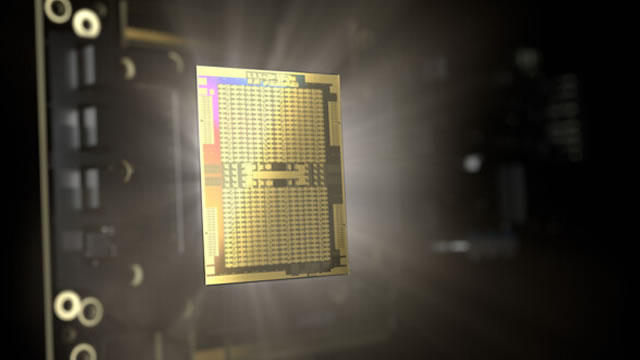
Investment Rating - The report maintains a "Buy" rating for both Intel (INTC US) with a target price of 50.00 and AMD (AMD US) with a target price of 280.00 [7][25]. Core Insights - The focus of AI investment in 2026 is shifting from physical AI to Agentic AI, emphasizing the need for computational power in real-time responses and inference [1]. - AMD has launched the complete MI400 series, with the MI500 expected to be released in 2027, showcasing advancements in AI infrastructure [1]. - Intel has officially entered mass production of its 18A process technology, which integrates RibbonFET and PowerVia technologies, enhancing performance and power efficiency [4]. Summary by Sections AMD Developments - AMD introduced the MI400 series, including the Helios platform designed for Yotta-FLOPS level AI infrastructure, featuring 72 MI455X GPUs and a memory bandwidth of 1.4PB/s [1]. - The Ryzen AI 400 series, based on Zen 5 architecture, is set to launch in Q1 2026, aiming to facilitate local AI deployment [2]. - AMD's new developer platform, Ryzen AI Halo, will support local execution of models with up to 200 billion parameters, lowering barriers for AI development [2]. Intel Developments - Intel's Core Ultra Series 3, based on the 18A process, features 16 CPU cores and 12 Xe cores, targeting over 200 OEM PCs [3]. - The integrated Arc B390 graphics card, with 96 XMX AI accelerators, achieves approximately 120 TOPS of AI performance, comparable to NVIDIA's RTX 4050 [3]. - Intel emphasizes the transition of AI workloads to edge and industrial applications, highlighting the importance of hybrid AI solutions [3]. Market Trends - The report indicates a structural shift in AI demand, focusing on edge computing and vertical applications in industries such as healthcare and manufacturing [1][3]. - The integration of advanced process technologies is seen as a strategic move for both AMD and Intel to enhance their competitive positions in the semiconductor market [4].
AI的尽头是医疗!AMD苏姿丰最新对话:开发药物,将像造iPhone一样简单!
Xin Lang Cai Jing· 2026-01-07 10:57
Core Insights - The discussion at CES 2026 highlighted the transformative role of AI in biotechnology and pharmaceuticals, focusing on drug discovery and development [1][15] Group 1: AI in Drug Discovery - Absci is utilizing generative AI and synthetic biology to design new drugs, aiming to address unmet medical needs and ensure manufacturability [3][4][18] - The company is currently focusing on androgenetic alopecia and endometriosis, with the goal of fundamentally changing disease progression rather than just alleviating symptoms [4][19] - AMD's investment in Absci has significantly enhanced their reasoning capabilities, allowing them to screen over one million drug candidates daily [4][20] Group 2: Precision Medicine and Genomics - Illumina emphasizes the importance of high-precision DNA sequencing for disease prevention, diagnosis, and treatment, relying heavily on data and computational power [5][22] - The company generates more sequencing data daily than YouTube, making collaboration with AMD crucial for transforming vast data into medical insights [5][22][23] - Over the past decade, Illumina's technology has been applied in clinical diagnostics for major diseases, saving millions of lives [6][23] Group 3: AI's Future Impact on Healthcare - The integration of generative AI, genomics, and proteomics is expected to revolutionize the understanding of biology, accelerating drug development and changing disease prevention strategies [7][24] - AstraZeneca is leveraging AI to enhance productivity and innovation in drug development, utilizing historical experimental data to train generative AI models for faster candidate drug delivery [8][26] - The implementation of generative AI has resulted in a 50% increase in the speed of candidate drug delivery and improved clinical outcomes [10][26] Group 4: Vision for Healthcare Transformation - The executives express excitement about the potential of AI to shift from passive treatment to proactive prevention of chronic diseases, ultimately redefining longevity and health [12][29][30] - The collaboration among companies, academia, and AI startups is essential for achieving breakthroughs in healthcare [7][24][30] - AMD's role in optimizing the AI drug development workflow is highlighted as a key factor in advancing the industry [11][27]

Should You Buy the Invesco QQQ ETF With the Nasdaq at an All-Time High? Here's What History Says
The Motley Fool· 2026-01-07 10:03
Core Insights - The Nasdaq-100 has consistently outperformed other indexes like the S&P 500 due to its high concentration of technology stocks [1] - The index features 100 of the largest nonfinancial companies listed on the Nasdaq, with over 60% of its weighting in the technology sector [2] - The Invesco QQQ Trust, which tracks the Nasdaq-100, is currently trading near an all-time high after a 20% gain in 2025 [3] Technology Sector Dominance - The Nasdaq-100's performance is heavily influenced by larger companies, with a cap ensuring no single company exceeds 24% of the index [4] - The top 10 holdings in the Invesco QQQ ETF account for 51.7% of the total weighting, indicating a top-heavy structure [5] - Key companies in the top 10 include Nvidia (9.04%), Apple (8.01%), and Microsoft (7.17%), which are involved in rapidly growing tech segments [6][7] Performance and Returns - The average return of the top 10 stocks over the last five years is 346%, contributing to the Nasdaq-100's outperformance compared to the S&P 500 [7] - Advanced Micro Devices and Micron Technology had significant share price increases of 77% and 239% respectively in 2025, positioning them as important players in the AI semiconductor space [9] - The Invesco QQQ ETF has produced an average annual return of 10.5% since its inception in 1999, with accelerated returns of 19.3% over the last decade [11] Diversification and Volatility - While the Nasdaq-100 is primarily tech-focused, it includes non-technology holdings like Costco, Linde, PepsiCo, and Starbucks, which can help mitigate some volatility [10] - Historical performance accounts for various market downturns, including five bear markets since 1999, demonstrating the index's resilience [13] - Despite current high trading levels, historical trends suggest it may still be a favorable time to invest in the Invesco QQQ ETF for long-term gains [15]



联想大秀“朋友圈”:四大芯片巨头CEO齐站台,智能体及多款硬件新品亮相
Sou Hu Cai Jing· 2026-01-07 08:56
Core Insights - Lenovo showcased its personal AI agent Qira and a range of innovative concept products at the largest global innovation technology conference in its history during CES 2026 [2] - The company aims to integrate personal, enterprise, and public intelligence through a hybrid AI model, enhancing user perception and creativity while empowering businesses to make autonomous decisions based on their data [2] Group 1: AI Collaboration and Partnerships - Lenovo announced a collaboration with NVIDIA to launch a gigawatt-level AI factory plan, marking a new milestone in their 30-year partnership, with a goal to quadruple business cooperation in the next 3 to 4 years [3] - AMD and Lenovo will work together to create rack-level AI infrastructure, focusing on providing superior performance and flexibility for enterprise users [5] - Intel and Lenovo plan to deepen their collaboration in PC, data center, and cloud computing sectors to promote responsible AI development [5] Group 2: Product Launches and Innovations - Lenovo introduced the Qira AI agent, designed to facilitate seamless interaction across devices, allowing users to continue tasks from smartphones to AI PCs [8] - The Qira agent features real-time responsiveness, emotional awareness, and cross-device execution, integrating user data while prioritizing privacy [8] - Lenovo also unveiled the ThinkPad Rollable concept AI PC, which features a flexible screen design, attracting significant attention [10] Group 3: Sports Technology Solutions - As an official technology partner for FIFA, Lenovo is preparing a series of technological solutions for the 2026 World Cup, including AI-driven products and special edition devices [10]

黄仁勋、苏姿丰、陈立武同台,联想Tech World大会登上CES核心舞台
Xin Lang Cai Jing· 2026-01-07 08:56
专题:2026年度国际消费电子展(CES) CES 2026开幕第二天,联想Tech World大会在拉斯维加斯标志性的天幕大球sphere剧场进行。这是联想 首次在CES期间举办自己的年度科技大会。 联想CEO杨元庆携手科技行业顶级大咖亮相主题演讲,包括英伟达CEO黄仁勋、AMD CEO苏姿丰、英 特尔CEO陈立武。此外,国际足联主席因凡蒂诺也将出席,与杨元庆一道展望即将召开的2026年世界 杯。 专题:2026年度国际消费电子展(CES) CES 2026开幕第二天,联想Tech World大会在拉斯维加斯标志性的天幕大球sphere剧场进行。这是联想 首次在CES期间举办自己的年度科技大会。 联想CEO杨元庆携手科技行业顶级大咖亮相主题演讲,包括英伟达CEO黄仁勋、AMD CEO苏姿丰、英 特尔CEO陈立武。此外,国际足联主席因凡蒂诺也将出席,与杨元庆一道展望即将召开的2026年世界 杯。 新浪声明:所有会议实录均为现场速记整理,未经演讲者审阅,新浪网登载此文出于传递更多信息之目 的,并不意味着赞同其观点或证实其描述。 责任编辑:李昂 新浪声明:所有会议实录均为现场速记整理,未经演讲者审阅,新浪网登载此 ...
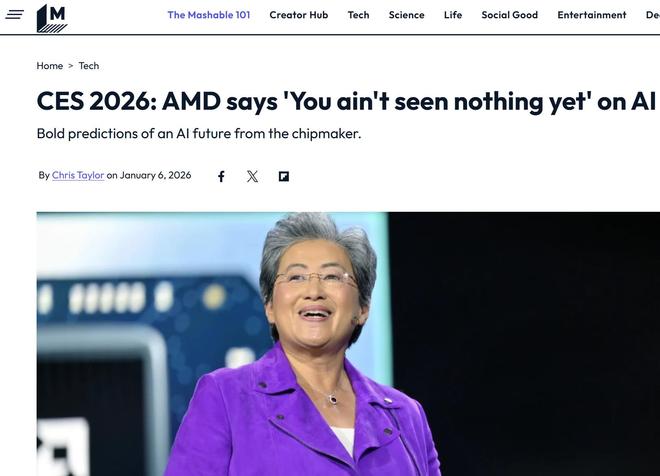
AMD在CES 2026高调宣示AI雄心,苏姿丰称“好戏还在后头”
Huan Qiu Wang Zi Xun· 2026-01-07 08:33
Group 1 - The core message from AMD's CEO Lisa Su at CES 2026 is the company's commitment to not only participate in the current AI wave but also to lead the next phase of explosive growth in the sector [1][4] - AMD predicts that the number of active global AI users will increase from 1 billion to 5 billion over the next five years, highlighting the company's optimistic view on the speed of AI adoption [4] - As a major competitor to Nvidia in the AI chip market, AMD is accelerating its development of a full-stack AI infrastructure [4] Group 2 - To enhance credibility, Lisa Su invited OpenAI co-founder Greg Brockman to join her on stage during the presentation [4] - Despite the ambitious narrative and technological aspirations presented, the capital market's reaction was relatively subdued, with AMD's stock price experiencing a slight decline on the day of the CES event [4] - Investors appear to be cautious, waiting to see if AMD's AI strategy can translate into sustained revenue growth [4]