
Atour Lifestyle (ATAT)

Search documents
Atour Lifestyle: Bullish On Beat And Raise Quarter
Seeking Alpha· 2025-11-27 13:41
Core Insights - The article emphasizes the focus on value investing in Asia, particularly in Hong Kong, targeting stocks with significant discrepancies between market price and intrinsic value [1] - It highlights two main categories of investment opportunities: deep value balance sheet bargains and wide moat stocks, which are characterized by their strong competitive advantages [1] Group 1: Investment Strategy - The research service aims to identify deep value stocks, such as net cash stocks and low price-to-book (P/B) ratio stocks, which are available at a discount [1] - It also seeks wide moat stocks, which are high-quality businesses with sustainable competitive advantages, often referred to as "Magic Formula" stocks [1] - Monthly updates and watch lists are provided to keep investors informed about potential investment opportunities [1] Group 2: Market Focus - The primary focus is on the Asian equity market, with a particular emphasis on Hong Kong-listed stocks [1] - The service is designed for value investors looking for unique investment opportunities in the region [1]


亚朵酒店:400元枕头里面有100元广告费?
36氪· 2025-11-27 10:02
Core Viewpoint - At the end of Q3 2025, Atour's revenue growth is significantly driven by its retail business, which has led to increased marketing expenses, raising questions about its valuation as a hotel or a home textile company [4][12][30]. Group 1: Financial Performance - In Q3 2025, Atour achieved a revenue of 2.628 billion RMB, a year-on-year increase of 38.4%, and an adjusted net profit of 488 million RMB, up 27.0% [4][5]. - Atour's GMV reached 994 million RMB in Q3, reflecting a year-on-year growth of 75.5% [5]. - Retail revenue for the first three quarters of 2025 was 2.505 billion RMB, a substantial increase of 74.81%, contributing 35.78% to total revenue [12][23]. Group 2: Marketing and Sales Expenses - Marketing expenses as a percentage of total revenue rose from 6.19% in 2022 to 14.71% in Q3 2025, indicating a significant increase in advertising spending [7][9]. - It is estimated that Atour spent approximately 6.12 million RMB on marketing for its retail business in the first three quarters of 2025, with a sales expense ratio of about 24.43% [16][30]. Group 3: Business Model and Market Position - Atour's retail business, launched in 2021, has shown a cost structure similar to home textile companies, suggesting a shift towards a "home textile" model [20][31]. - The retail business's revenue contribution has been increasing annually, from 15.42% in 2022 to 35.78% in Q3 2025, indicating a potential future where retail could rival its hotel operations [23][32]. - The current valuation of Atour as a hotel stock (PE ratio of 25-28) contrasts with home textile companies like Luolai Life, which trades at a lower PE ratio of 14-16, raising questions about Atour's market positioning [24][30].

亚朵(ATAT):继续上调全年零售业务增速,双轮驱动品牌势能走强
Guoxin Securities· 2025-11-27 08:44
Investment Rating - The investment rating for the company is "Outperform the Market" [7] Core Views - The company has raised its full-year revenue growth guidance to 35%, driven by strong retail business performance, with Q3 revenue growth of 38.4% year-on-year [1][10] - The hotel business continues to expand, with a net increase of 124 hotels in Q3 and a total of 1948 operating hotels, reflecting a 27% year-on-year growth [2][14] - The retail business has shown exceptional growth, with Q3 revenue increasing by 76.4%, leading to an upward revision of the full-year revenue growth target from 60% to 65% [3][15] - The company is positioned as a lifestyle brand targeting mid-to-high-end consumers, benefiting from the recovery of business activities in high-tier cities [4][16] Summary by Sections Financial Performance - In Q3 2025, the company reported revenue of 2.63 billion yuan, a year-on-year increase of 38.4%, and adjusted net profit of 490 million yuan, up 27% [1][10] - The company expects to achieve revenues of 9.82 billion, 12.29 billion, and 14.78 billion yuan for 2025, 2026, and 2027, respectively, with year-on-year growth rates of 35.4%, 25.2%, and 20.2% [5][18] Hotel Business - The company opened 152 new hotels in Q3, bringing the total to 1948, with a target of 500 new openings for the year [2][14] - The RevPAR (Revenue per Available Room) for Q3 was 371 yuan, showing a slight decline of 2.2% year-on-year, but an improvement compared to previous quarters [3][15] Retail Business - The retail segment achieved a GMV of 999.4 million yuan in Q3, with revenue growth of 76.4%, contributing 32% to total revenue [3][15] - The introduction of the "Atour Planet Deep Sleep Standard" aims to enhance product offerings and strengthen brand positioning in the sleep industry [4][16]
亚朵(ATAT):酒店及零售双曲线增长向好
HTSC· 2025-11-27 06:28
Investment Rating - The report maintains a "Buy" rating for the company with a target price of $50.50 [1] Core Insights - The company reported Q3 revenue of 2.628 billion yuan, a year-on-year increase of 38.4%, and a net profit attributable to shareholders of 474 million yuan, up 23.2% year-on-year [5] - The hotel business is expected to continue its marginal recovery, while the retail segment shows strong growth, prompting the company to raise its full-year revenue growth guidance to 35% [5][8] - The dual growth momentum from both hotel and retail sectors is highlighted as a key strength for the company [5] Financial Performance - Q3 RevPAR (Revenue Per Available Room) showed a slight year-on-year decline of 2.2%, but there are signs of recovery driven by increased leisure travel demand [6] - The company operates 1,948 hotels as of the end of Q3, with a year-on-year increase of 27.1%, and aims to achieve the target of "2,000 good hotels" by year-end [7] - Retail business GMV (Gross Merchandise Volume) reached 999.4 million yuan, a year-on-year increase of 75.5%, with online sales accounting for over 90% [8] Earnings Forecast and Valuation - Revenue projections for 2025-2027 have been adjusted upwards to 9.759 billion yuan, 11.783 billion yuan, and 13.505 billion yuan respectively, reflecting a growth rate of 34.64% for 2025 [9] - The net profit attributable to shareholders is forecasted to reach 1.656 billion yuan in 2025, with an EPS of 12.04 yuan [9] - The target price is set based on a PE ratio of 23 times for 2026, reflecting the company's growth potential and market positioning [9]
亚朵季报图解:营收26亿净利4.7亿,派息5000万美元
3 6 Ke· 2025-11-26 23:32
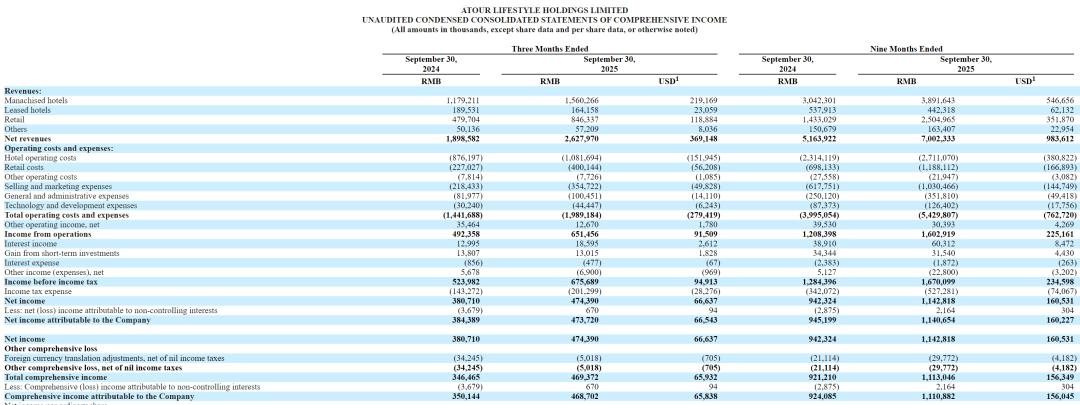
Core Viewpoint - Atour (NASDAQ: ATAT) reported a significant increase in revenue and net income for the first nine months of 2025, indicating strong growth in its hotel and retail segments [1][3][20]. Financial Performance - For the first nine months of 2025, Atour's revenue reached 7 billion RMB (approximately 983 million USD), a 35.6% increase from 5.164 billion RMB in the same period last year [1]. - The operating profit for the same period was 1.6 billion RMB (approximately 225 million USD), up from 1.2 billion RMB the previous year [1][20]. - Net income for the first nine months of 2025 was 1.14 billion RMB (approximately 161 million USD), compared to 942 million RMB in the prior year [1][20]. Quarterly Performance - In Q3 2025, Atour's revenue was 2.63 billion RMB, a 38.4% increase from 1.9 billion RMB in Q3 2024 [3][9]. - Adjusted net income for Q3 2025 was 488 million RMB (approximately 69 million USD), reflecting a 27% increase from the previous year [20]. - The average daily rate (ADR) for Q3 2025 was 447 RMB, with an occupancy rate of 80.2% [10][20]. Business Segments - Revenue from managed hotels in Q3 2025 was 1.56 billion RMB, a 32.3% increase from 1.18 billion RMB in Q3 2024 [9][10]. - Retail revenue surged to 846 million RMB in Q3 2025, a 76% increase from 480 million RMB in the same quarter last year [9][10]. - The total number of hotels operated by Atour reached 1,948, with a total of 219,359 rooms as of September 30, 2025 [3][20]. Cash and Dividends - As of September 30, 2025, Atour held approximately 2.7 billion RMB (375 million USD) in cash and cash equivalents [6][20]. - The company announced a cash dividend of 50 million USD as part of its commitment to enhance shareholder value, with a total of approximately 108 million USD in dividends for 2025 [4][5].
亚朵20251125
2025-11-26 14:15
Summary of Atour's Q3 2025 Conference Call Company Overview - **Company**: Atour - **Industry**: Hospitality and Retail Key Financial Performance - **RevPAR**: Q3 2025 RevPAR reached RMB 371.3, 97.8% of Q3 2024 levels [2][4] - **Occupancy Rate**: Occupancy at 99.9%, indicating near-full recovery [2][4] - **ADR**: Average Daily Rate (ADR) at 98.1% compared to Q3 2024 [2][4] - **Net Revenues**: Grew by 38.4% YoY to RMB 2,628 million [23] - **Adjusted Net Income**: RMB 488 million, a 27.0% YoY increase [24] - **Cash Position**: Cash and cash equivalents totaled RMB 2,670 million as of September 30, 2025 [25] Hotel Network Expansion - **New Openings**: 152 new hotels opened in Q3 2025, bringing the total to 1,948, a 27.1% YoY increase [2][4] - **Future Target**: On track to exceed 2,000 hotels by year-end [2][4] Brand Performance - **Atour3.6 Hotels**: Gaining market traction with meticulous design; operational for over three months with RevPAR exceeding RMB 500 [2][5][6] - **Sahe Hotel**: Upscale lifestyle brand with RevPAR exceeding RMB 900; third hotel soft opened in Guangzhou [2][8] - **Atour Lite**: Continued strong performance with RevPAR surpassing year-ago levels; upgraded version 3.3 received positive feedback [2][9] Retail Business Growth - **GMV**: Retail business GMV reached RMB 994 million, a 75.5% YoY increase [2][10] - **Online Contribution**: Online channels contributed over 90% of total GMV [2][10] - **Product Performance**: Deep Sleep Memory Foam Pillow Pro 3.0 achieved over RMB 100 million GMV in 25 days [2][13] Consumer Behavior Insights - **Value Prioritization**: Consumers are prioritizing value and making more rational purchasing decisions due to macroeconomic volatility [3] - **Experiential Focus**: Retail market consumption is increasingly focused on experiential offerings and quality of life upgrades [3] Strategic Focus Areas - **User-Centric Approach**: Focus on enhancing user experiences and emotional connections [21] - **Employee Development**: Attention to employee growth and redefining promotion paths [21][22] - **Operational Efficiency**: Leveraging digital solutions for comprehensive upgrades in efficiency and customer experience [22] Future Outlook - **RevPAR Trends**: Expectation of further easing pressure from year-on-year declines in RevPAR during Q4 2025 [26] - **Long-Term Goals**: Aiming for 1,000 hotels under the "Tour Light" brand in the long term [39] Shareholder Returns - **Dividend Distribution**: Announced second dividend distribution of approximately $50 million, totaling about $108 million for the year [35] - **Share Repurchase Program**: Commenced in September, aligned with a three-year plan [35][36] Conclusion Atour demonstrates strong recovery and growth in both its hotel and retail segments, with strategic expansions and a focus on user experience and operational efficiency. The company is well-positioned to navigate the evolving market landscape while maintaining a commitment to shareholder returns.
乌克兰:“原则同意”
Sou Hu Cai Jing· 2025-11-26 00:39
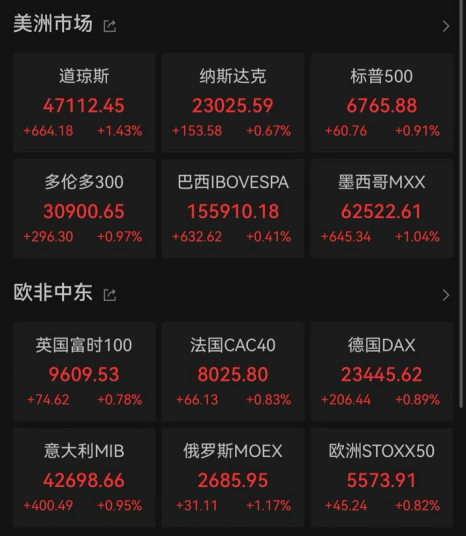
Market Performance - US stock markets collectively rose, with the three major indices experiencing gains for the third consecutive trading day. The S&P 500 index increased by nearly 1%, while the Dow Jones Industrial Average rose over 1% [1][5] - Specific index performances included: Dow Jones at 47112.45 (+664.18, +1.43%), S&P 500 at 6765.88 (+60.76, +0.91%), and Nasdaq at 23025.59 (+153.58, +0.67%) [2][5] Federal Reserve Developments - The final interviews for the new Federal Reserve Chair candidates are expected to conclude soon, with Kevin Hassett being viewed as the frontrunner for the position [8][9] - Federal Reserve Governor Milan stated that the US economy requires significant interest rate cuts, indicating that current monetary policy is hindering economic growth and contributing to rising unemployment [3][15] - Financial markets anticipate a 25 basis point rate cut during the Federal Reserve's meeting on December 9-10, which would lower the federal funds rate target range from 3.75% to 4% [15] Technology Sector Insights - Nvidia claimed its technology remains "a generation ahead of the industry," asserting it is the only platform capable of running all AI models across various computing scenarios [4][5] - Nvidia's stock faced a significant drop of over 7% before recovering slightly, closing down approximately 2.6%, marking a two-month low in market value [6] International Relations - Reports indicate that Ukraine has tentatively agreed to a peace agreement proposed by the US, although some terms are still under discussion [11][10] - The US and Ukrainian delegations have reached consensus on core terms of the peace agreement, with expectations for Ukrainian President Zelensky to visit the US soon to finalize the deal [11]




隔夜欧美·11月26日
Sou Hu Cai Jing· 2025-11-26 00:32
Market Performance - The three major U.S. stock indices closed higher, with the Dow Jones up 1.43% at 47112.45 points, the S&P 500 up 0.91% at 6765.88 points, and the Nasdaq up 0.67% at 23025.59 points [1] - Major U.S. tech stocks mostly rose, with Facebook increasing nearly 4%, Google up over 1%, Amazon up more than 1%, Microsoft up 0.63%, Apple up 0.38%, and Tesla up 0.39%. Nvidia, however, fell over 2% [1] - Chinese concept stocks showed mixed results, with Hesai Technology up nearly 11%, Tuya Smart up nearly 9%, and Qifu Technology up over 7%. NIO fell over 4%, Alibaba down over 2%, Atour down nearly 2%, and Baidu down over 1% [1] European Market - European stock indices all closed higher, with Germany's DAX index up 0.89% at 23445.62 points, France's CAC40 index up 0.83% at 8025.8 points, and the UK's FTSE 100 index up 0.78% at 9609.53 points [1] Commodity Markets - International precious metal futures generally rose, with COMEX gold futures up 0.78% at $4126.3 per ounce and COMEX silver futures up 1.50% at $51.08 per ounce [1] - U.S. oil main contract fell 1.24% to $58.11 per barrel, while Brent crude oil main contract dropped 1.2% to $61.97 per barrel [1] Currency and Bond Markets - The U.S. dollar index fell 0.39% to 99.81, while the offshore RMB appreciated by 239 basis points against the dollar to 7.0829 [1] - U.S. Treasury yields collectively declined, with the 2-year yield down 3.62 basis points to 3.459%, the 3-year yield down 2.23 basis points to 3.452%, the 5-year yield down 2.79 basis points to 3.564%, the 10-year yield down 3.07 basis points to 3.996%, and the 30-year yield down 2.05 basis points to 4.650% [1] - European bond yields also fell, with the UK 10-year yield down 0.8 basis points to 4.536%, France's 10-year yield down 2.6 basis points to 3.445%, Germany's 10-year yield down 1.1 basis points to 2.690%, Italy's 10-year yield down 1.9 basis points to 3.438%, and Spain's 10-year yield down 1.4 basis points to 3.193% [1]




Atour Lifestyle Holdings Limited (NASDAQ:ATAT) Maintains Strong Position in Hospitality Sector
Financial Modeling Prep· 2025-11-25 23:06
Core Viewpoint - Atour Lifestyle Holdings Limited (NASDAQ: ATAT) is experiencing significant growth in the hospitality sector, as evidenced by its strong financial performance and positive market outlook [2][3][5]. Financial Performance - In Q3 2025, Atour's net revenues increased by 38.4% year-over-year, reaching RMB 2,628 million (approximately $369 million) [2][6]. - The company's net income rose by 24.6% year-over-year to RMB 474 million (around $67 million), indicating robust growth [3][6]. Market Position - Atour operates a large network of 1,948 hotels with 219,359 rooms as of September 30, 2025, positioning itself as a leading player in the Chinese hospitality market [1]. - The company's market capitalization is approximately $5.24 billion, with a trading volume of 1,031,620 shares [5]. Stock Performance - Macquarie has reaffirmed its "Outperform" rating for ATAT, raising the price target from $39 to $44, reflecting confidence in the company's financial metrics and growth potential [3][6]. - The current stock price is $37.75, with a slight decrease of 0.21% during the trading day, and has shown volatility over the past year, ranging from a high of $42.34 to a low of $21.50 [4].
Atour Lifestyle (ATAT) - 2025 Q3 - Earnings Call Transcript
2025-11-25 13:02
Financial Data and Key Metrics Changes - The company's net revenues for Q3 2025 grew by 38.4% year-over-year and 6.5% quarter-over-quarter to RMB 2,628 million [31] - Adjusted net income for Q3 2025 was RMB 488 million, representing a 27.0% increase year-over-year, with an adjusted net profit margin of 18.6% [35] - Adjusted EBITDA for Q3 2025 was RMB 685 million, up by 28.7% year-over-year, with an adjusted EBITDA margin of 26.1% [35] Business Line Data and Key Metrics Changes - In the hotel business, ROPA was RMB 371.3 million, representing 97.8% of its level in the same period of 2024, with OCC at 99.9% and ADR at 98.1% of the prior year [8] - The retail business achieved GMV of RMB 994 million, reflecting a 75.5% year-over-year increase, with online channels contributing over 90% of total GMV [20] Market Data and Key Metrics Changes - The hotel sector showed moderate recovery with robust travel and leisure demand, while the retail market increasingly focused on experiential offerings and quality-of-life upgrades [5][6] - The company opened 152 new hotels in Q3 2025, a record high for a single quarter, bringing the total to 1,948 hotels, a 27.1% year-over-year increase [10] Company Strategy and Development Direction - The company emphasizes quality-first principles in its expansion strategy, focusing on premier hotels in core locations while maintaining operational quality [47] - Atour Planet aims to lead the sleep industry with innovative product standards based on sensory science, differentiating itself from competitors [54] Management's Comments on Operating Environment and Future Outlook - Management noted a shift in consumer behavior towards value and rational purchasing decisions amid macroeconomic volatility [5] - The company expects continued divergence in market performance but remains optimistic about long-term growth through quality offerings and user engagement [42] Other Important Information - The company declared a second cash dividend for 2025 totaling approximately USD 50 million, representing about 29% of last year's net income [61] - The company maintains a healthy cash position with cash and cash equivalents totaling RMB 2,670 million as of September 30, 2025 [35] Q&A Session Summary Question: Could the management share the REFPA trend since October? - Management indicated that REFPA has shown progressive improvement year-over-year, with expectations for easing pressure in Q4 due to strong demand in core cities [40][41] Question: Could you share more about the recent new hotel signing trends? - Management confirmed that new hotel signings are in line with last year, maintaining a steady development pace, with a target of 500 new openings for the year [49] Question: Could the management share your perspective on the competition in the retail business? - Management acknowledged increasing competition but emphasized a focus on evolving user needs and the introduction of innovative product standards to maintain a competitive edge [53][54] Question: Could management provide an update on the planning and progress regarding shareholder returns? - Management stated that the cumulative dividend for the year reaches about USD 108 million, exceeding their commitment of at least 50% of net income [61][62] Question: Could you share your plan for the Atour Lite brand in the next steps? - Management expressed optimism about Atour Lite's long-term development, focusing on solidifying operational foundations and aiming for 1,000 hotels in the future [69]