BABA(BABA)

Search documents
阿里:坚定加大投入淘宝闪购以达到市场绝对第一
Di Yi Cai Jing· 2026-01-08 05:44
Group 1 - Alibaba's latest communication with investors indicates that Taobao Flash Sale has made significant progress in the most recent quarter [1] - The company's investment strategy for Taobao Flash Sale by 2026 has become clearer, with a primary goal of market share growth [1] - Alibaba is committed to increasing investments to achieve absolute market leadership in the flash sale segment [1]

阿里:加大投入淘宝闪购以达到市场绝对第一
第一财经· 2026-01-08 05:43
Group 1 - The core viewpoint of the article highlights that Alibaba's Taobao Flash Sale has made significant progress in the latest quarter [1] - Alibaba Group has clarified its investment strategy for Taobao Flash Sale, aiming for market share growth and committing to increased investment to achieve absolute market leadership by 2026 [1]


阿里明确淘宝闪购2026年目标,加大投入争夺市场份额绝对第一
Cai Jing Wang· 2026-01-08 05:20
Core Insights - Alibaba aims to increase its market share in the flash purchase segment to achieve absolute market leadership by 2026, with a clear strategy to increase investments in this area [1][3]. Group 1: Business Performance - In the latest quarter, Taobao Flash Purchase has shown significant progress, with strong growth momentum continuing into Q4 of 2025 [1][3]. - The non-food instant retail segment is advancing rapidly, and Taobao Flash Purchase is reducing losses faster than its competitors [1][3]. - The progress made in December has further strengthened Alibaba's confidence in increasing investments in the flash purchase business [1][3].
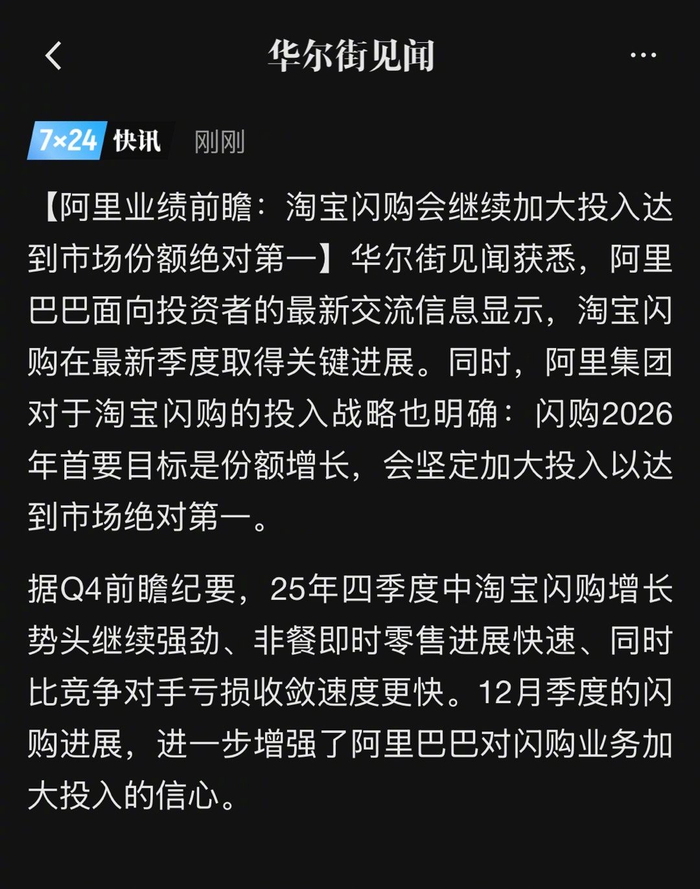
淘宝闪购:2026首要目标是份额增长,坚定加大投入达到市场绝对第一
Xin Lang Cai Jing· 2026-01-08 05:14
Core Insights - Alibaba's Taobao Flash Purchase has made significant progress in the latest quarter, with a clear investment strategy aimed at achieving market leadership by 2026 [1][5] - The focus remains on market share growth, with strong momentum in the fourth quarter of 2025, particularly in non-food instant retail, and a faster reduction in losses compared to competitors [1][7] Group 1: Business Performance - In the December quarter, Taobao Flash Purchase saw continuous growth in GMV share, with an increase in average order value (AOV) and stable order share [1][6] - The platform achieved a peak daily order volume of 120 million in August, with monthly active buyers surpassing 300 million, indicating rapid market share growth [6][7] - The non-food retail segment is accelerating, with significant collaboration effects observed with Hema and Tmall Supermarket, leading to a 70% year-on-year increase in daily orders for Hema after integration [3][6] Group 2: Strategic Initiatives - The company is focusing on high-value user engagement and retail category development, utilizing features like "explosive good stores" to drive higher average transaction values [2][6] - New service upgrades, such as 20-minute free delivery and 1v1 delivery, are enhancing overall user experience [2][6] - The company plans to continue investing in high-value user acquisition and non-food retail over the next few quarters to increase user scale and loyalty [4][7] Group 3: Financial Outlook - The expected loss for Taobao Flash Purchase in the fourth quarter is around 20 billion, with a faster loss reduction compared to competitors, alleviating market concerns about sustainable investment [3][7] - Efficiency improvements are driven by three key levers: user structure optimization, order structure optimization, and fulfillment cost optimization [7]
阿里为什么非要打千问这场仗?
Tai Mei Ti A P P· 2026-01-08 04:45
Core Insights - Alibaba's Qianwen App achieved over 30 million monthly active users (MAU) within 23 days of its launch, setting a global record for AI application growth, reflecting the company's urgency to secure its future in the AI landscape [1] - The C-end market for AI technology has fully penetrated, with 515 million users in China by June 2025, and over one-third of internet users having engaged with AI applications, showing a preference for domestic models [2] - Alibaba's CEO emphasized the dual focus on AI to B and AI to C strategies, aiming to create an "AI-native super application" [3] Group 1: Competitive Landscape - Alibaba's obsession with maintaining its "entry point" stems from past experiences of being challenged in the internet space, particularly during the rise of third-party platforms that impacted its e-commerce ecosystem [4][5] - The shift to mobile internet intensified Alibaba's need for high-frequency entry points, leading to strategic failures in social media attempts, which resulted in costly and passive user acquisition [6] - Competitors like ByteDance and Tencent have successfully captured significant user engagement, with ByteDance's AI assistant surpassing 100 million daily active users (DAU) and Tencent's product ranking among the top three in the domestic market [6] Group 2: Strategic Initiatives - In December, Alibaba established the Qianwen C-end business group to consolidate its AI efforts, with a clear mandate to position Qianwen as the "super app" of the AI era [7] - The company is shifting its focus from a tool-based approach to an AI-native strategy, as evidenced by the appointment of a young technical expert to lead product development [8] - Alibaba is rebranding its "Tongyi" app to "Qianwen" to unify its technology and product branding, aiming to create a strong association between Alibaba AI and Qianwen in users' minds [9] Group 3: Ecosystem Integration - Qianwen is positioned as a core component of Alibaba's AI capabilities, integrating various services like food delivery, ticket booking, and shopping to become a daily life super entry point [12] - The app's integration with Gaode Map is just the beginning, with plans for deeper collaboration with platforms like Taobao and Alipay to streamline user experiences across services [17] - The complexity of integrating these systems poses challenges, especially in a tightening cash flow environment, but successful implementation is crucial for Alibaba's strategic objectives [17] Group 4: Market Dynamics - Alibaba's cash reserves have been surpassed by Pinduoduo for the first time, highlighting a significant shift in the competitive landscape and the urgency for Alibaba to focus its resources on AI [8] - The public cloud market for large models is rapidly evolving, with a projected 400% growth in model usage in the first half of 2025, emphasizing the need for cloud providers to control their models to avoid becoming mere service providers [20] - Alibaba's strategy involves using the C-end entry point to drive B-end growth, showcasing its AI capabilities to attract enterprise clients and maintain pricing power in the cloud market [18][21]
【独家】淘宝闪购非餐订单已稳定在日均1000万单
Xin Lang Cai Jing· 2026-01-08 04:34
1月8日消息,智通财经独家获悉,淘宝闪购非餐订单量已经稳定在日均1000万单。这是淘宝闪购业务的 又一关键进展。 另有市场消息显示,12月季度,淘宝闪购GMV份额持续增长,订单结构持续改善,比竞对亏损收敛速 度更快,非餐即时零售进展快,对远场电商交叉销售符合预期。淘宝闪购的首要目标是份额增长,会加 大投入以达到市场绝对第一。(智通财经记者 程璐) ...
中国股票策略 - 中港市场主动型多头基金的持仓-China Equity Strategy-Positions of Active Long-only Managers in ChinaHK
2026-01-08 02:43
Summary of Key Points from the Conference Call Industry Overview - The report focuses on the **China Equity Strategy** and the dynamics of **foreign fund flows** into Chinese equities, particularly in the context of **A-shares** and **Hong Kong** markets [1][2]. Core Insights - **Foreign Inflows**: In December, foreign inflows into Chinese equities accelerated to **US$3.5 billion**, driven by **US$4.4 billion** from passive funds and **US$0.9 billion** from active funds [1][11]. - **Cumulative Inflows**: For 2025, cumulative foreign long-only fund inflows reached **US$14 billion**, a significant recovery compared to **US$26 billion** outflow in 2023-24 [11]. - **Market Liquidity**: Onshore equity mutual fund AUM rose sharply in December, with a net increase of **Rmb2.2 trillion** in 2025, nearly double the **Rmb1.0 trillion** increase in 2024 [11][12]. - **Sector Performance**: Active fund managers increased their positions in sectors such as **Insurance**, **Capital Goods**, and **Consumer Discretionary**, while trimming positions in **Bank**, **Pharmaceutical**, and **Consumer Durables & Apparel** [11]. Fund Flow Dynamics - **Passive vs. Active Funds**: Passive funds saw inflows of **US$4.4 billion** in December, while active funds experienced outflows of **US$0.9 billion**, indicating a shift in investor preference towards passive investment strategies [11][12]. - **Retail Participation**: Retail investor activity remained stable, with new SSE account openings slightly increasing to **2.6 million** in December, compared to **2.4 million** in November [21]. Additional Insights - **Money Market Funds**: AUM for money market funds declined to **Rmb116 billion** in December, reflecting a reallocation of assets towards equities [31]. - **Private Fund Activity**: Private fund AUM remained stable after a significant increase in October, indicating continued interest from high-net-worth investors [24]. - **Sector-Specific Trends**: Companies like **Ping An Insurance**, **PDD**, and **Alibaba** saw increased investment, while **CCB**, **Xiaomi**, and **Anta** were trimmed by active fund managers [11]. Conclusion - The overall trend indicates a positive shift in foreign investment towards Chinese equities, particularly through passive funds, while active funds are experiencing outflows. The significant increase in AUM for onshore equity mutual funds suggests a strong reallocation towards equities, reflecting investor confidence in the market's recovery.



文华东方完成资产出售 将私有化退市
Zheng Quan Shi Bao· 2026-01-07 18:02
Group 1 - The core point of the news is that Mandarin Oriental has completed the sale of part of its property in Hong Kong, which is a key condition for the privatization by Jardine Matheson Group [1] - Alibaba Group and Ant Group purchased floors 21 to 35 of the building, along with advertising space and parking spots, for $925 million (approximately HKD 7.2 billion) to establish their future headquarters in Hong Kong [1] - Jardine Matheson Group initiated the privatization plan in October 2025, offering $2.75 per share in cash for the remaining 11.96% of shares, with a total payout of $3.35 per share including special dividends [1] Group 2 - Mandarin Oriental was initially listed on the Hong Kong Stock Exchange in 1986 and has undergone several changes in its listing status, including a move to Bermuda and listings in New York and Singapore [2] - The privatization is seen as a strategy to relieve the company from the pressures of short-term performance and complex decision-making processes, allowing for a more flexible execution of long-term strategies [2] - The CEO of Mandarin Oriental emphasized that the shift towards a light-asset growth model remains a core strategy, and the sale of non-core assets is viewed positively for the company's long-term value creation [2]

高德扫街榜升级:科技赋能,开启本地生活新篇章
Sou Hu Cai Jing· 2026-01-07 17:43
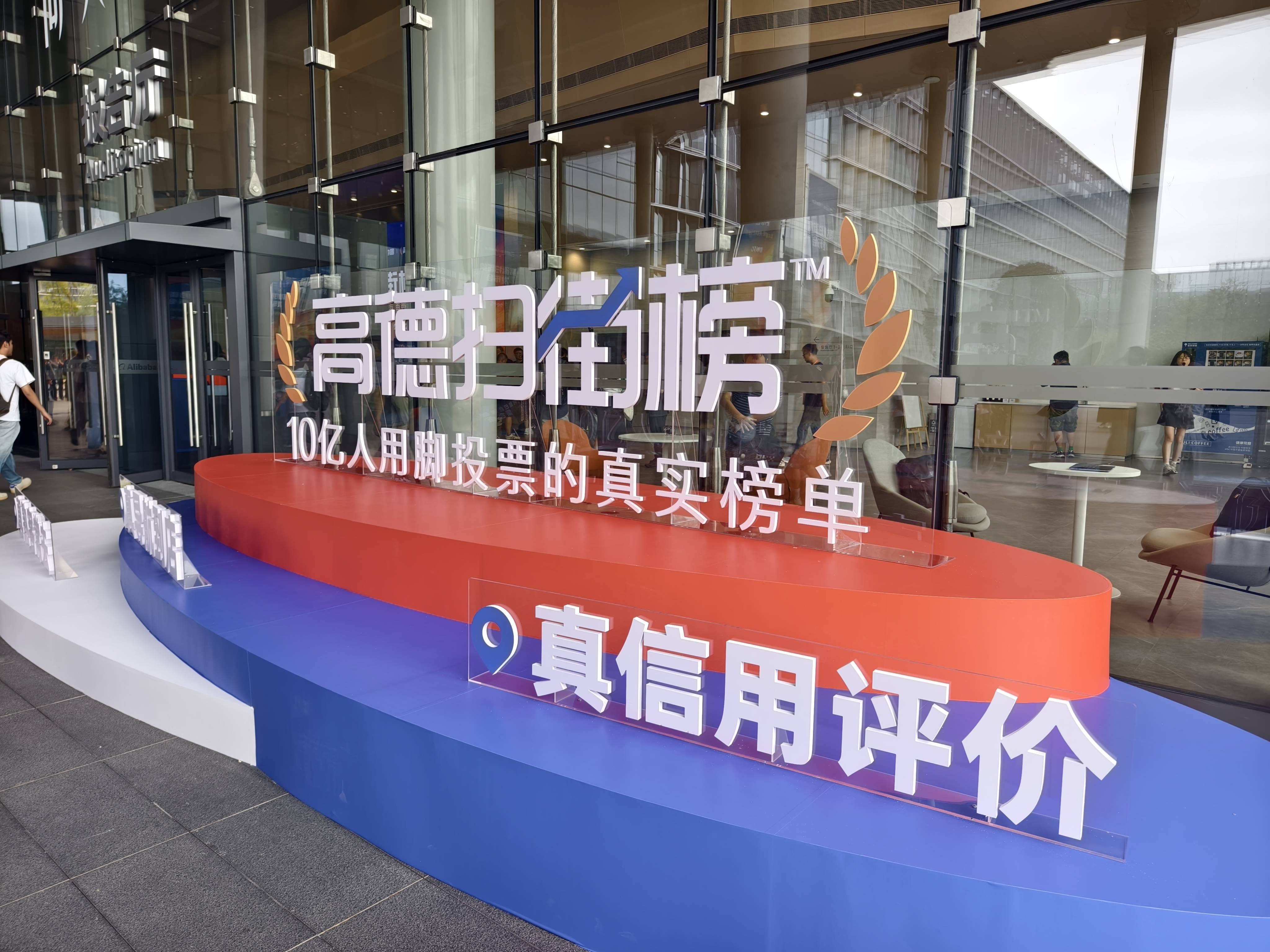
Core Insights - Alibaba's Gaode launched the upgraded Gaode Street Ranking 2026, introducing the "Flying Street View" feature, which allows users to view real store environments from a street perspective, and plans to offer this feature for free to 1 million merchants [3][5] - The Gaode Street Ranking has surpassed 660 million users, with an average of 46 million new monthly active users since its launch, bringing the total to 996 million [4] - The platform has attracted 860,000 new merchants within 100 days, with merchant order volume increasing by over 330% and revenue growing by over 270% [4] User Engagement and Features - The Gaode Street Ranking has expanded from food rankings to cover all local life scenarios, aiming to become a super entry point for local services [5] - The "Flying Street View" feature enhances consumer decision-making by providing detailed information about restaurant environments, parking conditions, and private room visuals [5] - New features include seasonal and location-based dynamic service rankings, with 1,550 category rankings covering various interests such as hiking and camping, along with personalized ranking creation and sharing options for users [5][6] Business Opportunities - The upgrade not only enhances user experience but also provides merchants with more opportunities for visibility and growth, marking a new chapter in local service offerings [6]
相中微盟私域流量 淘宝闪购猛攻即时零售
Bei Jing Shang Bao· 2026-01-07 15:39
淘宝闪购选择拉上微信的盟友。1月7日,北京商报记者从微盟获悉,微盟集团已与阿里巴巴集团旗下本 地生活服务平台淘宝闪购达成战略合作,双方将围绕即时零售、数字营销、技术创新等领域展开多维业 务合作与探索。 淘宝闪购是即时零售赛道的实力选手,微盟是微信私域流量的资深玩家。公私域流量、商家供给资产、 数字化经营能力等资源,是双方"联姻"的推手,也是当下急需补上的短板。 各取所需 电子商务交易技术国家工程实验室研究员赵振营也表示,微盟能扩大SaaS覆盖与订阅收入,淘宝闪购能 补齐私域与商户运营能力,双方共同做大即时零售蛋糕,可以把"顾客资产"变成生态共有的增长引擎。 精细化运营 从微盟和淘宝闪购具体的合作内容来看,双方将进行系统打通和业务协同,在商户资源上实现共享。例 如微盟的商户能高效接入淘宝闪购平台,实现本地零售"到家、到店"的一体化运营。这意味着,淘宝闪 购将借势获得更多本地生活领域的商家资源。根据微盟2025年上半年的财报数据,使用微盟SaaS产品等 订阅方案服务的商家数量有5.9万家,覆盖本地生活、服饰、快消、美妆等领域。其中,有1227家品牌 商家使用微盟的智慧零售解决方案服务,这类商家每用户平均订单收入为 ...