
Bank of America(BAC)

Search documents
信用卡资金炒股风险巨大
Zheng Quan Ri Bao· 2025-08-27 16:20
Core Viewpoint - The use of credit card funds for stock trading is prohibited by banks and regulatory authorities due to the inherent risks and misalignment with the intended purpose of credit cards, which is for consumer spending rather than investment [1][4]. Group 1: Risks of Using Credit Card Funds for Stock Trading - Using credit card funds for stock trading significantly amplifies the debt risk for cardholders due to high borrowing costs and short repayment periods, making it unsuitable for investment purposes [2]. - Credit card funds are often accessed through cash advances or other means that incur fees several times higher than brokerage financing rates, creating a burden that requires excessive returns to cover costs [2]. - The mismatch between the short repayment cycle of credit cards and the uncertain duration of stock investments can lead to financial distress for investors [2]. Group 2: Impact on Banking and Risk Management - The diversion of credit card funds into the stock market undermines the established risk management frameworks of banks, which are based on predictable consumer behavior and spending patterns [3]. - This shift necessitates increased operational costs for banks as they must invest more resources to meet compliance requirements and manage the heightened risk associated with stock market volatility [3]. - The potential for increased default rates and bad debts due to stock market investments poses a threat to the asset quality of banks [3]. Group 3: Broader Financial Market Implications - The speculative nature of using credit card debt for stock trading can disrupt normal market operations, leading to irrational price fluctuations and undermining the price discovery process [4]. - Such practices transfer stock market risks to the banking system, increasing the overall risk exposure of the financial system [4]. - The consequences of investment losses can lead to a cycle of debt for cardholders, potentially impacting the stability of the credit market and the broader financial ecosystem [4].

AI热潮卷至证券化市场!美银预测:数据中心将推动数字基建证券化规模明年突破1100亿美元
智通财经网· 2025-08-26 03:34
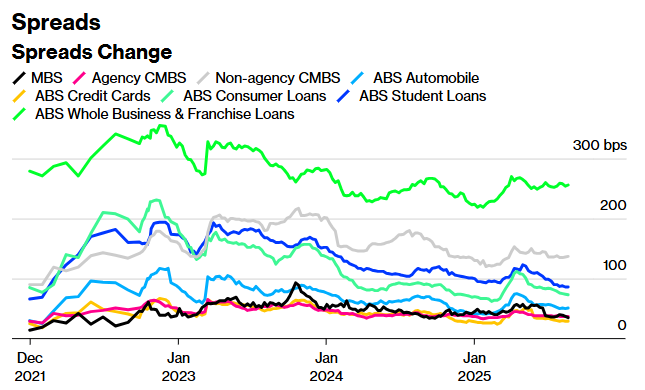
Group 1 - The securities market supported by various digital infrastructures, including data centers, is expected to grow by approximately 46% by the end of next year, reaching about $115 billion [1] - Data centers currently account for 61% of the $79 billion digital infrastructure securitization market, with fiber infrastructure at 20% and base stations at 18% [1] - Companies are building large data centers to meet the demand for artificial intelligence, with banks and private lenders competing to underwrite these transactions [1] Group 2 - Following strong earnings reports from major corporations, investor concerns regarding the development of data centers, cloud technology applications, and investment paths in artificial intelligence have eased [2] - Major data center developers like Microsoft, Google, Amazon, and Meta have reported higher cloud business revenues and reaffirmed plans to increase capital expenditures [2] - The risk premiums for all three types of digital infrastructure asset-backed securities have significantly increased over the past two years, but they are expected to maintain higher relative value compared to other types of asset-backed securities [2] Group 3 - The spread of container asset-backed securities (ABS) will be limited as market participants assess recent economic data, tariff policies, and monetary policies [4] - Container shipping volumes have remained near historical highs, with an estimated new issuance of container asset-backed securities around $1.5 billion this year [4] - The first issuance scale of asset-backed securities in the U.S. for 2025 has decreased by approximately 0.9% compared to the same period last year, reaching $239.7 billion [4]




【银行观察】优化银行风险管理 落实好并购贷款政策
Zheng Quan Shi Bao· 2025-08-26 00:55
Core Viewpoint - The National Financial Supervision Administration has released a draft for the "Management Measures for Mergers and Acquisitions Loans by Commercial Banks," marking a comprehensive upgrade in the regulatory framework for acquisition loans since 2015. The revision aims to optimize services while controlling risks, providing policy support for banks to expand their business while enhancing their risk management capabilities [1][2]. Group 1: Regulatory Changes - The new measures introduce a balanced approach of "moderate looseness and strictness," allowing for financial support in industrial integration while setting clear risk boundaries for banks [1]. - For the first time, the measures include support for equity acquisitions, addressing the previous limitation of only covering controlling acquisitions, aligning with current industrial chain collaboration needs [1]. - The loan ratio and term have been relaxed, with the upper limit for controlling acquisition loans raised from 60% to 70% and the maximum term extended from 7 years to 10 years. For equity acquisitions, the loan ratio is capped at 60% with a maximum term of 7 years, easing financial pressure on acquirers [1]. Group 2: Enhanced Supervision - The measures require banks engaging in acquisition loans to meet basic conditions such as "good regulatory ratings" and "compliance with key prudential regulatory indicators," along with asset size thresholds to prevent smaller banks from engaging in high-risk activities [2]. - A closed-loop risk control process is mandated, focusing on pre-loan assessments of borrowers' repayment capabilities and post-loan vigilance against fund misappropriation and fraudulent acquisitions [2]. - Quantified risk boundaries are established through prohibitive clauses, such as limiting the total balance of acquisition loans to no more than 50% of Tier 1 capital and capping equity loan balances at 30% of total acquisition loans [2]. Group 3: Risk Management Requirements - Banks are encouraged to establish specialized management mechanisms and systems to comply with the new measures, including defining business processes, risk assessment standards, and approval mechanisms, along with developing dedicated information systems for real-time monitoring of acquisition transactions and financial flows [2][3]. - The establishment of professional teams is emphasized, requiring banks to form multidisciplinary teams including acquisition experts, credit analysts, industry researchers, lawyers, and accountants to enhance risk identification accuracy [3]. - A multi-dimensional repayment capacity assessment system is to be constructed, incorporating both financial and non-financial factors to evaluate the ongoing profitability and debt repayment ability of acquired companies, thus avoiding misjudgments based on singular indicators [3].
美股集体收跌!芯片巨头警告风险
Guo Ji Jin Rong Bao· 2025-08-26 00:48
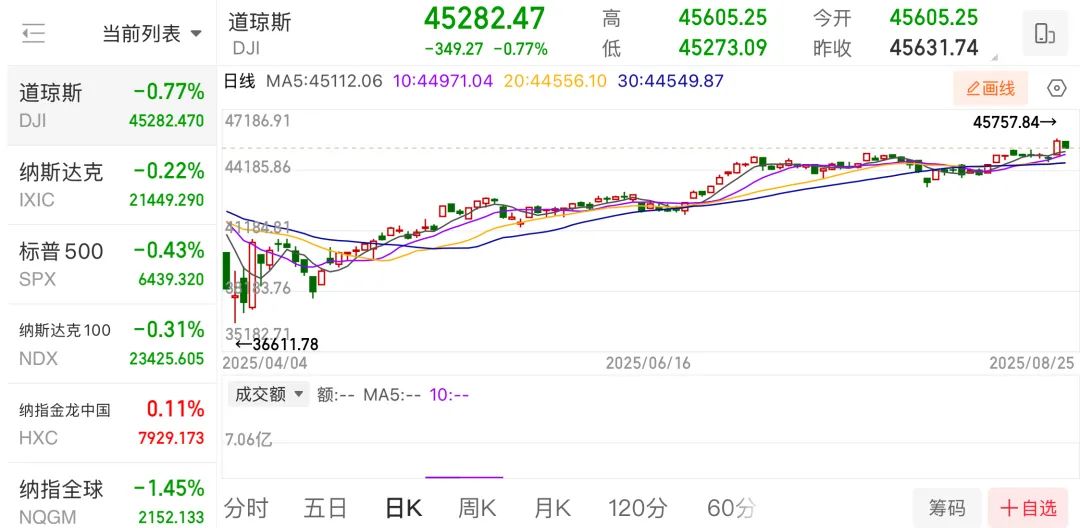
Market Overview - On August 25, US stock indices collectively declined, with the Dow Jones falling by 349.27 points to close at 45,282.47, a decrease of 0.77% [1] - The Nasdaq dropped by 47.24 points to 21,449.29, down 0.22%, while the S&P 500 fell by 27.59 points to 6,439.32, a decline of 0.43% [1] Technology Sector - Major tech stocks showed mixed performance; Tesla rose by 1.94%, Google increased by over 1%, and Nvidia also gained over 1%. In contrast, Microsoft fell by 0.59%, Amazon by 0.39%, Apple by 0.26%, and Facebook by 0.2% [3] - Nvidia announced the launch of the Drive AGX Thor development kit, available for pre-order immediately and set to ship in September, aimed at accelerating the design, testing, and deployment of autonomous vehicles and smart transportation solutions [3] - Nvidia also launched the Jetson AGX Thor developer kit, specifically designed for robotics applications, with a starting price of $3,499, now available for global customers including those in China [3] - Intel stated that Trump's US stockholding plan poses business risks, and on August 22, Intel announced an agreement with the US federal government for an $8.9 billion investment to acquire 433.3 million shares of Intel common stock at $20.47 per share, representing 9.9% of the company [3] Banking Sector - Most bank stocks declined, with JPMorgan down 0.49%, Goldman Sachs down 0.45%, Citigroup down 0.31%, and Morgan Stanley down 0.25%. However, Bank of America rose by 0.04%, and Wells Fargo increased by over 1% [4] Chinese Stocks - The Nasdaq Golden Dragon China Index saw a slight increase of 0.11%. Among popular Chinese stocks, Daqo New Energy rose by over 4%, Melco Resorts increased by over 3%, and NetEase gained over 2%. Conversely, Newegg fell by over 15%, DaJiang Cloud Warehouse dropped by over 9%, and Semtech declined by over 5% [4] Economic Indicators - According to the CME Group's FedWatch tool, traders currently estimate an 84% probability of a Federal Reserve interest rate cut in September [5] - The London Stock Exchange was closed, while the other two major European indices reported declines, with the CAC40 index in Paris closing at 7,843.04, down 126.65 points or 1.59%, and the DAX index in Frankfurt closing at 24,273.12, down 89.97 points or 0.37% [5]


鲍威尔鸽声助力,美小盘股强势反弹!美银、瑞银加入看多阵营
Zhi Tong Cai Jing· 2025-08-25 23:23
Group 1 - The core viewpoint is that small-cap stocks are experiencing a rotation of funds from large-cap technology stocks, supported by dovish signals from the Federal Reserve Chairman Jerome Powell, indicating potential interest rate cuts [1][2] - The Russell 2000 index, a benchmark for small-cap stocks, has outperformed the Nasdaq 100 index in recent weeks, with a 9% increase over three weeks compared to a 3.2% rise for the Nasdaq [1] - Following Powell's comments, the Russell 2000 index saw a single-day increase of 3.9%, marking its best performance since early April, and the inflow into the iShares Russell 2000 ETF reached the highest level since November of the previous year [2] Group 2 - Analysts from Bank of America and UBS believe that small-cap stocks may continue to outperform large-cap stocks in the near term, provided there are no significant macroeconomic surprises [1] - RBC Capital Markets noted that small-cap stocks have finally broken out of their consolidation phase, driven by investor repositioning and outflows from large-cap tech stocks [2] - Truist Financial raised its rating on U.S. small-cap stocks from "less attractive" to "neutral," citing valuation advantages and improving earnings trends [3]

Fed Turns Dovish, Signals Upcoming Rate Cut: What This Means for Banks
ZACKS· 2025-08-25 16:06
Group 1: Federal Reserve's Stance - Federal Reserve Chair Jerome Powell indicated a dovish tone, suggesting a potential rate cut due to a "curious balance" in the labor market with slowing hiring and a shrinking workforce [1][4] - Current market expectations are leaning towards lower rates, with nearly 87% of traders anticipating a 25-basis-point cut in September [2] Group 2: Market Reactions - Stocks experienced a rally following Powell's remarks, with the KBW Nasdaq Bank Index increasing by 3.2% and major banks like Citigroup, Bank of America, JPMorgan Chase, and Wells Fargo showing significant gains [3][10] Group 3: Labor Market and Economic Growth - Powell highlighted rising risks in the labor market, noting that while unemployment is low, hiring and labor supply are declining, which could lead to layoffs and increased joblessness [4] - The Fed is shifting its focus from controlling inflation to protecting jobs and sustaining economic momentum, indicating a more dovish approach [5] Group 4: Financial Conditions and Credit Flows - Elevated borrowing costs are impacting households and businesses, and a rate cut is aimed at easing financing pressures to sustain economic growth [6] - The Fed's rate reductions have begun to stabilize funding costs for banks, supporting net interest income expansion, which is crucial for profitability [7] Group 5: Impact on Banks - Lower rates are expected to relieve financial stress for borrowers, making refinancing more affordable and improving credit quality for banks [8] - Increased lending activity due to lower rates could enhance bank profitability, although the full impact may take time to materialize [9]

美银:The Flow Show-My herd is my bond
美银· 2025-08-24 14:47
Investment Rating - The report indicates a neutral investment sentiment with the BofA Bull & Bear Indicator at 6.0, down from 6.1, suggesting a cautious approach to market conditions [7][41]. Core Insights - There has been a record inflow of $97 billion to global bond funds over the past four weeks, with year-to-date (YTD) inflows for bonds annualizing at a record $700 billion, primarily driven by investment-grade (IG) bonds [1][3]. - The report highlights significant inflows to IG bonds, totaling $57.4 billion over the past four weeks, marking the largest inflow since July 2020 [2][11]. - In contrast, there have been notable outflows from European equities, with a $2.3 billion outflow, the largest in four months, and a continued trend of outflows from UK equities for 18 consecutive weeks [2][17]. Summary by Sections Asset Class Flows - Equities experienced a $3.0 billion inflow, with $10.4 billion inflow to ETFs and $7.3 billion outflow from mutual funds [16]. - Bonds saw inflows of $23.0 billion over the past week, continuing a streak of 17 weeks of positive inflows [17]. - Precious metals recorded a slight inflow of $0.1 billion over the past two weeks [16]. Investment Strategies - BofA private clients have allocated 64.1% of their assets under management (AUM) to stocks, 18.1% to bonds, and 10.7% to cash, indicating a strong preference for equities [3][29]. - The report notes that BofA private clients have been buying industrials, high-yield (HY) bonds, and bank loan ETFs while selling energy, healthcare, and staples [3][23]. Market Indicators - The BofA Bull & Bear Indicator reflects a neutral market sentiment, suggesting that investor sentiment is currently balanced, with no extreme bullish or bearish positions [41]. - The report emphasizes the importance of monitoring upcoming economic indicators, including payrolls and inflation data, which could influence market dynamics [1].
Warren Buffett Is Selling Apple and Bank of America and Piling Into This Beaten Down Value Stock Instead
The Motley Fool· 2025-08-23 14:10
Core Viewpoint - Berkshire Hathaway's stock has declined approximately 10% following the announcement of Warren Buffett stepping down as CEO, primarily due to a contracting valuation multiple as investors reassess the company's worth without his leadership [2][3]. Investment Activity - Berkshire Hathaway has been net selling stocks for 11 consecutive quarters, with significant sales in Apple and Bank of America, while Buffett made a notable investment of around $2 billion in a value stock during the second quarter [3][6]. - Buffett sold 20 million shares of Apple and 26 million shares of Bank of America in the second quarter, contributing to a total of $6.9 billion in stock sales [6]. Valuation Considerations - The forward PE ratio for Apple was between 27 and 29 during most of the quarter, significantly higher than the single-digit multiple Buffett paid in 2016 [8][9]. - Bank of America stock's price to tangible book value exceeded 1.7, which is considered expensive, especially given the current economic conditions [10]. UnitedHealth Group Investment - UnitedHealth Group has faced challenges, including a decline in net margin from 4.3% to 3.1% year-over-year and a revised earnings outlook, now expecting "at least" $16 in earnings per share, down from $27.66 [13]. - The company is under investigation by the DOJ regarding its Medicare Advantage program, which could lead to significant financial penalties [14]. - Despite these challenges, UnitedHealth maintains a strong competitive position due to its scale, which provides negotiating leverage and a solid balance sheet with $32 billion in cash [15][17]. - The stock trades at about 16 times the 2026 earnings per share estimates, with expected annual EPS growth of 13% to 16%, presenting a potential investment opportunity [18].



Billionaire Warren Buffett Sold 41% of Berkshire's Stake in Bank of America and Is Piling Into an Industry Leader That's Gained Almost 47,000% Since Its IPO
The Motley Fool· 2025-08-23 07:24
Group 1 - Berkshire Hathaway has reduced its stake in Bank of America, now holding over 605 million shares, which represents an 8.2% stake in the bank and 9.8% of Berkshire's total stock portfolio [3][5] - From July 2024 through the second quarter of the current year, Berkshire has sold approximately 427 million shares of Bank of America, equating to around 41% of its previous position [5] - Berkshire's cash reserves have reached a record $344 billion, attributed to selling shares in Bank of America and other stocks, including Apple [6][10] Group 2 - Berkshire's decision to sell shares may be influenced by the expectation of an increase in the marginal corporate tax rate, allowing for lower tax payments now [7] - The price-to-book ratio of Bank of America was around 1.29 at the start of August, indicating the stock was trading at a 29% premium [7][9] Group 3 - In the second quarter, Berkshire increased its stake in Pool by approximately 136%, now owning over 3.4 million shares valued at over $1 billion [10] - Pool is the largest wholesaler of swimming pool equipment and has seen a stock price return of nearly 47,000% since its IPO in October 1995 [11] - Pool possesses characteristics that align with Buffett's investment criteria, including a competitive moat, consistent profits, shareholder-friendly leadership, and an attractive dividend [13]

优化商业银行并购贷款服务
Zheng Quan Ri Bao· 2025-08-23 00:16
Core Viewpoint - The recent announcement by the National Financial Supervision and Administration Commission regarding the draft of the "Management Measures for Commercial Bank Mergers and Acquisitions Loans" reflects a regulatory shift aimed at promoting industrial structure optimization and supporting the transformation and upgrading of the real economy, thereby providing stronger financial support for market-oriented mergers and acquisitions in China [1]. Summary by Sections Mergers and Acquisitions Loan Policy Changes - The new measures expand the scope of applicable mergers and acquisitions loans, categorizing them into controlling mergers and equity participation mergers, allowing loans for equity participation under certain conditions [1][2]. - The upper limit for the proportion of loans in the transaction price for controlling mergers has been increased to 70%, with a loan term of up to 10 years, while equity participation loans remain capped at 60% with a 7-year term [2]. Impact on Industries - The adjustments are expected to enhance the activity of mergers and acquisitions in sectors such as technology innovation, advanced manufacturing, and green low-carbon industries, significantly reducing the financial burden on companies in these fields [2]. - The measures are anticipated to benefit cross-border mergers and private equity acquisitions, potentially increasing market liquidity through leveraged returns [2]. Requirements for Commercial Banks - Commercial banks engaging in these loan businesses must meet differentiated asset scale requirements, with a minimum asset balance of 50 billion RMB for controlling mergers and 100 billion RMB for equity participation mergers [3]. - The relaxation of the loan policy necessitates that banks enhance their risk identification capabilities during credit evaluations, particularly for technology and advanced manufacturing sectors [3]. Risk Assessment Emphasis - The new measures stress the importance of assessing the borrower's repayment capacity, requiring banks to conduct comprehensive risk analyses, including strategic, legal, operational, and financial risks associated with mergers [4].