
Bank of America(BAC)

Search documents
Bank of America warns major threat could push trillions out of U.S. banks
Yahoo Finance· 2026-01-16 18:10
Core Viewpoint - Bank of America CEO Brian Moynihan warns that up to $6 trillion in deposits, approximately 30% to 35% of total U.S. commercial bank deposits, could shift to stablecoins, potentially disrupting the banking system [1][2][4]. Group 1: Stablecoin Impact on Banking - Moynihan's projection is based on studies from the U.S. Treasury Department, highlighting the ongoing tensions among lawmakers, regulators, and financial institutions regarding the implications of interest-bearing stablecoins [2]. - He compares stablecoins to money market mutual funds, noting that reserves are typically held in short-term instruments like U.S. Treasurys, which do not contribute to traditional lending [3]. - A significant outflow of deposits to stablecoins could hinder banks' ability to issue credit, which is essential for U.S. economic activity [4]. Group 2: Legislative Developments - The latest Senate crypto market structure bill includes provisions that would prohibit digital asset service providers from offering interest or yield on stablecoin holdings [5]. - The draft legislation allows for "activity-based" rewards, such as incentives related to staking or liquidity provision, amidst intense lobbying from both the crypto and banking sectors [6]. - Concerns have been raised about the bill potentially expanding financial surveillance powers, with a report from Galaxy Research indicating it could grant the Treasury Department extensive authority over digital asset transactions [6][7].

Bank Of America CEO Warns $6 Trillion Could Flee To Stablecoins—Here's Why Banks Are Terrified - Bank of America (NYSE:BAC)
Benzinga· 2026-01-16 17:36
Core Viewpoint - Bank of America CEO Brian Moynihan warns that the introduction of interest-bearing stablecoins could lead to a significant outflow of deposits from banks, potentially amounting to $6 trillion [1][2]. Group 1: Impact on Banking System - Moynihan highlighted that stablecoins designed like money market funds could draw deposits away from banks, forcing them to rely on more expensive wholesale funding instead of cheaper customer deposits [2]. - The disparity in yields is a key factor; if stablecoins offer a 4% yield while banks provide only 0.1% on savings accounts, depositors are likely to shift their funds to stablecoins [2]. - The loss of deposits would compel banks to either reduce lending or borrow from the Federal Reserve at market rates, which would increase loan costs for both businesses and consumers [3]. Group 2: Legislative Developments - A Senate bill introduced by Banking Committee Chair Tim Scott includes a ban on paying interest for merely holding stablecoins, while allowing rewards for activity-based actions like staking [4]. - The markup of the bill was postponed after Coinbase CEO Brian Armstrong expressed that the provisions would negatively impact rewards on stablecoins, indicating ongoing negotiations among stakeholders [5]. - The legislative outcome will determine whether crypto can compete directly with banks for deposits or remain restricted from offering basic savings account features [6].


ASML hits record high on AI boost — and analysts see plenty of room to run
CNBC· 2026-01-16 16:06
Core Viewpoint - ASML Holding NV has reached record highs in its stock price, driven by strong earnings from TSMC, indicating robust demand for advanced semiconductor manufacturing equipment [2][4]. Group 1: Company Performance - ASML's shares have increased approximately 7% following TSMC's earnings report, contributing to a market capitalization of around 450 billion euros ($522 billion) [2]. - The stock has rallied 25% year-to-date in 2026, marking significant growth for the company [2]. Group 2: Market Outlook - Morgan Stanley projects a potential 70% surge in ASML's stock price, estimating it could reach up to 2,000 euros if tech valuations continue to rise and profits exceed expectations [3]. - The price target set by Morgan Stanley for ASML is 1,400 euros, reflecting a bullish outlook on the company's future performance [3]. Group 3: Industry Demand - Increased capital expenditures (capex) for foundries and memory, along with better-than-expected demand from China, are expected to drive higher earnings for ASML in FY27 [4]. - TSMC's capex guidance has significantly surpassed prior expectations, suggesting near-term upside for ASML as advanced manufacturing tools become essential for efficiency [4].



一周热榜精选:特朗普暂缓对伊动武,金银比跌至危险区间
Jin Shi Shu Ju· 2026-01-16 14:19
Market Overview - The market this week was driven by two main themes: the investigation rumors surrounding Federal Reserve Chairman Jerome Powell and the fluctuating geopolitical situation regarding Iran, impacting gold, silver, and oil prices [2][3] - The US dollar index faced initial pressure due to political uncertainty but later strengthened, supported by better-than-expected economic data and reduced rate cut expectations, aiming for a third consecutive week of gains [2] - Gold prices reached a historical high of $4642.85 per ounce before settling at $4583 per ounce, while silver peaked at nearly $93.70 per ounce, marking a nearly 30% increase this year [3] Federal Reserve Insights - Concerns over the independence of the Federal Reserve have led to speculation that it may adopt a more hawkish stance, as indicated by various financial institutions [5] - Multiple Federal Reserve officials emphasized the need to maintain independence and base decisions on data rather than political pressure, with some suggesting that current economic data does not support immediate rate cuts [12][13] Geopolitical Developments - The geopolitical situation in Iran has seen a temporary easing, with the US indicating a reduced likelihood of large-scale military action, although military readiness remains [14][15] - Diplomatic efforts from Middle Eastern countries have contributed to the de-escalation of tensions, with the US maintaining a stance of observing Iran's actions closely [15] Investment Strategies - The introduction of dynamic margin requirements for precious metals by CME is expected to increase market volatility, particularly affecting high-leverage traders [16] - The National Grid of China plans to invest 4 trillion yuan in the construction of a new power system during the 14th Five-Year Plan, marking a 40% increase from the previous plan [21] Corporate Earnings - Major banks such as Goldman Sachs and Morgan Stanley reported strong quarterly earnings, driven by a rebound in investment banking activities and robust trading revenues [27] - TSMC reported a record net profit of NT$505.7 billion (approximately $16 billion) for Q4 2025, with a 35% year-on-year increase, attributed to strong demand for AI-related chips [24]





一周热榜精选:特朗普暂缓对伊动武,鲍威尔获美欧央行集体护驾
Jin Shi Shu Ju· 2026-01-16 13:33
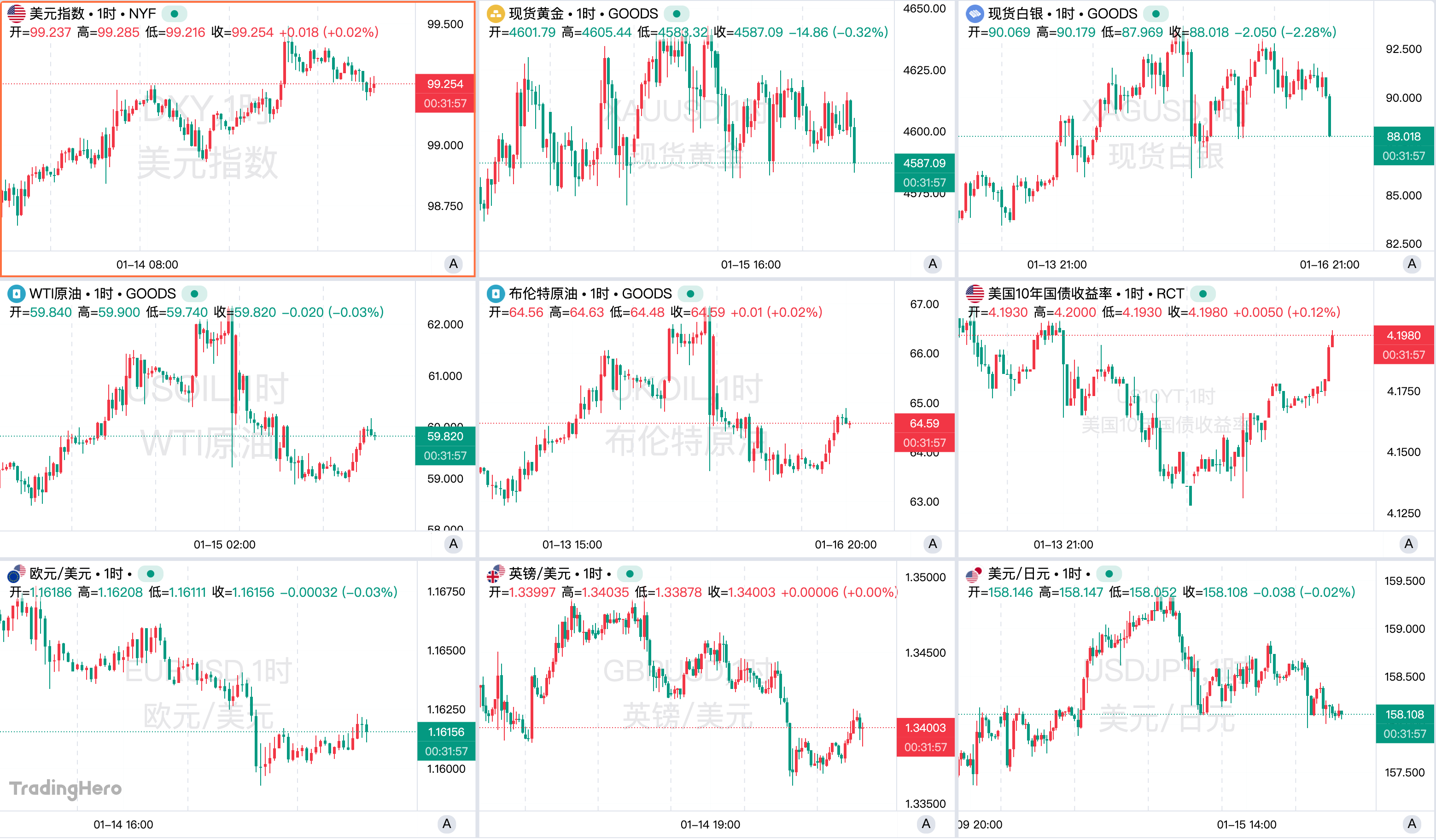
Market Overview - The market this week was influenced by two main themes: the investigation rumors surrounding Federal Reserve Chairman Jerome Powell and concerns over the "independence of the Federal Reserve," impacting the dollar and interest rate expectations; and fluctuating geopolitical news related to Iran, leading to volatility in gold and oil prices [1] - The dollar index faced pressure early in the week due to political uncertainty but later strengthened supported by better-than-expected U.S. economic data and reduced expectations for recent rate cuts, aiming for a third consecutive week of gains [1] - Gold prices initially surged to a historical high of $4642.85 per ounce due to geopolitical tensions and uncertainty regarding Federal Reserve policies, but later entered a consolidation phase, closing at $4583 per ounce [1] - Silver saw a significant increase, peaking at nearly $93.70 per ounce, with a year-to-date rise of nearly 30%, although it experienced extreme volatility [1] Non-U.S. Currencies - The "high market trading" led to the Japanese yen falling below the 159 mark against the dollar, reaching its weakest level since July 2024; the euro and pound showed slight weakness while the Australian dollar remained relatively stable [2] - Oil prices were primarily driven by news related to Iran, initially rising due to concerns over internal unrest but later retracing gains as U.S. political statements eased tensions [2] Investment Bank Insights - Lloyds Bank suggested that the Federal Reserve might become a scapegoat for the weak U.S. job market; UBS indicated that concerns over the Fed's independence could lead to a more hawkish stance [5] - Goldman Sachs noted that the Fed would continue to make decisions based on data, unaffected by investigation pressures; Morgan Stanley stated that inflation remains above target, insufficient to support a rate cut in January [5] Major Events - Trump criticized Powell again, claiming he is either incompetent or corrupt, amidst a backdrop of a criminal investigation into Powell, which has drawn support for him from global central bank leaders [6] - The Senate Majority Leader questioned the investigation's legitimacy, emphasizing the importance of the Fed's independence [7] - The December CPI data indicated a strong signal of cooling inflation, leading to increased market bets on early rate cuts, although Fed officials warned against premature easing [8] Corporate Developments - TSMC reported a record net profit of NT$505.7 billion (approximately $16 billion) for Q4 2025, a 35% year-on-year increase, driven by strong demand for AI-related chips [24] - Apple and Google reached a potential $5 billion AI partnership, opting for Google's Gemini model over OpenAI, impacting the competitive landscape in AI technology [26] - Tesla announced a shift from a one-time purchase model for its Full Self-Driving (FSD) feature to a subscription model, aiming to create a more stable revenue stream and lower entry barriers for consumers [28]

Bank Stocks Get Punished After Earnings—Is Valuation the Real Problem?
Investing· 2026-01-16 12:11
Group 1 - The article provides a market analysis focusing on major financial institutions, specifically Bank of America Corp, JPMorgan Chase & Co, and Wells Fargo & Company [1] - It highlights the performance metrics and market positioning of these banks in the current economic environment [1] - The analysis includes insights into their financial health, profitability, and growth prospects based on recent financial reports [1] Group 2 - The article discusses the competitive landscape among the banks, emphasizing their strategies to navigate market challenges [1] - It examines the impact of interest rate changes and regulatory developments on the banking sector [1] - The analysis also touches on the broader economic indicators that influence the performance of these financial institutions [1]


华尔街对白银后市看法
Sou Hu Cai Jing· 2026-01-16 08:57
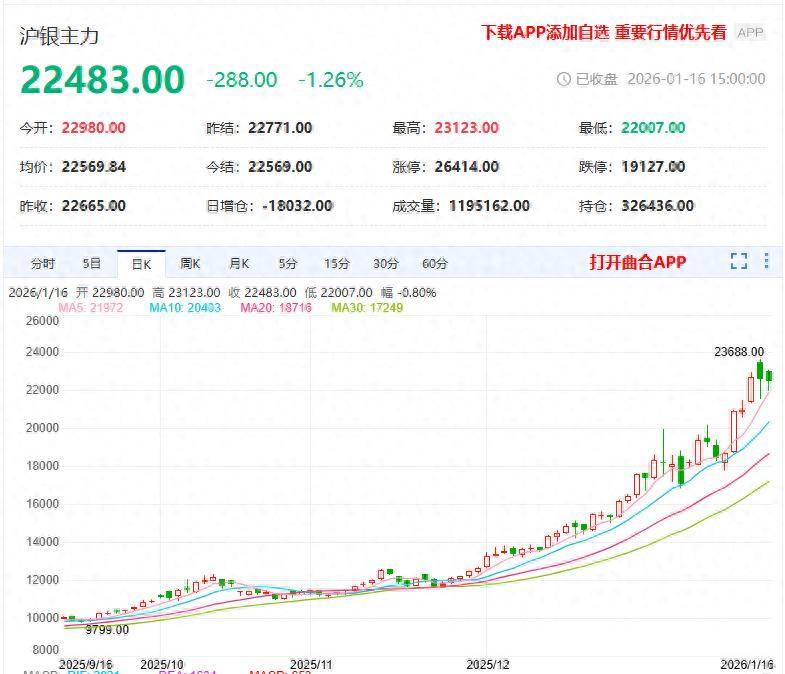
Group 1 - Citigroup has significantly raised its silver price target for the next 0-3 months from $62/oz to $100/oz, while also bullish on gold at $5000/oz, driven by escalating geopolitical risks, persistent physical market shortages, and expectations of easing monetary policy due to doubts about the Federal Reserve's independence [1] - UBS predicts that silver may outperform gold by 2026, driven by industrial demand growth in sectors like renewable energy and AI, with a forecast of reaching $100/oz in the first half of the year, but potentially falling to around $75/oz by year-end due to the nearing end of the Fed's easing cycle [1] - Goldman Sachs emphasizes that silver is more sensitive to capital flows due to the lack of central bank reserve demand, predicting continued price increases but with significantly higher volatility and uncertainty compared to gold [1] Group 2 - JPMorgan maintains a cautious outlook, projecting an average silver price of $40.1/oz for 2026, acknowledging that geopolitical risks and global debt issues will support silver prices, but the pace of increase may be slower [2] - Bank of America provides a wide price range forecast for silver, suggesting it could peak between $135 and $309/oz, based on the expectation that gold reaching $5000/oz will drive silver's rise, alongside supply-demand gaps and industrial demand growth, though no specific timeline is given [2] Group 3 - GF Futures notes that bullish funds are significantly increasing their positions in silver through ETFs and physical delivery, driving prices higher, while global inventory tightness has not truly eased, potentially suppressing industrial demand [5] - The firm warns that the current high price levels may lead to a correction due to irrational price movements driven by short-term capital sentiment, suggesting a cautious approach with light long positions above $70/oz [5]


Trump’s Market Mayhem: A Daily Dose of Volatility, Served Fresh
Stock Market News· 2026-01-16 06:00
Financial Sector - The financial sector experienced a significant downturn following President Trump's announcement of a one-year cap of 10% on credit card interest rates, effective January 20, 2026, aimed at protecting consumers from high rates averaging around 20% [2][3] - Major financial institutions like JPMorgan Chase, Bank of America, Citigroup, and Wells Fargo saw their stock prices drop significantly, with JPMorgan's shares falling 4.2% to $310.90 despite better-than-expected earnings [3][4] - Consumer finance firms specializing in credit cards faced even steeper declines, with drops between 8% and 11% for companies like Synchrony Financial and Capital One, while Visa and Mastercard also saw declines of over 2% [4] Semiconductor Industry - A trade deal between the U.S. and Taiwan resulted in a reduction of tariffs on Taiwanese goods from 20% to 15%, in exchange for Taiwan's commitment to invest $250 billion in U.S. semiconductor and AI sectors [6][7] - Taiwan Semiconductor Manufacturing Co. reported a 35% year-over-year increase in fourth-quarter profit, leading to a 4.5% surge in its U.S.-listed shares, with trading volume increasing by 159% [7] - Despite a new 25% tariff on specific high-end AI chips, Nvidia's stock rebounded by around 3% due to positive earnings from TSMC and exemptions for companies investing in America [8][9] Healthcare Sector - President Trump introduced "The Great Healthcare Plan" aimed at lowering prescription drug prices and insurance premiums, but the lack of details and the need for Congressional approval left the market skeptical [10] - Some healthcare stocks like UnitedHealth Group and Cigna saw modest gains, but the overall market impact was minimal due to concerns over rising premium costs for millions of Americans [10] Geopolitical Developments - President Trump's announcement of a "Board of Peace" in Gaza and withdrawal from 66 global organizations had little immediate market impact, overshadowed by economic news [11] - Oil prices dropped approximately 5% following Trump's de-escalation of military threats against Iran, indicating a positive market reaction to reduced geopolitical tensions [11] Market Volatility - The week illustrated the unpredictable nature of the market under Trump's administration, characterized by sudden policy announcements and immediate market reactions, creating a challenging environment for investors [12]


原油,大跌!刚刚,白银、黄金跳水
Zhong Guo Ji Jin Bao· 2026-01-16 00:28
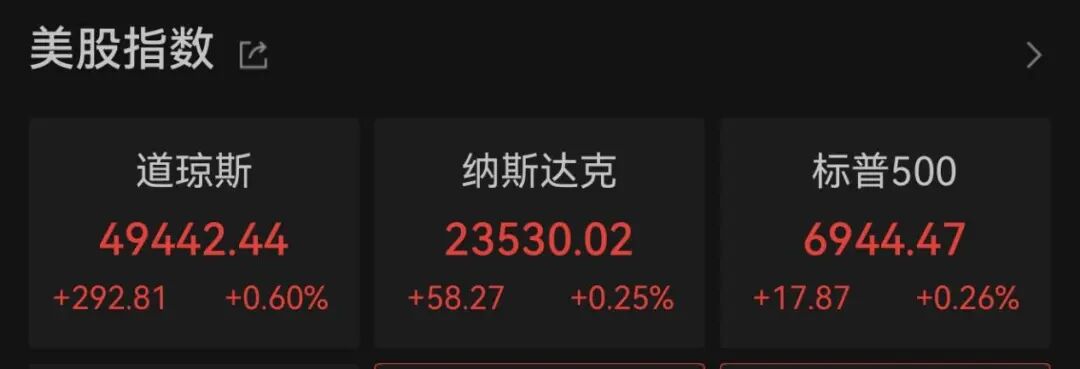
Market Overview - US stock market closed higher, led by gains in bank and chip stocks, with the Dow Jones up 292.81 points (0.60%) at 49,442.44, Nasdaq up 58.27 points (0.25%) at 23,530.02, and S&P 500 up 17.87 points (0.26%) at 6,944.47 [1] Chip Sector - The semiconductor sector saw a broad increase following TSMC's earnings report, with the Philadelphia Semiconductor Index rising 1.76% to a new historical high [4] - The White House announced a 25% import tariff on certain semiconductors and related equipment starting January 15, affecting products like Nvidia's H200 chip and AMD's MI325X AI accelerator chip, while excluding semiconductors for data centers and R&D [4] - TSMC reported a 35% increase in net profit for Q4 2025, reaching approximately $16 billion, marking a record high and exceeding expectations [5] Technology Sector - Major tech stocks showed mixed performance, with Nvidia up over 2%, Facebook up 0.86%, and Amazon up 0.65%, while Google down nearly 1%, Apple down 0.67%, and Microsoft down 0.59% [6] - Apple announced an expansion of Apple Pay's cross-border payment support for users of specific Chinese banks [7] Banking Sector - Bank stocks generally rose, with JPMorgan up 0.48%, Goldman Sachs up over 4%, Citigroup up over 4%, Morgan Stanley up nearly 6%, and Bank of America up 0.16%, while Wells Fargo fell 0.34% [8] - Goldman Sachs and Morgan Stanley reported record high revenues in their trading divisions, with Goldman planning to issue $16 billion in investment-grade bonds, the largest such issuance in Wall Street history [9] Commodity Market - Brent crude oil futures fell by $2.76 (4.15%), and WTI crude oil futures dropped by $2.83 (4.56%) [10] - Gold and silver prices experienced significant declines, with silver down over 1.5% [10]



两大利好突袭 美股全线大涨!
Zheng Quan Shi Bao Wang· 2026-01-15 23:36
Group 1: Market Performance - The U.S. stock market saw a strong performance with all three major indices rising, driven by better-than-expected earnings reports from Morgan Stanley and Goldman Sachs, leading to significant gains in financial stocks [1][2] - Morgan Stanley's stock surged over 6%, while Goldman Sachs rose over 4%, both reaching historical highs [1][2] - The Nasdaq index experienced a peak increase of over 1% during trading, reflecting renewed investor enthusiasm for technology stocks, particularly in the semiconductor sector [1] Group 2: Financial Sector Earnings - Morgan Stanley reported Q4 2025 revenues of $17.89 billion, a 10.3% year-over-year increase, surpassing market expectations of $17.77 billion, with earnings per share of $2.68, exceeding the forecast of $2.44 [2] - Goldman Sachs disclosed Q4 revenues of $13.45 billion, a slight decline of 3% year-over-year, but its Non-GAAP earnings per share reached $14.01, significantly above the expected $11.76 [2] Group 3: Semiconductor Sector Insights - TSMC's Q4 earnings report showed a gross margin exceeding 60% for the first time, with a net profit of $16 billion, a substantial 35% increase year-over-year, exceeding analyst expectations [3] - TSMC plans to significantly increase its capital expenditure to $56 billion in 2026, a 37% rise from the $40.9 billion spent in 2025, indicating a strong commitment to capitalize on AI opportunities [3] - The positive earnings from TSMC led to a 4.4% increase in its stock price, contributing to a broader rally in semiconductor stocks, with the Philadelphia Semiconductor Index rising by 1.76% [3] Group 4: Federal Reserve Policy Signals - Recent labor market data indicated a decrease in initial jobless claims to 198,000, significantly below the expected 215,000, alleviating concerns about a weakening labor market [4][5] - Several Federal Reserve officials suggested a pause in interest rate cuts, citing a stable labor market and ongoing inflation pressures [5] - The comments from Fed officials indicate a preference for maintaining a moderately restrictive monetary policy to address persistent inflation concerns [5]