
Barclays(BCS)

Search documents
巴克莱:美国对印度征收关税不太可能促使印度央行降息
news flash· 2025-08-04 03:58
Core Viewpoint - Barclays economists report that the 25% tariffs imposed by the U.S. on India are unlikely to prompt the Reserve Bank of India (RBI) to cut interest rates [1] Group 1: Tariff Impact - The tariff rate and the threat of penalties may place India at a disadvantage [1] - India's tariff rates are higher than those of other regional countries, only slightly lower than the 26% rate announced in April [1] Group 2: Trade Negotiations - As trade negotiations between the two countries continue, India may secure lower tariffs from the U.S. [1] - Barclays suggests that the RBI's monetary policy committee should act cautiously and not overly worry about the potential impact of these tariffs on economic growth [1] Group 3: Monetary Policy Outlook - Barclays anticipates a "dovish pause" from the RBI in its upcoming meeting [1]

今年涨了34%,欧洲银行股飙升至2008年以来最高
Hua Er Jie Jian Wen· 2025-08-03 14:02
Group 1 - The European banking sector is experiencing a significant turnaround, moving from being seen as a "market orphan" to a favored investment, driven by rising long-term interest rates and improved economic outlook [1][3] - Major European bank stocks have reached their highest levels since the 2008 global financial crisis, with HSBC, Barclays, Santander, and UniCredit hitting multi-year peaks [1][3] - The Stoxx 600 Banks Index has risen by 34% year-to-date, outperforming U.S. counterparts and poised for its best annual performance since 2009 [1] Group 2 - Analysts attribute the recovery to higher interest rates, a favorable macroeconomic environment, and banks' efficiency measures, which have significantly boosted net interest income [3][4] - The yield curve in Germany and the UK has created an excellent profit environment for banks, with the 30-year bond yields exceeding 2-year yields by 1.3 and 1.5 percentage points, respectively [4] Group 3 - Despite the stock price increases, many investors still view European bank stocks as undervalued, with a price-to-earnings ratio of around 10, lower than U.S. peers at over 13 [5] - Many European banks have recently returned to their book value, indicating potential for further valuation convergence compared to global counterparts [5][6] Group 4 - There are concerns about the sustainability of the current rally, with some market participants questioning whether the upward momentum can continue without further increases in long-term interest rates [6] - Political resistance has hindered potential industry consolidation, limiting growth prospects for the sector [6] - Despite these challenges, European banks still hold valuation discounts compared to global peers, suggesting potential for future appreciation [6]



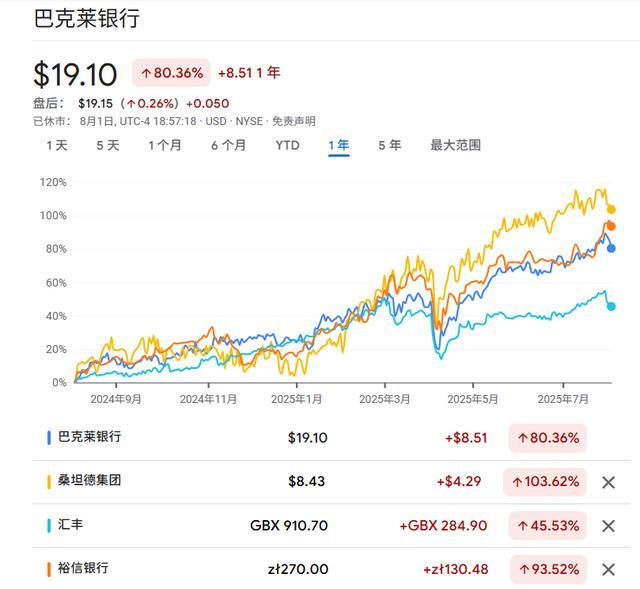
今年涨了34%,欧洲银行股飙升至2008年以来最高!
Hua Er Jie Jian Wen· 2025-08-03 11:33
Core Viewpoint - The European banking sector, once considered a "market orphan," is experiencing a significant resurgence, driven by rising long-term interest rates and improved economic prospects [1][2]. Group 1: Market Performance - Major European bank stocks have reached their highest levels since the 2008 global financial crisis, with HSBC, Barclays, Santander, and UniCredit hitting multi-year peaks [2]. - The European Stoxx 600 Bank Index has risen 34% year-to-date, outperforming U.S. counterparts and poised for its best annual performance since 2009 [2]. Group 2: Industry Transformation - The European banking industry is undergoing a transformation from being viewed as a "market orphan" to a favored sector, as noted by Schroders' analyst Justin Bisseker [4]. - After over a decade of being criticized for insufficient capital and facing regulatory pressures, European banks are now benefiting from higher interest rates and a favorable macroeconomic environment [4]. Group 3: Profitability Drivers - Central banks have raised interest rates to combat inflation, significantly increasing banks' net interest income, which is crucial for profitability [4]. - For instance, the yield on Germany's 30-year government bonds is currently 1.3 percentage points higher than that of 2-year bonds, while in the UK, the spread exceeds 1.5 percentage points, creating an excellent profit environment for banks [5]. Group 4: Valuation Appeal - Despite the substantial rise in stock prices, many investors still view European bank stocks as "cheap," with Pictet's chief strategist highlighting their low valuations and unique advantages in a recovering domestic demand environment [6]. - According to FactSet, many European banks' valuations have just returned to their book values, while U.S. counterparts like JPMorgan have a price-to-book ratio of about 2.4 times [6]. - Bloomberg data indicates that the expected price-to-earnings ratio for European banks is around 10 times, lower than the over 13 times for U.S. peers, with many European banks now achieving a tangible return on equity (ROTE) exceeding 10% [6]. Group 5: Future Challenges - There are uncertainties regarding the sustainability of the current rally in European banks without continued increases in long-term interest rates [7]. - Market sentiment is shifting, with some analysts suggesting that the best times for banks may be behind them, despite the current favorable conditions [7]. - Additionally, attempts at industry consolidation, such as BBVA's bid for Sabadell and UniCredit's interest in BPM, have faced political obstacles, limiting growth potential [7]. - However, Bisseker from Schroders notes that European banks still have valuation discounts compared to global peers, indicating potential for further valuation convergence in the future [7].
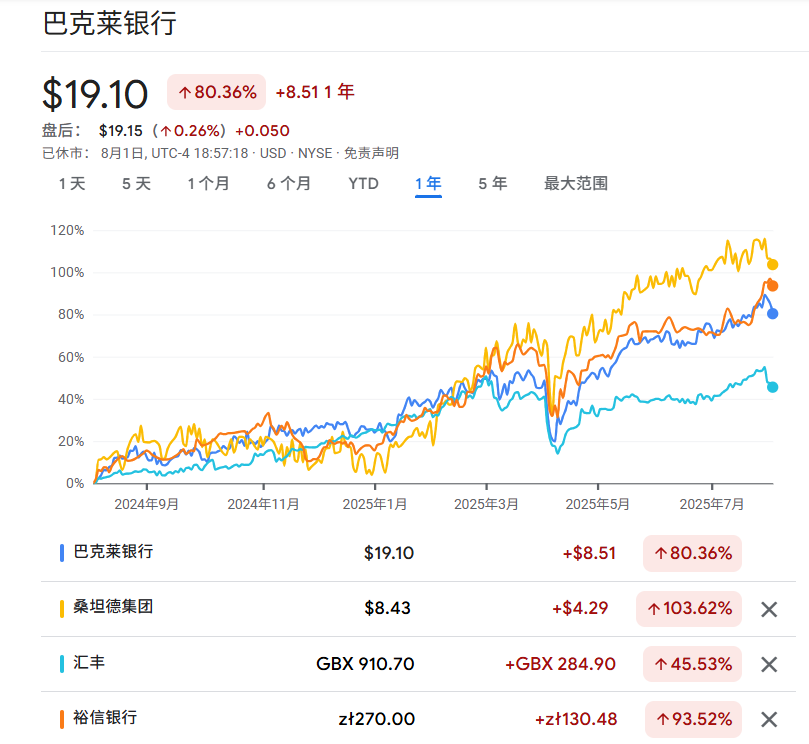
“对等关税”落地,新加坡是亚洲最大赢家、越南是输家,但半导体和药品关税风险更大
Hua Er Jie Jian Wen· 2025-08-02 08:30
Core Viewpoint - The implementation of Trump's "reciprocal tariff" policy has been finalized, with Singapore emerging as the biggest winner in Asia due to a 10% tariff rate, while Vietnam faces the highest value-added weighted U.S. tariff rate globally. The semiconductor and pharmaceutical industries are warned to face greater uncertainty despite current exemptions from broad tariffs [1][2][5]. Tariff Rates Summary - Singapore: 10% [2] - Malaysia: 19% (down from 25%) [2] - Thailand: 19% (down from 36%) [2] - Pakistan: 19% (down from 29%) [2] - Taiwan: 20% (down from 32%) [2] - Sri Lanka: 20% (down from 44%) [2] - South Korea: 15% [3] - Indonesia: 19% [3] - Philippines: 19% [3] - Vietnam: 20% [3] - India: 25% [3] Value-Added Weighted Tariff Analysis - Vietnam has the highest value-added weighted U.S. tariff rate at 2.3%, followed by Thailand, Malaysia, and South Korea in the range of 1.0% to 1.4% [5][6]. - The analysis indicates that Vietnam has a domestic value-added exposure of 15.1% to U.S. tariffs, while Thailand, Malaysia, South Korea, and Singapore have exposures of 9.0%, 8.7%, 6.9%, and 6.8% respectively [6][7]. - In contrast, the Philippines (3.1%), Indonesia (2.3%), and India (2.0%) have relatively lower risk exposures [7]. Semiconductor and Pharmaceutical Industry Risks - The semiconductor and pharmaceutical sectors are highlighted as facing potential tariff threats, with the U.S. Department of Commerce expected to announce results of a national security investigation into semiconductor imports, which may lead to new tariffs [8][9]. - A proposed 200% tariff on pharmaceuticals could severely impact Singapore, as pharmaceuticals are a significant part of its trade with the U.S. [8][9].

7月31日电,巴克莱将2025年欧元区GDP增长预测从之前的0.8%上调至1.1%。
news flash· 2025-07-31 11:59
Core Viewpoint - Barclays has revised its GDP growth forecast for the Eurozone in 2025 from 0.8% to 1.1% [1] Economic Outlook - The upward adjustment in GDP growth indicates a more optimistic economic outlook for the Eurozone [1]
巴克莱:结束做多美元兑台币一年期NDF 预计供需将转回有利台币
news flash· 2025-07-31 06:31
巴克莱银行策略师Lemon Zhang在报告中称,对先前做多美元/台币一年期无本金交割远期合约 (NDF) 的部位进行获利了结;预计来自股利发放、实质资金(real money)增加避险的美元买盘即将结束,令市 场供需动态将重新转为有利台币走强。 ...
巴克莱:特朗普关税威胁加剧印度卢比下跌风险
news flash· 2025-07-31 01:37
巴克莱:特朗普关税威胁加剧印度卢比下跌风险 金十数据7月31日讯,巴克莱银行亚洲外汇及新兴市场宏观策略主管米图尔·科特查在一份研究报告中表 示,特朗普威胁对印度商品加征25%的关税,可能给印度卢比带来更多压力。在关税威胁消息传出后, 卢比已出现大幅下跌。数据显示,美元兑卢比汇率反弹幅度超出预期,但2月触及的略低于88.00的高点 仍是强劲阻力位。此外,从技术面看,卢比短期已呈现超卖状态。 ...
3 Finance Stocks to Watch After Crushing Earnings Expectations: BCS, CINF, LC
ZACKS· 2025-07-31 00:15
Group 1: Barclays - Barclays stock reached a 52-week high of $20 after reporting Q2 EPS of $0.62, exceeding estimates by 24% [2] - Year-over-year, Barclays' Q2 earnings increased by 47% from $0.42, driven by a 20% sales growth to $9.59 billion [2][3] - The bank's valuation remains attractive, trading at 8.9X forward earnings and under 2X forward sales, compared to European peers [3] Group 2: Cincinnati Financial - Cincinnati Financial reported Q2 EPS of $1.97, surpassing estimates by nearly 42% and reflecting a 53% increase from $1.29 in Q2 2024 [4] - The company has a 2.28% annual dividend yield, significantly higher than the S&P 500's average of 1.16% and the industry average of 0.27% [5] - Cincinnati Financial is recognized as a Dividend King, having increased its dividend for over 50 consecutive years with an annualized growth rate of 8.39% [5] Group 3: LendingClub - LendingClub posted Q2 earnings of $0.33, exceeding estimates by 120% and increasing from $0.13 in the prior year [8] - The company achieved Q2 sales of $248.43 million, which was 10% above expectations and a 32% increase from $187.24 million a year ago [8] - LendingClub has consistently surpassed EPS estimates for 10 consecutive quarters, with an average earnings surprise of 53.93% in the last four reports [9]



美联储决议前瞻:或现30年来罕见双反对票
Sou Hu Cai Jing· 2025-07-30 06:52
Group 1 - The Federal Reserve is expected to maintain the federal funds rate in the range of 4.25% to 4.50% for the fifth consecutive time during the July meeting [1] - Barclays anticipates at least one dissenting vote in the upcoming decision, with a possibility of two dissenting votes, indicating growing internal divisions within the FOMC [1] - Fed officials Waller and Bowman have expressed support for rate cuts, citing inflation nearing the 2% target and signs of labor market weakness [1] Group 2 - The June meeting minutes reveal that some officials still prefer to keep rates unchanged for the year, with Barclays predicting a 25 basis point cut in December [2] - Deutsche Bank shares a similar outlook, forecasting two additional rate cuts in the first quarter of 2026 [2] - UBS believes that the FOMC's collective decision-making will remain stable despite potential changes in leadership, although upcoming departures may tilt the voting structure towards a dovish stance [2] Group 3 - Market analysts note that tariff policies are increasing prices for trade-sensitive goods, contributing to inflationary pressures [2] - UBS is optimistic about high-rated bonds and gold allocations, projecting a year-end target price of $3,500 per ounce for gold [2] - The dollar is expected to stabilize after recent fluctuations, with a year-end target of 1.21 for the euro against the dollar [2]
