
China Steel(CISEY)

Search documents
今日学习丨毛新平:“十五五”,中国钢铁剑指全球钢铁工业技术进步核心策源地
Xin Lang Cai Jing· 2026-02-05 12:18
Core Viewpoint - By 2030, China's steel industry aims to reach globally advanced technological levels, focusing on high-end steel material preparation and low-carbon metallurgy technologies, establishing itself as a core source of technological progress in the global steel industry [1][26]. Group 1: Achievements During the 14th Five-Year Plan - Significant achievements in technological innovation were made in the steel industry, including breakthroughs in key common technologies, low-carbon transformation, intelligent manufacturing, and high-end material supply, which supported high-quality industry development [2][27]. - The industry successfully tackled critical challenges in large equipment manufacturing and low-carbon metallurgy, publishing a list of best available technologies for ultra-low emissions, positioning itself among the world's leaders in low-carbon metallurgy technology [2][27]. - The self-sufficiency rate for 22 categories of steel products reached 100%, with continuous improvements in high-strength, high-plasticity, lightweight, and easy-welding properties, leading to diversification and high-end development of steel products [2][27]. Group 2: Innovation Ecosystem Development - Key listed steel companies are expected to have an average R&D investment ratio of 4.3% by 2024, with continuous increases in innovation input intensity and significant improvements in R&D efficiency [3][28]. - The establishment of a steel industry technology innovation working committee and the formation of a consensus among research institute leaders have promoted collaborative innovation across industry, academia, and research [3][28]. Group 3: Challenges Facing the 15th Five-Year Plan - The steel industry faces five major challenges, including the urgent need for green transformation and low-carbon development, with issues such as immature key low-carbon technologies and insufficient experience in responding to international green barriers [4][29]. - Digital and intelligent transformation is insufficient, characterized by inadequate infrastructure, low autonomy of key software and models, and a severe shortage of interdisciplinary talent [4][29]. - Bottlenecks in high-end and low-carbon steel material development persist, including lagging original theoretical research and issues with product quality consistency [5][30]. Group 4: Key Technological Directions for the 15th Five-Year Plan - The overall goal for the end of the 15th Five-Year Plan includes achieving international advanced levels in product quality stability and consistency, with a focus on key high-end steel products for major national projects [6][31]. - Eight key technological directions have been identified, including efficient resource development, energy-saving iron-making technology, and clean steel production technology, with specific targets set for 2030 and 2035 [7][32][33]. - The development of digital and intelligent manufacturing process control technologies is also prioritized, aiming for significant advancements in production efficiency and resource collaboration by 2030 [11][36].


中国钢铁四巨头,加起来还比不过日本制铁,凭什么?
Sou Hu Cai Jing· 2026-02-05 02:41
Group 1 - The core point of the article highlights that despite the large scale of Chinese steel companies, their profit margins remain weak, with significant revenue but low net profits per ton of steel produced [2][3][4] - In 2024, major Chinese steel companies reported revenues and net profits as follows: Baowu Group with 322.1 billion yuan and 7.362 billion yuan; CITIC Special Steel with 109.2 billion yuan and 5.126 billion yuan; Nanjing Steel with 61.8 billion yuan and 2.261 billion yuan; and Huazhong Steel with 14.46 billion yuan and 2.032 billion yuan, totaling over 16.7 billion yuan in net profit [2] - The article emphasizes that the product structure of Chinese steel, heavily reliant on low-margin ordinary products like rebar and wire rods, leads to lower profitability compared to Japanese steel companies that focus on high-end products [3][4] Group 2 - Japanese steel companies, such as Nippon Steel, have shifted their focus to high-value products, allowing them to sell steel at significantly higher prices, averaging over 1,500 USD per ton compared to China's 755 USD per ton [4][6] - The article notes that while Chinese companies are making efforts to develop high-end products, their overall proportion of high-end offerings still lags behind that of Japanese competitors, which impacts their profitability [8][9] - Strategic moves by Japanese companies, such as Nippon Steel's acquisition of U.S. Steel for 14.1 billion USD, are aimed at securing a stable market and capitalizing on low-carbon steel production advantages [11] Group 3 - Chinese steel companies are also taking steps towards modernization and sustainability, with projects like Baowu's hydrogen metallurgy and Nanjing Steel's focus on raw material stability, indicating a shift towards lower carbon emissions [13] - The article suggests that the future competitive landscape will be defined by low-carbon and intelligent manufacturing, with the potential for Chinese companies to leverage their scale and market advantages if they can effectively transition to higher-margin products [15] - The current disparity in profitability is framed as a reflection of different development stages and paths, with Chinese companies needing to convert their production advantages into profits more effectively [15]


中国钢铁工业协会第十三次会员大会在北京举行
Zhong Guo Jing Ji Wang· 2026-02-01 05:46
Core Viewpoint - The China Iron and Steel Association (CISA) held its 13th member conference, summarizing the steel industry's performance in 2025 and outlining the development direction for the 15th Five-Year Plan, emphasizing the need for strategic clarity and confidence in development amidst a challenging market environment [1] Group 1: Industry Performance and Characteristics - In 2025, the steel industry is expected to maintain stable operations, with economic benefits increasing and resilience strengthening, characterized by a continued supply-demand imbalance, high steel exports, declining imports, lower steel prices with minor fluctuations, increased total profits, and improved environmental indicators [1] - The 15th Five-Year Plan period is crucial for achieving socialist modernization and high-quality development in the steel industry, with global economic resilience and cautious external demand, while domestic economic stability presents new opportunities amidst differentiated downstream demand [2] Group 2: Challenges and Recommendations - The steel industry faces significant challenges, including a persistent supply-demand imbalance, low industry concentration, declining profitability, branding shortcomings, and high trade barriers affecting exports [2] - Recommendations for the steel industry include deepening supply-demand collaboration, fostering innovation, enhancing standards, promoting green and intelligent transformation, strengthening safety measures, improving supply chain efficiency, and solidifying policy support for high-quality development [2] Group 3: Trade and Export Analysis - Despite achieving record-high steel exports in 2025, the industry must recognize the challenges of increasing export volume while facing declining prices, making exports a critical channel for absorbing production under the supply-demand imbalance [3] - The Ministry of Commerce emphasizes the importance of compliant, high-quality, and mutually beneficial development in the steel trade, pledging to support steel enterprises in navigating trade risks and promoting healthy industry growth through precise policies [3] Group 4: Organizational Developments - The conference also included the election of new vice presidents and the approval of new vice president units, alongside discussions on membership expansion, the establishment of a price supervision system, and initiatives aimed at quality improvement in the steel industry [4]
中国钢铁行业超低排放改造工程已累计投入超3700亿元
Zhong Guo Xin Wen Wang· 2026-01-30 11:57
Group 1 - The Chinese steel industry is set to complete its ultra-low emission transformation project by the end of 2025, with a total investment exceeding 370 billion yuan, achieving over 80% of crude steel capacity meeting ultra-low emission standards [2] - The "Three-Year Action Plan for Steel Extreme Energy Efficiency Benchmarking" initiated at the end of 2022 involves 143 enterprises with a total steel capacity of 750 million tons [2] - By 2025, companies like Zhanjiang Steel and Shagang will implement energy efficiency measures, resulting in a reduction of energy consumption in blast furnaces and converters by 2.5% and 12.2% respectively compared to 2023, saving 13.2 million tons of standard coal and reducing carbon dioxide emissions by 34 million tons, equivalent to the annual carbon absorption of approximately 3.1 billion trees [2] Group 2 - The 14th Five-Year Plan period is characterized by significant investment in the steel industry, with a total investment of 1.27 trillion yuan completed for ultra-low emissions and capacity replacement steel enterprises [2] - The industry aims to accelerate the transition to a fully green transformation, promoting the completion of ultra-low emission modifications for remaining steel production capacity and the application of advanced pollution reduction and carbon reduction technologies [3] - The industry will guide enterprises in establishing carbon asset management systems and enhance their capabilities to participate in carbon markets, collaborating with the Ministry of Ecology and Environment on quota distribution and accounting methods [3]
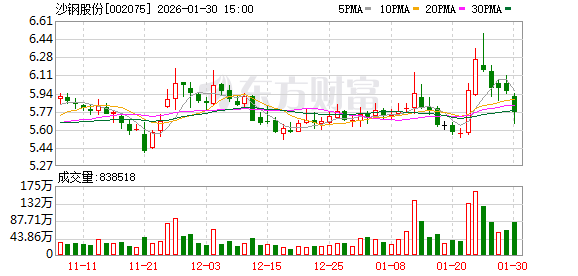
沙钢连续10年上榜中国钢铁竞争力A+企业
Zhong Guo Jin Rong Xin Xi Wang· 2026-01-22 09:52
Group 1 - The core viewpoint of the article highlights that Shagang Group has been rated A+ (extremely strong) for the tenth consecutive year in the competitiveness ranking of domestic steel enterprises by the Metallurgical Industry Planning and Research Institute [1] - Shagang is focusing on technological innovation to upgrade its product structure, achieving breakthroughs in high-end materials, including low-temperature tempered high-strength steel and high-toughness shipbuilding steel [1] - The company is actively integrating AI into production processes, establishing itself as a smart manufacturing benchmark with various intelligent systems and platforms [1] Group 2 - Shagang is committed to green and low-carbon development, successfully implementing multiple projects in renewable energy and becoming the first private steel enterprise in China to pass the "dual carbon best practice energy efficiency benchmark demonstration" [1] - The brand "Shagang" is widely recognized, with products used in major national projects and exported to high-end markets in Germany, the Netherlands, Thailand, and South Korea [2] - Looking ahead, Shagang aims to build a world-class steel enterprise under its "136" development strategy, focusing on efficiency, talent, and innovation while reinforcing its green advantages [2]

2025年11月中国钢铁板材出口数量和出口金额分别为600万吨和38.36亿美元
Chan Ye Xin Xi Wang· 2026-01-05 03:24
Core Insights - The report by Zhiyan Consulting highlights the export performance of China's steel plate industry, indicating a stable export volume with a slight decrease in export value for November 2025 [1] Export Performance - In November 2025, China's steel plate export volume was 6 million tons, showing no year-on-year change [1] - The export value for the same period was $3.836 billion, reflecting a year-on-year decrease of 2.1% [1]

2025年11月中国钢铁线材出口数量和出口金额分别为25万吨和1.98亿美元
Chan Ye Xin Xi Wang· 2026-01-05 03:24
Core Insights - The report by Zhiyan Consulting highlights the growth in China's steel wire rod exports, with a notable increase in both quantity and value in November 2025 [1] Group 1: Export Performance - In November 2025, China's steel wire rod export volume reached 250,000 tons, representing a year-on-year increase of 17.1% [1] - The export value for the same period was $19.8 million, showing a year-on-year growth of 9.8% [1] Group 2: Industry Analysis - Zhiyan Consulting is recognized as a leading industry consulting firm in China, specializing in comprehensive industry research and providing tailored consulting services [1] - The firm has a strong focus on delivering in-depth industry reports, business plans, feasibility studies, and customized services to empower investment decisions [1]

2025年11月中国钢铁棒材出口数量和出口金额分别为171万吨和9.53亿美元
Chan Ye Xin Xi Wang· 2026-01-05 03:24
Core Insights - China's steel bar exports reached 1.71 million tons in November 2025, representing a year-on-year increase of 29.1% [1] - The export value of steel bars amounted to $953 million, reflecting a year-on-year growth of 22.1% [1] Export Data Summary - Export quantity of steel bars: 1.71 million tons, up 29.1% year-on-year [1] - Export value of steel bars: $953 million, up 22.1% year-on-year [1]

“数”里行间透视“十四五”期间中国钢铁向“绿”而兴发展轨迹
Yang Shi Wang· 2025-12-24 02:34
Core Viewpoint - The establishment of China's first million-ton near-zero carbon steel production line in Zhanjiang marks a significant breakthrough in the green and low-carbon development of the steel industry, utilizing advanced hydrogen metallurgy technology to replace traditional coke and significantly reduce carbon emissions [1][4]. Group 1: Production Technology and Environmental Impact - The new production line employs hydrogen as the main reducing agent, achieving a carbon reduction of 50% to 80% compared to traditional methods [1]. - The hydrogen-based vertical furnace produces direct reduced iron with a metalization rate that meets expected targets, while efficient electric furnaces enhance energy utilization [1]. - The facility can reduce carbon dioxide emissions by 2,500 tons per day, making it the most environmentally friendly and lowest carbon emission smelting process currently available [3]. Group 2: Annual Carbon Reduction and Industry Contribution - The million-ton near-zero carbon steel production line is expected to reduce carbon emissions by over 3.14 million tons annually, equivalent to creating 2,000 square kilometers of forest [4]. - This project serves as a model for low-carbon transformation in the steel industry and contributes to high-quality development [4]. Group 3: Industry Trends and Goals - During the "14th Five-Year Plan" period, the steel industry is focusing on green transformation, with a significant increase in the number of green factories, totaling 126 new green factories from 2021 to 2024 [11]. - Key pollutants such as sulfur dioxide, particulate matter, and nitrogen oxides have seen significant reductions, with respective decreases of 28%, 26.7%, and 36.5% by the end of Q3 2025 compared to the end of 2021 [11]. - Water resource efficiency in the steel industry has improved, with water consumption per ton of steel decreasing from 2.50 cubic meters in 2021 to 2.33 cubic meters in 2024, a reduction of 6.8% [14]. Group 4: Energy Efficiency and International Competitiveness - The steel industry has initiated an extreme energy efficiency project, aiming for a total energy saving of approximately 10.5 million tons of standard coal and a carbon reduction of about 27.5 million tons by 2024 [16]. - The launch of the environmental product declaration platform for the steel industry has registered over 9,000 users, enhancing the international competitiveness of Chinese steel products by breaking down foreign green trade barriers [19].
中钢协姜维:中国钢铁行业迫切需要从“竞争”向“竞合”转变
Zheng Quan Shi Bao Wang· 2025-12-21 13:02
Group 1 - The core viewpoint of the articles emphasizes the challenges and opportunities facing the Chinese steel industry, particularly in the context of green development and technological innovation [1][2][3] - The Chinese steel industry is experiencing a decline in domestic demand at a faster rate than previous periods, yet profits for key enterprises remain strong due to unified industry strategies [1][2] - The current high inventory levels and the late timing of the upcoming Spring Festival necessitate a focus on risk prevention rather than profit maximization in winter storage strategies for steel companies [2] Group 2 - The industry is urged to adopt nine strategic paths for high-quality development, including technological innovation, digital transformation, and a shift towards green low-carbon practices [2] - The energy transition is seen as a historic opportunity for the industry, with predictions of significant growth in renewable energy capacity by 2035, which will transform the production landscape [3] - The integration of energy revolution, industrial revolution, and artificial intelligence is expected to lead the industry into a new era of resource creation, zero-carbon development, and intelligent innovation [4]