DiDi(DIDIY)

Search documents
广汽埃安与滴滴自动驾驶联合打造的无人驾驶出租车交付
Bei Ke Cai Jing· 2026-01-23 14:57
Group 1 - The core viewpoint of the news is the delivery of the new generation Robotaxi R2, developed by GAC Aion and Didi Autonomous Driving, which has received road testing licenses in Guangzhou and plans to launch in multiple cities by 2026 [1][2] Group 2 - GAC Group's Chairman, Feng Xingya, stated that the company will deepen strategic cooperation with Didi, leveraging their complementary strengths in vehicle manufacturing, autonomous driving technology development, mobility ecosystem, and scenario operations [2]


广汽埃安联手滴滴自动驾驶,Robotaxi R2正式交付
Nan Fang Du Shi Bao· 2026-01-23 14:55
Core Insights - GAC Aion and Didi Autonomous Driving have successfully delivered the new generation Robotaxi, R2, marking a significant milestone in the commercial operation of autonomous driving technology [1][3] - The R2 aims to achieve three core goals: unmanned operation, mass production, and commercialization, with significant advancements in technology, safety, passenger experience, and operational efficiency [1][3] Group 1: Vehicle Specifications and Technology - The R2 is equipped with 33 high-precision sensors and the industry's first mass-produced three-domain fusion computing brain, boasting a computing power exceeding 2000 TOPS while reducing costs by 74% [1] - The vehicle features an interactive front bumper screen, a 17.3-inch ceiling-mounted entertainment screen, and smart voice control, enhancing user experience [3] - GAC's GEP 3.0 platform integrates electric vehicle architecture, an open control platform, electronic steering, and redundant braking systems, providing robust support for autonomous driving [3] Group 2: Strategic Collaboration and Future Plans - The collaboration between GAC and Didi Autonomous Driving has accelerated the rollout of the Robotaxi model, enhancing GAC's brand image as a technology-driven company [3][4] - The successful delivery of R2 and its road testing signify a new phase in the mass production of autonomous driving, aiming to improve user experience and value [3] - By 2026, R2 is planned to be deployed in cities like Guangzhou and Beijing, gradually becoming a valuable addition to urban smart mobility solutions [3][4] Group 3: Future Development - GAC and Didi Autonomous Driving will continue to deepen their collaboration, focusing on vehicle lifecycle management, scenario expansion, and iterative upgrades of the Robotaxi model [4] - The partnership aims to transition autonomous driving from technology validation to practical commercial applications [4]

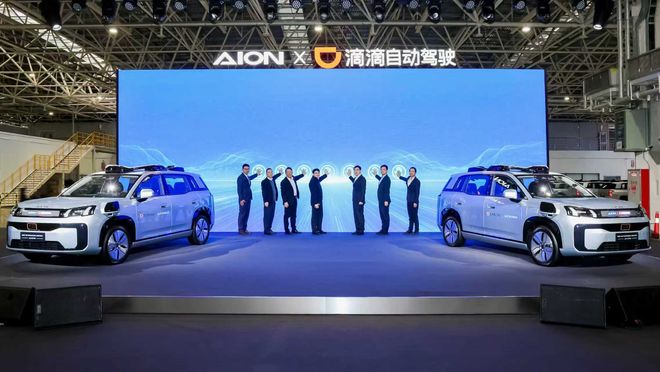
广汽埃安与滴滴自动驾驶Robotaxi交付,国内首个整车厂与自动驾驶公司合资项目落地
Xin Lang Cai Jing· 2026-01-23 14:01
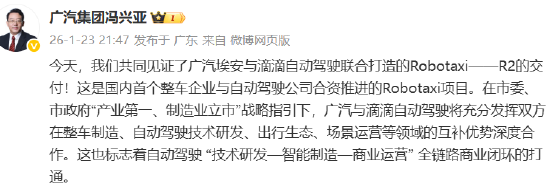
Core Insights - GAC Group's chairman, Feng Xingya, announced the delivery of the R2 Robotaxi, a collaboration between GAC Aion and Didi Autonomous Driving, marking the first joint venture in China between a vehicle manufacturer and an autonomous driving company [1][5] - The partnership aims to leverage complementary strengths in vehicle manufacturing, autonomous driving technology development, mobility ecosystem, and scenario operations under the guidance of local government strategies [1][5] - This initiative signifies the establishment of a complete commercial closed loop for autonomous driving, integrating technology research and development, smart manufacturing, and commercial operations [2][6]
广汽埃安与滴滴自动驾驶合作R2车型正式交付,首批车辆已获广州路测牌照
Mei Ri Jing Ji Xin Wen· 2026-01-23 12:21
Group 1 - The core point of the article is the delivery of the new generation Robotaxi R2, developed jointly by GAC Aion and Didi Autonomous Driving, which has received road testing licenses in Guangzhou [1] - The first batch of R2 vehicles is equipped with 33 high-precision sensors and a three-domain fusion computing brain, boasting a computing power exceeding 2000 TOPS [1] - The R2 is planned to be gradually deployed for demonstration applications in cities such as Guangzhou and Beijing throughout this year [1]
广汽埃安与滴滴自动驾驶联手打造 Robotaxi R2正式交付
Zheng Quan Shi Bao Wang· 2026-01-23 11:12
Core Insights - GAC Aion and Didi Autonomous Driving have jointly launched the next-generation Robotaxi, R2, marking a significant milestone in the autonomous driving sector in China [1][2] - The successful delivery of R2 signifies the establishment of a complete commercial closed loop for autonomous driving, encompassing technology research and development, intelligent manufacturing, and commercial operations [1] Group 1: Vehicle Specifications and Technology - The Robotaxi R2 is designed for commercial operation with three core objectives: unmanned operation, mass production, and commercialization [1] - R2 is equipped with 33 high-precision sensors and the industry's first mass-produced three-domain fusion computing brain, achieving over 2000 TOPS of computing power while reducing costs by 74% [1] - The vehicle meets both Chinese and European five-star safety standards, featuring a comprehensive safety redundancy system validated through rigorous functional safety tests and all-scenario testing [1] Group 2: Strategic Collaboration and Future Plans - GAC Group plans to deepen its strategic cooperation with Didi, leveraging their complementary strengths in vehicle manufacturing, autonomous driving technology development, mobility ecosystem, and scenario operations [1] - The R2 is built on the GAC GEP 3.0 platform, known for its high degree of interface openness and stability, integrating electric vehicle platform, open control platform, electronic steering, and redundant braking systems [2] - By 2026, R2 is expected to be deployed in a phased manner in cities like Guangzhou and Beijing, contributing to urban smart mobility [2]
广汽埃安与滴滴自动驾驶合作的Robotaxi R2车型正式交付
2 1 Shi Ji Jing Ji Bao Dao· 2026-01-23 09:20
Core Insights - GAC Aion and Didi Autonomous Driving have jointly launched the next-generation Robotaxi, named R2, which has been officially delivered at the GAC Aion factory [1] - The first batch of vehicles has received road testing licenses for intelligent connected vehicles in Guangzhou [1] - The Robotaxi R2 is set to begin demonstration applications in cities such as Guangzhou and Beijing in a phased manner starting in 2026 [1]
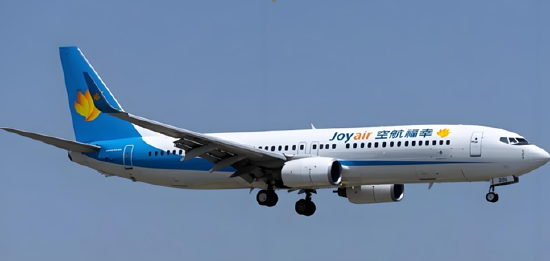
幸福航空欠薪超200天,对话飞行员:大家去跑滴滴、送外卖、拍短剧了
Xin Lang Cai Jing· 2026-01-22 01:07
Core Insights - After 255 days of suspension, there seems to be a glimmer of hope for the employees of Happy Airlines regarding their unpaid wages [2][10] - The company's debt has exceeded 5 billion yuan, excluding internal wage arrears, and efforts to find new strategic investors have not yielded results [2][10] - Many employees are resorting to part-time jobs to survive, with some working as ride-hailing drivers, food delivery personnel, or even acting in short plays [2][12] Financial Situation - Happy Airlines' debt has surpassed 5 billion yuan, and the company has not resolved wage issues since its suspension on April 27, 2025 [2][10] - Employees report significant unpaid wages, with some pilots owed amounts as high as 6 to 7 million yuan [12] - The company has faced a surge in legal disputes, with 87 judicial cases reported in 2025, including 29 labor disputes [15] Operational Challenges - The company has only two operational aircraft out of the original fleet of over 20, which has severely limited its operational capacity [13] - Happy Airlines has been attempting to transition from operating the indigenous Xinzhou aircraft to Boeing 737s, but this strategy has not improved financial performance [13][14] - The management has made commitments to maintain pilot qualifications and address employee insurance issues, but many pilots have since given up on training due to a lack of progress [15] Future Outlook - The company is at risk of losing its public air transport license if operations do not resume soon, as it has been nearly a year since the suspension [16] - There are concerns that without new investment, the company may face bankruptcy [15] - The value of the airline's operating license is questioned, as it may only be valuable when there is interest from potential investors [16]
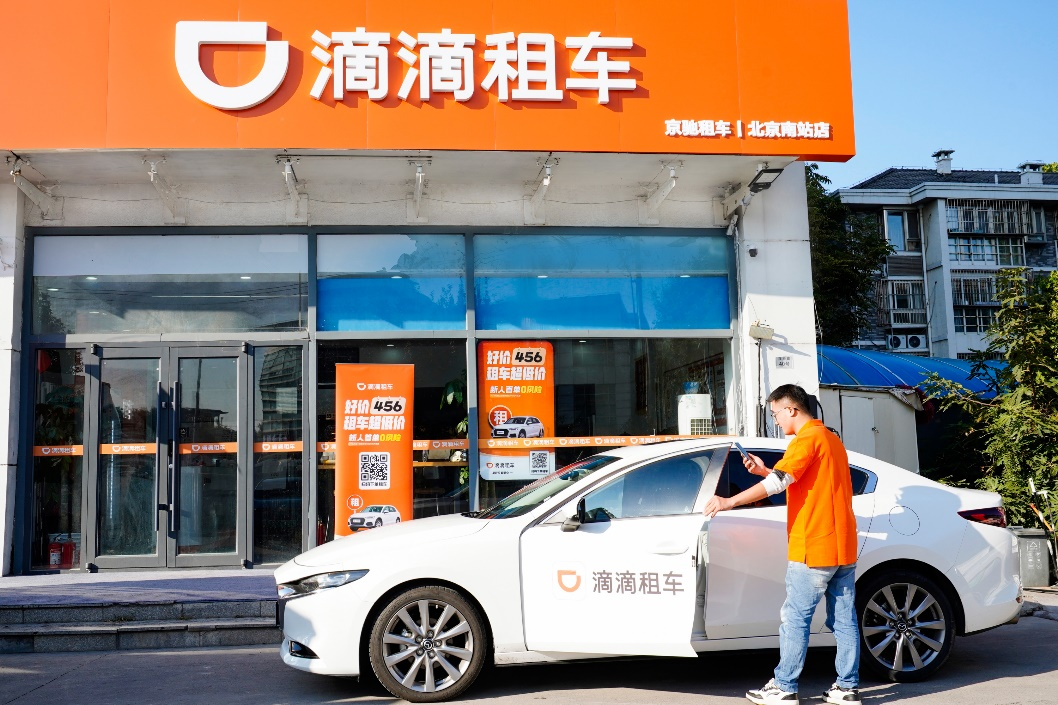
滴滴租车“春节服务升级承诺”来了!“守护租”全面护航自驾出游
Jin Rong Jie· 2026-01-21 06:33
Core Insights - Didi Car Rental has launched a "Spring Festival Service Upgrade Commitment" to enhance user experience during the upcoming Spring Festival, focusing on three core initiatives: guaranteed vehicle availability, transparent damage assessment, and clear cancellation fees [1][3] Group 1: Service Enhancements - The "Guardian Rental" initiative addresses industry pain points by ensuring vehicle availability. If a vehicle is not provided due to merchant issues, Didi will prioritize coordinating equivalent or higher-grade vehicles without additional costs to users [1] - In case of damage disputes, users can upload damage information, and the platform will offer free third-party damage assessment services, providing a damage report from professional institutions in collaboration with multiple insurance companies [1] - Cancellation policies have been improved, allowing users to cancel for free before vehicle pickup on non-holidays, and up to 24 hours before pickup during the Spring Festival, with a maximum cancellation fee of 30% thereafter [1][3] Group 2: User Benefits and Market Strategy - The service upgrade aims to provide a more transparent consumer experience, reducing potential disputes from changes in plans or unexpected situations, making car rental more secure and flexible [3] - Didi Car Rental has introduced limited-time benefits, including a "Multi-Rent Multi-Province" promotion that can waive up to 3 days of rental fees and a lottery for cash prizes and discounts on special models [3] - The company anticipates a peak in bookings during the 10 days leading up to the Spring Festival and has prepared sufficient vehicle supply in collaboration with national partners, shifting the rental industry focus from price competition to service competition [3]
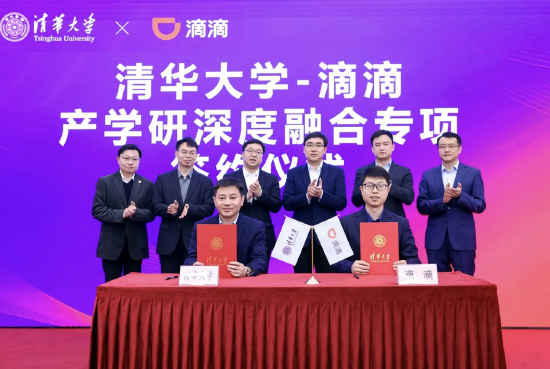
滴滴清华签署未来出行联合研究中心二期合作协议
Bei Jing Shang Bao· 2026-01-20 12:45
自2019年滴滴与清华大学成立未来出行联合研究中心以来,双方在共享出行、大数据与人工智能、自动 驾驶等领域累计联合开展科研合作近百项,多项技术从实验室创新转化为产业应用。2025年,滴滴与王 建强教授团队联合攻关的"智能车辆行驶安全关键技术及产业化应用"项目,获北京市科技进步一等奖。 期间,双方通过联合课程建设、设立实习实践基地等方式,共同培养行业优秀人才。 北京商报讯(记者 魏蔚)1月20日,滴滴宣布已与清华大学签署未来出行联合研究中心二期合作协议, 同时开启强化学习产学研深度融合专项合作。双方将进一步加强前沿技术联合攻关、创新人才培养,在 未来出行生态构建等方面持续深化合作。 ...
滴滴与清华大学签署合作协议,程维:坚持负责任的科技创新,希望技术成果能惠及更多群体
Xin Lang Cai Jing· 2026-01-20 03:52
Core Viewpoint - Didi and Tsinghua University have signed a second-phase cooperation agreement for the Future Mobility Joint Research Center, focusing on deep integration of academia and industry in reinforcement learning and advanced technology development [1][5][6] Group 1: Partnership Details - The collaboration aims to enhance joint research in cutting-edge technologies, talent cultivation, and the construction of future mobility ecosystems [1][6] - Since the establishment of the Future Mobility Joint Research Center in 2019, Didi and Tsinghua University have conducted nearly 100 joint research projects, successfully translating multiple technologies from the lab to industry applications [3][8] Group 2: Research Focus - The partnership will specifically target breakthroughs in autonomous driving technology, with a focus on multimodal large models, world models, and reinforcement learning [3][9] - An innovative operational model combining "entity operation + joint office" will be adopted to unify technical routes and industrialization systems, creating a "research-engineering-business" triangle [3][8] Group 3: Goals and Aspirations - The collaboration is seen as a new starting point for deepening integration between academia and industry, aiming to advance key technology breakthroughs and system innovations [4][9] - Didi emphasizes its mission to make transportation better, believing that innovation can lead to safer and more efficient travel services, while Tsinghua University focuses on the application of research outcomes in the industry [4][9]