
Alphabet(GOOG)

Search documents
早报央行:继续实施好适度宽松的货币政策;美联储官员最新发声
Sou Hu Cai Jing· 2026-02-10 23:15
Industry News - The Ministry of Industry and Information Technology and four other departments released an implementation opinion on strengthening the capacity building of the information and communication industry to support low-altitude infrastructure development, emphasizing the integration of low-altitude equipment with low-altitude information communication and the development of equipment [3] - The National Development and Reform Commission and other departments issued an implementation opinion to accelerate the application of artificial intelligence in the bidding and tendering field, aiming for full coverage of key scenarios by the end of 2026 and broader nationwide application by the end of 2027 [3] - The Shanghai Intelligent Connected Vehicle Testing and Demonstration Promotion Working Group published the "Shanghai Intelligent Connected Vehicle Development Report (2025)", indicating that as of last year, 3,173 automated driving test roads covering 5,238.82 kilometers have been opened in the city [3] - Analysts on Wall Street are showing high enthusiasm for Chinese artificial intelligence (AI) related stocks, as evidenced by recent ratings given to several listed companies, with JPMorgan analysts covering two companies and giving them an "overweight" rating [3] Company News - Semiconductor Manufacturing International Corporation (SMIC) reported a net profit of 1.223 billion yuan for the fourth quarter of 2025, representing a year-on-year increase of 23.2% [5] - Jianghuai Automobile disclosed a report on its private placement, with Ge Weidong investing approximately 1 billion yuan to subscribe for 20.0481 million shares [6] - CITIC Securities announced that its subsidiary, Huaxia Fund, achieved a net profit of 2.396 billion yuan for 2025 [7] - Dabe Technology announced that its Zhangbei Data Center project does not involve computing power leasing business [7] - Zhongtung High-tech announced plans to invest 145 million yuan in a new project to produce 30 million PCB drill rods per year [8] - Changfei Optical Fiber reported that the proportion of its optical fiber and cable products used in data centers and interconnections is relatively small compared to global market demand [8] - Baichuan Co., Ltd. announced that the market prices of some of its main products have increased, but the impact on the company's performance cannot be estimated at this time [8] - The Shenzhen Stock Exchange announced that *ST Cube's stock price has fluctuated significantly, triggering multiple abnormal trading standards, leading to self-regulatory measures such as trading suspension [8] - Hengdian Film and Television announced that the box office of three films, including "Fast and Furious 3," remains uncertain, and the company may apply for a trading suspension if its stock price continues to rise abnormally [8] - Yunjiji Group announced that its wholly-owned subsidiary signed a total EPC contract worth 1.331 billion yuan, accounting for 86.66% of the company's audited revenue for 2024 [8] - Jiamei Packaging announced that if its stock price continues to rise abnormally, it may apply for a trading suspension again [9] - Runtu Co., Ltd. stated that the sustainability of price fluctuations in disperse dyes is uncertain, making it difficult to estimate the impact on the company's performance [9]




云巨头天价资本支出
2 1 Shi Ji Jing Ji Bao Dao· 2026-02-10 23:09
Core Insights - The financial reports from major tech companies like Microsoft, Google, and Amazon reveal a strong growth in AI-related cloud services, but also raise concerns about their massive capital expenditures [1][2][3][4]. Group 1: Cloud Business Performance - Microsoft Azure experienced a 39% year-over-year growth, while Google Cloud surged by 48%, and AWS recorded a 24% growth, marking its fastest rate in thirteen quarters [1][3][4]. - Google Cloud's revenue reached $17.664 billion in the fourth quarter, exceeding analyst expectations by over 9%, and is projected to surpass $70 billion in annual revenue by the end of 2025 [3]. - AWS generated $35.6 billion in sales for the fourth quarter, reflecting a 24% year-over-year increase, which is the highest growth since the end of 2022 [4]. Group 2: Capital Expenditures - Microsoft reported a record capital expenditure of $37.5 billion for the quarter, a 66% increase year-over-year, while Google plans to spend between $175 billion and $185 billion in 2026, nearly doubling its 2025 budget [1][8]. - Amazon's capital expenditure for 2026 is expected to reach approximately $200 billion, representing a more than 50% increase from 2025 [8]. - The significant capital investments are primarily directed towards advanced AI chips, global data centers, and sustainable energy sources [8]. Group 3: Future Orders and Revenue Visibility - Google Cloud's unfulfilled orders reached $240 billion by the end of 2025, more than doubling year-over-year, while AWS's backlog surged by 40% to $244 billion [5][7]. - Microsoft's remaining performance obligations soared to $625 billion, a 110% increase, with 45% dependent on a single client, OpenAI [6][7]. Group 4: Market Dynamics and Investor Sentiment - Investors are increasingly concerned about the sustainability of returns given the high capital expenditures, with stock prices for Microsoft, Google, and Amazon dropping significantly post-earnings reports [1][8]. - The market is shifting focus from revenue growth to the sustainability of capital returns, as companies face pressure to demonstrate how their investments will translate into profits [11].


周三你需要知道的隔夜全球要闻:特朗普威胁或向中东再派航母打击群 芝商所将于今夏起推出个股期货
Sou Hu Cai Jing· 2026-02-10 22:34
Group 1 - US President Trump is considering deploying another aircraft carrier strike group to the Middle East if negotiations with Iran fail [1] - The Chicago Mercantile Exchange (CME) will launch individual stock futures this summer, allowing market participants to trade futures on over 50 top US stocks from the S&P 500, Nasdaq 100, and Russell 1000 indices [3] - Ford Motor Company's Q4 total revenue was $45.9 billion, a decrease of 4.8% year-over-year, with adjusted EBIT of $1.04 billion, down 51% year-over-year [10] Group 2 - Alphabet raised $11 billion in bond sales in Europe, bringing its total global debt issuance to over $30 billion [7] - Blackstone is reportedly increasing its investment in AI company Anthropic PBC, raising its stake to approximately $1 billion based on the startup's current valuation [8] - The EIA's short-term energy outlook report forecasts Brent crude oil prices at $58 per barrel and WTI crude oil prices at $53.42 per barrel by 2026 [6]


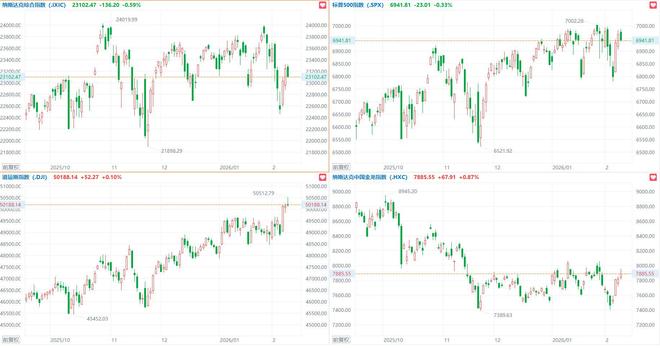
美股三大指数收盘涨跌不一,闪迪跌超7%,中概指数涨0.87%
Ge Long Hui A P P· 2026-02-10 22:25
Core Viewpoint - The U.S. stock market showed mixed results with the Dow Jones increasing by 0.1%, while the Nasdaq and S&P 500 indices decreased by 0.59% and 0.33% respectively [1] Group 1: Stock Performance - Major technology stocks experienced varied performance, with Oracle rising over 2% and Tesla increasing more than 1%, while Google and Broadcom fell over 1% [1] - The residential construction, railway transportation, and tourism sectors saw significant gains, with Marriott Hotels rising over 8%, Hilton Hotels increasing over 3%, and Union Pacific up over 2% [1] - Storage and cryptocurrency-related stocks faced notable declines, with Western Digital dropping over 8%, SanDisk down over 7%, and Seagate Technology falling over 6% [1] Group 2: Chinese Stocks - The Nasdaq Golden Dragon China Index rose by 0.87%, with popular Chinese stocks such as Li Auto increasing by 2.9%, and BYD and Alibaba both rising over 2% [1] - Other Chinese companies like NIO, Xpeng, New Oriental, and JD.com saw increases of over 1%, while Tencent fell by 1.4% and Meituan dropped by 2.8% [1]




Alphabet is issuing a 100-year bond; here is why.
Yahoo Finance· 2026-02-10 22:19
Yes, Google's parent company, Alphabet, is just tapping the bond market with a 100year time frame. No joke, this bond is not going to mature until the year 2126. And the wild part is investors could not get enough of it.So, Alphabet is raising about $32 billion across multiple bond deals in multiple currencies and only a smalish part, 1 billion British pounds, is for a hundred years. Now, let's talk about who buys something like this. Some buyers like pension funds and insurers want steady payments for a ve ...


Alphabet's 100-year bond explained, plus a closer look at AI's impact on software stocks
Yahoo Finance· 2026-02-10 21:58
Market Domination anchor Josh Lipton breaks down the day's market moves for February 10, 2026. Google's parent company, Alphabet, is selling a 100-year bond to investors. Yahoo Markets and Data Editor Jared Blikre explains what the bond is and how it works for investors. Wealthspire Advisors' chief market strategist, Chris Maxey, examines how markets are reacting to companies taking on big debt over huge capex spending for AI, AI's impact on software, and why investors should consider diversifying outside t ...

2月11日外盘头条:美商务部长承认去过爱泼斯坦私人岛屿 谷歌24小时发债320亿美元 特斯拉全球电动车销售换帅
Xin Lang Cai Jing· 2026-02-10 21:40
Group 1 - U.S. Secretary of Commerce, Howard Lutnick, admitted to dining on Jeffrey Epstein's private island during a family vacation in 2012 [4][23] - The European Parliament is closer to approving a U.S.-EU trade agreement after senior lawmakers agreed to adjust terms before a planned vote [8][24] - Alphabet Inc. is set to raise nearly $32 billion in bond offerings within 24 hours, highlighting the tech giant's significant financing needs amid competition in AI development [10][26] - Tesla appointed Joe Ward, the Vice President for EMEA, to lead global electric vehicle sales, marking a leadership change in its struggling automotive business [12][28][29] - Abu Dhabi's MGX is nearing a deal to invest several hundred million dollars in Anthropic's latest funding round, which is expected to exceed $20 billion [15][31] - The U.S. is considering seizing oil tankers transporting Iranian oil to exert pressure on Tehran, although concerns about potential retaliation and global oil market impacts have delayed action [17][33][34]

Google sent personal and financial information of student journalist to ICE
TechCrunch· 2026-02-10 20:41
Core Viewpoint - Google provided extensive personal data of a student and journalist to U.S. Immigration and Customs Enforcement (ICE) in response to an administrative subpoena that lacked judicial approval [1][2]. Group 1: Data Provided - Google handed over usernames, physical addresses, IP addresses, phone numbers, subscriber numbers, identities, and financial information linked to Amandla Thomas-Johnson's account [2]. - The data transfer occurred shortly after Cornell University informed Thomas-Johnson that his student visa had been revoked [3]. Group 2: Nature of the Subpoena - The subpoena included a gag order and did not specify the justification for ICE's request for personal data [3]. - Administrative subpoenas are issued by federal agencies without judicial oversight and can request identifiable information but not the contents of emails or online searches [5]. Group 3: Broader Implications - This incident exemplifies the U.S. government's use of administrative subpoenas to obtain data from tech companies regarding individuals critical of the government, including those involved in protests [4]. - The Electronic Frontier Foundation has urged major tech companies to cease providing data to the Department of Homeland Security in response to such subpoenas, emphasizing the need for user privacy protection [7][9].
Australian bank CBA posts record first-half cash earnings on lending growth
Reuters· 2026-02-10 20:38
Core Insights - Commonwealth Bank of Australia reported record first-half cash earnings, driven by strong growth in lending and deposit volumes, despite margin pressures from tight competition [1] Group 1: Financial Performance - The bank achieved record cash earnings in the first half of the year, indicating robust financial health and operational efficiency [1] - Growth in lending and deposit volumes contributed significantly to the earnings, showcasing the bank's strong market position and customer trust [1] Group 2: Market Conditions - Margins were under pressure due to tight competition in the banking sector, highlighting the challenges faced by financial institutions in maintaining profitability amidst competitive pricing [1]

Better Artificial Intelligence Stock: AMD vs. Alphabet
Yahoo Finance· 2026-02-10 20:10
Core Insights - Artificial intelligence remains a volatile yet attractive investment sector in 2026, with recent earnings reports from Advanced Micro Devices (AMD) and Alphabet disappointing Wall Street, leading to share price declines [1][2] Group 1: AMD Performance - AMD reported record revenue of $10.3 billion for its fiscal fourth quarter ended December 27, 2025, with all divisions, including data centers and gaming, showing year-over-year sales growth [3] - The strong performance was driven by the rapidly growing AI market, as customers sought AMD's products to enhance computing power for AI applications [3] - AMD forecasts fiscal Q1 revenue of approximately $9.8 billion, reflecting a 32% increase from the previous year's $7.4 billion, although this forecast did not meet Wall Street's high expectations, resulting in a share price drop [4] Group 2: Alphabet Performance - Alphabet's Q4 sales increased by 18% year over year to $113.8 billion, marking the first time its 2025 revenue exceeded $400 billion [5] - The Google search engine significantly contributed to this growth, with Q4 sales reaching $63.1 billion, up from $54 billion in 2024 [5] - The rise in Google's search income is attributed to AI, with CEO Sundar Pichai noting increased usage driven by AI advancements [6] - Despite strong results, Alphabet's stock fell due to a 95% year-over-year increase in capital expenditures (capex) to $27.9 billion in Q4, leading to total capex costs exceeding $91 billion for 2025 [6] - Wall Street was particularly concerned about Alphabet's plans to increase capex in 2026, estimating expenditures between $175 billion and $185 billion, which the company views as necessary for advancing its AI technology [7]
