Honda Motor(HMC)

Search documents
Honda Motor(HMC) - 2026 Q1 - Earnings Call Presentation
2025-08-06 06:30
Financial Performance (Q1 2025) - Operating profit decreased by 49.6% to 244.1 billion yen, compared to 484.7 billion yen in the same period last year[7] - Profit attributable to owners of the parent decreased by 50.2% to 196.6 billion yen, from 394.6 billion yen[7] - Sales revenue decreased slightly by 1.2% to 5,340.2 billion yen[7] - Operating margin declined by 4.4 percentage points to 4.6%[7] Financial Forecast (FYE 2026) - Revised operating profit forecast upward by 200 billion yen to 700 billion yen[3] - Revised profit for the year forecast to 420 billion yen[3] - Sales revenue forecast revised to 21,100 billion yen, a decrease of 2.7% from the previous year[8] - Operating profit forecast decreased by 42.3% to 700 billion yen[8] Shareholder Returns - Acquired 646.66 million of the company's own shares for 936.5 billion yen, achieving 85.1% of the planned acquisition[5, 9]

日本贸易代表达成协议后再赴美,石破茂称落实协定更具挑战性
Di Yi Cai Jing· 2025-08-05 08:35
Group 1 - The trade agreement between the US and Japan aims to reduce the automobile tariff from 25% to 15%, with Japan committing to invest $550 billion in the US [1][3] - Japan's exports to the US in 2024 are projected to total 21 trillion yen, with automobiles and parts contributing over 7.2 trillion yen, accounting for one-third of the total [3] - The agreement has raised concerns in Japan regarding the lack of a written document, as it may complicate the implementation of the agreed terms [3] Group 2 - Goldman Sachs analysts predict that the overall negative impact on Japan's seven major automakers will decrease from a loss of 3.47 trillion yen to 1.89 trillion yen under the new 15% tariff [4] - Specific impacts on major automakers include Toyota's tariff-related costs dropping from 1.6 trillion yen to 872 billion yen, Honda's from 560 billion yen to 305 billion yen, and Nissan's from 470 billion yen to 256 billion yen [5] - Japanese automakers have reduced export prices to the US by 19% in June, the largest drop since 2016, to maintain competitiveness in the North American market [5] Group 3 - The US automotive industry has expressed dissatisfaction with the trade agreement, arguing that it favors Japanese automakers and does not significantly improve US car exports to Japan [6] - The American Automotive Policy Council has raised concerns that many Japanese cars use minimal US parts and are assembled in Canada and Mexico, potentially harming US industry and workers [6] - The United Auto Workers union criticized the agreement, claiming it neglects the interests of American workers and does not address the long-standing advantages enjoyed by Japanese manufacturers in the US market [6]



关税+日元走强双重夹击之下 汽车巨头丰田与本田迎来业绩大考
智通财经网· 2025-08-04 04:14
Group 1 - The Japanese automotive giants Toyota and Honda are expected to report mixed results due to the strong yen and U.S. tariffs impacting profits, despite resilient sales [1] - Toyota's operating profit is projected to decline in the first fiscal quarter, influenced by promotional pricing, rising supply chain costs, and potential tariffs of up to 25% before a trade agreement [1][2] - Honda is also expected to see a slight decrease in operating profit, with a significant 19% reduction in U.S. export prices in June, marking the largest drop since 2016 [1][2] Group 2 - Japan's chief trade negotiator is urging the U.S. to lower tariffs on automobiles and parts to 15%, which could positively impact future earnings guidance from the companies [2] - Toyota has raised its global production target for 2025 to 10 million vehicles, while Honda's profits are expected to increase by 28% in the fiscal year 2026 due to recent tariff relaxations [2] - Following the announcement of the U.S.-Japan trade agreement, Japanese automotive stocks saw significant rebounds, with Honda and Toyota shares rising over 10% [3] Group 3 - The U.S. has agreed to set tariffs on Japanese imports, including automobiles, at 15%, down from the previously threatened 25%, which has relieved pressure on Japanese automakers [3] - Increased government spending in Japan and the impact of U.S. tariffs on industrial giants are expected to support sales and profit growth for companies like Mitsubishi Heavy Industries and Kawasaki Heavy Industries [3][4] - Analysts predict that while Kawasaki Heavy's transportation sector may face challenges from tariffs, its defense sector is likely to drive profit margin expansion [4]
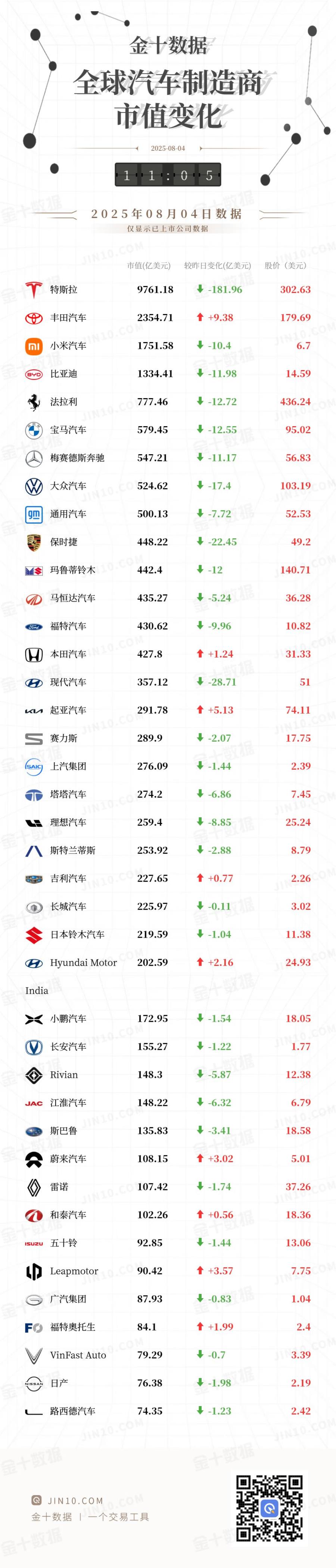
金十图示:2025年08月04日(周一)全球汽车制造商市值变化
news flash· 2025-08-04 03:15
Summary of Key Points Core Viewpoint - The automotive industry is experiencing significant fluctuations in sales and performance metrics across various companies, with some brands showing substantial declines while others maintain or grow their market presence. Group 1: Company Performance - Xiaomi Automotive reported a revenue of 1751.58 million, with a decrease of 10.4% [2] - BYD's revenue stood at 1334.41 million, reflecting a decline of 11.98% [2] - Ferrari's revenue was 777.46 million, down by 12.72% [2] - BMW Automotive generated 579.45 million, with a decrease of 12.55% [2] - Mercedes-Benz reported 547.21 million, down by 11.17% [2] Group 2: Additional Company Metrics - Volkswagen's revenue was 524.62 million, showing a significant drop of 17.4% [3] - General Motors reported 500.13 million, with a decrease of 7.72% [3] - Porsche's revenue was 448.22 million, down by 22.45% [3] - Mahindra Automotive generated 435.27 million, reflecting a decline of 5.24% [3] - Ford Automotive reported 430.62 million, down by 9.96% [3] Group 3: Emerging Players - NIO's revenue was 108.15 million, with an increase of 3.02% [4] - Rivian reported 148.3 million, reflecting a decrease of 5.87% [4] - VinFast Auto generated 79.29 million, down by 0.7% [4] - Leapmotor's revenue was 90.42 million, showing an increase of 3.57% [4] - Xpeng Automotive reported 172.95 million, down by 1.54% [4]


X @Bloomberg
Bloomberg· 2025-08-01 02:45
Financial Performance - Toyota and Honda earnings will present a mixed picture [1] - A stronger yen and US auto tariffs are impacting profit [1] Market Dynamics - Resilient unit sales are observed despite challenges [1]
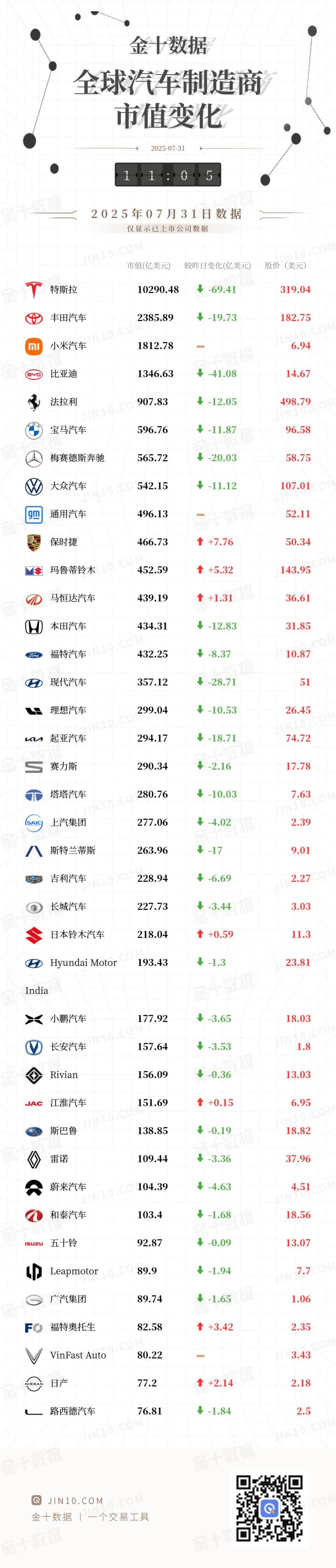
金十图示:2025年07月31日(周四)全球汽车制造商市值变化
news flash· 2025-07-31 03:08
金十图示:2025年07月31日(周四)全球汽车制造商市值变化 量十数据 | והו | 小米汽车 | 1812.78 | | 6.94 | | --- | --- | --- | --- | --- | | (BHD) | 比亚迪 | 1346.63 | + -41.08 | 14.67 | | ર | 法拉利 | 907.83 | + -12.05 | 498.79 | | (1) | 宝马汽车 | 596.76 | + -11.87 | 96.58 | | | 梅赛德斯奔驰 | 565.72 | + -20.03 | 58.75 | | 人》 大众汽车 | 542.15 | + -11.12 | 107.01 | | --- | --- | --- | --- | | 通用汽车 | 496.13 | | 52.11 | | 保时捷 | 466.73 | 1 +7.76 | 50.34 | | > 玛鲁蒂铃木 | 452.59 | 1 +5.32 | 143.95 | | 马恒达汽车 | 439.19 | 1 +1.31 | 36.61 | | 本田汽车 1-0 | 434.31 | + -12.83 | ...


本田大撤退,日系的崩溃
Tai Mei Ti A P P· 2025-07-30 01:25
Core Viewpoint - Honda is undergoing a significant retreat from the Chinese market, marked by the closure of production facilities and a disappointing performance in the electric vehicle sector [1][2]. Group 1: Production Changes - Honda China announced the closure of the Dongfeng Honda second factory in Wuhan by November 2024, which was previously transformed into a new energy vehicle production base [1]. - GAC Honda will also close its factory in Guangzhou by October 2024, indicating a broader trend of production facility shutdowns [1]. - The Dongfeng Honda second factory is expected to be repurposed for commercial real estate development, following the precedent set by the first factory [1]. Group 2: Sales Performance - Honda's electric vehicle sales in China have been underwhelming, with cumulative sales from July 2024 to June 2025 totaling less than 24,000 units, averaging under 2,000 units per month [2]. - GAC Honda's e:NP1 and e:NP2 models sold 2,062 and 3,312 units respectively over the past year, while Dongfeng Honda's e:NS1 and e:NS2 models sold only 1,473 and 940 units [3]. - Overall, Honda's new car sales in June 2025 showed a significant decline, with Dongfeng Honda's sales down 23.62% year-on-year and GAC Honda's down 12.61% [7][8]. Group 3: Market Position and Challenges - Honda's decline in the Chinese market is attributed to a combination of factors, including a failure to adapt to the rapid growth of the electric vehicle market and competition from domestic brands like BYD and Geely [16][21]. - Despite having an early start in the electric vehicle segment, Honda's sales have plummeted since reaching a peak in 2020, with Dongfeng Honda's sales dropping by 49.64% and GAC Honda's by 41.60% by 2024 [9][13]. - The company's attempts to pivot towards electric vehicles have been criticized as insufficient, with new models failing to gain traction in a competitive market [17][20].
中国“电鸡”,驶向东南亚
21世纪经济报道· 2025-07-29 13:30
Core Viewpoint - The electric bicycle market in Southeast Asia is experiencing rapid growth, driven by government incentives and increasing market demand, presenting opportunities for Chinese brands like Yadea, Aima, and Tailg to expand their presence in the region [2][3]. Market Overview - China has over 350 million electric two-wheelers, indicating limited future growth domestically, while Southeast Asia has a motorcycle household penetration rate of 75%, significantly higher than the global average of 29% [3]. - The ASEAN electric two-wheeler market is projected to reach USD 1.0778 billion in 2024 and grow to USD 2.232 billion by 2030, with a compound annual growth rate (CAGR) of 12.90% from 2025 to 2030 [3]. Government Policies - Southeast Asian governments are implementing favorable policies to encourage the transition from fuel to electric vehicles, such as zero tariffs on electric motorcycle imports in the Philippines and a target for 25% of two-wheel sales to be electric in Vietnam by 2030 [6]. - Vietnam plans to establish 10,000 public charging points to support the adoption of electric motorcycles, although the lack of standardized charging infrastructure may hinder penetration rates [6]. Competitive Landscape - Traditional fuel motorcycle manufacturers like Honda, Yamaha, and Suzuki dominate the market but are slow to transition to electric, creating opportunities for Chinese electric two-wheeler manufacturers to enter Southeast Asia [9][10]. - Chinese brands are investing in local production facilities in countries like Indonesia, Vietnam, and Thailand, with Yadea already operating over 400 stores in Vietnam [10]. Consumer Preferences - Southeast Asian consumers prioritize economic practicality, reliable range, and affordable pricing when choosing electric two-wheelers, which aligns with the strengths of Chinese manufacturers in cost control and supply chain integration [12]. - The demand for electric motorcycles with a range of over 100 kilometers and low maintenance costs is significant, especially in regions with challenging climates and infrastructure [14]. Industry Trends - The development of battery swapping models is seen as a key trend in the electric motorcycle market, similar to the initial growth path of electric vehicles in China [12]. - The focus on practical and economical solutions in Southeast Asia contrasts with the emphasis on lightweight and high energy density in the European and American markets [13].




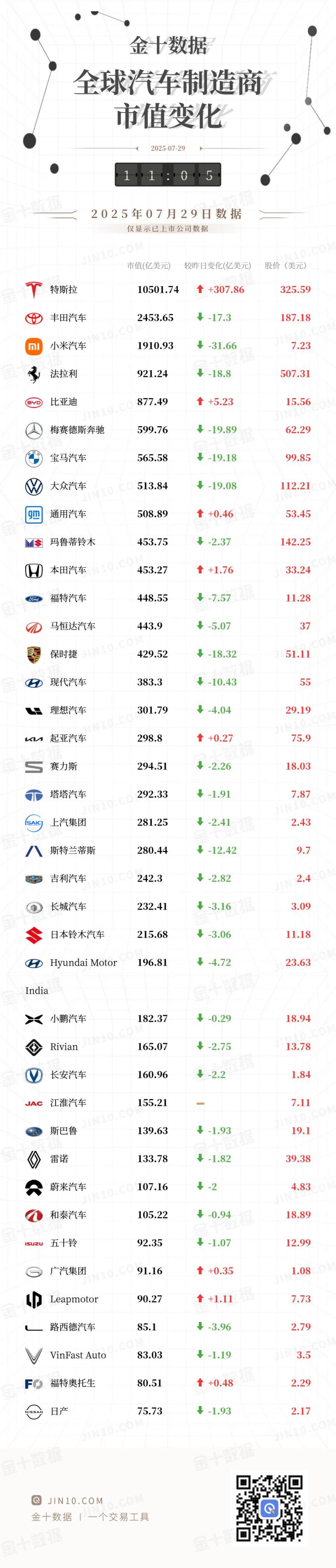
金十图示:2025年07月29日(周二)全球汽车制造商市值变化
news flash· 2025-07-29 03:11
Group 1 - The automotive industry is experiencing fluctuations in market capitalization, with major players like Volkswagen and General Motors showing significant changes in their valuations [2] - Volkswagen's market cap stands at 513.84 billion, reflecting a decrease of 19.08 billion, while General Motors has a market cap of 508.89 billion, with a slight increase of 0.46 billion [2] - Other notable companies include Ford with a market cap of 448.55 billion, down by 7.57 billion, and Hyundai Motor at 196.81 billion, down by 4.72 billion [2] Group 2 - In the Indian automotive market, companies like Xpeng and Rivian are also facing market cap changes, with Xpeng at 182.37 billion, down by 0.29 billion, and Rivian at 165.07 billion, down by 2.75 billion [3] - Changan Automobile has a market cap of 160.96 billion, down by 2.2 billion, while NIO stands at 107.16 billion, down by 2 billion [3] - The overall trend indicates a mixed performance across various automotive companies, with some experiencing declines while others show slight increases [3]