JP MORGAN CHASE(JPM)

Search documents
JPMorgan faces crypto backlash as calls to boycott mount
Finbold· 2025-11-24 11:15
Core Viewpoint - JPMorgan Chase & Co. is facing backlash from the cryptocurrency community due to accusations of targeting Bitcoin-focused entities, leading to calls for a boycott of the bank [1][4]. Group 1: Account Closures and Controversy - The controversy was ignited when Jack Mallers, CEO of Strike, disclosed that JPMorgan closed his personal accounts in September 2025, citing unspecified compliance concerns, despite a long-standing banking relationship [2]. - The closure of accounts has prompted significant reactions from the crypto community, with advocates urging customers to withdraw their funds from JPMorgan [4]. Group 2: Market Impact and Warnings - JPMorgan's research division issued a warning regarding Strategy (formerly MicroStrategy), indicating that it could face forced outflows of up to $8.8 billion if MSCI Inc. excludes "digital asset treasury companies" from its listings by early 2026 [3]. - This warning has raised concerns across both crypto and equity markets, as Strategy's business model is closely linked to Bitcoin's price and public perception [3]. Group 3: Broader Implications - The incident highlights a significant flashpoint in the relationship between crypto-native businesses and traditional financial institutions, suggesting that actions taken by major banks can provoke swift and widespread responses from the crypto community [5].



The Zacks Analyst Blog JPMorgan, Netflix, AbbVie and Ohio Valley Banc
ZACKS· 2025-11-24 11:11
Core Insights - The article highlights the performance and outlook of several key stocks, including JPMorgan Chase, Netflix, AbbVie, and Ohio Valley Banc Corp, as discussed in the Zacks Analyst Blog [1][2]. Group 1: JPMorgan Chase & Co. (JPM) - JPMorgan Chase shares have increased by 27.2% year-to-date, compared to a 29.6% gain in the Zacks Financial - Investment Bank industry [4]. - The company's net interest income (NII) is projected to grow at a CAGR of 3.3% by 2027, supported by business expansion and loan demand [5]. - Non-interest income is expected to decline due to elevated costs from technology and marketing investments, with expenses anticipated to grow at a CAGR of 4.4% by 2027 [6]. Group 2: Netflix, Inc. (NFLX) - Netflix shares have outperformed the Zacks Broadcast Radio and Television industry, gaining 18.9% compared to a decline of 59.6% in the industry [7]. - The advertising tier now represents over 55% of new sign-ups, and the company aims to double its revenues by 2030, targeting a $1 trillion market capitalization [8]. - For the fourth quarter, Netflix forecasts $11.96 billion in revenue, reflecting a 16.7% growth and a 23.9% operating margin, driven by major releases [9]. Group 3: AbbVie Inc. (ABBV) - AbbVie shares have risen by 34.9% year-to-date, outperforming the Zacks Large Cap Pharmaceuticals industry, which gained 17.9% [10]. - The company has successfully launched new immunology medicines, Skyrizi and Rinvoq, to offset the impact of Humira's loss of exclusivity [10]. - AbbVie is expected to return to robust revenue growth in 2025, despite facing challenges from competitive pressures and macroeconomic factors [11]. Group 4: Ohio Valley Banc Corp. (OVBC) - Ohio Valley Banc shares have surged by 62.5% year-to-date, significantly outperforming the Zacks Banks - Midwest industry, which saw a decline of 1.3% [12]. - The company is enhancing its net interest margin (NIM) by focusing on higher-yielding loans and maintaining low-cost deposits [12]. - Despite strong earnings from targeted loan growth, rising provisioning needs and macro sensitivity pose risks to future performance [13].




Bitcoin’s Swoon Prompts IBIT Exodus
Yahoo Finance· 2025-11-24 11:00
Core Insights - Bitcoin has experienced significant price volatility, dropping from a record high of approximately $126,000 to below $90,000, representing a 20% decline in the past month [2] - The outflows from Bitcoin ETFs, particularly BlackRock's iShares Bitcoin Trust ETF (IBIT), indicate a shift in investor sentiment towards riskier assets, with a record outflow of $523 million in one day [2][3] - Despite recent outflows, IBIT remains substantial with $70 billion in net assets, having attracted $4.3 billion in October alone [4] Investor Behavior - Investors are reducing exposure to speculative assets like cryptocurrencies, with many viewing the recent influx of new crypto ETFs as an exit point [3] - Major institutional investors, such as Harvard University's endowment and JPMorgan Chase, have increased their holdings in Bitcoin ETFs, indicating a mixed sentiment in the market [5] - Other Bitcoin ETFs, such as the Grayscale Bitcoin Trust ETF (GBTC) and Ark 21Shares Bitcoin ETF (ARKB), have faced significant outflows, highlighting the varied performance among different funds [7]


“跌疯了”的币圈“阴谋论满天飞”:美国政府“抢钱”,华尔街“做空”,甚至是“摩根大通大战特朗普”
Hua Er Jie Jian Wen· 2025-11-24 10:56
Core Viewpoint - A report from JPMorgan has ignited anger within the cryptocurrency community, leading to conspiracy theories about Wall Street's manipulation and government involvement in the recent Bitcoin crash [1][3]. Group 1: JPMorgan's Report and Its Implications - JPMorgan warned that MSCI is considering removing companies with significant Bitcoin holdings from its index, which could lead to a potential outflow of up to $8.8 billion from MicroStrategy [1][4][5]. - The report indicated that if MicroStrategy were removed from the MSCI index, it could trigger a passive sell-off of $2.8 billion, with total outflows potentially reaching $8.8 billion if other index providers follow suit [5]. - MicroStrategy's stock has underperformed Bitcoin, with its valuation premium significantly narrowing, reflecting market concerns over the index removal risk [5]. Group 2: Market Reactions and Conspiracy Theories - The cryptocurrency community reacted with outrage, launching a "Boycott JPMorgan" movement and accusing the bank of short-selling MicroStrategy [1][8]. - Some investors are calling for a repeat of the "GameStop" event, suggesting that retail investors could unite to drive up MicroStrategy's stock price against JPMorgan's alleged short positions [15][21]. - Conspiracy theories have emerged, suggesting that the U.S. government orchestrated the market crash to acquire Bitcoin and MicroStrategy at lower prices, with claims that the government aims to achieve a price-to-book ratio of 1.0 for MicroStrategy [17][18][20]. Group 3: Broader Financial Narrative - The situation has been framed as a battle between the "old monetary order," represented by JPMorgan and the Federal Reserve, and a "new digital framework" led by the Trump administration and Bitcoin [3][21]. - Speculation suggests that the U.S. government may strategically invest in MicroStrategy to gain control over its assets, with the ongoing monetary power struggle being a critical component of this narrative [22].

摩根大通(JPMorgan)对宁德时代的多头持仓比例增至6.0%
Xin Lang Cai Jing· 2025-11-24 10:26
Group 1 - The core point of the article is that JPMorgan has increased its long position in Contemporary Amperex Technology Co., Limited (CATL) H-shares from 5.85% to 6.0% as of November 18, 2025 [1] Group 2 - The increase in JPMorgan's holdings indicates a growing confidence in CATL's market position and future prospects [1] - The adjustment in the holding percentage reflects a strategic investment decision by JPMorgan in the context of the electric vehicle and battery technology industry [1]

摩根大通对宁德时代的多头持仓比例增至6.0%
Zhi Tong Cai Jing· 2025-11-24 09:54
据 香港交易所 披露, 摩根大通 对 宁德时代 新能源 科技股份有限公司- H股的多头持仓比例于2025年 11月18日从5.85%增至6.0%。 ...
美国私募信贷市场暗含这一生意经,分析师:警惕潜在系统性风险
Di Yi Cai Jing· 2025-11-24 09:11
美国私募信贷市场此前在长期快速发展后曾多次爆雷。该行业的数据缺失及不透明问题也被放大在投资 者面前。当前,在华尔街,收购数据提供商,然后将私募信贷数据有偿提供给更多机构,正在逐渐成为 一些机构潜在的生意经。一些评级机构、大型金融机构已纷纷布局。 华尔街从这些暴雷事件中看到了提供私人市场数据的新生意。上个月,标普全球宣布计划以18亿美元收 购With Intelligence,成为最新一家斥资收购私人资产数据提供商的华尔街巨头。贝莱德于今年3月就斥 资32亿美元收购Preqin,MSCI于2023年以9亿美元收购Burgiss,晨星于2016年以2亿美元收购 PitchBook。 虽然私募市场近期暂时平静,但缺乏详细的业绩数据,加之与其他金融机构相关性越来越高,一些分析 师警示,美国私募信贷市场潜在的系统性风险仍不容小觑。 数据缺失暗含生意经 私募信贷,简言之就是资产管理公司充当银行的角色给企业放贷。和银行贷款资金主要来源于客户存款 不同,私募信贷公司的资金来源于养老基金、保险公司及高净值个人等私人投资者。 2008年全球金融危机后,银行业的监管标准大幅提高,使得美欧银行业对实体经济的信贷投放量大幅下 降,但贷 ...

外资唱多中国股市
财联社· 2025-11-24 08:35
Core Viewpoint - The rise of Chinese stocks driven by artificial intelligence (AI) is not a bubble, as Chinese tech companies still have room to enhance valuations and profits through a focus on AI applications [1][3] Group 1: AI Investment and Market Dynamics - China is directing more funds towards AI applications compared to the U.S., leading to stronger short-term commercialization potential for AI in China [1] - The demand for AI-related products needs to be effectively converted into actual revenue by companies [1] - The optimistic sentiment surrounding China's emergence as an AI superpower has been fueled by the launch of efficient and low-cost AI models by startups like DeepSeek and major tech companies introducing new AI tools [1] Group 2: Valuation Comparisons - The total market capitalization of China's top ten tech companies is approximately $2.5 trillion, while their U.S. counterparts stand at $25 trillion, indicating a tenfold difference [3] - U.S. tech giants account for about 40% of the S&P 500 index's total market capitalization, whereas Chinese tech giants represent only around 15% [3] - The AI investment cycle in China is approximately 18 months behind that of the U.S., suggesting further growth potential and the possibility of translating this into profit and revenue growth [3] Group 3: Profit Growth and Market Outlook - Goldman Sachs forecasts a profit growth rate for Chinese companies of 12% to 13% next year, a significant increase from the current expectation of 2% to 3% [4] - After a 48% increase in the price-to-earnings ratio of the MSCI China Index since the end of 2022, future valuation adjustments are expected to slow to around 5% to 10% [4] - By 2027, Chinese stocks are projected to rise an additional 30% [4] - Factors contributing to profit growth include AI investment, overall GDP growth in China, anti-involution policies, and the globalization of Chinese companies [4] Group 4: Foreign Investment and Market Sentiment - Strong capital inflows from both domestic and international investors are expected to support the continuation of the bull market in Chinese stocks [5] - Global investors are increasingly willing to explore investment opportunities in China, recognizing the strong growth potential in the tech and AI sectors [5] - Clients from emerging markets such as Mexico, Chile, and the Middle East are actively investing in Chinese assets, viewing the tech sector as crucial for long-term growth and diversification [5] Group 5: Positive Outlook from Foreign Investment Banks - Despite recent pullbacks in global tech stocks, several foreign investment banks have expressed bullish views on Chinese stocks [6] - Morgan Stanley predicts that Chinese stocks will continue to rise through 2026, maintaining the strong momentum seen this year [7] - JPMorgan analysts indicate that the recovery of Chinese tech stocks from their lows is still in its early stages, with significant growth potential driven by tech companies and Hong Kong stocks [7] - UBS anticipates another fruitful year for Chinese stocks in 2026, supported by favorable factors including developments in innovative sectors [7]



JPMorgan Faces Heavy Backlash from Grant Cardone, Jack Mallers, Max Keiser, Other Bitcoin Advocates
Yahoo Finance· 2025-11-24 08:29
JPMorgan Faces Heavy Backlash from Grant Cardone, Jack Mallers, Max Keiser, Other Bitcoin Advocates — Source: CoinGape Strategy and Bitcoin advocates including Max Keiser calls for boycott of JPMorgan. Grant Cardone and other closed their JPMorgan bank accounts. Strike CEO Jack Mallers revealed that he was debanked by JPMorgan. Financial giant JPMorgan is in the crosshairs as the bank faces backlash and account closures following attacks on Bitcoin, including treasury firm Strategy, and links to th ...
跑输大盘6年后,美国中小盘发起大反攻!摩根大通:未来3-6年或迎30%-60%超额收益
Hua Er Jie Jian Wen· 2025-11-24 07:29
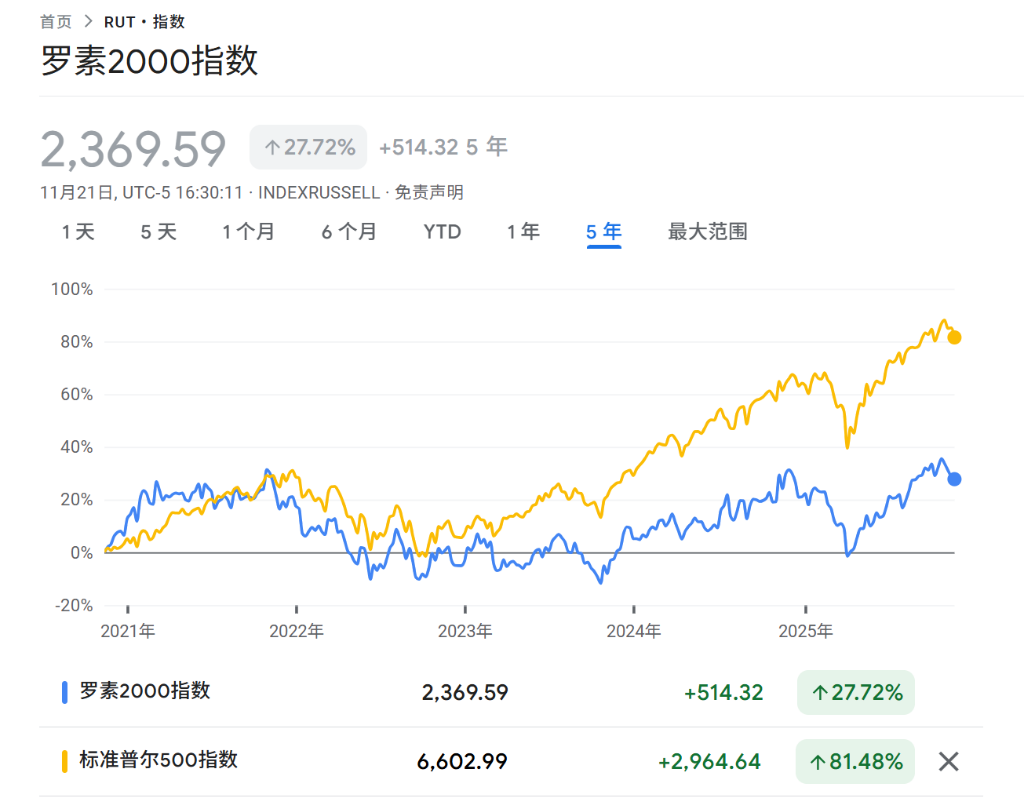
Core Viewpoint - After several years of underperformance, U.S. small-cap stocks are at a critical market turning point, poised for valuation recovery and macro-driven benefits, with potential excess returns of 30% to 60% over the next 3 to 6 years [1][2]. Valuation Discount - U.S. small-cap stocks have significantly underperformed large-cap stocks, with the Russell 2000 index down 60% relative to the S&P 500 since its peak in 2021, marking one of the largest historical performance gaps outside the tech bubble [2][4]. Macro Environment Changes - The previous headwinds of rising interest rates and wage inflation that suppressed small-cap profitability have now turned into tailwinds, with expectations of declining interest rates alleviating financial burdens on small businesses [4][5]. - Wage growth has decreased from a peak of 5.9% in May 2022 to 3.7%, improving the earnings outlook for small-cap stocks as these companies are more labor-intensive [4][5]. Policy Environment - A favorable policy environment for small-cap stocks is emerging, characterized by tax cuts and tariff exemptions that benefit domestic-focused businesses, which are more prevalent among small-cap firms [5][6]. - Small-cap stocks are better insulated from tariff impacts and currency fluctuations due to their lower reliance on international markets, enhancing their competitive position in the new policy cycle [6]. Market Dynamics - The dynamics of market funding are shifting, particularly regarding stock buybacks, which have been predominantly executed by large-cap companies. As interest rates rise, the ability of these companies to repurchase shares is constrained, leveling the playing field between small and large-cap stocks [6].